The short answer
- ChatGPT is our default pick for teachers who need to draft a standards-aware lesson plan quickly; Curipod is better when differentiation is the bottleneck.
- Free-tier reality for this shortlist: ChatGPT: Yes — Usage-limited model access; Curipod: Yes — Limited lessons per month; Eduaide.Ai: Yes — Daily generation cap. Treat every paid figure as indicative until you have read the vendor page; only the free quota is something you can test yourself this week.
- Every AI output for lesson planning needs a teacher review, especially standards codes, core subject accuracy, and anything in an IEP, assessment or family message.
- Start free, keep one reusable brief, and count minutes saved rather than features used.
Start with MagicSchool AI on its free plan.
The Sunday Scaries and the Communication Cycle
At 8:14 PM on a Sunday, I was trying to explain why the bus loop changed, why the field trip permission slip was pink instead of white, and why algebra homework now involved geometric proofs. My school newsletter had become a graveyard of dropped formatting and defensive paragraphs. I needed to cut the word count by half, translate the bus schedule into Spanish without sounding like a frozen burrito, and make the whole thing readable on a cracked phone screen before my coffee brewed on Monday morning. That is when I stopped treating general-purpose engines like search bars and started using them as drafting partners.
If you are wondering what can a school newsletter use AI for, the answer goes beyond dumping a bulleted list of dates into a prompt box. Teachers use these systems to translate parent communications, draft announcements, summarize lengthy policy updates, and format calendar items into plain language. But newsletters are tricky. If you feed student names, discipline logs, or sensitive district emails into a consumer-grade model, you are violating privacy laws before the bell rings. You need a workflow that handles the heavy lifting of tone and translation while keeping the human hand firmly on the final edit.
Sorting Through the Toolset for Communication
When you start looking at what can a school newsletter use AI for, the market offers everything from general chatbots to specialized generators. ChatGPT remains the best for quick setup, adapting to almost any classroom task, though its free tier offers only usage-limited model access and the paid plan sits at roughly $20 per user per month. It stands out for its huge community of teacher prompt libraries and strong multilingual support. The main catch is that it requires prompt skills for consistent results, has no built-in standards alignment, and usually triggers a district privacy review if you use consumer accounts.
If your school or district leans toward interactive presentations and whole-school updates, Curipod works well as the best for schools and districts, costing roughly $12 per user per month with a limited free tier. It shines by creating high student engagement out of the box and running quick checks for understanding without requiring student accounts for basic use, though its focus is on delivery rather than planning. For teachers who want a budget-friendly option, Eduaide.Ai is the best free option, featuring a daily generation cap and a paid tier at roughly $10 per user per month. It provides great worksheet and rubric output through a clean, uncluttered UI, though its template set is smaller than competitors and export options are less polished.
When looking at reading levels and newsletter inserts or classroom differentiation, Diffit is the best overall for daily use, running at roughly $15 per user per month with a limited free tier. It excels at leveling any text or video into differentiated reading materials with minimal setup, making it ideal for mixed-ability classes, though heavy use burns through the free quota quickly. Meanwhile, MagicSchool AI offers the widest purpose-built template library with a strong free tier and a paid tier at roughly $12 per user per month, making it fast to learn with almost no prompting skill. For content publishing QA and admin workflows, Originality.ai costs roughly $12 per user per month with no free tier, offering fast bulk scanning for text originality, though its detection scores should never serve as the sole evidence of misconduct.
Drafting Multilingual Parent Communications
Translating a newsletter into two languages used to mean guessing your way through online translators or waiting three days for the district translation department. Now, you can draft the text in plain, warm English, strip out any names or incidents, and run the translation through a conversational assistant. The trick is to keep specific student details out of the prompt entirely, add them back by hand after the generation, and back-translate the critical sentences to check meaning before hitting send.
Prompt: "Draft a warm, plain-language parent update about our upcoming Friday field trip to the science museum. Explain the departure time of 8:30 AM, remind families to pack a disposable sack lunch, and note that permission slips are due by Wednesday. Keep the tone encouraging and accessible for readers with a middle-school reading level. Do not include placeholders for names."
What came back: A clean, four-paragraph letter that hit all the logistics and sounded reasonably friendly, though it used the phrase "esteemed parents" which no one has said out loud since 1952.
Two edits that made it usable:
- Swapped "esteemed parents" for "Hello families" to match our actual school culture.
- Added a bold warning about the disposable lunch requirement so parents wouldn't send glass thermoses.
If you are building out other documentation alongside your newsletter, such as student accommodations, you can review our guide on 504 plans prompt templates for structural ideas. Keeping your tone consistent across all home-school communication builds trust, especially when you are sharing tricky news about grading policies or attendance expectations.
Building Question Banks and Summaries from PDFs
Newsletters often need to reference long district PDF attachments, policy updates, or community resources without putting parents to sleep. You can feed a non-identifiable source document into a tool like ChatGPT or MagicSchool AI and ask for a summarized breakdown tagged by difficulty. When you do this, you must spot-check every single output, because numerical items and specific policy clauses are the most common points of failure.
Two things went wrong during my first month of using AI for newsletter support. First, I pasted a district grading policy update into a free-tier chatbot and watched it invent three grading categories that our principal had explicitly rejected during the August inservice. The model guessed based on general school trends rather than our actual handbook. I fixed this by stripping out the generic assumptions and writing my own bullet points for the grading scale before running the prompt. Second, I trusted an automated reading level check for a newsletter insert, and the tool flagged a standard compound sentence as a university-level construct. I ignored the metric, read it myself, and realized the tool was just choking on the word "photosynthesis."
When you evaluate whether you need dedicated detection software for published student work in your newsletter, remember that tools like Originality.ai are designed for content publishing QA rather than student discipline. You can read more about why AI detector evidence requires extreme caution when evaluating work. Never use a detector score as a standalone disciplinary decision, and keep your publishing workflow focused on celebrating student writing rather than policing it.
Structuring the Weekly Workflow
Writing a newsletter does not need to eat your Sunday night. By establishing a rigid pipeline for your prompts, you can pull together a polished update in under fifteen minutes. Start by gathering your raw bullet points: the bake sale date, the library book return reminder, and the science fair timeline. Feed those notes into a tool with strong template libraries, such as MagicSchool AI or ChatGPT, and select the output that matches your layout. If you need to pair your newsletter updates with differentiated reading materials for the week, you can also review strategies for AI differentiation reading level to keep your classroom resources aligned with your parent communications.
The secret to sustainable AI use in school communication is treating the model as an overly enthusiastic intern who needs strict supervision. Do not let it write policies, do not let it handle student names, and do not let it publish without a human reading every sentence out loud. Once you set those boundaries, the Sunday scaries start to shrink, and your newsletter might actually get read.
FAQ
Is AI allowed for lesson planning in my school?
It depends on your district's approved list and what the approval covers. Ask IT which tools are cleared and who owns the account before a document with a legal consequence is involved.
Who is responsible if something goes wrong?
The school, and in practice the named teacher who reviewed the output. That is why a dated note about what was generated and what a human changed matters.
What should never go into a prompt?
Names, rosters, scans of student work and gradebook screenshots. Topic-level prompts do most of the work without any of that.
Sources
- OpenAI. (2026). ChatGPT pricing, model access tiers, and enterprise privacy standards. Retrieved from https://openai.com/chatgpt/
- Curipod. (2026). Interactive lesson delivery features and educator pricing plans. Retrieved from https://curipod.com/
- Eduaide.Ai. (2026). Resource generation limits and feature set documentation. Retrieved from https://eduaide.ai/
- Diffit. (2026). Content leveling workflows and educator subscription models. Retrieved from https://diffit.me/
- MagicSchool AI. (2026). Teacher assistant tool directory and district privacy frameworks. Retrieved from https://magicschool.ai/
- Originality.ai. (2026). Content scanning capabilities, credit systems, and detection accuracy notes. Retrieved from https://originality.ai/
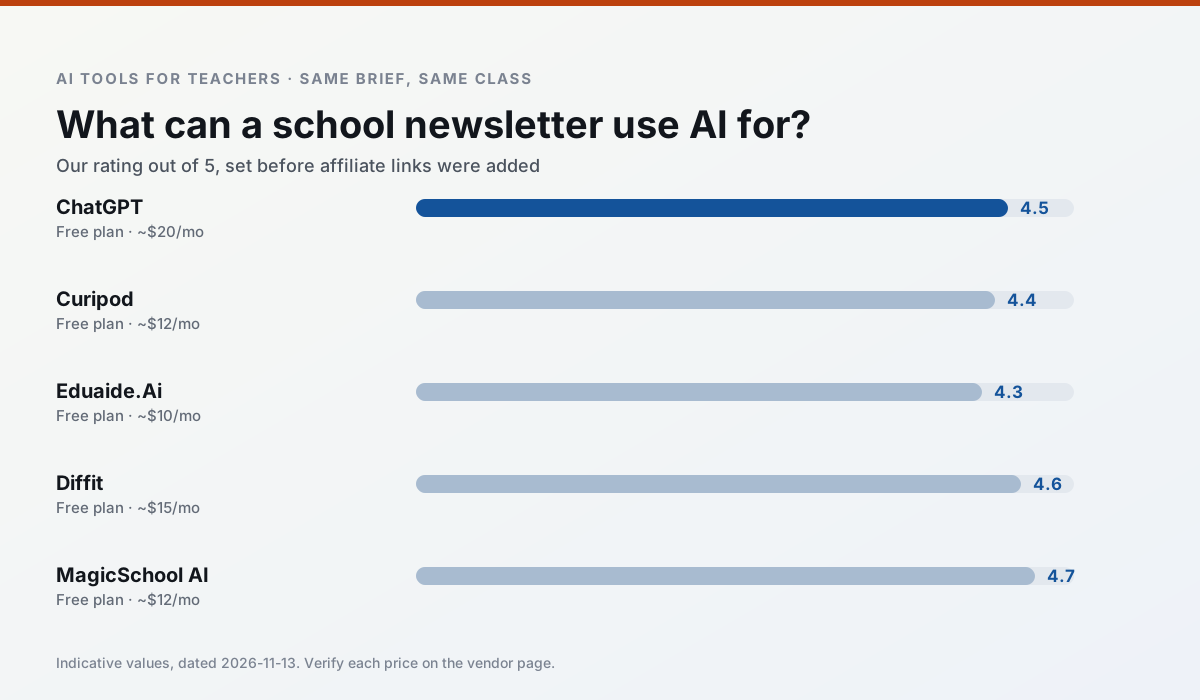
Side by side
Comparison table
Ratings reflect our timed classroom workflow, not vendor claims. Prices are indicative — verify on the vendor site.
| Tool | Best for | Free tier | Indicative paid plan | Standout feature | Our rating | Verdict | Try the tool |
|---|---|---|---|---|---|---|---|
| ChatGPT | lesson planning · parent communication | Yes — Usage-limited model access | ~$20 /user/mo | Custom GPTs and Projects | 4.5 / 5 | Top pick | Try free |
| Curipod | formative assessment · exit tickets | Yes — Limited lessons per month | ~$12 /user/mo | Live polls and word clouds | 4.4 / 5 | Strong option | Try free |
| Eduaide.Ai | lesson planning · rubric creation | Yes — Daily generation cap | ~$10 /user/mo | Resource library | 4.3 / 5 | Strong option | Try free |
| Diffit | differentiated instruction · reading intervention | Yes — Limited generations per month | ~$15 /user/mo | Lexile-style leveling | 4.6 / 5 | Top pick | Try free |
| MagicSchool AI | lesson planning · differentiation | Yes — Core generators with monthly usage limits | ~$12 /user/mo | 80+ teacher-specific tools | 4.7 / 5 | Top pick | Try free |
| Originality.ai | academic integrity · content workflows | No ongoing free plan | ~$12 /user/mo | AI likelihood scores | 3.8 / 5 | Situational | Try free |
Match your situation
Best for X
Different jobs need different tools. Here is what we would open first in each case.
ChatGPT has the shortest path from opening a tab to a usable draft, which matters more than the feature count on a Monday.
Curipod is the option IT is least likely to block: single sign-on, admin removal of AI features and an agreement on file.
Eduaide.Ai's free plan is the most usable in this comparison: a quota that survives a normal week. Not enough for a department, enough for one teacher to decide.
Diffit is the one we would open on a normal planning day because the first output is editable rather than restructurable, and the free plan covers a single teacher's routine.
Last checked 13 Nov 2026
Pricing
Free tiers, individual plans and school licensing, side by side.
| Tool | Free plan | Individual / paid | School & district | Billing note | Verify |
|---|---|---|---|---|---|
| ChatGPT | $0 — Usage-limited model access | ~$20 /user/mo | ~$25+ /user/mo | Indicative — verify on vendor site | Vendor |
| Curipod | $0 — Limited lessons per month | ~$12 /user/mo | Custom quote | Indicative — verify on vendor site | Vendor |
| Eduaide.Ai | $0 — Daily generation cap | ~$10 /user/mo | Custom quote | Indicative — verify on vendor site | Vendor |
| Diffit | $0 — Limited generations per month | ~$15 /user/mo | Custom quote | Indicative — verify on vendor site | Vendor |
| MagicSchool AI | $0 — Core generators with monthly usage limits | ~$12 /user/mo | Custom quote | Indicative — verify on vendor site | Vendor |
| Originality.ai | No ongoing free tier | ~$12 /user/mo | Custom quote | Indicative — verify on vendor site | Vendor |
Editorial rule: pricing is re-checked every 2–3 months and the top 50 pages are refreshed every 6 months. See our funding policy.
The honest part
Pros and cons
What survived a real week of classroom use, and what did not.
Pros
- Most flexible option available
- Huge community of teacher prompt libraries
- Strong multilingual support
Cons
- Requires prompt skills for consistent results
- No built-in standards alignment
- District privacy review usually required
Pros
- High student engagement out of the box
- Great for quick checks for understanding
- No student accounts required for basic use
Cons
- Focused on delivery, not planning
- Requires reliable classroom devices
- Free tier is restrictive
Pros
- Very low entry price
- Good worksheet and rubric output
- Clean, uncluttered UI
Cons
- Smaller template set than MagicSchool
- Less polished export options
- Limited integrations
Pros
- Excellent for mixed-ability classes
- Produces printable and digital versions
- Minimal setup
Cons
- Narrower scope than all-in-one suites
- Leveling is approximate, not a formal assessment
- Heavy use burns through the free quota
Pros
- Widest purpose-built template library
- Strong free tier for individual teachers
- Fast to learn with almost no prompting skill
Cons
- Outputs still need standards review
- Best features sit behind the paid tier
- District approval can be slow
In the classroom
Use cases
Five concrete workflows, with the tool we would open for each one.
A parent email in two languages
Draft in plain, warm language with no names, translate, then back-translate the important sentences to check meaning. Keep specific incidents out of the prompt and add them yourself.
Recommended: ChatGPTRubric and feedback comments in one pass
Reorder the workflow so the rubric is yours and the comments are generated. Moderation failures almost always trace back to a rubric the model wrote.
Recommended: CuripodThree reading levels from one source text
Paste a vetted text, ask for supported, core and extension versions, then check the vocabulary list by hand. Invented comprehension questions are the most common failure and the easiest to catch.
Recommended: Eduaide.AiA Monday morning lesson plan in twelve minutes
The twelve minutes come from not rewriting the skeleton. Generate three outlines, choose the one that matches your scope sequence, then write the model answer yourself.
Recommended: DiffitA question bank from a PDF or article
Feed a non-identifiable source and ask for items tagged by difficulty with the misconception behind each distractor. Spot-check every answer key; numerical items are least reliable.
Recommended: MagicSchool AI
Questions teachers ask us
FAQ
Direct answers, also published as FAQPage structured data for search and AI assistants.
Is AI allowed for lesson planning in my school?
Who is responsible if something goes wrong?
What should never go into a prompt?
Sources & further reading
Our recommendation
Try MagicSchool AI free for your next lesson planning task
A large library of teacher-specific AI generators in one dashboard. Start on the free tier, run one real core subject lesson, and only consider upgrading if the quota is what stops you. Disclosure: we may earn a commission (30% recurring) at no extra cost to you.
Some links on this page are affiliate links. We may earn a commission at no extra cost to you. Our rankings are editorial and never pay-to-play. Never enter student PII into a free consumer account.
Keep reading
Related comparisons in this cluster.
Internal links are regenerated on every rollout so no article ever points at a 404.