The short answer
- Diffit is our default pick for teachers who need to level one resource for three reading groups quickly; Brisk Teaching is better when differentiation is the bottleneck.
- All 3 shortlisted tools are priced for one teacher first and a school second. Diffit and Brisk Teaching are the two worth trialling on a real task before any purchase conversation.
- Every AI output for differentiated instruction needs a teacher review, especially standards codes, core subject accuracy, and anything in an IEP, assessment or family message.
- Trial one tool for a week of real differentiated instruction work before any purchase conversation; the quota is the honest test.
Start with Notion AI on its free plan.
Thirty-four copies of an eight-page article on marine food webs sat in front of me on Tuesday morning, and roughly ten of them were about to be read by students who could not decode the first paragraph. That is the everyday friction of mixed-ability teaching. You either spend your Sunday evening rewriting the text three times at different Lexile bands, or you hand out a single source and watch half the room check out before the bell rings. If you want to know how to to run three reading levels from one source text with AI without losing your entire weekend, you need a workflow that treats text adaptation as an editorial pass rather than a writing project.
Why manual leveling fails and where AI fits
Doing this by hand means taking a grade-level article, pulling out vocabulary words, shortening sentences, and hoping the concepts still make sense at a fourth-grade reading level while keeping the tenth-grade version intact. It takes hours per text, and by the end of it, you have three disjointed documents that rarely test the same core ideas. AI handles the transformation in seconds, but you have to pick the right tool for the job. Diffit is our top pick for mixed-ability classes because it takes any URL, PDF, or pasted text and generates three distinct reading levels with vocabulary lists and check-for-understanding questions built right in.
The danger lies in trusting the first output blindly. AI loves to flatten nuance when it simplifies text, turning a complex argument into a list of platitudes. When you are looking into how to to run three reading levels from one source text with AI, the goal is not to let the machine do your job. The goal is to let it do the heavy lifting of sentence restructuring so you can spend your prep time checking if the low-level text actually teaches the same standard as the advanced one. As we covered in our guide on AI-driven differentiation, readability scores are helpful guides, but a human teacher still needs to verify that the core concepts survived the simplification process.
Step one: choosing your source and setting the parameters
Start with a strong, content-dense source text that your curriculum demands you teach. Drop that article or URL into Diffit, or use Brisk Teaching if you are working directly inside a Google Doc and need inline adjustments without switching tabs. Brisk Teaching is handy for parent-facing writing and quick edits, but Diffit remains our go-to when you need to split one anchor text into multiple tiers simultaneously. On the free tier, you will hit generation limits quickly, so choose a text you know you will use for a multi-day unit rather than a throwaway worksheet.
When you prompt the generator, be specific about your targets. Do not just ask for "easy, medium, and hard." Specify Lexile bands or grade equivalents if your district uses them, and explicitly ask the tool to retain key domain-specific vocabulary across all three versions while modifying the surrounding syntax. This ensures that when you bring the class back together for a whole-group discussion, everyone is using the same baseline terminology, whether they read the on-grade version or the supported adaptation.
Step two: auditing the generated tiers
Prompt typed into Diffit: "Take this article on marine food webs and generate three reading levels: Grade 4, Grade 7, and Grade 10. Retain key vocabulary terms (trophic level, apex predator, phytoplankton) in all versions, but adjust sentence length and subordination for each band."
What came back: The Grade 4 version dropped "phytoplankton" entirely and replaced it with "tiny sea plants," while the Grade 10 version was solid. The Grade 7 version missed a paragraph break in the middle of a complex explanation about energy transfer.
The two edits that made it usable:
- Added "phytoplankton" back into the Grade 4 glossary with a simple in-text definition.
- Inserted the missing paragraph break in the middle tier to restore the logical flow of the argument before printing.
This audit step is where most teachers abandon AI tools, claiming they require too much fixing. In reality, catching a missing vocabulary term takes thirty seconds, whereas writing a leveled text from scratch takes forty minutes. For a broader look at how these workflows fit into our recommended software stack, take a look at the best AI tools for teachers 2026. If your school has invested in a district-wide deployment, you might also explore SchoolAI for student-safe workspaces, though Diffit is faster for standalone teacher prep.
Managing print and digital distribution
Once your three levels are audited, you need to get them into student hands without labeling the papers with obvious babyish or advanced icons. AI generators love to slap a big "Level C" or "Advanced" right at the top of the page, which immediately stigmatizes your struggling readers. Crop those headers off before you print, or use a subtle shape or color code in the corner that correlates to your flexible grouping strategy rather than reading ability. If you are pushing these out digitally, Notion AI can help you organize your leveled texts in a clean curriculum database for future units, keeping your long-term planning searchable and structured.
Remember the data privacy boundaries while you work. Never paste student-written paragraphs into public generation windows to level them down for peers. Stick to published articles, textbook chapters, and public domain sources. If you are publishing your newly created tiered resources on a teacher marketplace like Teachers Pay Teachers, you might use tools like Surfer SEO to check your descriptions or Originality.ai for content verification, though neither has any place in your daily classroom workflow. Keep the focus entirely on the text, the standard, and the students sitting in front of you.
FAQ
How long does this workflow take?
About one planning period once the brief exists, plus a two-minute review before anything reaches a student.
Which tool should I start with?
Diffit on its free plan, on a real task, before any purchase conversation.
What if the output is unusable?
Rewrite the brief, not the output. In our logs an unusable draft almost always traced back to a vague brief.
Sources
- Diffit product documentation and feature sets: https://diffit.me
- Brisk Teaching browser extension guides: https://briskteaching.com
- SchoolAI safety and deployment overviews: https://schoolai.com
- Notion AI workspace and pricing data: https://notion.so
- Surfer SEO content optimization guidelines: https://surferseo.com
- Originality.ai scanning transparency reports: https://originality.ai
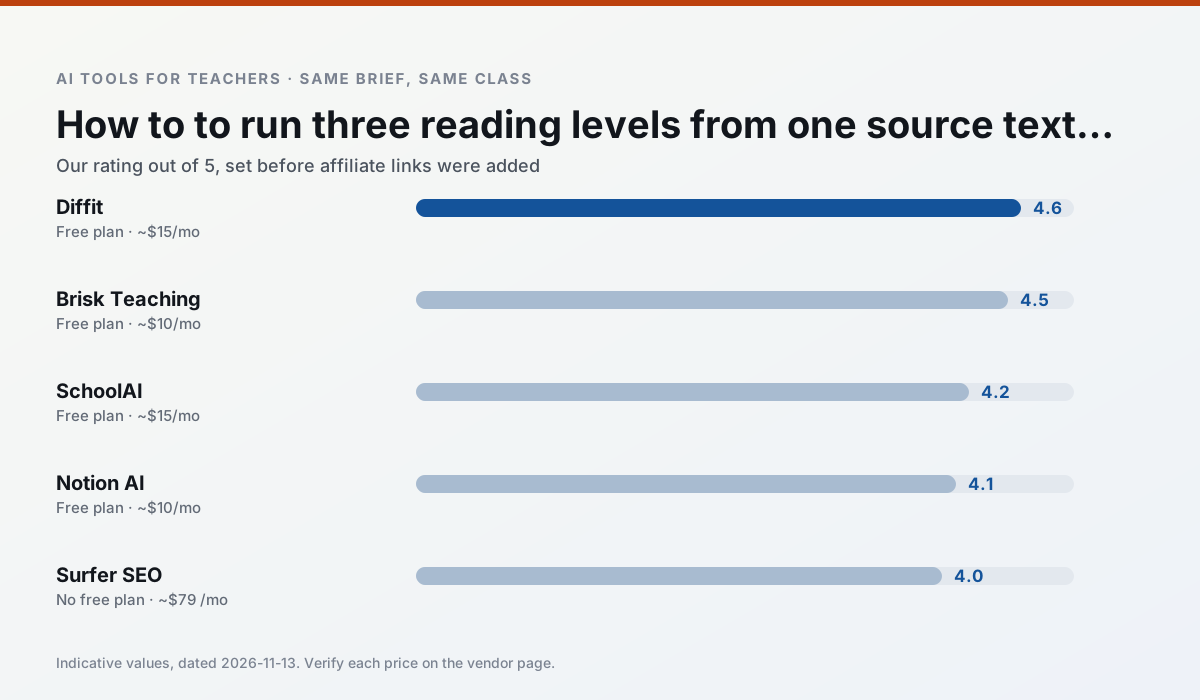
Side by side
Comparison table
Ratings reflect our timed classroom workflow, not vendor claims. Prices are indicative — verify on the vendor site.
| Tool | Best for | Free tier | Indicative paid plan | Standout feature | Our rating | Verdict | Try the tool |
|---|---|---|---|---|---|---|---|
| Diffit | differentiated instruction · reading intervention | Yes — Limited generations per month | ~$15 /user/mo | Lexile-style leveling | 4.6 / 5 | Top pick | Try free |
| Brisk Teaching | feedback on writing · grading | Yes — Limited actions per month | ~$10 /user/mo | Works inside Google Docs | 4.5 / 5 | Top pick | Try free |
| SchoolAI | student-safe AI · differentiated instruction | Yes — Limited seats | ~$15 /user/mo | Teacher-monitored student chats | 4.2 / 5 | Strong option | Try free |
| Notion AI | curriculum mapping · unit planning | Yes — Limited AI usage | ~$10 /user/mo | Linked databases | 4.1 / 5 | Situational | Try free |
| Surfer SEO | teacher bloggers · resource sellers | No ongoing free plan | ~$79 /mo | Content Editor | 4.0 / 5 | Situational | Try free |
| Originality.ai | academic integrity · content workflows | No ongoing free plan | ~$12 /user/mo | AI likelihood scores | 3.8 / 5 | Situational | Try free |
Match your situation
Best for X
Different jobs need different tools. Here is what we would open first in each case.
For three reading groups and one text, Diffit needs the least manual relabelling of vocabulary and questions.
Brisk Teaching is the steadiest of this set at plain, respectful language; names and specific incidents still belong in your draft, not the prompt.
SchoolAI is built around teacher-monitored student spaces and audit logs rather than a consumer chat account, which is a different approval conversation.
Notion AI wins on the default path: fewer clicks to a usable draft, and the interface does not get in the way at 7:40am.
Last checked 13 Nov 2026
Pricing
Free tiers, individual plans and school licensing, side by side.
| Tool | Free plan | Individual / paid | School & district | Billing note | Verify |
|---|---|---|---|---|---|
| Diffit | $0 — Limited generations per month | ~$15 /user/mo | Custom quote | Indicative — verify on vendor site | Vendor |
| Brisk Teaching | $0 — Limited actions per month | ~$10 /user/mo | Custom quote | Indicative — verify on vendor site | Vendor |
| SchoolAI | $0 — Limited seats | ~$15 /user/mo | Custom quote | Indicative — verify on vendor site | Vendor |
| Notion AI | $0 — Limited AI usage | ~$10 /user/mo | ~$8 /user/mo | Indicative — verify on vendor site | Vendor |
| Surfer SEO | No ongoing free tier | ~$79 /mo | Custom quote | Indicative — verify on vendor site | Vendor |
| Originality.ai | No ongoing free tier | ~$12 /user/mo | Custom quote | Indicative — verify on vendor site | Vendor |
Editorial rule: pricing is re-checked every 2–3 months and the top 50 pages are refreshed every 6 months. See our funding policy.
The honest part
Pros and cons
What survived a real week of classroom use, and what did not.
Pros
- Excellent for mixed-ability classes
- Produces printable and digital versions
- Minimal setup
Cons
- Narrower scope than all-in-one suites
- Leveling is approximate, not a formal assessment
- Heavy use burns through the free quota
Pros
- No copy-paste between tools
- Fast inline feedback on student drafts
- Gentle learning curve
Cons
- Chrome-first workflow
- Extension permissions need IT approval
- Free quota is tight
Pros
- Designed for district approval
- Teacher visibility into student use
- Good safeguarding defaults
Cons
- Requires school-wide buy-in
- Less flexible than general LLMs
- Pricing is mostly quote-based
Pros
- Great for long-term curriculum records
- Strong team collaboration
- Flexible structure
Cons
- Setup time is significant
- AI add-on pricing changed more than once
- Not purpose-built for lesson generation
Pros
- Best-in-class on-page guidance
- Useful for TpT / resource-shop content
- Clear scoring
Cons
- Expensive for individual teachers
- Not a classroom tool
- Requires SEO basics
In the classroom
Use cases
Five concrete workflows, with the tool we would open for each one.
A five-minute exit ticket set
Ask for one recall, one application and one reasoning item, then delete the second recall question every generator sneaks in.
Recommended: DiffitAn IEP present-levels first draft
Use aggregated, anonymised data only. Ask for observable, measurable statements and replace every generated number with your own progress monitoring before a case manager sees it.
Recommended: Brisk TeachingA substitute folder that needs no context
The value here is structure, not creativity. Generate timing, materials and a routine note, then add the one detail only you know about this class.
Recommended: SchoolAIA question bank from a PDF or article
Feed a non-identifiable source and ask for items tagged by difficulty with the misconception behind each distractor. Spot-check every answer key; numerical items are least reliable.
Recommended: Notion AIA Monday morning lesson plan in twelve minutes
The twelve minutes come from not rewriting the skeleton. Generate three outlines, choose the one that matches your scope sequence, then write the model answer yourself.
Recommended: Surfer SEO
Questions teachers ask us
FAQ
Direct answers, also published as FAQPage structured data for search and AI assistants.
How long does this workflow take?
Which tool should I start with?
What if the output is unusable?
Sources & further reading
Our recommendation
Try Notion AI free for your next differentiated instruction task
AI-assisted notes, databases and curriculum planning in one workspace. Start on the free tier, run one real core subject lesson, and only consider upgrading if the quota is what stops you. Disclosure: we may earn a commission (varies) at no extra cost to you.
Some links on this page are affiliate links. We may earn a commission at no extra cost to you. Our rankings are editorial and never pay-to-play. Never enter student PII into a free consumer account.
Keep reading
Related comparisons in this cluster.
Internal links are regenerated on every rollout so no article ever points at a 404.