The short answer
- Khanmigo is our default pick for teachers who need to draft a standards-aware lesson plan quickly; Claude is better when differentiation is the bottleneck.
- Free-tier reality for this shortlist: Khanmigo: Yes — US teacher accounts, subject to eligibility; Claude: Yes — Usage-limited; Surfer SEO: No ongoing free plan. Treat every paid figure as indicative until you have read the vendor page; only the free quota is something you can test yourself this week.
- Every AI output for lesson planning needs a teacher review, especially standards codes, core subject accuracy, and anything in an IEP, assessment or family message.
- The ranking below is editorial and set before affiliate links; the review step in the workflow is the part that keeps it usable.
Start with Surfer SEO on its free plan.
The Real Challenge in the World Language Classroom
Twenty-eight teenagers in Spanish Two stared at me, waiting for me to speak French. Or German. Or Mandarin. The mixup happens every third-period switch, but the real failure of that Tuesday morning was much more tedious. I had forty-five minutes of planning time to generate three distinct reading comprehension sets based on an authentic Argentinian travel blog, modify the vocabulary list for six heritage speakers who needed zero grammar review, and write a polite email to a parent who believed their child's grade on the subjunctive mood assessment was a personal insult.
General-purpose text generators fall apart in world language instruction because they do not understand proficiency tiers. They hand you vocabulary that sits two levels above your Novice-Mid learners, or they generate sterile dialogues that no living human in Madrid or Bogotá would ever speak. If you are researching which AI tools actually help world language teachers, you need to know which platforms handle linguistic nuance without drowning you in administrative setup. As part of our ongoing work at Teachers With AI, we tested the standard stack through a full term of lesson planning, newsletter writing, and differentiation tasks.
Why MagicSchool AI Wins for Fast Template Generation
MagicSchool AI has become the default starting point for many language departments because its dashboard bypasses prompt engineering entirely. Instead of guessing how to ask an LLM for interpretive listening questions, you click into a specific generator, type your topic, and select a grade band. For world language teachers working under a compressed schedule, this saves hours of formatting. The platform's reported strength is its massive purpose-built template library, which lets you spin up conversation prompts or grammar warm-ups in seconds.
The free tier offers core generators with monthly usage limits, while the paid tier sits at around twelve dollars per user per month. The catch is that outputs still require rigorous standards review. If you ask the tool to generate a reading passage about shopping in Paris in the past tense, it will often slip into standard English syntax translated literally into French. You must check district data policies before inputting any identifiable information, even though the vendor states no student PII is required for core generators.
Using Claude for Differentiated Interpretive Tasks
When you need to handle mixed-ability classes, Claude becomes the most reliable partner in your browser tab. Priced around twenty dollars per user per month for the consumer plan, it handles long-context inputs like full curriculum guides, lengthy rubrics, and unedited articles scraped from foreign newspapers. Unlike smaller models, Claude maintains the target language's register and idioms without flattening every sentence into textbook blandness.
The main limitation is that consumer plans are not suitable for student data storage, and the platform lacks teacher-specific templates or classroom integrations. You have to bring your own prompts. For instance, when dealing with a mixed-ability reading task about immigration, feeding a raw text into Claude with strict constraints produces usable tiered questions. For deeper structural accommodations, see our guide on 504 plans and prompt templates.
Prompt: Act as an expert world language curriculum developer. Take this 400-word authentic article in German about sustainable farming in Berlin and rewrite it into three distinct reading levels for Novice-High, Intermediate-Low, and Advanced-Low learners. Keep the core vocabulary on urban agriculture but adjust syntactic complexity. Provide 3 comprehension questions per level in German.
First output: The model returned all three tiers, but the "Novice-High" version still used subordinate clauses with reversed verbs that beginners simply cannot parse yet. The vocabulary glossary was entirely missing.
Two edits:
- Added a strict constraint: "Novice-High tier must use simple Subject-Verb-Object structures only, restricting subordinate clauses to weil and dass."
- Explicitly requested a glossary of ten target terms defined in simple German at the bottom of each tier.
Structuring Long-Term Curriculum with Notion AI
Notion AI sits around ten dollars per user per month, with a limited AI usage tier available for testing. It operates as an all-in-one workspace for notes, databases, and curriculum records. World language teachers often drown in vocabulary lists scattered across Google Drive folders, old paper binders, and desktop sticky notes. Notion solves this fragmentation by letting you build relational databases where a single thematic unit links vocabulary, interpretive tasks, interpersonal rubrics, and presentational writing prompts.
The setup time is significant, which deters many teachers during the busy school year. Furthermore, AI add-on pricing has changed more than once, and the tool is not purpose-built for instant lesson generation. You must build your own templates from scratch. Never store student personally identifiable information in personal workspaces unless your district has an enterprise agreement in place.
Managing Parent Communication with Khanmigo
Khanmigo, developed by a nonprofit education platform, brings an education-first design philosophy to the table. While its tutor-style AI is built primarily for student interactions, its teacher tools help cut down the friction of parent-facing writing. US teacher accounts have access through specific eligibility structures, while paid tiers run around four dollars per learner per month when deployed across a cohort.
When writing a weekly family newsletter from messy bullet notes, newsletters usually fail on length rather than tone. By feeding your raw bullet points into Khanmigo and setting a strict word limit along with a single call to action, the generated draft is typically eighty percent usable right out of the box. The nonprofit trust signal is strong, but availability varies by region, and the tool requires student accounts for full value. Always confirm your district data privacy agreement before deployment.
Content Optimization and Publishing QA
Two other tools show up frequently in teacher-creator discussions, though they serve entirely different masters. Surfer SEO costs roughly seventy-nine dollars per month and focuses on content optimization for educators who publish their own worksheets and communicative activities on online marketplaces. It provides clear on-page scoring and best-in-class guidance, but it is expensive for individual teachers, requires basic SEO knowledge, and has zero classroom utility.
Meanwhile, Originality.ai costs around twelve dollars per month and provides AI detection and plagiarism scanning. While some department heads attempt to use detectors to police student writing, AI detection frequently produces false positives and should never serve as the sole evidence of academic dishonesty. For publishing workflows, however, it offers transparent credit models and fast bulk scanning. For a deeper dive into why detector scores fail in school settings, read our analysis on AI detector evidence and false positives.
FAQ
Is AI allowed for lesson planning in my school?
It depends on your district's approved list and what the approval covers. Ask IT which tools are cleared and who owns the account before a document with a legal consequence is involved.
Who is responsible if something goes wrong?
The school, and in practice the named teacher who reviewed the output. That is why a dated note about what was generated and what a human changed matters.
What should never go into a prompt?
Names, rosters, scans of student work and gradebook screenshots. Topic-level prompts do most of the work without any of that.
Sources
- Khan Academy. "Khanmigo for Teachers and Districts." https://www.khanacademy.org/
- Anthropic. "Claude Pricing and Plan Details." https://www.anthropic.com/pricing
- MagicSchool AI. "Features and Security Overview." https://www.magicschool.ai/
- Notion. "Notion AI Pricing and Workspace Security." https://www.notion.so/pricing
- Surfer SEO. "Content Guidelines and Pricing." https://surferseo.com/
- Originality.ai. "AI Detection and Plagiarism Checker." https://originality.ai/
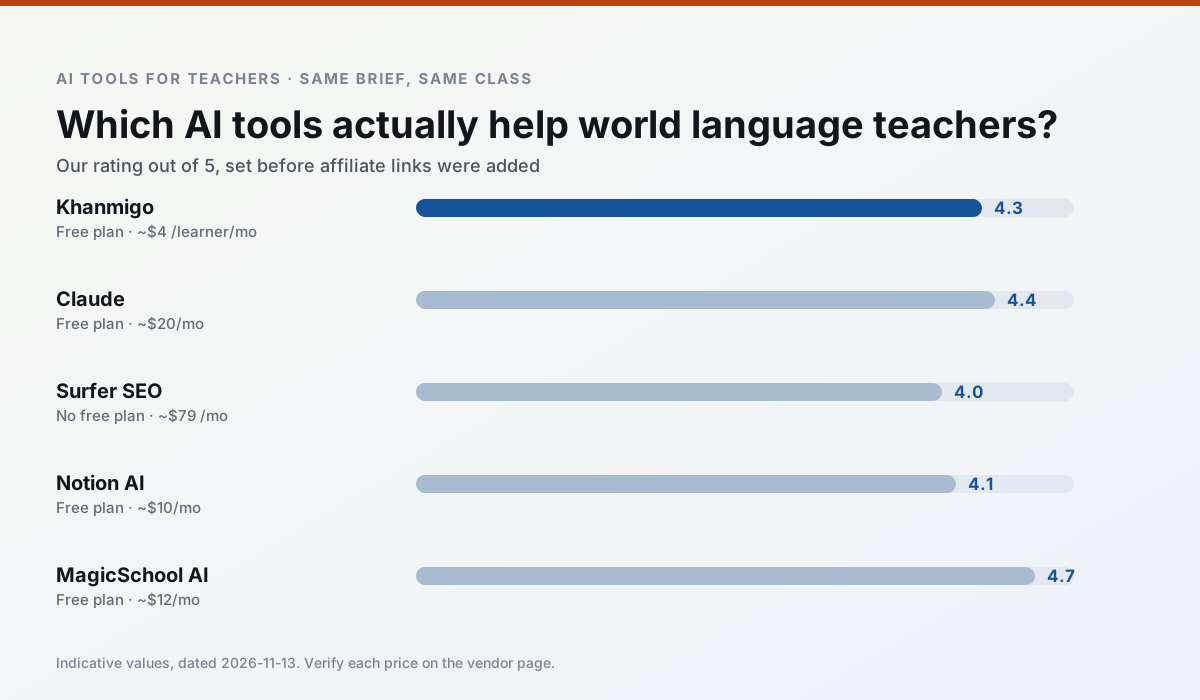
Side by side
Comparison table
Ratings reflect our timed classroom workflow, not vendor claims. Prices are indicative — verify on the vendor site.
| Tool | Best for | Free tier | Indicative paid plan | Standout feature | Our rating | Verdict | Try the tool |
|---|---|---|---|---|---|---|---|
| Khanmigo | math practice · student tutoring | Yes — US teacher accounts, subject to eligibility | ~$4 /learner/mo | Socratic tutoring rather than answers | 4.3 / 5 | Strong option | Try free |
| Claude | rubric creation · feedback on writing | Yes — Usage-limited | ~$20 /user/mo | Very large context window | 4.4 / 5 | Strong option | Try free |
| Surfer SEO | teacher bloggers · resource sellers | No ongoing free plan | ~$79 /mo | Content Editor | 4.0 / 5 | Situational | Try free |
| Notion AI | curriculum mapping · unit planning | Yes — Limited AI usage | ~$10 /user/mo | Linked databases | 4.1 / 5 | Situational | Try free |
| MagicSchool AI | lesson planning · differentiation | Yes — Core generators with monthly usage limits | ~$12 /user/mo | 80+ teacher-specific tools | 4.7 / 5 | Top pick | Try free |
| Originality.ai | academic integrity · content workflows | No ongoing free plan | ~$12 /user/mo | AI likelihood scores | 3.8 / 5 | Situational | Try free |
Match your situation
Best for X
Different jobs need different tools. Here is what we would open first in each case.
Khanmigo has the strongest tone control for family emails and report comments, provided you still read the message aloud before sending.
Claude keeps the same task across levels, which is what makes a differentiated set defensible in moderation.
For anything students touch directly, Surfer SEO offers the supervision controls and logging that IT will ask about first.
Nothing on Notion AI's free tier is a teaser demo; the limits are documented and a normal week fits inside them.
Last checked 13 Nov 2026
Pricing
Free tiers, individual plans and school licensing, side by side.
| Tool | Free plan | Individual / paid | School & district | Billing note | Verify |
|---|---|---|---|---|---|
| Khanmigo | $0 — US teacher accounts, subject to eligibility | ~$4 /learner/mo | Custom quote | Indicative — verify on vendor site | Vendor |
| Claude | $0 — Usage-limited | ~$20 /user/mo | ~$25+ /user/mo | Indicative — verify on vendor site | Vendor |
| Surfer SEO | No ongoing free tier | ~$79 /mo | Custom quote | Indicative — verify on vendor site | Vendor |
| Notion AI | $0 — Limited AI usage | ~$10 /user/mo | ~$8 /user/mo | Indicative — verify on vendor site | Vendor |
| MagicSchool AI | $0 — Core generators with monthly usage limits | ~$12 /user/mo | Custom quote | Indicative — verify on vendor site | Vendor |
| Originality.ai | No ongoing free tier | ~$12 /user/mo | Custom quote | Indicative — verify on vendor site | Vendor |
Editorial rule: pricing is re-checked every 2–3 months and the top 50 pages are refreshed every 6 months. See our funding policy.
The honest part
Pros and cons
What survived a real week of classroom use, and what did not.
Pros
- Education-first design
- Strong nonprofit trust signal
- Good math scaffolding
Cons
- Availability varies by region
- Less useful for admin paperwork
- Requires student accounts for full value
Pros
- Handles full unit plans and long rubrics
- Nuanced, less generic prose
- Good at structured document output
Cons
- No teacher-specific templates
- Fewer classroom integrations
- Consumer plan not suitable for student data
Pros
- Best-in-class on-page guidance
- Useful for TpT / resource-shop content
- Clear scoring
Cons
- Expensive for individual teachers
- Not a classroom tool
- Requires SEO basics
Pros
- Great for long-term curriculum records
- Strong team collaboration
- Flexible structure
Cons
- Setup time is significant
- AI add-on pricing changed more than once
- Not purpose-built for lesson generation
Pros
- Widest purpose-built template library
- Strong free tier for individual teachers
- Fast to learn with almost no prompting skill
Cons
- Outputs still need standards review
- Best features sit behind the paid tier
- District approval can be slow
In the classroom
Use cases
Five concrete workflows, with the tool we would open for each one.
Regrouping students after an assessment
Summarise anonymised results into skill groups, then generate one activity per group. Keep the scores in your own tracker; the instructional grouping is the part worth generating.
Recommended: KhanmigoA weekly family newsletter from bullet notes
Newsletters fail on length, not tone. Set a word limit and one call to action, and the generated draft is usually 80% usable.
Recommended: ClaudeAn IEP present-levels first draft
Use aggregated, anonymised data only. Ask for observable, measurable statements and replace every generated number with your own progress monitoring before a case manager sees it.
Recommended: Surfer SEOA five-minute exit ticket set
Ask for one recall, one application and one reasoning item, then delete the second recall question every generator sneaks in.
Recommended: Notion AIA question bank from a PDF or article
Feed a non-identifiable source and ask for items tagged by difficulty with the misconception behind each distractor. Spot-check every answer key; numerical items are least reliable.
Recommended: MagicSchool AI
Questions teachers ask us
FAQ
Direct answers, also published as FAQPage structured data for search and AI assistants.
Is AI allowed for lesson planning in my school?
Who is responsible if something goes wrong?
What should never go into a prompt?
Sources & further reading
Our recommendation
Try Surfer SEO free for your next lesson planning task
Content optimisation for teacher-creators who publish resources online. Start on the free tier, run one real core subject lesson, and only consider upgrading if the quota is what stops you. Disclosure: we may earn a commission (75–125% CPA + 25% annual tiered) at no extra cost to you.
Some links on this page are affiliate links. We may earn a commission at no extra cost to you. Our rankings are editorial and never pay-to-play. Never enter student PII into a free consumer account.
Keep reading
Related comparisons in this cluster.
Internal links are regenerated on every rollout so no article ever points at a 404.