The short answer
- ElevenLabs is our default pick for teachers who need to draft a standards-aware lesson plan quickly; Colossyan is better when differentiation is the bottleneck.
- Start with ElevenLabs on its free plan, keep Colossyan as the second opinion, and do not open a card until the quota, not the feature list, is what stops you.
- Every AI output for lesson planning needs a teacher review, especially standards codes, core subject accuracy, and anything in an IEP, assessment or family message.
- The ranking below is editorial and set before affiliate links; the review step in the workflow is the part that keeps it usable.
Start with ElevenLabs on its free plan.
At 3:15 on a Tuesday afternoon, a sophomore handed me an essay on the New Deal that read like a cross between a congressional speech and a Wikipedia page. I ran it through an online detector. The meter blinked red: 98 percent probability of artificial generation. When I confronted him the next morning, he looked me dead in the eye and swore he wrote every word at his kitchen table. I had a percentage score and zero actual proof. That is the exact moment every teacher realizes that asking "can an AI detector score be used as evidence" is the wrong question to start with.
We need to talk about what these scores actually measure, what institutional platforms like Turnitin Clarity / Feedback Studio can and cannot prove, and how to handle academic integrity without turning our classrooms into digital courtrooms. If you have spent any time looking into the broader landscape of our best AI tools for teachers 2026, you know that technology creates as many administrative headaches as it solves. Let us break down what detector scores mean, where they fail, and what you should do instead.
The Problem with Probability Scores
Most teachers assume an AI detector works like a metal detector or a spellchecker. It does not. Detectors look for patterns of predictability and variation in word choice, known as perplexity and burstiness. If a text reads with uniform predictability, the algorithm flags it.
The trouble is that many neurodivergent students, English language learners, and careful students who rely on formulaic five-paragraph structures write with high predictability. When a detector flags their authentic work, the burden of proof shifts unfairly. A percentage score is a statistical guess, not a forensic fact. Relying on it alone during a grade appeal is a fast track to losing the trust of both students and parents.
What Institutional Checkers Show
When districts license tools with built-in similarity checking, such as Turnitin Clarity / Feedback Studio, the software typically flags matched text from web sources or student repositories. That is solid, defensible evidence. If a paragraph is lifted verbatim from an online syllabus or another student's paper, you have a match you can point to.
However, AI writing detection within these same platforms remains contested. Even the developers acknowledge that false positives happen. An institutional similarity report is useful for showing where text matches existing databases, but a generative AI probability score is an indicator for a conversation, not a verdict for a zero on an assignment.
Prompt: Act as an instructional coach. Review this student's essay on the New Deal and generate three specific, text-based questions I can ask the student in a conference to verify their understanding of their own argument, without mentioning AI detectors.
First response: The model suggested asking about the economic implications of the Agricultural Adjustment Act and why the student chose to frame the thesis around federal intervention.
Edit 1: Added a constraint to keep the vocabulary accessible so the conference tests comprehension, not competing academic jargon.
Edit 2: Inserted a requirement that the questions target specific lines where the student's syntax shifted dramatically from their usual in-class writing samples.
When Verifiable Proof Fails in Practice
Two distinct failures happen constantly when teachers try to treat detector outputs as hard evidence. First, you get caught in a technical rabbit hole where the student brings in their version history, but the cloud autosave overwritten by a browser extension makes the timeline look suspicious even though the work is legitimate. Second, you spend forty minutes arguing about a 74 percent AI probability score instead of talking about the historical analysis in the paragraph.
When this happens, abandon the detector score immediately. Shift the entire conversation to process. Ask the student to pull up their research notes, explain an unusual vocabulary word they used in the second paragraph, or write the next paragraph of their argument by hand in front of you. Authentic work always survives a process check.
Using AI for Prevention Rather Than Policing
Instead of spending hours trying to catch students after the fact, many educators use tools from our wider toolkit to make AI generation less appealing or less necessary. For instance, you can use Claude to generate three distinct reading levels from a single source text for an upcoming history unit, ensuring every student can access the primary sources without needing an external chatbot to translate the concepts.
Similarly, teachers use Grammarly to polish parent communication, or pull up Khanmigo to scaffold math problems during class so students get support at their desks rather than searching for shortcuts at midnight. When assignments require local context, personal reflection, or specific in-class references, the temptation to paste a prompt into a text generator drops dramatically.
Moving Past the Percentage Trap
If a student's writing raises red flags, your best evidence is never a proprietary percentage from a web widget. Your best evidence is the student's inability to explain their own thesis, a sudden and uncharacteristic leap in vocabulary combined with a lack of rough drafts, or a refusal to participate in a verbal check-in. Use institutional similarity reports for matched text, use your professional judgment for style, and leave the probabilistic guesswork out of your gradebook.
FAQ
Is AI allowed for lesson planning in my school?
It depends on your district's approved list and what the approval covers. Ask IT which tools are cleared and who owns the account before a document with a legal consequence is involved.
Who is responsible if something goes wrong?
The school, and in practice the named teacher who reviewed the output. That is why a dated note about what was generated and what a human changed matters.
What should never go into a prompt?
Names, rosters, scans of student work and gradebook screenshots. Topic-level prompts do most of the work without any of that.
Sources
- Turnitin. (2026). Turnitin Clarity and Feedback Studio Product Overview. Retrieved from vendor documentation.
- OpenAI & Anthropic. (2026). Model Capabilities and Limitations Documentation. Retrieved from developer technical notes.
- National Center for Education Statistics. (2025). Policies on Digital Integrity and Assessment. US Department of Education.
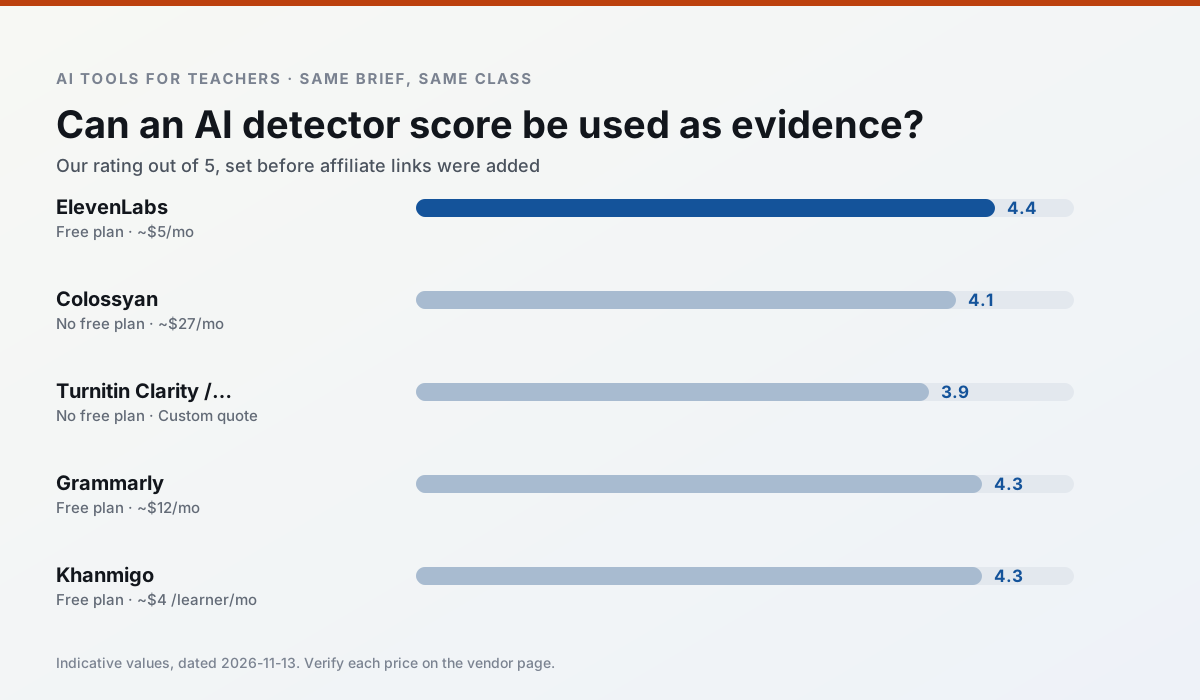
Side by side
Comparison table
Ratings reflect our timed classroom workflow, not vendor claims. Prices are indicative — verify on the vendor site.
| Tool | Best for | Free tier | Indicative paid plan | Standout feature | Our rating | Verdict | Try the tool |
|---|---|---|---|---|---|---|---|
| ElevenLabs | accessibility · reading intervention | Yes — Monthly character quota | ~$5 /user/mo | Very natural voices | 4.4 / 5 | Strong option | Try free |
| Colossyan | PD materials · video lessons | No ongoing free plan | ~$27 /user/mo | PDF/PPT-to-video | 4.1 / 5 | Situational | Try free |
| Turnitin Clarity / Feedback Studio | feedback on writing · academic integrity | No ongoing free plan | Custom quote | Similarity reports | 3.9 / 5 | Situational | Try free |
| Grammarly | parent communication · report card comments | Yes — Core grammar and tone checks | ~$12 /user/mo | Tone adjustments | 4.3 / 5 | Strong option | Try free |
| Khanmigo | math practice · student tutoring | Yes — US teacher accounts, subject to eligibility | ~$4 /learner/mo | Socratic tutoring rather than answers | 4.3 / 5 | Strong option | Try free |
| Claude | rubric creation · feedback on writing | Yes — Usage-limited | ~$20 /user/mo | Very large context window | 4.4 / 5 | Strong option | Try free |
Match your situation
Best for X
Different jobs need different tools. Here is what we would open first in each case.
If there is no budget, start with ElevenLabs: free plan with clearest quota is the least punishing free tier here.
Colossyan wins on the default path: fewer clicks to a usable draft, and the interface does not get in the way at 7:40am.
Turnitin Clarity / Feedback Studio has the shortest path from opening a tab to a usable draft, which matters more than the feature count on a Monday.
For a school rollout, Grammarly offers the paperwork and the admin console; the classroom features are standard by comparison.
Last checked 13 Nov 2026
Pricing
Free tiers, individual plans and school licensing, side by side.
| Tool | Free plan | Individual / paid | School & district | Billing note | Verify |
|---|---|---|---|---|---|
| ElevenLabs | $0 — Monthly character quota | ~$5 /user/mo | ~$22 /user/mo | Indicative — verify on vendor site | Vendor |
| Colossyan | No ongoing free tier | ~$27 /user/mo | Custom quote | Indicative — verify on vendor site | Vendor |
| Turnitin Clarity / Feedback Studio | No ongoing free tier | Custom quote | Custom quote | LMS-wide deployment | Vendor |
| Grammarly | $0 — Core grammar and tone checks | ~$12 /user/mo | ~$15 /user/mo | Indicative — billed annually | Vendor |
| Khanmigo | $0 — US teacher accounts, subject to eligibility | ~$4 /learner/mo | Custom quote | Indicative — verify on vendor site | Vendor |
| Claude | $0 — Usage-limited | ~$20 /user/mo | ~$25+ /user/mo | Indicative — verify on vendor site | Vendor |
Editorial rule: pricing is re-checked every 2–3 months and the top 50 pages are refreshed every 6 months. See our funding policy.
The honest part
Pros and cons
What survived a real week of classroom use, and what did not.
Pros
- Excellent for accessible audio versions
- Low entry price
- Fast generation
Cons
- Quota-based billing
- Voice cloning consent considerations
- Not a teaching platform
Pros
- Strong for staff training, not just lessons
- Good compliance/LMS export
- Fast document-to-video
Cons
- No permanent free plan
- Higher price point
- Less suited to K-12 student-facing content
Pros
- Already licensed at many schools
- Consistent institutional workflow
- Detailed revision history
Cons
- Individual teachers cannot buy it
- AI detection remains contested
- Heavy administrative setup
Pros
- Catches errors in high-stakes parent emails
- Works everywhere you already write
- Very low learning curve
Cons
- Not education-specific
- Can flatten teacher voice
- Premium needed for tone rewriting
Pros
- Education-first design
- Strong nonprofit trust signal
- Good math scaffolding
Cons
- Availability varies by region
- Less useful for admin paperwork
- Requires student accounts for full value
In the classroom
Use cases
Five concrete workflows, with the tool we would open for each one.
Three reading levels from one source text
Paste a vetted text, ask for supported, core and extension versions, then check the vocabulary list by hand. Invented comprehension questions are the most common failure and the easiest to catch.
Recommended: ElevenLabsA Monday morning lesson plan in twelve minutes
The twelve minutes come from not rewriting the skeleton. Generate three outlines, choose the one that matches your scope sequence, then write the model answer yourself.
Recommended: ColossyanA parent email in two languages
Draft in plain, warm language with no names, translate, then back-translate the important sentences to check meaning. Keep specific incidents out of the prompt and add them yourself.
Recommended: Turnitin Clarity / Feedback StudioRubric and feedback comments in one pass
Reorder the workflow so the rubric is yours and the comments are generated. Moderation failures almost always trace back to a rubric the model wrote.
Recommended: GrammarlyAn IEP present-levels first draft
Use aggregated, anonymised data only. Ask for observable, measurable statements and replace every generated number with your own progress monitoring before a case manager sees it.
Recommended: Khanmigo
Questions teachers ask us
FAQ
Direct answers, also published as FAQPage structured data for search and AI assistants.
Is AI allowed for lesson planning in my school?
Who is responsible if something goes wrong?
What should never go into a prompt?
Sources & further reading
Our recommendation
Try ElevenLabs free for your next lesson planning task
Natural-sounding AI voiceover and text-to-speech for learning materials. Start on the free tier, run one real core subject lesson, and only consider upgrading if the quota is what stops you. Disclosure: we may earn a commission (22% recurring) at no extra cost to you.
Some links on this page are affiliate links. We may earn a commission at no extra cost to you. Our rankings are editorial and never pay-to-play. Never enter student PII into a free consumer account.
Keep reading
Related comparisons in this cluster.
Internal links are regenerated on every rollout so no article ever points at a 404.