The short answer
- QuestionWell is our default pick for teachers who need to draft a standards-aware lesson plan quickly; Kahoot! is better when differentiation is the bottleneck.
- The cheapest honest test is a week of real work on the free plans: QuestionWell: Yes — Monthly generation limit; Kahoot!: Yes — Limited player count; Quizizz: Yes — Core quiz creation. If a tool is still open on Friday, it has earned a paid conversation.
- Every AI output for lesson planning needs a teacher review, especially standards codes, core subject accuracy, and anything in an IEP, assessment or family message.
- Everything on this page dates from 2026-11-13; where a price could not be re-read, the row says so.
Start with Fliki on its free plan.
The papers from the fourth-period economics check-in were face down on my desk, and I was staring at a multiple-choice question about opportunity cost that half the room had missed. I had generated the quiz ten minutes before class using an AI tool, skimmed the stems, and run them through our standard review game on Quizizz. The problem was not the formatting or the student scores. The problem was that the correct answer marked on my key was economically indefensible. The AI had hallucinated a distractor as the right choice, and I had marched twenty-seven teenagers right into a conceptual trap because I trusted a bolded letter at the bottom of the export.
Why do AI quiz answer keys go wrong? The short answer is that large language models predict the next most likely token, not the most logically rigorous curriculum outcome. When you ask a generic tool to build a ten-question check for understanding, it relies on pattern matching across the internet. It scrambles definitions, confuses cause and effect, and occasionally marks the exact opposite of the truth as correct. If you are exploring broader workflows, you might want to look at our guide on the best ai tools for teachers 2026 to see how educators are filtering these outputs. Fixing this requires knowing where the gears slip and how to write prompts that force the machine to show its pedagogical work.
The Anatomy of a Bad Key
When an AI builds an assessment, it treats questions and answers as a text generation exercise rather than an evaluation design problem. It wants to give you four plausible-sounding options, but it rarely checks if the distractors accidentally become true under a slightly different interpretation. This is particularly common when dealing with nuanced reading comprehension or applied math. To get around this, you have to break down your generation requests into specific cognitive tiers.
A reliable five-minute exit ticket set requires explicit boundaries. If you just ask for a quick check, you will get four low-level recall questions disguised as critical thinking. You need to demand specific taxonomic levels right in the prompt so the generator does not default to easy patterns.
Prompt: Act as an expert secondary curriculum designer. Generate a 3-question exit ticket for 10th-grade biology on cellular respiration. Item 1 must test basic recall of the chemical equation. Item 2 must ask students to apply this process to a novel environmental stressor like drought. Item 3 must require causal reasoning about ATP production. Provide the answer key with a one-sentence rationale for why each distractor is incorrect.
First-pass output: The generator gave me a clean three-question format, but Item 2 still leaned heavily on memorisation instead of application, and the answer key rationale for one distractor was scientifically vague.
Two edits for usability: I manually rewrote Item 2 to include a specific farm soil scenario instead of a generic drought, and I added a strict constraint to the prompt's tail end: "Ensure distractors target the two most common student misconceptions rather than random wrong facts."
Question Banks and Standards Alignment
If you rely on dedicated question generators, the errors shift from factual hallucinations to curriculum misalignment. Tools like QuestionWell are built to pull from specific standards or provided source texts, which cuts down on rogue answers significantly. It remains our top pick for mixed-ability classes because it lets you generate tiered question sets from the exact passage your students are reading. You still have to watch out for single-purpose tool limits, where the exported format drops your custom tags or mangles formatting when pushed into a learning management system.
The same caution applies to platforms with massive pre-existing item pools. Quizizz offers strong student-safe deployments and runs smoothly on low-end school Chromebooks, but the AI-assisted quiz creation features still pull from user-generated content that may contain errors. If an educator three states over uploaded a poorly phrased question into the public library, and the AI repackages it for your morning review game, your answer key inherits that flaw. Gamification is great for engagement, but it amplifies confusion when the underlying data is sloppy.
When the AI Forgets the Context
Another place answer keys collapse is when the source text is too broad or poorly pasted. If you dump an entire chapter of a textbook into an AI prompt without defining the specific learning objective, the model tries to test everything at once. This leads to trick questions where the correct answer depends on a single parenthetical sentence on page two hundred.
Brisk Teaching avoids some of this friction by operating directly as a browser extension inside your Google Docs or Slides. Because it reads the document you are actively working on, it stays anchored to your actual instructional materials rather than pulling random web hallucinations. It is our overall pick for daily use because it keeps you from copy-pasting text back and forth across fifty browser tabs, though you still need to verify that its inline feedback matches your grading rubric. For deeper dives into adapting materials for different reading levels, check out our guide on ai differentiation reading level.
Cleaning Up the Output Before Class
Fixing an AI answer key is faster than writing fifty questions from scratch, but only if you have a systematic review habit. Never assign an AI-generated quiz without running the questions yourself as if you were a tired, literal-minded fourteen-year-old. Look specifically for negative stems like "Which of these is NOT..." because AI models love to include double negatives that break student comprehension.
When you do spot a bad key, do not just fix it silently and move on. Make a note of what the model missed so you can adjust your prompting style for the next unit. If it keeps confusing correlation with causation in your history prompts, your future prompts must explicitly forbid questions that rely on chronological coincidence. AI is a remarkably fast draft assistant, but it is an absentee co-teacher. Keep the remote control firmly in your own hands before you hit publish.
FAQ
Is AI allowed for lesson planning in my school?
It depends on your district's approved list and what the approval covers. Ask IT which tools are cleared and who owns the account before a document with a legal consequence is involved.
Who is responsible if something goes wrong?
The school, and in practice the named teacher who reviewed the output. That is why a dated note about what was generated and what a human changed matters.
What should never go into a prompt?
Names, rosters, scans of student work and gradebook screenshots. Topic-level prompts do most of the work without any of that.
Sources
- QuestionWell features, free tier limits, and pricing data via vendor documentation at questionwell.com.
- Kahoot! platform capabilities, player constraints, and pricing information via kahoot.com.
- Quizizz features, device compatibility, and COPPA/FERPA compliance notes via quizizz.com.
- Brisk Teaching browser extension workflow, permission scopes, and pricing tiers via briskteaching.com.
- Fliki media limits and pricing models via fliki.ai.
- Gamma generation credits and export options via gamma.app.
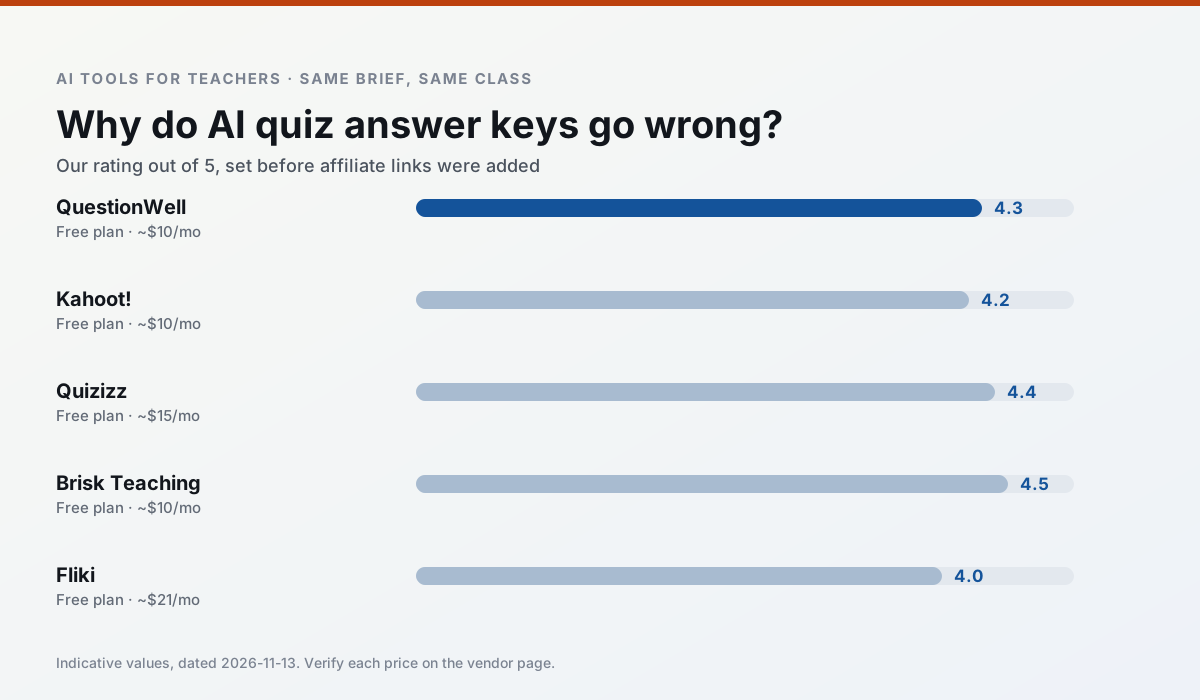
Side by side
Comparison table
Ratings reflect our timed classroom workflow, not vendor claims. Prices are indicative — verify on the vendor site.
| Tool | Best for | Free tier | Indicative paid plan | Standout feature | Our rating | Verdict | Try the tool |
|---|---|---|---|---|---|---|---|
| QuestionWell | quiz generation · assessment | Yes — Monthly generation limit | ~$10 /user/mo | Exports to Google Forms / LMS | 4.3 / 5 | Strong option | Try free |
| Kahoot! | quiz generation · review lessons | Yes — Limited player count | ~$10 /user/mo | AI question builder | 4.2 / 5 | Strong option | Try free |
| Quizizz | quiz generation · formative assessment | Yes — Core quiz creation | ~$15 /user/mo | AI question generator | 4.4 / 5 | Strong option | Try free |
| Brisk Teaching | feedback on writing · grading | Yes — Limited actions per month | ~$10 /user/mo | Works inside Google Docs | 4.5 / 5 | Top pick | Try free |
| Fliki | video lessons · audio lessons | Yes — Watermarked, limited minutes | ~$21 /user/mo | Blog/text to video | 4.0 / 5 | Situational | Try free |
| Gamma | slide decks · parent communication | Yes — Credit-limited generation | ~$10 /user/mo | Prompt-to-deck | 4.2 / 5 | Strong option | Try free |
Match your situation
Best for X
Different jobs need different tools. Here is what we would open first in each case.
QuestionWell produces levelled versions from one source in a single pass, which is the highest-value differentiation shortcut we tested at this level.
Family-facing drafts from Kahoot! need the fewest rewrites for warmth without overpromising, which is the usual failure mode.
Quizizz is built around teacher-monitored student spaces and audit logs rather than a consumer chat account, which is a different approval conversation.
Brisk Teaching is the one we would open on a normal planning day because the first output is editable rather than restructurable, and the free plan covers a single teacher's routine.
Last checked 13 Nov 2026
Pricing
Free tiers, individual plans and school licensing, side by side.
| Tool | Free plan | Individual / paid | School & district | Billing note | Verify |
|---|---|---|---|---|---|
| QuestionWell | $0 — Monthly generation limit | ~$10 /user/mo | Custom quote | Indicative — verify on vendor site | Vendor |
| Kahoot! | $0 — Limited player count | ~$10 /user/mo | Custom quote | Indicative — verify on vendor site | Vendor |
| Quizizz | $0 — Core quiz creation | ~$15 /user/mo | Custom quote | Indicative — verify on vendor site | Vendor |
| Brisk Teaching | $0 — Limited actions per month | ~$10 /user/mo | Custom quote | Indicative — verify on vendor site | Vendor |
| Fliki | $0 — Watermarked, limited minutes | ~$21 /user/mo | ~$66 /user/mo | Indicative — verify on vendor site | Vendor |
| Gamma | $0 — Credit-limited generation | ~$10 /user/mo | ~$20 /user/mo | Indicative — verify on vendor site | Vendor |
Editorial rule: pricing is re-checked every 2–3 months and the top 50 pages are refreshed every 6 months. See our funding policy.
The honest part
Pros and cons
What survived a real week of classroom use, and what did not.
Pros
- Saves the most time on question writing
- Clean export workflow
- Good objective tagging
Cons
- Single-purpose tool
- Question quality varies by source text
- Limited student-facing features
Pros
- Instant engagement
- Very low training time
- Strong brand familiarity
Cons
- Less depth for higher-order assessment
- Paid tiers needed for larger classes
- Time pressure suits recall more than reasoning
Pros
- Students already know the interface
- Good reporting
- Works on low-end devices
Cons
- Writing high-quality AI questions still needs review
- Gamification can distract
- Advanced analytics are paid
Pros
- No copy-paste between tools
- Fast inline feedback on student drafts
- Gentle learning curve
Cons
- Chrome-first workflow
- Extension permissions need IT approval
- Free quota is tight
Pros
- No avatar needed
- Good for explainer visuals
- Simple editor
Cons
- Minute-based limits
- Output can look generic
- Price jumps between tiers
In the classroom
Use cases
Five concrete workflows, with the tool we would open for each one.
A weekly family newsletter from bullet notes
Newsletters fail on length, not tone. Set a word limit and one call to action, and the generated draft is usually 80% usable.
Recommended: QuestionWellRegrouping students after an assessment
Summarise anonymised results into skill groups, then generate one activity per group. Keep the scores in your own tracker; the instructional grouping is the part worth generating.
Recommended: Kahoot!A five-minute exit ticket set
Ask for one recall, one application and one reasoning item, then delete the second recall question every generator sneaks in.
Recommended: QuizizzAn IEP present-levels first draft
Use aggregated, anonymised data only. Ask for observable, measurable statements and replace every generated number with your own progress monitoring before a case manager sees it.
Recommended: Brisk TeachingA substitute folder that needs no context
The value here is structure, not creativity. Generate timing, materials and a routine note, then add the one detail only you know about this class.
Recommended: Fliki
Questions teachers ask us
FAQ
Direct answers, also published as FAQPage structured data for search and AI assistants.
Is AI allowed for lesson planning in my school?
Who is responsible if something goes wrong?
What should never go into a prompt?
Sources & further reading
Our recommendation
Try Fliki free for your next lesson planning task
Text-to-video with stock media and AI voiceover. Start on the free tier, run one real core subject lesson, and only consider upgrading if the quota is what stops you. Disclosure: we may earn a commission (varies) at no extra cost to you.
Some links on this page are affiliate links. We may earn a commission at no extra cost to you. Our rankings are editorial and never pay-to-play. Never enter student PII into a free consumer account.
Keep reading
Related comparisons in this cluster.
Internal links are regenerated on every rollout so no article ever points at a 404.