The short answer
- HeyGen is our default pick for teachers who need to draft a standards-aware lesson plan quickly; Synthesia is better when differentiation is the bottleneck.
- The cheapest honest test is a week of real work on the free plans: HeyGen: Yes — Limited credit plan; Synthesia: No ongoing free plan; QuestionWell: Yes — Monthly generation limit. If a tool is still open on Friday, it has earned a paid conversation.
- Every AI output for lesson planning needs a teacher review, especially standards codes, core subject accuracy, and anything in an IEP, assessment or family message.
- Everything on this page dates from 2026-11-13; where a price could not be re-read, the row says so.
Start with HeyGen on its free plan.
Seventy-eight short answer papers were sitting in my canvas bag on a Tuesday night in November 2026. My coffee was cold, my thumb was twitching from scrolling through rubric rows, and I was wondering why I signed up to teach four sections of ninth-grade English. Does AI grading really shorten turnaround? The short answer is yes, but only if you stop treating the machine like an omniscient grader and start treating it like a very fast, slightly sloppy student assistant who needs you to check every single column. When we talk about AI grading and assessment tools like QuestionWell, Kahoot!, and Quizizz, we are rarely talking about dropping a raw PDF of essays into a black box and walking away. We are talking about shrinking the prep time so you actually have the cognitive bandwidth left to read the student work yourself.
Why Question Generation Beats Essay Scoring
Most teachers start their AI journey by trying to automate summative grading. That is usually where things break down. The tools that actually give you your evenings back are the ones operating upstream. QuestionWell remains my favorite for student-safe deployments because it generates standards-aligned question banks from any text or objective without forcing you to upload student work to the cloud. You paste a reading passage, pick your grade level, and pull the output into a clean export. It has a monthly generation limit on the free tier, and the paid plan runs around $10 a user per month, which is fair for something that spares you three hours of Sunday planning. The trick is keeping your source text clean and only pasting non-identifiable material, which is a baseline rule for any of these platforms.
Prompt: Act as an 8th-grade science teacher. Generate a five-minute exit ticket set based on the attached text about plate tectonics. Include one recall question, one application question, and one reasoning question.
First Output: The AI generated three multiple-choice questions and two short-answer questions, completely ignoring my request for a strict three-item set. It also snuck in a second recall question about the 1906 San Francisco earthquake.
Teacher Edits: I deleted the rogue second recall question, changed the multiple-choice application item into an open-ended prompt so students couldn't guess, and tightened the wording on the reasoning question to match our state standard rubric.
Daily Review Without the Prep Bleed
When you need immediate feedback during class rather than grading papers at midnight, interactive review platforms take over. Kahoot! is still best overall for daily use because kids know the interface, training time is zero, and it creates instant engagement. The free tier limits player counts, while paid tiers run around $10 a user per month. It is brilliant for quick recall, though you have to remember that time pressure suits memorization much better than deep reasoning. If you want something with a bit more structural depth and student reporting that works well on low-end devices, Quizizz is the natural sibling. It sits around $15 a user per month for the paid tier, offering AI-assisted quiz creation alongside a massive question bank. Just watch out for the gamification distractors, and always review the AI-generated distractor options because they occasionally write multiple-choice wrong answers that are more confusing than the correct one.
Prompt: Create a 10-question formative quiz on fractions for a mixed-ability 6th-grade math class. Use the AI question generator to build two easy, six medium, and two hard questions.
First Output: The difficulty split was completely inverted, giving me six easy computation problems and only two hard ones, with the middle tier missing entirely. Two of the fraction graphics descriptions were also gibberish.
Teacher Edits: I tossed the broken graphics descriptions, manually wrote four middle-tier word problems about baking recipes, and kept the two hard conceptual questions the AI managed to get right.
When Video and Translation Actually Matter
Sometimes turnaround isn't about papers; it's about getting instructional content across the language barrier before a unit starts. HeyGen has become my go-to choice for mixed-ability classes because of its best-in-class lip-sync translation. If you have newcomer families who need translated lesson breakdowns, it generates multilingual video output that looks shockingly natural. The paid tier sits around $29 a user per month, and while the voice and likeness cloning raise obvious consent questions that require documented permission slips, the trial credits are generous enough to test a unit opener. Synthesia operates in a similar space around $29 a user per month, turning text scripts into presenter-led videos without requiring a camera or editing skills. It is best for parent-facing writing like weekly newsletters or school-wide policy updates where you need a polished talking head. OpusClip handles a different workflow entirely around $15 a user per month, taking long recorded lessons and chopping them into short, captioned review clips. If you use OpusClip, never upload recordings containing identifiable students, and stick strictly to your own lecturing segments.
Where Things Go Wrong in Practice
Two major failures taught me how to use these tools without losing my mind. First, I tried using an AI quiz generator on an unedited chapter of a historical novel without reading the source text first. The generator pulled a passage containing outdated racial terminology from the 19th-century text and turned it into a vocabulary matching question. I caught it during my third-period prep, but the lesson was five minutes away from launching. Now, I skim every AI source text through a human filter before clicking generate, treating the AI as a drafter rather than a curator.
Second, I tried to automate a weekly family newsletter from a messy list of bullet notes. Newsletters fail on length, not tone. The first AI draft tried to turn three bullet points about permission slips and bake sales into a four-paragraph essay that no parent would ever read on a phone. The fix was simple: I added a strict word limit and a single call to action to the prompt, which brought the output down to an 80 percent usable state that took two minutes to polish. If you want to dive deeper into structuring prompts for complex education workflows, take a look at our guide on 504 plans prompt templates for teachers or explore broader applications in the best AI tools for teachers in 2026.
FAQ
Is AI allowed for lesson planning in my school?
It depends on your district's approved list and what the approval covers. Ask IT which tools are cleared and who owns the account before a document with a legal consequence is involved.
Who is responsible if something goes wrong?
The school, and in practice the named teacher who reviewed the output. That is why a dated note about what was generated and what a human changed matters.
What should never go into a prompt?
Names, rosters, scans of student work and gradebook screenshots. Topic-level prompts do most of the work without any of that.
Sources
- HeyGen Pricing and Features: https://www.heygen.com/pricing
- Synthesia Product Overview: https://www.synthesia.io/features
- QuestionWell Documentation: https://www.questionwell.ai/
- Kahoot! Educator Plans: https://kahoot.com/schools-u/
- OpusClip Specifications: https://www.opus.pro/
- Quizizz Feature List: https://quizizz.com/home/sol/work/schools
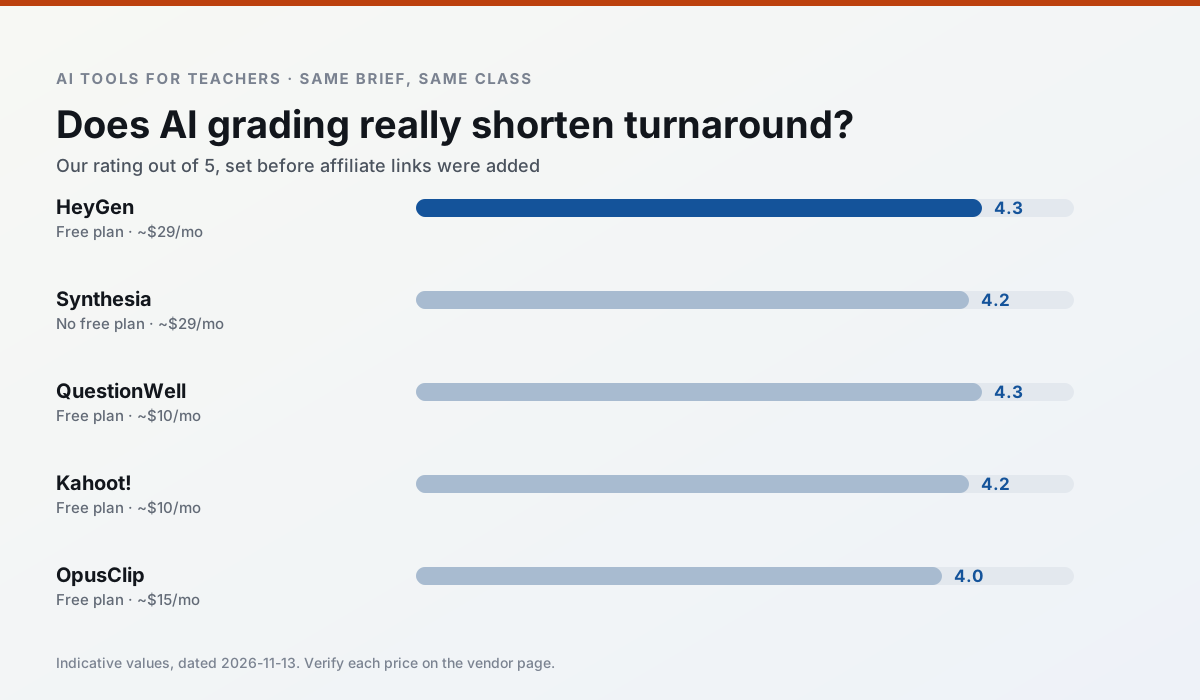
Side by side
Comparison table
Ratings reflect our timed classroom workflow, not vendor claims. Prices are indicative — verify on the vendor site.
| Tool | Best for | Free tier | Indicative paid plan | Standout feature | Our rating | Verdict | Try the tool |
|---|---|---|---|---|---|---|---|
| HeyGen | video lessons · translation | Yes — Limited credit plan | ~$29 /user/mo | Video translation | 4.3 / 5 | Strong option | Try free |
| Synthesia | flipped lessons · video lessons | No ongoing free plan | ~$29 /user/mo | 140+ languages | 4.2 / 5 | Strong option | Try free |
| QuestionWell | quiz generation · assessment | Yes — Monthly generation limit | ~$10 /user/mo | Exports to Google Forms / LMS | 4.3 / 5 | Strong option | Try free |
| Kahoot! | quiz generation · review lessons | Yes — Limited player count | ~$10 /user/mo | AI question builder | 4.2 / 5 | Strong option | Try free |
| OpusClip | PD materials · flipped lessons | Yes — Limited monthly clips | ~$15 /user/mo | Auto captions | 4.0 / 5 | Situational | Try free |
| Quizizz | quiz generation · formative assessment | Yes — Core quiz creation | ~$15 /user/mo | AI question generator | 4.4 / 5 | Strong option | Try free |
Match your situation
Best for X
Different jobs need different tools. Here is what we would open first in each case.
For three reading groups and one text, HeyGen needs the least manual relabelling of vocabulary and questions.
Family-facing drafts from Synthesia need the fewest rewrites for warmth without overpromising, which is the usual failure mode.
For anything students touch directly, QuestionWell offers the supervision controls and logging that IT will ask about first.
Kahoot! is the one we would open on a normal planning day because the first output is editable rather than restructurable, and the free plan covers a single teacher's routine.
Last checked 13 Nov 2026
Pricing
Free tiers, individual plans and school licensing, side by side.
| Tool | Free plan | Individual / paid | School & district | Billing note | Verify |
|---|---|---|---|---|---|
| HeyGen | $0 — Limited credit plan | ~$29 /user/mo | Custom quote | Indicative — verify on vendor site | Vendor |
| Synthesia | No ongoing free tier | ~$29 /user/mo | Custom quote | Indicative — verify on vendor site | Vendor |
| QuestionWell | $0 — Monthly generation limit | ~$10 /user/mo | Custom quote | Indicative — verify on vendor site | Vendor |
| Kahoot! | $0 — Limited player count | ~$10 /user/mo | Custom quote | Indicative — verify on vendor site | Vendor |
| OpusClip | $0 — Limited monthly clips | ~$15 /user/mo | ~$29 /user/mo | Indicative — verify on vendor site | Vendor |
| Quizizz | $0 — Core quiz creation | ~$15 /user/mo | Custom quote | Indicative — verify on vendor site | Vendor |
Editorial rule: pricing is re-checked every 2–3 months and the top 50 pages are refreshed every 6 months. See our funding policy.
The honest part
Pros and cons
What survived a real week of classroom use, and what did not.
Pros
- Best-in-class lip-sync translation
- Useful for multilingual families
- Generous trial credits
Cons
- Credit-based pricing is confusing
- Voice cloning raises consent questions
- Overkill for everyday lessons
Pros
- No camera or editing skills required
- Excellent multilingual voice output
- Easy updates to existing videos
Cons
- Cost is hard to justify for a single teacher
- Avatar video can feel impersonal
- No free ongoing tier
Pros
- Saves the most time on question writing
- Clean export workflow
- Good objective tagging
Cons
- Single-purpose tool
- Question quality varies by source text
- Limited student-facing features
Pros
- Instant engagement
- Very low training time
- Strong brand familiarity
Cons
- Less depth for higher-order assessment
- Paid tiers needed for larger classes
- Time pressure suits recall more than reasoning
Pros
- Turns a recorded lesson into review clips
- Excellent captions
- Fast
Cons
- Optimised for social formats
- Not a lesson design tool
- Free plan is restrictive
In the classroom
Use cases
Five concrete workflows, with the tool we would open for each one.
A weekly family newsletter from bullet notes
Newsletters fail on length, not tone. Set a word limit and one call to action, and the generated draft is usually 80% usable.
Recommended: HeyGenRegrouping students after an assessment
Summarise anonymised results into skill groups, then generate one activity per group. Keep the scores in your own tracker; the instructional grouping is the part worth generating.
Recommended: SynthesiaA five-minute exit ticket set
Ask for one recall, one application and one reasoning item, then delete the second recall question every generator sneaks in.
Recommended: QuestionWellAn IEP present-levels first draft
Use aggregated, anonymised data only. Ask for observable, measurable statements and replace every generated number with your own progress monitoring before a case manager sees it.
Recommended: Kahoot!A substitute folder that needs no context
The value here is structure, not creativity. Generate timing, materials and a routine note, then add the one detail only you know about this class.
Recommended: OpusClip
Questions teachers ask us
FAQ
Direct answers, also published as FAQPage structured data for search and AI assistants.
Is AI allowed for lesson planning in my school?
Who is responsible if something goes wrong?
What should never go into a prompt?
Sources & further reading
Our recommendation
Try HeyGen free for your next lesson planning task
AI avatar video and video translation for instructional content. Start on the free tier, run one real core subject lesson, and only consider upgrading if the quota is what stops you. Disclosure: we may earn a commission (35% recurring) at no extra cost to you.
Some links on this page are affiliate links. We may earn a commission at no extra cost to you. Our rankings are editorial and never pay-to-play. Never enter student PII into a free consumer account.
Keep reading
Related comparisons in this cluster.
Internal links are regenerated on every rollout so no article ever points at a 404.