The short answer
- Diffit is our default pick for teachers who need to draft a standards-aware lesson plan quickly; Synthesia is better when differentiation is the bottleneck.
- Start with Diffit on its free plan, keep Synthesia as the second opinion, and do not open a card until the quota, not the feature list, is what stops you.
- Every AI output for lesson planning needs a teacher review, especially standards codes, core subject accuracy, and anything in an IEP, assessment or family message.
- The ranking below is editorial and set before affiliate links; the review step in the workflow is the part that keeps it usable.
Start with Synthesia on its free plan.
At 7:15 last Tuesday, my coffee was cold and my school-issued district email address was throwing a 403 error every time I tried to log into a new generator. Half the platforms block the .edu domains outright because of state-level privacy filters, while the other half demand a Google SSO that our IT department locked down in 2024. If you are wondering whether you can use AI tools without a personal email, the short answer is that while you can create accounts with school credentials on platforms that offer Google or Microsoft single sign-on, you will hit roadblocks the moment your district firewall meets a third-party vendor's terms of service.
Most teachers do not want to hand over their personal Gmail to a classroom app, but our district logins are so heavily restricted that we are often forced into a corner. We need tools that respect our boundaries, work within our infrastructure, and help us get through prep period without violating student privacy laws. As we look at the landscape in late 2026, understanding which platforms accommodate standard sign-in methods without demanding your personal phone number or home email has become a survival skill for classroom prep.
The Reality of District Logins and Third-Party AI
Every time a teacher registers for a new app, we play a game of digital hopscotch. Some platforms let you log in through Google Workspace for Education, which bypasses the need for a personal email entirely if your district allows OAuth integrations. Others require a direct email sign-up that rejects anything without a .com suffix.
When you are exploring the best options for lesson planning, as outlined in our guide to the best AI tools for teachers in 2026, you will notice a split between tools built for enterprise settings and those thrown together for quick consumer use. If your school uses Google Workspace, you can often piggyback on that single sign-on for platforms like Canva for Education, which requires strict verification anyway. If your district blocks Google SSO for external apps, you are stuck choosing between using a personal burner email or abandoning the tool entirely.
Platform Check: Which Tools Allow Non-Personal Access?
Let us look at how specific platforms handle authentication and whether they respect the boundary between your work life and your home inbox.
Canva for Education is one of the easiest to onboard because it relies on teacher verification through standard education credentials rather than forcing a personal email. Once verified, you get access to a massive template library, AI writing features, and image generation. The free tier is robust, though the AI features are capped, and verification can sometimes take a few days if you teach in a small district that isn't on their pre-approved database.
Diffit is another heavy hitter for mixed-ability classes, functioning as our best choice for student-safe deployments. It lets you level any text or video into differentiated reading materials quickly. You can sign in using standard school Google accounts, avoiding the need for a personal email, though heavy use will rapidly burn through your free quota before you need to consider the paid tier at roughly $15 per user per month.
Gamma offers a remarkably fast path from a simple prompt to a full presentation deck, though it relies on credit-limited generations. You can log in via standard work accounts, but because its design control is limited and credits run out quickly, you have to decide if it is worth burning your daily generation limit on a single slide deck.
Video Generators and Enterprise Barriers
When we move into video and avatar tools, authentication gets trickier because these platforms are built primarily for corporate marketing departments rather than K-12 classrooms.
Synthesia turns a script into a presenter-led video using AI avatars, making it useful for parent-facing writing or multi-lingual translation without requiring any camera skills. However, it has no free ongoing tier, and at roughly $29 per user per month, the cost is hard to justify for a single teacher. More importantly for our current question, its enterprise-grade security posture often means your district IT department will flag the domain, pushing you toward personal login workarounds if you want to test it.
HeyGen operates similarly, offering standout lip-sync translation that helps communicate with multilingual families. It is our top pick for mixed-ability and multilingual support, but its credit-based pricing is confusing, and voice cloning raises serious consent questions. Like Synthesia, it is not built with K-12 data privacy baked into its casual tier, meaning you must be exceptionally careful about how you sign up and what data you input.
Formative sits in a different category entirely as a live assessment tool with auto-grading and standards tracking. Because it integrates directly with major LMS platforms and offers school-grade data privacy agreements, districts are much more likely to whitelist it, allowing teachers to use their official credentials without resorting to personal accounts.
Prompt: Generate a 5-question reading comprehension quiz based on this article about photosynthesis, with one recall question, one application question, and one reasoning question, including the misconception behind each distractor.
What came back: Three recall questions about chlorophyll, two application questions, and multiple-choice distractors that were obviously generated by a generic language model, plus a hidden extra recall question at the end.
Two edits that made it usable:
- Deleted the second recall question that the generator snuck in, leaving the exact mix of cognitive depths required for the standard.
- Rewrote the numerical distractor on question four because the AI's math was completely disconnected from the source text.
Two Real Classroom Failures and How to Fix Them
Even with proper logins, AI tools love to invent data when you least expect it. Last month, I tried using a quick presentation generator to build a substitute teacher folder that needed no context. The tool generated a generic timeline and materials list, but it completely hallucinated a school-wide assembly schedule that does not exist on our campus. The fix was simple: I stripped out the automated schedule and replaced it with the one specific routine note only I know about my third-period class. Structure is helpful, but creativity without local context is just another thing to correct.
A similar breakdown happened when I tested an AI tool to draft an IEP present-levels first draft using anonymised data. The output looked professional, but it invented baseline percentages that had zero grounding in my actual student work monitoring logs. I had to delete every generated number and manually insert my own progress-monitoring data before I let our case manager see it. If you need more strategies for handling specialized learning plans, our guide on 504 plans and prompt templates for teachers breaks down how to keep your data compliant.
Ultimately, you can navigate the AI landscape without handing over your personal email, provided you stick to tools that support standard Google or Microsoft school SSO and avoid platforms that treat K-12 educators like corporate marketers. Check your district's whitelist, protect your students' names, and never trust a generated data point without checking it against your physical gradebook.
FAQ
Is AI allowed for lesson planning in my school?
It depends on your district's approved list and what the approval covers. Ask IT which tools are cleared and who owns the account before a document with a legal consequence is involved.
Who is responsible if something goes wrong?
The school, and in practice the named teacher who reviewed the output. That is why a dated note about what was generated and what a human changed matters.
What should never go into a prompt?
Names, rosters, scans of student work and gradebook screenshots. Topic-level prompts do most of the work without any of that.
Sources
- Diffit. Product features, free tier limits, and pricing information. https://diffit.me
- Synthesia. Avatar video generation and enterprise tier details. https://www.synthesia.io
- HeyGen. Video translation and credit-based plan structures. https://www.heygen.com
- Canva for Education. Verification requirements and education suite terms. https://www.canva.com/education
- Gamma. Presentation generation and credit limits. https://gamma.app
- Formative. Assessment tools, LMS integrations, and data privacy frameworks. https://www.formative.com
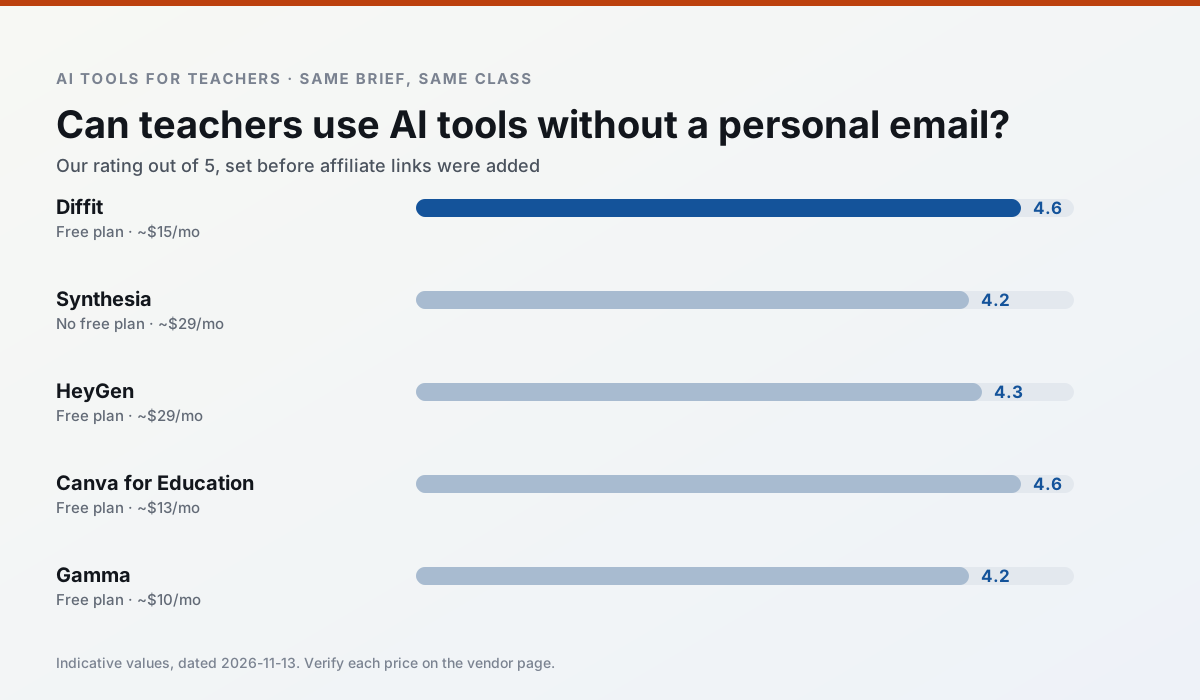
Side by side
Comparison table
Ratings reflect our timed classroom workflow, not vendor claims. Prices are indicative — verify on the vendor site.
| Tool | Best for | Free tier | Indicative paid plan | Standout feature | Our rating | Verdict | Try the tool |
|---|---|---|---|---|---|---|---|
| Diffit | differentiated instruction · reading intervention | Yes — Limited generations per month | ~$15 /user/mo | Lexile-style leveling | 4.6 / 5 | Top pick | Try free |
| Synthesia | flipped lessons · video lessons | No ongoing free plan | ~$29 /user/mo | 140+ languages | 4.2 / 5 | Strong option | Try free |
| HeyGen | video lessons · translation | Yes — Limited credit plan | ~$29 /user/mo | Video translation | 4.3 / 5 | Strong option | Try free |
| Canva for Education | slide decks · worksheets | Yes — Verification required | ~$13 /user/mo | Thousands of education templates | 4.6 / 5 | Top pick | Try free |
| Gamma | slide decks · parent communication | Yes — Credit-limited generation | ~$10 /user/mo | Prompt-to-deck | 4.2 / 5 | Strong option | Try free |
| Formative | formative assessment · grading | Yes — Core assessment tools | ~$15 /user/mo | Live student responses | 4.3 / 5 | Strong option | Try free |
Match your situation
Best for X
Different jobs need different tools. Here is what we would open first in each case.
Diffit is the student-facing option here with boundaries a teacher can actually set and supervise.
Synthesia has the strongest tone control for family emails and report comments, provided you still read the message aloud before sending.
HeyGen keeps the same task across levels, which is what makes a differentiated set defensible in moderation.
Canva for Education runs in a browser tab with no extension, no student accounts and no onboarding call, so you can test it in a free period.
Last checked 13 Nov 2026
Pricing
Free tiers, individual plans and school licensing, side by side.
| Tool | Free plan | Individual / paid | School & district | Billing note | Verify |
|---|---|---|---|---|---|
| Diffit | $0 — Limited generations per month | ~$15 /user/mo | Custom quote | Indicative — verify on vendor site | Vendor |
| Synthesia | No ongoing free tier | ~$29 /user/mo | Custom quote | Indicative — verify on vendor site | Vendor |
| HeyGen | $0 — Limited credit plan | ~$29 /user/mo | Custom quote | Indicative — verify on vendor site | Vendor |
| Canva for Education | $0 — Verification required | ~$13 /user/mo | Custom quote | Indicative — verify on vendor site | Vendor |
| Gamma | $0 — Credit-limited generation | ~$10 /user/mo | ~$20 /user/mo | Indicative — verify on vendor site | Vendor |
| Formative | $0 — Core assessment tools | ~$15 /user/mo | Custom quote | Indicative — verify on vendor site | Vendor |
Editorial rule: pricing is re-checked every 2–3 months and the top 50 pages are refreshed every 6 months. See our funding policy.
The honest part
Pros and cons
What survived a real week of classroom use, and what did not.
Pros
- Excellent for mixed-ability classes
- Produces printable and digital versions
- Minimal setup
Cons
- Narrower scope than all-in-one suites
- Leveling is approximate, not a formal assessment
- Heavy use burns through the free quota
Pros
- No camera or editing skills required
- Excellent multilingual voice output
- Easy updates to existing videos
Cons
- Cost is hard to justify for a single teacher
- Avatar video can feel impersonal
- No free ongoing tier
Pros
- Best-in-class lip-sync translation
- Useful for multilingual families
- Generous trial credits
Cons
- Credit-based pricing is confusing
- Voice cloning raises consent questions
- Overkill for everyday lessons
Pros
- Effectively free for verified teachers
- Huge template library
- No design skills needed
Cons
- AI features are capped
- Easy to produce cluttered slides
- Account verification can be slow
Pros
- Fastest path from outline to deck
- Modern-looking output by default
- Good export options
Cons
- Design control is limited
- Credits run out quickly
- Not built for student data
In the classroom
Use cases
Five concrete workflows, with the tool we would open for each one.
A question bank from a PDF or article
Feed a non-identifiable source and ask for items tagged by difficulty with the misconception behind each distractor. Spot-check every answer key; numerical items are least reliable.
Recommended: DiffitA substitute folder that needs no context
The value here is structure, not creativity. Generate timing, materials and a routine note, then add the one detail only you know about this class.
Recommended: SynthesiaAn IEP present-levels first draft
Use aggregated, anonymised data only. Ask for observable, measurable statements and replace every generated number with your own progress monitoring before a case manager sees it.
Recommended: HeyGenA five-minute exit ticket set
Ask for one recall, one application and one reasoning item, then delete the second recall question every generator sneaks in.
Recommended: Canva for EducationA parent email in two languages
Draft in plain, warm language with no names, translate, then back-translate the important sentences to check meaning. Keep specific incidents out of the prompt and add them yourself.
Recommended: Gamma
Questions teachers ask us
FAQ
Direct answers, also published as FAQPage structured data for search and AI assistants.
Is AI allowed for lesson planning in my school?
Who is responsible if something goes wrong?
What should never go into a prompt?
Sources & further reading
Our recommendation
Try Synthesia free for your next lesson planning task
Turn a script into a presenter-led video with AI avatars. Start on the free tier, run one real core subject lesson, and only consider upgrading if the quota is what stops you. Disclosure: we may earn a commission (25% recurring) at no extra cost to you.
Some links on this page are affiliate links. We may earn a commission at no extra cost to you. Our rankings are editorial and never pay-to-play. Never enter student PII into a free consumer account.
Keep reading
Related comparisons in this cluster.
Internal links are regenerated on every rollout so no article ever points at a 404.