The short answer
- Jasper is our default pick for teachers who need to draft a standards-aware lesson plan quickly; OpusClip is better when differentiation is the bottleneck.
- Start with Jasper on its free plan, keep OpusClip as the second opinion, and do not open a card until the quota, not the feature list, is what stops you.
- Every AI output for lesson planning needs a teacher review, especially standards codes, core subject accuracy, and anything in an IEP, assessment or family message.
- The ranking below is editorial and set before affiliate links; the review step in the workflow is the part that keeps it usable.
Start with Jasper on its free plan.
Last Tuesday, I handed our department chair three different rubrics for our upcoming poetry unit: one I wrote at midnight after three cups of coffee, one pulled from an archived district drive, and one generated by an AI assistant in roughly forty seconds. She didn't look at the coffee one. She didn't care about the archived one. She stared at the third option, blinked at the performance descriptors, and asked a simple question: "Will an AI-written rubric survive moderation?"
It is a fair question. When you bring an AI-generated assessment or communication piece to a grade-level moderation meeting, department heads and curriculum leads can spot generic phrasing from across the room. Words like "demonstrates profound understanding" or "utilizes sophisticated techniques" sound impressive until you try to apply them to an eighth-grader who just wrote a two-stanza poem about a toaster. If a rubric does not survive moderation, your students suffer inconsistent grading, and you spend your planning period defending numbers you cannot justify. We need writing assistants that save time without collapsing under scrutiny, whether we are crafting parent emails, generating training content, or building accessible learning materials.
Polishing High-Stakes Parent Comms With Jasper
Every teacher knows the dread of drafting an email to a parent about a sensitive behavioral incident when your patience is completely gone. When you need a consistent tone across school communications teams or a polished district-level message, Jasper remains a heavy-duty option. It runs roughly $39 per user per month with no free tier, which makes it far too expensive for an individual classroom teacher buying their own supplies.
The strength here is the long-form editor and brand-voice controls that keep multi-author newsletters sounding like the same school wrote them. But you have to remember that Jasper was built for marketing departments, not K-12 pedagogy. It lacks education-specific features, and because it is designed for commercial copy, you must never feed it student data. When I use it for generic school announcements, I have to strip out any corporate fluff it loves to insert.
Prompt:
Write a professional, firm community newsletter update explaining our new cell phone policy for the middle school, maintaining an objective and supportive tone.

First draft returned:
As we navigate the dynamic landscape of modern education, our educational ecosystem strives to empower stakeholders with cutting-edge solutions for optimal focus.

Two edits that made it usable:
1. Deleted the marketing jargon about dynamic landscapes and cutting-edge solutions entirely.
2. Replaced the corporate framing with direct, plain-English expectations: phones off and in lockers from 8:00 AM to 3:00 PM.
Turning Lesson Recordings Into Review Clips With OpusClip
If you teach mixed-ability classes and want to make sure kids who miss a lecture or need reinforcement can catch up, recording your instruction is a standard move. OpusClip takes those long recordings and carves them into short, captioned clips for roughly $15 per user per month, offering a limited free tier. It is exceptionally fast and generates clean captions that help visual learners and students processing audio instructions.
The catch is that this tool is optimized for social media formats and viral clipping, not pedagogical lesson design. It will happily clip the middle of your sentence if you pause for breath. More importantly, you must never upload recordings containing identifiable students due to privacy and consent rules. When I use it, I record only my own screen and voice while working through a math proof, keeping students entirely out of the frame and off the audio track.
Building Student-Safe Audio With ElevenLabs
Reading materials aloud to students who struggle with decoding is a daily necessity, but recording every text yourself takes hours. ElevenLabs provides natural-sounding AI voiceover and text-to-speech for around $5 per user per month, backed by a monthly character quota. It is fast, cheap, and creates clear, accessible audio versions of reading passages that you can drop straight into your digital backpack.
The limitations are clear: it operates on strict quota-based billing, and voice cloning comes with massive consent considerations. You must never clone a student's or a colleague's voice without explicit written consent. When I generate read-alouds for our text-dependent analysis tasks, I stick to the built-in synthetic stock voices rather than trying to replicate human staff members, ensuring our digital deployment stays strictly student-safe.
Creating Quick Staff Training Videos With Colossyan
When you need to turn a dense PDF of new school safety protocols or a complex slide deck into a clear explainer video for staff, Colossyan handles document-to-video conversion efficiently. It costs roughly $27 per user per month with no permanent free tier. It is strong for staff training and compliance exports to your learning management system, which beats reading bullet points off a projector at the start of an inservice day.
However, it has no permanent free tier and sits at a higher price point that makes it a hard sell for personal teacher budgets. It is also less suited for K-12 student-facing content because the avatars and presentation styles look corporate rather than engaging for children. If you use it, you must confirm local data residency settings to ensure your school district complies with privacy rules before uploading administrative documents.
Managing Institutional Writing Feedback With Turnitin Clarity
For high-school writing teachers drowning in essays, Turnitin Clarity and Feedback Studio offer institutional writing feedback and similarity checking. There is no free tier and pricing requires a custom institutional quote because individual teachers cannot buy licenses on their own. It is already licensed at many schools, providing a consistent institutional workflow and detailed revision histories that track student drafting over time.
The administrative setup is notoriously heavy, and AI detection tools within these suites remain heavily contested by writing experts and educators alike. Teachers often find themselves arguing with false positives on plagiarism reports rather than teaching the craft of writing. For a broader look at how writing tools fit into our daily workflows, see our guide on the best AI tools for teachers. If you are navigating accommodations alongside your feedback, our breakdown of 504 plans prompt templates for teachers offers practical guardrails.
Polishing Everyday Teacher Writing With Grammarly
We all send dozens of emails a week to parents, colleagues, and administrators, and typos happen when you are grading essays at 10:00 PM. Grammarly acts as a writing assistant for polished parent emails, newsletters, and reports for roughly $12 per user per month, alongside a free tier that handles core grammar and tone checks. It works right inside your browser where you already write, meaning a very low learning curve.
It is not education-specific, and if you rely too heavily on its tone rewriting, it can flatten your authentic teacher voice into a bland, corporate mush. On school devices, you need to ensure text collection is disabled and check your district's data processing agreement. When I use it to clean up a rushed email to a skeptical parent, I always override its suggestions if they make me sound like an insurance agent instead of an educator who actually knows the kid.
Using AI in education is never about hitting generate and walking away. Whether you are building rubrics that have to pass moderation or writing parent emails that need to de-escalate tension, the human check is where the actual teaching happens.
FAQ
Is AI allowed for lesson planning in my school?
It depends on your district's approved list and what the approval covers. Ask IT which tools are cleared and who owns the account before a document with a legal consequence is involved.
Who is responsible if something goes wrong?
The school, and in practice the named teacher who reviewed the output. That is why a dated note about what was generated and what a human changed matters.
What should never go into a prompt?
Names, rosters, scans of student work and gradebook screenshots. Topic-level prompts do most of the work without any of that.
Sources
- Jasper pricing and product details: Jasper Pricing
- OpusClip features and limitations: OpusClip Pricing
- ElevenLabs voice generation specs: ElevenLabs Pricing
- Colossyan training video platform: Colossyan Pricing
- Turnitin Feedback Studio overview: Turnitin Products
- Grammarly writing assistant data: Grammarly Plans
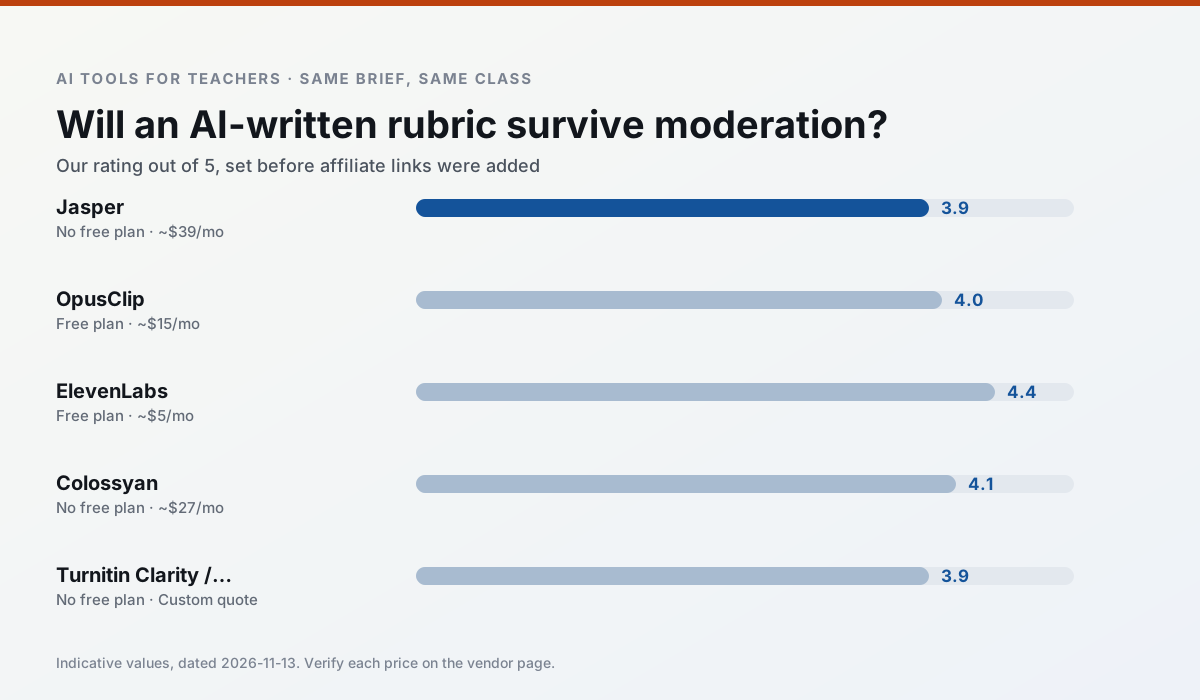
Side by side
Comparison table
Ratings reflect our timed classroom workflow, not vendor claims. Prices are indicative — verify on the vendor site.
| Tool | Best for | Free tier | Indicative paid plan | Standout feature | Our rating | Verdict | Try the tool |
|---|---|---|---|---|---|---|---|
| Jasper | newsletters · parent communication | No ongoing free plan | ~$39 /user/mo | Brand voice profiles | 3.9 / 5 | Situational | Try free |
| OpusClip | PD materials · flipped lessons | Yes — Limited monthly clips | ~$15 /user/mo | Auto captions | 4.0 / 5 | Situational | Try free |
| ElevenLabs | accessibility · reading intervention | Yes — Monthly character quota | ~$5 /user/mo | Very natural voices | 4.4 / 5 | Strong option | Try free |
| Colossyan | PD materials · video lessons | No ongoing free plan | ~$27 /user/mo | PDF/PPT-to-video | 4.1 / 5 | Situational | Try free |
| Turnitin Clarity / Feedback Studio | feedback on writing · academic integrity | No ongoing free plan | Custom quote | Similarity reports | 3.9 / 5 | Situational | Try free |
| Grammarly | parent communication · report card comments | Yes — Core grammar and tone checks | ~$12 /user/mo | Tone adjustments | 4.3 / 5 | Strong option | Try free |
Match your situation
Best for X
Different jobs need different tools. Here is what we would open first in each case.
Family-facing drafts from Jasper need the fewest rewrites for warmth without overpromising, which is the usual failure mode.
OpusClip produces levelled versions from one source in a single pass, which is the highest-value differentiation shortcut we tested at this level.
ElevenLabs is the student-facing option here with boundaries a teacher can actually set and supervise.
Nothing on Colossyan's free tier is a teaser demo; the limits are documented and a normal week fits inside them.
Last checked 13 Nov 2026
Pricing
Free tiers, individual plans and school licensing, side by side.
| Tool | Free plan | Individual / paid | School & district | Billing note | Verify |
|---|---|---|---|---|---|
| Jasper | No ongoing free tier | ~$39 /user/mo | ~$59+ /user/mo | Indicative — verify on vendor site | Vendor |
| OpusClip | $0 — Limited monthly clips | ~$15 /user/mo | ~$29 /user/mo | Indicative — verify on vendor site | Vendor |
| ElevenLabs | $0 — Monthly character quota | ~$5 /user/mo | ~$22 /user/mo | Indicative — verify on vendor site | Vendor |
| Colossyan | No ongoing free tier | ~$27 /user/mo | Custom quote | Indicative — verify on vendor site | Vendor |
| Turnitin Clarity / Feedback Studio | No ongoing free tier | Custom quote | Custom quote | LMS-wide deployment | Vendor |
| Grammarly | $0 — Core grammar and tone checks | ~$12 /user/mo | ~$15 /user/mo | Indicative — billed annually | Vendor |
Editorial rule: pricing is re-checked every 2–3 months and the top 50 pages are refreshed every 6 months. See our funding policy.
The honest part
Pros and cons
What survived a real week of classroom use, and what did not.
Pros
- Consistent tone across communications
- Strong long-form editor
- Good for district comms teams
Cons
- Priced for marketing teams
- Overkill for one classroom
- No education-specific features
Pros
- Turns a recorded lesson into review clips
- Excellent captions
- Fast
Cons
- Optimised for social formats
- Not a lesson design tool
- Free plan is restrictive
Pros
- Excellent for accessible audio versions
- Low entry price
- Fast generation
Cons
- Quota-based billing
- Voice cloning consent considerations
- Not a teaching platform
Pros
- Strong for staff training, not just lessons
- Good compliance/LMS export
- Fast document-to-video
Cons
- No permanent free plan
- Higher price point
- Less suited to K-12 student-facing content
Pros
- Already licensed at many schools
- Consistent institutional workflow
- Detailed revision history
Cons
- Individual teachers cannot buy it
- AI detection remains contested
- Heavy administrative setup
In the classroom
Use cases
Five concrete workflows, with the tool we would open for each one.
An IEP present-levels first draft
Use aggregated, anonymised data only. Ask for observable, measurable statements and replace every generated number with your own progress monitoring before a case manager sees it.
Recommended: JasperA five-minute exit ticket set
Ask for one recall, one application and one reasoning item, then delete the second recall question every generator sneaks in.
Recommended: OpusClipA question bank from a PDF or article
Feed a non-identifiable source and ask for items tagged by difficulty with the misconception behind each distractor. Spot-check every answer key; numerical items are least reliable.
Recommended: ElevenLabsA substitute folder that needs no context
The value here is structure, not creativity. Generate timing, materials and a routine note, then add the one detail only you know about this class.
Recommended: ColossyanThree reading levels from one source text
Paste a vetted text, ask for supported, core and extension versions, then check the vocabulary list by hand. Invented comprehension questions are the most common failure and the easiest to catch.
Recommended: Turnitin Clarity / Feedback Studio
Questions teachers ask us
FAQ
Direct answers, also published as FAQPage structured data for search and AI assistants.
Is AI allowed for lesson planning in my school?
Who is responsible if something goes wrong?
What should never go into a prompt?
Sources & further reading
Our recommendation
Try Jasper free for your next lesson planning task
Brand-voice writing assistant for school communications teams. Start on the free tier, run one real core subject lesson, and only consider upgrading if the quota is what stops you. Disclosure: we may earn a commission (varies) at no extra cost to you.
Some links on this page are affiliate links. We may earn a commission at no extra cost to you. Our rankings are editorial and never pay-to-play. Never enter student PII into a free consumer account.
Keep reading
Related comparisons in this cluster.
Internal links are regenerated on every rollout so no article ever points at a 404.