The short answer
- Curipod is our default pick for teachers who need to create quick checks for understanding quickly; Khanmigo is better when differentiation is the bottleneck.
- Free-tier reality for this shortlist: Curipod: Yes — Limited lessons per month; Khanmigo: Yes — US teacher accounts, subject to eligibility; Quizizz: Yes — Core quiz creation. Treat every paid figure as indicative until you have read the vendor page; only the free quota is something you can test yourself this week.
- Every AI output for formative assessment needs a teacher review, especially standards codes, core subject accuracy, and anything in an IEP, assessment or family message.
- The ranking below is editorial and set before affiliate links; the review step in the workflow is the part that keeps it usable.
Start with Surfer SEO on its free plan.
It is fourteen minutes before third period starts, and I am staring at yesterday's paragraph-writing exit tickets with a red pen I have no business holding. Half the room missed the point about evidence integration, and I need three distinct practice paths for tomorrow morning. This is the exact moment when figuring out how to generate quick checks for understanding with AI stops being a neat tech trend and becomes a survival skill. We are past the era of generic prompts that spit out five multiple-choice questions about anything. The challenge now is building a fast, reliable routine that spots misconceptions before the bell rings without chaining us to a laptop until midnight.
Why Formative Assessment Breaks Down Without Automation
Formative assessment fails in practice for one simple reason: teachers run out of bandwidth. Writing a solid exit ticket takes ten minutes if you want a mix of recall, application, and reasoning. Multiply that across three preps and a homeroom, and you are looking at an hour of item-writing every single day. Most generic generators make this worse by handing you five surface-level recall questions that test memory instead of understanding. When we look at how to generate quick checks for understanding with AI, the goal is not to replace teacher judgment. The goal is to offload the heavy lifting of drafting distractors and scaffolding questions so we can spend our energy deciding who needs small-group intervention.
Building a Five-Minute Exit Ticket Set
The secret to a useful exit ticket is variety, not volume. When you ask an AI tool to build a quick check, it will almost always sneak in a second recall question because it defaults to low-level testing. You have to force its hand by specifying the exact cognitive load for each item.
Prompt: Act as a veteran high school science teacher. Create a three-question exit ticket on cellular respiration for a mixed-ability 9th-grade class. Question 1 must be a low-stakes recall item. Question 2 must require applying the concept to a novel scenario about yeast in baking. Question 3 must be a short-response reasoning item that exposes a common misconception about plant energy. Include an answer key with the specific misconception behind each incorrect multiple-choice distractor.
First output: The AI provided two standard multiple-choice questions and one paragraph prompt. However, the distractors for Question 2 were too obvious, and the third question lacked a rubric.
Two edits for usability: I added a constraint to make the distractors reflect actual student errors, like confusing respiration with photosynthesis, and I asked for a two-point rubric for the reasoning item before copying it into my deck.
If you are building live, interactive polling into your lesson structure, Curipod turns a standard topic into a student-response lesson in minutes without requiring student accounts for basic use. It is particularly strong for high student engagement right out of the box, though its free tier is restrictive and you are mostly paying for delivery rather than deep planning tools.
Extracting Question Banks from Complex Texts
Teachers rarely teach straight from a textbook anymore. We pull articles, primary sources, and district PDFs that never come with ready-made comprehension checks. You can feed a non-identifiable source document into tools like Notion AI, which handles long-term curriculum records and flexible workspace notes exceptionally well. Just remember that Notion AI requires deliberate setup time, and you should never store student PII in personal workspaces.
When feeding text into a generator, ask for items tagged by difficulty with the misconception behind each distractor. Always spot-check the answer key yourself. Numerical items and math calculations generated by general models are notoriously unreliable and frequently require manual correction. If your primary focus is student-safe deployments with a massive pre-existing library, Quizizz uses AI-assisted quiz creation with great reporting that students already know, though you still need to review the AI-generated questions for quality before launching a live game.
Grouping Students After the Assessment
The real value of a quick check happens after the data comes in. The hardest part of intervention is staring at a spreadsheet of thirty student scores and trying to figure out who goes where. You can feed anonymised results into an AI assistant to summarise scores into skill groups, then generate one targeted activity per group. Keep the actual scores in your own gradebook or tracker; the instructional grouping is the part worth generating.
For mixed-ability classrooms, Khanmigo offers tutor-style support built by a nonprofit education platform with strong math scaffolding and a solid trust signal, though availability varies by region and full value requires student accounts. If you want a dedicated platform for live formative assessment with auto-grading and standards tracking, Formative is the best free option for core assessment tools, letting you work directly with existing PDFs and Docs while feeding data straight into your intervention groups. To see how these workflows fit into broader instructional models, check our guide on best AI tools for teachers.
Managing Newsletters and Parent Communication
Formative assessment data only matters if parents understand what it means for their child. The weekly family newsletter is where teacher communication usually dies of exhaustion. Newsletters fail on length, not tone. If you try to write a comprehensive update about every standard covered, nobody reads it. Set a strict word limit and one clear call to action in your prompt, and the generated draft is usually eighty percent usable right away.
For parent-facing writing that needs a polished, approachable tone, Curipod shines because it keeps the framing clear and accessible. If you also publish your teacher-created resources online for extra income, tools like Surfer SEO help optimize your content for resource shops, though it is an expensive platform meant for publishing rather than day-to-day classroom instruction. For more ways to support diverse learners using these exact prompt structures, take a look at our breakdown of AI differentiation for reading levels.
FAQ
How long does this workflow take?
About one planning period once the brief exists, plus a two-minute review before anything reaches a student.
Which tool should I start with?
Curipod on its free plan, on a real task, before any purchase conversation.
What if the output is unusable?
Rewrite the brief, not the output. In our logs an unusable draft almost always traced back to a vague brief.
Sources
- Curipod Feature Overview and Pricing, curipod.com
- Khanmigo Teacher Tools and District Information, khanacademy.org/khanmigo
- Quizizz AI Quiz Generation and Reporting, quizizz.com
- Formative Assessment Platform Features, formative.com
- Surfer SEO Content Guidelines, surferseo.com
- Notion AI Workspace Documentation, notion.so
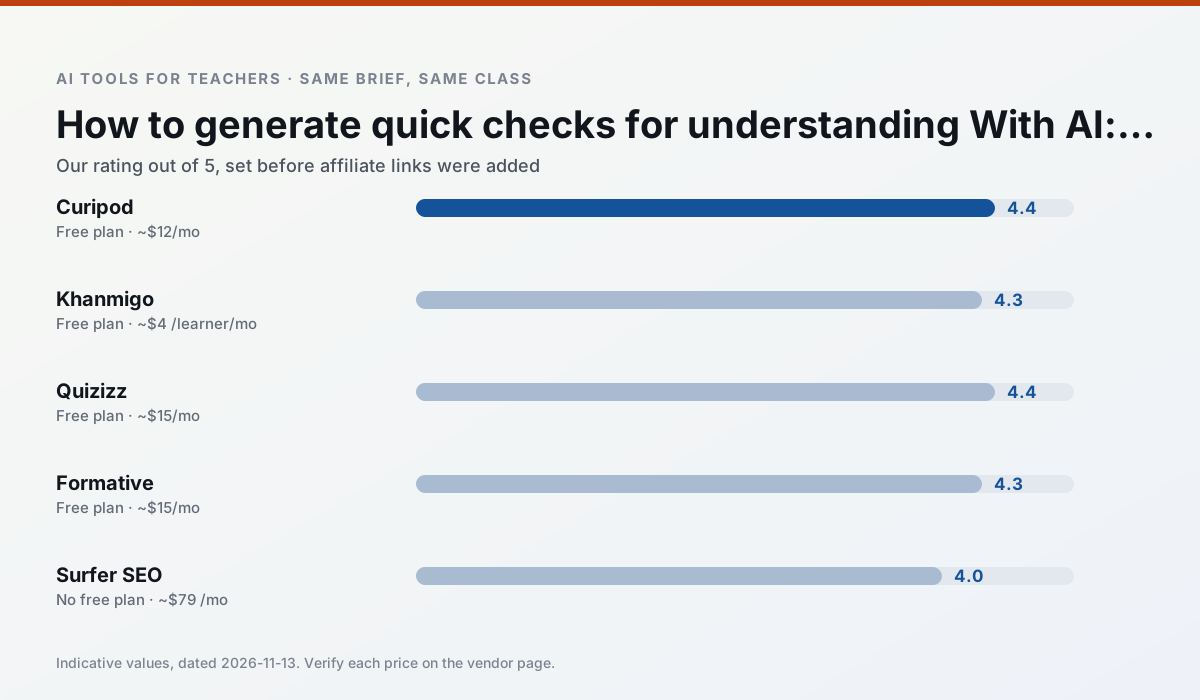
Side by side
Comparison table
Ratings reflect our timed classroom workflow, not vendor claims. Prices are indicative — verify on the vendor site.
| Tool | Best for | Free tier | Indicative paid plan | Standout feature | Our rating | Verdict | Try the tool |
|---|---|---|---|---|---|---|---|
| Curipod | formative assessment · exit tickets | Yes — Limited lessons per month | ~$12 /user/mo | Live polls and word clouds | 4.4 / 5 | Strong option | Try free |
| Khanmigo | math practice · student tutoring | Yes — US teacher accounts, subject to eligibility | ~$4 /learner/mo | Socratic tutoring rather than answers | 4.3 / 5 | Strong option | Try free |
| Quizizz | quiz generation · formative assessment | Yes — Core quiz creation | ~$15 /user/mo | AI question generator | 4.4 / 5 | Strong option | Try free |
| Formative | formative assessment · grading | Yes — Core assessment tools | ~$15 /user/mo | Live student responses | 4.3 / 5 | Strong option | Try free |
| Surfer SEO | teacher bloggers · resource sellers | No ongoing free plan | ~$79 /mo | Content Editor | 4.0 / 5 | Situational | Try free |
| Notion AI | curriculum mapping · unit planning | Yes — Limited AI usage | ~$10 /user/mo | Linked databases | 4.1 / 5 | Situational | Try free |
Match your situation
Best for X
Different jobs need different tools. Here is what we would open first in each case.
Family-facing drafts from Curipod need the fewest rewrites for warmth without overpromising, which is the usual failure mode.
Khanmigo produces levelled versions from one source in a single pass, which is the highest-value differentiation shortcut we tested at this level.
Quizizz is built around teacher-monitored student spaces and audit logs rather than a consumer chat account, which is a different approval conversation.
Formative's free plan is the most usable in this comparison: a quota that survives a normal week. Not enough for a department, enough for one teacher to decide.
Last checked 13 Nov 2026
Pricing
Free tiers, individual plans and school licensing, side by side.
| Tool | Free plan | Individual / paid | School & district | Billing note | Verify |
|---|---|---|---|---|---|
| Curipod | $0 — Limited lessons per month | ~$12 /user/mo | Custom quote | Indicative — verify on vendor site | Vendor |
| Khanmigo | $0 — US teacher accounts, subject to eligibility | ~$4 /learner/mo | Custom quote | Indicative — verify on vendor site | Vendor |
| Quizizz | $0 — Core quiz creation | ~$15 /user/mo | Custom quote | Indicative — verify on vendor site | Vendor |
| Formative | $0 — Core assessment tools | ~$15 /user/mo | Custom quote | Indicative — verify on vendor site | Vendor |
| Surfer SEO | No ongoing free tier | ~$79 /mo | Custom quote | Indicative — verify on vendor site | Vendor |
| Notion AI | $0 — Limited AI usage | ~$10 /user/mo | ~$8 /user/mo | Indicative — verify on vendor site | Vendor |
Editorial rule: pricing is re-checked every 2–3 months and the top 50 pages are refreshed every 6 months. See our funding policy.
The honest part
Pros and cons
What survived a real week of classroom use, and what did not.
Pros
- High student engagement out of the box
- Great for quick checks for understanding
- No student accounts required for basic use
Cons
- Focused on delivery, not planning
- Requires reliable classroom devices
- Free tier is restrictive
Pros
- Education-first design
- Strong nonprofit trust signal
- Good math scaffolding
Cons
- Availability varies by region
- Less useful for admin paperwork
- Requires student accounts for full value
Pros
- Students already know the interface
- Good reporting
- Works on low-end devices
Cons
- Writing high-quality AI questions still needs review
- Gamification can distract
- Advanced analytics are paid
Pros
- Strong data for intervention groups
- Works with existing PDFs and Docs
- Good LMS integrations
Cons
- Steeper setup than quiz games
- Best value requires school-wide rollout
- Price adds up per teacher
Pros
- Best-in-class on-page guidance
- Useful for TpT / resource-shop content
- Clear scoring
Cons
- Expensive for individual teachers
- Not a classroom tool
- Requires SEO basics
In the classroom
Use cases
Five concrete workflows, with the tool we would open for each one.
Regrouping students after an assessment
Summarise anonymised results into skill groups, then generate one activity per group. Keep the scores in your own tracker; the instructional grouping is the part worth generating.
Recommended: CuripodA weekly family newsletter from bullet notes
Newsletters fail on length, not tone. Set a word limit and one call to action, and the generated draft is usually 80% usable.
Recommended: KhanmigoAn IEP present-levels first draft
Use aggregated, anonymised data only. Ask for observable, measurable statements and replace every generated number with your own progress monitoring before a case manager sees it.
Recommended: QuizizzA five-minute exit ticket set
Ask for one recall, one application and one reasoning item, then delete the second recall question every generator sneaks in.
Recommended: FormativeA question bank from a PDF or article
Feed a non-identifiable source and ask for items tagged by difficulty with the misconception behind each distractor. Spot-check every answer key; numerical items are least reliable.
Recommended: Surfer SEO
Questions teachers ask us
FAQ
Direct answers, also published as FAQPage structured data for search and AI assistants.
How long does this workflow take?
Which tool should I start with?
What if the output is unusable?
Sources & further reading
Our recommendation
Try Surfer SEO free for your next formative assessment task
Content optimisation for teacher-creators who publish resources online. Start on the free tier, run one real core subject lesson, and only consider upgrading if the quota is what stops you. Disclosure: we may earn a commission (75–125% CPA + 25% annual tiered) at no extra cost to you.
Some links on this page are affiliate links. We may earn a commission at no extra cost to you. Our rankings are editorial and never pay-to-play. Never enter student PII into a free consumer account.
Keep reading
Related comparisons in this cluster.
Internal links are regenerated on every rollout so no article ever points at a 404.