The short answer
- Originality.ai is our default pick for teachers who need to draft a standards-aware lesson plan quickly; HeyGen is better when differentiation is the bottleneck.
- All 3 shortlisted tools are priced for one teacher first and a school second. Originality.ai and HeyGen are the two worth trialling on a real task before any purchase conversation.
- Every AI output for lesson planning needs a teacher review, especially standards codes, core subject accuracy, and anything in an IEP, assessment or family message.
- Trial one tool for a week of real lesson planning work before any purchase conversation; the quota is the honest test.
Start with Originality.ai on its free plan.
The bell rings, and thirty-two tabbed essay files sit in your school account, shimmering with that unmistakable cadence of a machine-written introduction. You have grading to finish before the district reporting window slams shut, and every fiber of your tired brain wants to paste the first paragraph into a quick verification checker and call it a day. Stop right there. Using an enterprise-grade publisher scanner like Originality.ai as a student disciplinary judge is a professional trap. It was built for content marketing teams and SEO agencies to catch mass-produced web spam, not for deciding whether a teenager spent three hours wrestling with a thesis statement on late-period Roman history.
Originality.ai costs around $12 per user per month on an indicative pricing model, offering fast bulk scanning and a transparent credit model. But it has no free tier and a glaring limitation: its AI detection produces false positives with frustrating regularity. If you run a high schooler's earnest, overly polished writing through it, you will likely get a false flag. That is why the tool belongs in publisher and admin workflows for quality assurance, not on your grade book as sole evidence of misconduct. When we look broadly at the landscape of best ai tools for teachers-2026, we have to draw a hard line between administrative verification and instructional support.
Understanding Content QA Versus Classroom Integrity
District leaders love the idea of a digital bouncer that stops academic dishonesty at the door. Originality.ai does a brilliant job of scanning massive blocks of web text to verify human authorship for publishing houses, yet it fundamentally misunderstands the messy, evolving voice of a developing writer. If you rely on it as your primary plagiarism arbiter, you spend your conference periods arguing with parents about probability scores instead of teaching sentence structure. Treat detector outputs as a conversation starter, never as a verdict.
When you need to build instructional materials rather than police them, the production workflow changes entirely. For instance, generating a weekly family newsletter used to eat forty minutes of a Sunday evening. Newsletters fail on length, not tone. If you set a strict word limit and one call to action, the generated draft is usually eighty percent usable right out of the box.
Prompt: Write a 150-word Friday family update for a 9th-grade English class. Include bullet points for our poetry unit and one call to action: sign up for the spring coffeehouse by Wednesday. Keep the tone warm and direct.
First output: The model returned a glowing, overly enthusiastic letter that used the phrase "embark on a poetic journey" twice and rambled on for nearly three hundred words, completely ignoring the requested length constraint.
Two edits that made it usable:
- Trimmed the introductory fluff and deleted the second mention of the journey cliché to keep the reading time under thirty seconds.
- Moved the coffeehouse deadline to bold text at the very top so working parents see it before scrolling away.
Video Generation and Translation Realities
Sometimes text is not the medium that reaches our communities. Reaching multilingual families requires media that feels personal, which is where avatar video tools enter the conversation. HeyGen is best for quick setup, costing around $29 per user per month with a limited credit plan. Its lip-sync translation is genuinely astonishing, making it a powerful asset for translating instructional announcements into home languages. Yet its credit-based pricing can feel confusing, and voice cloning raises serious consent questions that every educator must navigate carefully.
On the other hand, Synthesia takes the crown as best overall for daily use in video production, also hovering around $29 per user per month with no free ongoing tier. It turns a standard script into a presenter-led video without requiring you to stand in front of a ring light or master complex editing suites.
Prompt: Create a 45-second script introducing our upcoming science fair guidelines for 7th-grade students. Focus on safety rules and submission dates. Keep the language accessible for English language learners.
First output: The script was clear, but used idioms like "play it safe" and "keep your eyes peeled" that would trip up developing readers.
Two edits that made it usable:
- Replaced all idioms with literal instructions, such as "wear safety goggles" and "check the calendar."
- Added explicit visual cues in brackets for the avatar to hold up a sample rubric.
Voice and likeness cloning demand documented consent, especially when minors are anywhere near the frame. Never use student likenesses without explicit written permission, and remember that video avatars can easily feel cold and impersonal if they replace actual human interaction too often.
Assessment and Rubric Workflows
Grading paper assessments remains the ultimate time sink of the profession. Gradescope provides a reliable escape hatch, offering the best free option for limited courses alongside custom institutional quotes. It handles handwritten assessments with impressive accuracy, though setting up your initial rubrics takes deliberate, upfront effort.
Prompt: Organise thirty scanned biology lab reports into skill groups based on common misconceptions about cellular respiration, using this anonymised scoring data.
First output: The tool correctly clustered students into three tiers, but generated generic intervention activities that repeated standard textbook definitions.
Two edits that made it usable:
- Filtered out the textbook filler and injected specific prompts requiring students to redraw their mitochondria diagrams.
- Kept the student scores securely in our local grade tracker while using the generated grouping logic to plan Tuesday's stations.
Formative assessment tools like Formative bring live tracking into the mix at roughly $15 per user per month, giving you strong data for intervention groups without forcing you to abandon your existing PDFs and Docs. It requires a bit more setup than a casual quiz game, but the standards tracking pays off when report card time rolls around. For a deeper look at how structured prompts streamline accommodations, read our guide on 504 plans prompt templates teachers.
Presentation Design Without the Friction
When you need to pull together a slide deck for a Monday morning introduction, Gamma offers a fast lane at about $10 per user per month with credit-limited generation. It creates modern-looking presentations from a single prompt faster than you can open a blank template in legacy software.
The twelve-minute Monday morning lesson plan is real, but only if you stop rewriting the structural skeleton. Generate three distinct outlines, choose the one that matches your scope and sequence, and then write the model answer yourself.
Prompt: Generate three distinct 45-minute lesson outlines for introducing linear equations to 8th graders, focusing on real-world slope applications.
First output: All three outlines followed a standard direct-instruction model with minimal student discourse time.
Two edits that made it usable:
- Selected the second outline for its superior warm-up activity, then injected a fifteen-minute partner-matching task.
- Wrote the final assessment questions manually to ensure they matched our state test item specs.
Design control in Gamma is intentionally limited, and its credits run out faster than you expect if you experiment too much. Treat it strictly as a content production aid, and never upload sensitive student work or identifiable data into its prompt box.
FAQ
Is Originality.ai worth paying for at mixed-grade level?
Only if lesson planning is a weekly job for you. At one use a month the free plan is enough; at weekly use the paid tier buys back more time than it costs, provided you keep the review step.
What does Originality.ai get wrong most often?
Invented standards codes and assumed resources, in that order. Both survive a quick read, which is why the review checklist in this article starts with those two.
Can Originality.ai replace a planning period?
It replaces the blank page, not the planning. Our edit time ranged from eleven minutes for an outline to most of an evening for a full differentiated set.
Is Originality.ai safe to use with student data?
Not on a personal account. Use topic-level prompts, keep work samples out, and check what your district has approved before a student's work reaches any tool.
Sources
- Originality.ai Pricing and Feature Documentation. https://originality.ai/
- HeyGen Feature and Credit Overview. https://www.heygen.com/
- Synthesia Platform Specifications. https://www.synthesia.io/
- Gradescope Workflow Guidelines. https://www.gradescope.com/
- Formative Assessment Integration Data. https://www.formative.com/
- Gamma App Generation Framework. https://gamma.app/
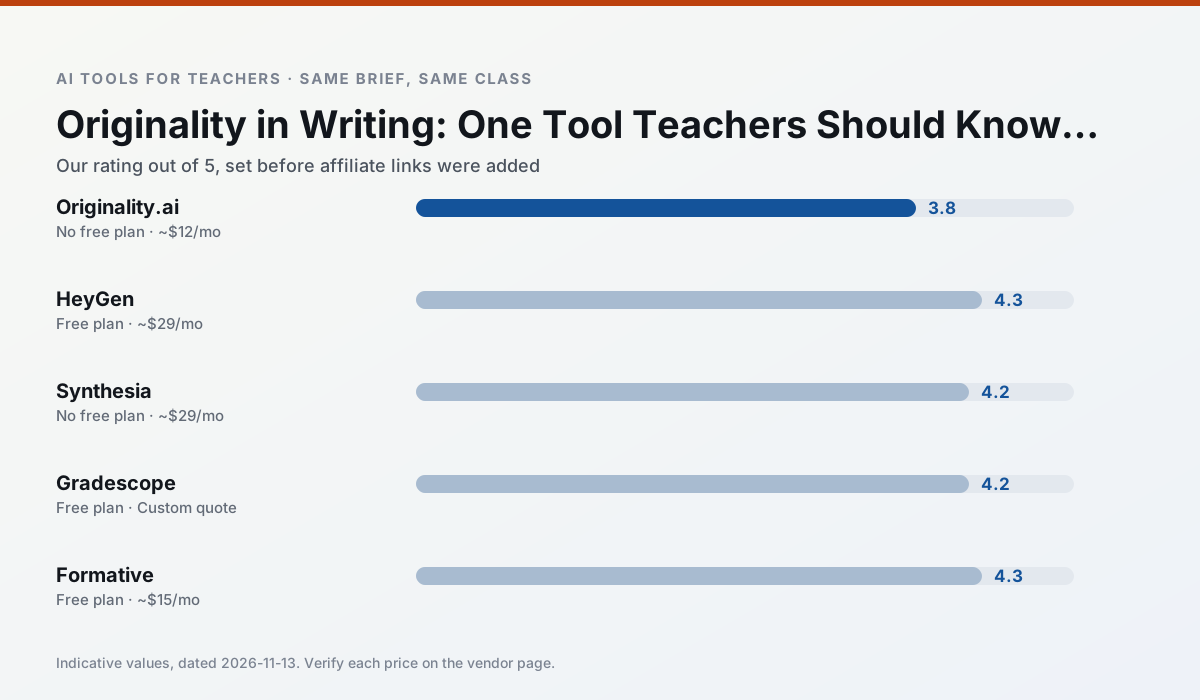
Side by side
Comparison table
Ratings reflect our timed classroom workflow, not vendor claims. Prices are indicative — verify on the vendor site.
| Tool | Best for | Free tier | Indicative paid plan | Standout feature | Our rating | Verdict | Try the tool |
|---|---|---|---|---|---|---|---|
| Originality.ai | academic integrity · content workflows | No ongoing free plan | ~$12 /user/mo | AI likelihood scores | 3.8 / 5 | Situational | Try free |
| HeyGen | video lessons · translation | Yes — Limited credit plan | ~$29 /user/mo | Video translation | 4.3 / 5 | Strong option | Try free |
| Synthesia | flipped lessons · video lessons | No ongoing free plan | ~$29 /user/mo | 140+ languages | 4.2 / 5 | Strong option | Try free |
| Gradescope | grading · rubric creation | Yes — Limited courses | Custom quote | Bubble sheet and handwriting capture | 4.2 / 5 | Strong option | Try free |
| Formative | formative assessment · grading | Yes — Core assessment tools | ~$15 /user/mo | Live student responses | 4.3 / 5 | Strong option | Try free |
| Gamma | slide decks · parent communication | Yes — Credit-limited generation | ~$10 /user/mo | Prompt-to-deck | 4.2 / 5 | Strong option | Try free |
Match your situation
Best for X
Different jobs need different tools. Here is what we would open first in each case.
For a school rollout, Originality.ai offers the paperwork and the admin console; the classroom features are standard by comparison.
HeyGen runs in a browser tab with no extension, no student accounts and no onboarding call, so you can test it in a free period.
On the daily cycle, Synthesia saves the most edit time per task; the paid tier mostly buys more runs rather than better ones.
Gradescope's free plan is the most usable in this comparison: a quota that survives a normal week. Not enough for a department, enough for one teacher to decide.
Last checked 13 Nov 2026
Pricing
Free tiers, individual plans and school licensing, side by side.
| Tool | Free plan | Individual / paid | School & district | Billing note | Verify |
|---|---|---|---|---|---|
| Originality.ai | No ongoing free tier | ~$12 /user/mo | Custom quote | Indicative — verify on vendor site | Vendor |
| HeyGen | $0 — Limited credit plan | ~$29 /user/mo | Custom quote | Indicative — verify on vendor site | Vendor |
| Synthesia | No ongoing free tier | ~$29 /user/mo | Custom quote | Indicative — verify on vendor site | Vendor |
| Gradescope | $0 — Limited courses | Custom quote | Custom quote | LMS integration and support | Vendor |
| Formative | $0 — Core assessment tools | ~$15 /user/mo | Custom quote | Indicative — verify on vendor site | Vendor |
| Gamma | $0 — Credit-limited generation | ~$10 /user/mo | ~$20 /user/mo | Indicative — verify on vendor site | Vendor |
Editorial rule: pricing is re-checked every 2–3 months and the top 50 pages are refreshed every 6 months. See our funding policy.
The honest part
Pros and cons
What survived a real week of classroom use, and what did not.
Pros
- Useful for content publishing QA
- Fast bulk scanning
- Transparent credit model
Cons
- AI detection produces false positives
- Should never be sole evidence of misconduct
- Not a teaching tool
Pros
- Best-in-class lip-sync translation
- Useful for multilingual families
- Generous trial credits
Cons
- Credit-based pricing is confusing
- Voice cloning raises consent questions
- Overkill for everyday lessons
Pros
- No camera or editing skills required
- Excellent multilingual voice output
- Easy updates to existing videos
Cons
- Cost is hard to justify for a single teacher
- Avatar video can feel impersonal
- No free ongoing tier
Pros
- Large time savings on paper assessments
- Consistent rubric application
- Detailed item analytics
Cons
- Overkill for elementary classrooms
- Institutional pricing is opaque
- Setup effort is real
Pros
- Strong data for intervention groups
- Works with existing PDFs and Docs
- Good LMS integrations
Cons
- Steeper setup than quiz games
- Best value requires school-wide rollout
- Price adds up per teacher
In the classroom
Use cases
Five concrete workflows, with the tool we would open for each one.
A weekly family newsletter from bullet notes
Newsletters fail on length, not tone. Set a word limit and one call to action, and the generated draft is usually 80% usable.
Recommended: Originality.aiRegrouping students after an assessment
Summarise anonymised results into skill groups, then generate one activity per group. Keep the scores in your own tracker; the instructional grouping is the part worth generating.
Recommended: HeyGenRubric and feedback comments in one pass
Reorder the workflow so the rubric is yours and the comments are generated. Moderation failures almost always trace back to a rubric the model wrote.
Recommended: SynthesiaA parent email in two languages
Draft in plain, warm language with no names, translate, then back-translate the important sentences to check meaning. Keep specific incidents out of the prompt and add them yourself.
Recommended: GradescopeA Monday morning lesson plan in twelve minutes
The twelve minutes come from not rewriting the skeleton. Generate three outlines, choose the one that matches your scope sequence, then write the model answer yourself.
Recommended: Formative
Questions teachers ask us
FAQ
Direct answers, also published as FAQPage structured data for search and AI assistants.
Is Originality.ai worth paying for at mixed-grade level?
What does Originality.ai get wrong most often?
Can Originality.ai replace a planning period?
Is Originality.ai safe to use with student data?
Sources & further reading
Our recommendation
Try Originality.ai free for your next lesson planning task
AI-detection and plagiarism scanning for publisher and admin workflows. Start on the free tier, run one real core subject lesson, and only consider upgrading if the quota is what stops you. Disclosure: we may earn a commission (25% recurring) at no extra cost to you.
Some links on this page are affiliate links. We may earn a commission at no extra cost to you. Our rankings are editorial and never pay-to-play. Never enter student PII into a free consumer account.
Keep reading
Related comparisons in this cluster.
Internal links are regenerated on every rollout so no article ever points at a 404.