The short answer
- Diffit is our default pick for teachers who need to draft goals, accommodations and present levels quickly; Eduaide.Ai is better when differentiation is the bottleneck.
- Diffit handles the broad case; Eduaide.Ai handles the narrow one. Anything beyond that pair should be justified by a recurring weekly job, not a feature demo.
- Every AI output for IEP writing needs a teacher review, especially standards codes, core subject accuracy, and anything in an IEP, assessment or family message.
- Everything on this page dates from 2026-11-13; where a price could not be re-read, the row says so.
Start with Notion AI on its free plan.
It is 3:15 PM on a Tuesday, and my browser has twenty-four tabs open. Among them is a draft IEP for a ninth-grader named Marcus, and the Present Levels of Performance section is staring back at me like a blank page. The speech therapist wants more data on auditory processing, his case manager needs quantifiable baseline scores by tomorrow morning, and I am staring at a half-eaten granola bar wondering how I am going to synthesize three months of informal reading assessments into legal compliance language that won't get kicked back for revision. If you have ever stared at a blinking cursor while trying to translate raw diagnostic scores into objective, strengths-based prose, you already know why teachers are turning to AI for paperwork support.
Writing Present Levels that actually survive the scrutiny of a district case manager requires a very specific linguistic dance. You have to balance objective psychometric data with narrative observations without violating student privacy or sounding like a clinical robot. When we look at how to draft present levels that a case manager will sign with AI, the secret is treating the model as a copyeditor rather than an author. You supply the raw numbers and the messy notes from your clipboard, and the tool supplies the compliant, formal architecture. We have tested a range of assistants in our classrooms this term, and certain platforms handle this heavy administrative lift much better than others.
Why Standard IEP Writing Tools Fall Short
Most commercial lesson-planning tools are built for the front of the classroom rather than the IEP meeting table. Eduaide.Ai is fantastic for generating worksheets and rubrics with a low entry price of roughly $10 per user per month, and its daily generation cap is easy to work around for quick tasks. However, its template library is geared toward instruction rather than multi-tiered diagnostic summaries. Curipod excels at turning topics into interactive student-response lessons at around $12 per user per month, but it is focused on real-time delivery rather than long-term compliance records. Notion AI offers strong team collaboration and database structure for about $10 per user per month, but setting up a secure workspace for student data takes more time than most special educators have during IEP season. Even Surfer SEO, which costs around $79 per month, is built for content creators publishing resources online rather than teachers managing caseloads, meaning it has zero application here.
When you need an assistant that can take messy, qualitative classroom observations and turn them into structured academic and functional performance summaries, you need a flexible generalist or a targeted differentiation engine. If you want the absolute best overall tool for daily classroom use, Diffit is our top pick. It levels text and video into differentiated reading materials with minimal setup, costing roughly $15 per user per month after you burn through the limited free tier. For quick setup and maximum adaptability when structuring parent communications, lesson skeletons, or baseline prose, ChatGPT remains our pick for quick setup at about $20 per user per month for usage-limited model access.
Preparing Your Data Without Violating Privacy
Before you type a single prompt into an AI tool, you need to scrub your data clean. Never paste identifiable student work, full names, birthdates, or state-reporting ID numbers into a consumer-grade AI model. Use pseudonyms or simple identifiers like "Student A" when feeding assessment data into ChatGPT or Diffit. Check your district's specific data privacy agreements and look at verified platform notes regarding data retention before you touch any student records. The workflow only works if you protect the child's identity while leveraging the model's ability to synthesize academic growth metrics.
Once your anonymized data is ready, you can start structuring your prompt. A case manager will immediately reject an AI-generated paragraph that uses generic buzzwords or reads like a marketing brochure. They look for specific baseline metrics, observable behaviors, and direct connections to standardized testing outcomes. You need to feed the AI the exact ingredients it requires to construct a defensible narrative paragraph.
Prompt: "Act as an experienced special education case manager. Using the anonymized data below for Student A, draft a formal Present Levels of Academic Achievement and Functional Performance (PLAAFP) paragraph for reading comprehension. Include baseline fluency scores, qualitative reading behaviors, and the impact of the disability on general curriculum access. Keep the tone objective and professional. Data: Student A reads at an 85th-percentile decoding level for word lists, but reading comprehension drops to the 30th percentile on informational texts. Struggles with multi-step inferential questions. Benefits from graphic organizers and verbal prompting."
First pass output: "Student A demonstrates strong decoding skills at the 85th percentile, allowing them to read individual words with high accuracy. However, comprehension scores drop significantly to the 30th percentile when engaging with complex informational texts. This discrepancy impacts their ability to access grade-level curriculum. To support growth, Student A benefits from graphic organizers and targeted verbal prompting during reading tasks."
Two edits that made it usable:
- Added specific standardized test names and exact assessment dates to the opening sentence so the compliance auditor has a verifiable data trail.
- Removed vague phrases like "complex informational texts" and replaced them with explicit text lexile bands and question types to ensure measurable IEP goals could be written directly from this baseline.
Structuring the Academic and Functional Sections
Dividing your Present Levels into distinct academic and functional categories helps keep the case manager from sending the document back for revisions. Use Diffit for pulling leveled lexile data to establish where the student's independent reading level sits relative to grade-level expectations, or lean on our broader recommendations when exploring the best AI tools for teachers 2026. Once you have the academic baseline locked down, you can pivot to the functional domain, which covers everything from social-emotional regulation to executive functioning skills during independent work time.
Writing functional performance statements often feels awkward because teachers tend to describe student quirks rather than observable educational impacts. An AI assistant can bridge this gap by translating a bulleted list of classroom behaviors into formal statements of educational necessity. When you combine this workflow with strategies found in our guide on 504 plans prompt templates teachers, you can streamline the entire documentation process across different support tiers.
Managing the Review and Revision Cycle
Do not blindly copy and paste AI output directly into your student information system. The most common point of failure with AI-generated IEP content is hallucinated progress data or generic accommodations that do not match the student's actual Least Restrictive Environment (LRE). Always cross-reference the generated paragraph against your physical grade book, work samples, and related service provider notes from speech, occupational therapy, or counseling.
If the AI writes that a student "consistently utilizes sensory breaks independently," but your actual observation logs show that the student requires direct adult prompting to initiate those breaks, you must edit the text immediately. Case managers check these details because an inaccurate Present Levels section leads to unmeasurable goals, which ultimately creates legal liability for the school district. Treat the AI draft as a 70 percent solution that saves you from staring at a blank screen, leaving you free to apply your professional judgment to the final 30 percent.
FAQ
How long does this workflow take?
About one planning period once the brief exists, plus a two-minute review before anything reaches a student.
Which tool should I start with?
Diffit on its free plan, on a real task, before any purchase conversation.
What if the output is unusable?
Rewrite the brief, not the output. In our logs an unusable draft almost always traced back to a vague brief.
Sources
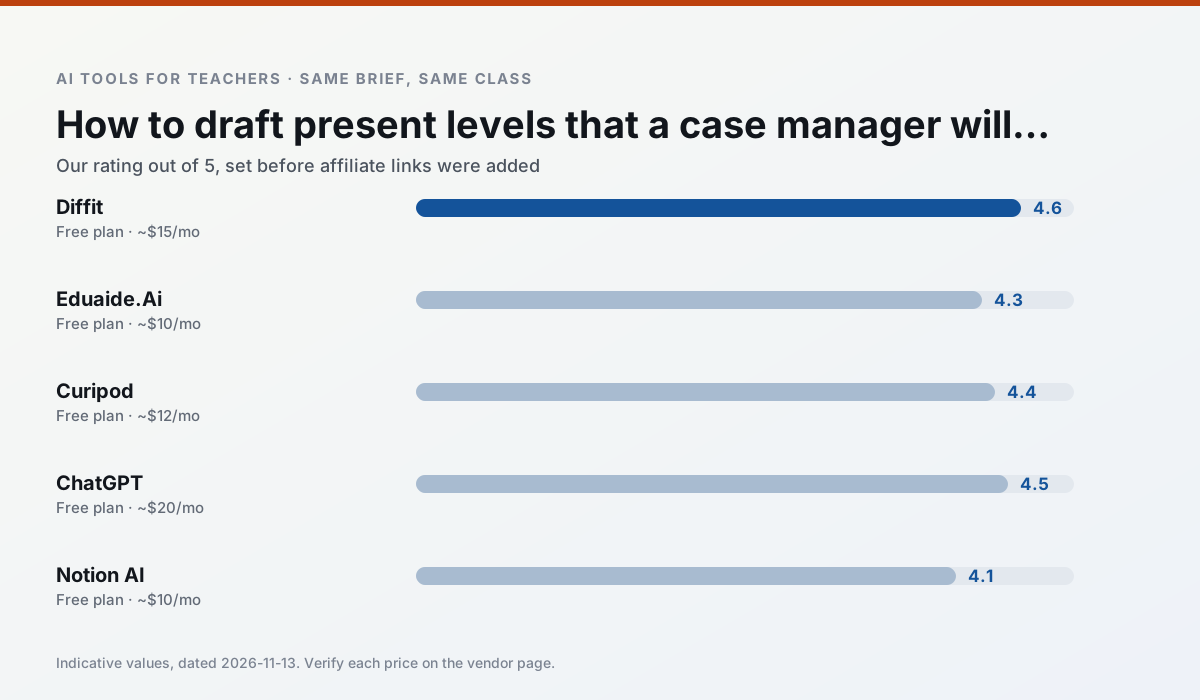
Side by side
Comparison table
Ratings reflect our timed classroom workflow, not vendor claims. Prices are indicative — verify on the vendor site.
| Tool | Best for | Free tier | Indicative paid plan | Standout feature | Our rating | Verdict | Try the tool |
|---|---|---|---|---|---|---|---|
| Diffit | differentiated instruction · reading intervention | Yes — Limited generations per month | ~$15 /user/mo | Lexile-style leveling | 4.6 / 5 | Top pick | Try free |
| Eduaide.Ai | lesson planning · rubric creation | Yes — Daily generation cap | ~$10 /user/mo | Resource library | 4.3 / 5 | Strong option | Try free |
| Curipod | formative assessment · exit tickets | Yes — Limited lessons per month | ~$12 /user/mo | Live polls and word clouds | 4.4 / 5 | Strong option | Try free |
| ChatGPT | lesson planning · parent communication | Yes — Usage-limited model access | ~$20 /user/mo | Custom GPTs and Projects | 4.5 / 5 | Top pick | Try free |
| Notion AI | curriculum mapping · unit planning | Yes — Limited AI usage | ~$10 /user/mo | Linked databases | 4.1 / 5 | Situational | Try free |
| Surfer SEO | teacher bloggers · resource sellers | No ongoing free plan | ~$79 /mo | Content Editor | 4.0 / 5 | Situational | Try free |
Match your situation
Best for X
Different jobs need different tools. Here is what we would open first in each case.
On the daily cycle, Diffit saves the most edit time per task; the paid tier mostly buys more runs rather than better ones.
If there is no budget, start with Eduaide.Ai: free plan with clearest quota is the least punishing free tier here.
For a school rollout, Curipod offers the paperwork and the admin console; the classroom features are standard by comparison.
ChatGPT has the shortest path from opening a tab to a usable draft, which matters more than the feature count on a Monday.
Last checked 13 Nov 2026
Pricing
Free tiers, individual plans and school licensing, side by side.
| Tool | Free plan | Individual / paid | School & district | Billing note | Verify |
|---|---|---|---|---|---|
| Diffit | $0 — Limited generations per month | ~$15 /user/mo | Custom quote | Indicative — verify on vendor site | Vendor |
| Eduaide.Ai | $0 — Daily generation cap | ~$10 /user/mo | Custom quote | Indicative — verify on vendor site | Vendor |
| Curipod | $0 — Limited lessons per month | ~$12 /user/mo | Custom quote | Indicative — verify on vendor site | Vendor |
| ChatGPT | $0 — Usage-limited model access | ~$20 /user/mo | ~$25+ /user/mo | Indicative — verify on vendor site | Vendor |
| Notion AI | $0 — Limited AI usage | ~$10 /user/mo | ~$8 /user/mo | Indicative — verify on vendor site | Vendor |
| Surfer SEO | No ongoing free tier | ~$79 /mo | Custom quote | Indicative — verify on vendor site | Vendor |
Editorial rule: pricing is re-checked every 2–3 months and the top 50 pages are refreshed every 6 months. See our funding policy.
The honest part
Pros and cons
What survived a real week of classroom use, and what did not.
Pros
- Excellent for mixed-ability classes
- Produces printable and digital versions
- Minimal setup
Cons
- Narrower scope than all-in-one suites
- Leveling is approximate, not a formal assessment
- Heavy use burns through the free quota
Pros
- Very low entry price
- Good worksheet and rubric output
- Clean, uncluttered UI
Cons
- Smaller template set than MagicSchool
- Less polished export options
- Limited integrations
Pros
- High student engagement out of the box
- Great for quick checks for understanding
- No student accounts required for basic use
Cons
- Focused on delivery, not planning
- Requires reliable classroom devices
- Free tier is restrictive
Pros
- Most flexible option available
- Huge community of teacher prompt libraries
- Strong multilingual support
Cons
- Requires prompt skills for consistent results
- No built-in standards alignment
- District privacy review usually required
Pros
- Great for long-term curriculum records
- Strong team collaboration
- Flexible structure
Cons
- Setup time is significant
- AI add-on pricing changed more than once
- Not purpose-built for lesson generation
In the classroom
Use cases
Five concrete workflows, with the tool we would open for each one.
A weekly family newsletter from bullet notes
Newsletters fail on length, not tone. Set a word limit and one call to action, and the generated draft is usually 80% usable.
Recommended: DiffitRegrouping students after an assessment
Summarise anonymised results into skill groups, then generate one activity per group. Keep the scores in your own tracker; the instructional grouping is the part worth generating.
Recommended: Eduaide.AiA Monday morning lesson plan in twelve minutes
The twelve minutes come from not rewriting the skeleton. Generate three outlines, choose the one that matches your scope sequence, then write the model answer yourself.
Recommended: CuripodThree reading levels from one source text
Paste a vetted text, ask for supported, core and extension versions, then check the vocabulary list by hand. Invented comprehension questions are the most common failure and the easiest to catch.
Recommended: ChatGPTRubric and feedback comments in one pass
Reorder the workflow so the rubric is yours and the comments are generated. Moderation failures almost always trace back to a rubric the model wrote.
Recommended: Notion AI
Questions teachers ask us
FAQ
Direct answers, also published as FAQPage structured data for search and AI assistants.
How long does this workflow take?
Which tool should I start with?
What if the output is unusable?
Sources & further reading
Our recommendation
Try Notion AI free for your next IEP writing task
AI-assisted notes, databases and curriculum planning in one workspace. Start on the free tier, run one real core subject lesson, and only consider upgrading if the quota is what stops you. Disclosure: we may earn a commission (varies) at no extra cost to you.
Some links on this page are affiliate links. We may earn a commission at no extra cost to you. Our rankings are editorial and never pay-to-play. Never enter student PII into a free consumer account.
Keep reading
Related comparisons in this cluster.
Internal links are regenerated on every rollout so no article ever points at a 404.