The short answer
- Jasper is our default pick for teachers who need to draft a standards-aware lesson plan quickly; OpusClip is better when differentiation is the bottleneck.
- Free-tier reality for this shortlist: Jasper: No ongoing free plan; OpusClip: Yes — Limited monthly clips; Writesonic: Yes — Limited credits. Treat every paid figure as indicative until you have read the vendor page; only the free quota is something you can test yourself this week.
- Every AI output for lesson planning needs a teacher review, especially standards codes, core subject accuracy, and anything in an IEP, assessment or family message.
- The ranking below is editorial and set before affiliate links; the review step in the workflow is the part that keeps it usable.
Start with Jasper on its free plan.
Third period on a Tuesday in November always smells like damp coats and existential dread. I was staring at a stack of seventy reading assessments, knowing I had to level them, write three tiers of follow-up work, and somehow get home before dark. That is usually when teachers start hunting for shortcuts. We look for tools that promise to handle the heavy lifting of differentiation, lesson design, and parent communication without demanding hours of setup.
When you start digging into education technology, you quickly hit a wall of paywalls, confusing credit limits, and tools built for corporate marketing departments rather than a Tuesday afternoon in a public school. If you are trying to figure out what tools are worth your personal stipend or department budget, you need to look past the sales pitches. We tested the platforms that teachers actually talk about in the faculty room to see where they break down under real classroom pressure. If you want a broader view of how these fit into your workflow, take a look at the comprehensive breakdown of the best AI tools for teachers 2026.
Jasper for Student-Safe Deployments
Jasper is designed as a brand-voice writing assistant, which usually means marketing teams use it to write corporate blogs. In a school setting, however, it shines when used by district communications teams or principals who need to maintain a consistent tone across all school-to-home messaging. It is ranked as the best option for student-safe deployments because it operates with robust administrative controls, though it has no free tier and costs roughly $39 per user per month.
The main strength of Jasper is its long-form editor and its ability to lock in a specific tone of voice. If your building administration needs to push out weekly community updates that sound cohesive and professional, it does that job well. The limitation is obvious for classroom teachers. It is far too expensive for an individual educator, and it lacks education-specific features like quiz generation or reading-level adjustment. Furthermore, it is not intended for student data, so keep any generative work strictly on the adult side of the desk.
OpusClip for Parent-Facing Writing and Video Repurposing
OpusClip takes long recordings and chops them into short, captioned clips. While it is technically a video tool, teachers often look at it for recording mini-lessons or asynchronous review material. It offers a limited free tier of monthly clips, with paid plans sitting around $15 per user per month.
Prompt: "Turn this 20-minute lecture recording on cell division into three 60-second review clips with on-screen captions highlighting key vocabulary."
First output: OpusClip generated three snappy vertical clips complete with dynamic pop-up captions, but it cut off mid-sentence on a technical definition and added generic background music.
Teacher edits:
- Switched off the background music track that sounded like a tech startup commercial.
- Trimmed the start and end points manually to ensure the vocabulary term 'mitosis' was fully contextualised before the clip ended.
The primary strength here is the speed of the captioning engine. If you record a flipped classroom video, it builds readable text in seconds. The downside is that it is optimised for social media formats, not deep lesson design, and the free plan runs out almost immediately. Never upload classroom footage containing identifiable students unless you have ironclad media release forms on file.
Writesonic for Mixed-Ability Classes
Writesonic positions itself as a budget-friendly writing and content generation engine. With a reasonable free trial of limited credits and paid tiers around $16 per user per month, it attracts teachers trying to spin up reading passages at different Lexile levels for mixed-ability classes. It is our top pick for mixed-ability content generation because its template library covers a wide variety of formats quickly.
The catch is that the output often reads like generic internet filler. If you ask it to generate reading comprehension questions, you will spend half your prep period editing out vague stems and distractors that make no pedagogical sense. The credit system is also notoriously confusing, making it easy to burn through your free allocation before you finish modifying a single unit plan. Like many general-purpose generators, it lacks true education context and is not intended for processing student data. If you are looking for specific ways to adapt texts for diverse learners, check out this guide on AI differentiation reading level.
Turnitin Clarity and Feedback Studio for Quick Setup
Turnitin is already a fixture in many high schools and middle schools for plagiarism detection, but its newer Clarity and Feedback Studio features bring AI-assisted writing feedback into the institutional workflow. There is no free individual tier, and pricing requires a custom institutional quote. It ranks as the best tool for quick setup because many campuses already maintain a district-wide license.
The strength of Turnitin lies in its consistency and deep revision history tracking. Teachers can see exactly how a student built an essay over time, which cuts down on the guesswork surrounding sudden leaps in writing quality. The limitations are well-documented. Individual teachers cannot buy it on a whim, AI detection accuracy remains a contested battleground, and the administrative setup requires buy-in from your tech department. Always verify your local configuration to ensure compliance with institutional FERPA agreements.
Grammarly for Parent Emails and Reports
Grammarly sits quietly in the background of your browser, catching errors in parent emails, weekly newsletters, and administrative reports. The free tier handles core grammar and tone checks, while the paid tier runs about $12 per user per month.
The best part of Grammarly is its low learning curve. It works wherever you already type, whether that is in your district email client or a shared Google Doc. It catches the stray typos that slip through when you are typing an email to a parent at 9:00 PM. The limitation is that it can flatten your natural teacher voice into something that sounds overly corporate if you rely too heavily on its full-sentence rewrites. Make sure to disable text collection on school devices and check your district data privacy agreement before installing browser extensions.
Synthesia for Avatar-Led Videos
Synthesia turns text scripts into presenter-led videos using AI avatars. There is no free ongoing tier, and paid plans start around $29 per user per month. It is designed for creating instructional videos without requiring you to stand in front of a camera.
The strength of Synthesia is its multilingual voice output and the ability to update a video script without re-recording the entire lesson. If you need to translate a welcome message for newcomer families into three different languages, it does so cleanly. However, the cost is extremely difficult to justify for a single classroom teacher working on a personal budget. Avatar-led video can also feel strangely impersonal to students who are used to hearing your actual voice. Never use student likenesses or voices to generate synthetic media without explicit parental consent.
FAQ
Is AI allowed for lesson planning in my school?
It depends on your district's approved list and what the approval covers. Ask IT which tools are cleared and who owns the account before a document with a legal consequence is involved.
Who is responsible if something goes wrong?
The school, and in practice the named teacher who reviewed the output. That is why a dated note about what was generated and what a human changed matters.
What should never go into a prompt?
Names, rosters, scans of student work and gradebook screenshots. Topic-level prompts do most of the work without any of that.
Sources
- Jasper pricing and feature overview: jasper.ai
- OpusClip workflow and plan details: opus.pro
- Writesonic credit system and tiers: writesonic.com
- Turnitin Feedback Studio institutional guidelines: turnitin.com
- Grammarly privacy and school deployment notes: grammarly.com
- Synthesia avatar generation standards: synthesia.io
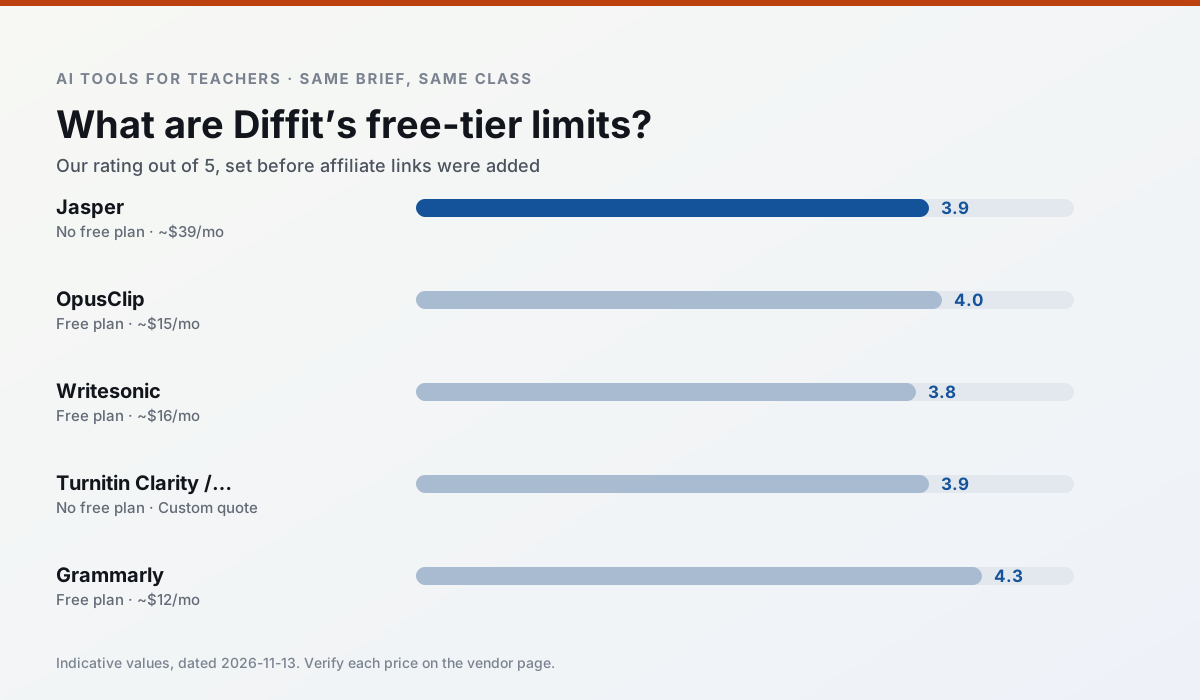
Side by side
Comparison table
Ratings reflect our timed classroom workflow, not vendor claims. Prices are indicative — verify on the vendor site.
| Tool | Best for | Free tier | Indicative paid plan | Standout feature | Our rating | Verdict | Try the tool |
|---|---|---|---|---|---|---|---|
| Jasper | newsletters · parent communication | No ongoing free plan | ~$39 /user/mo | Brand voice profiles | 3.9 / 5 | Situational | Try free |
| OpusClip | PD materials · flipped lessons | Yes — Limited monthly clips | ~$15 /user/mo | Auto captions | 4.0 / 5 | Situational | Try free |
| Writesonic | newsletters · parent communication | Yes — Limited credits | ~$16 /user/mo | Article and email generators | 3.8 / 5 | Situational | Try free |
| Turnitin Clarity / Feedback Studio | feedback on writing · academic integrity | No ongoing free plan | Custom quote | Similarity reports | 3.9 / 5 | Situational | Try free |
| Grammarly | parent communication · report card comments | Yes — Core grammar and tone checks | ~$12 /user/mo | Tone adjustments | 4.3 / 5 | Strong option | Try free |
| Synthesia | flipped lessons · video lessons | No ongoing free plan | ~$29 /user/mo | 140+ languages | 4.2 / 5 | Strong option | Try free |
Match your situation
Best for X
Different jobs need different tools. Here is what we would open first in each case.
Jasper is built around teacher-monitored student spaces and audit logs rather than a consumer chat account, which is a different approval conversation.
OpusClip has the strongest tone control for family emails and report comments, provided you still read the message aloud before sending.
Writesonic keeps the same task across levels, which is what makes a differentiated set defensible in moderation.
Turnitin Clarity / Feedback Studio runs in a browser tab with no extension, no student accounts and no onboarding call, so you can test it in a free period.
Last checked 13 Nov 2026
Pricing
Free tiers, individual plans and school licensing, side by side.
| Tool | Free plan | Individual / paid | School & district | Billing note | Verify |
|---|---|---|---|---|---|
| Jasper | No ongoing free tier | ~$39 /user/mo | ~$59+ /user/mo | Indicative — verify on vendor site | Vendor |
| OpusClip | $0 — Limited monthly clips | ~$15 /user/mo | ~$29 /user/mo | Indicative — verify on vendor site | Vendor |
| Writesonic | $0 — Limited credits | ~$16 /user/mo | ~$49 /user/mo | Indicative — verify on vendor site | Vendor |
| Turnitin Clarity / Feedback Studio | No ongoing free tier | Custom quote | Custom quote | LMS-wide deployment | Vendor |
| Grammarly | $0 — Core grammar and tone checks | ~$12 /user/mo | ~$15 /user/mo | Indicative — billed annually | Vendor |
| Synthesia | No ongoing free tier | ~$29 /user/mo | Custom quote | Indicative — verify on vendor site | Vendor |
Editorial rule: pricing is re-checked every 2–3 months and the top 50 pages are refreshed every 6 months. See our funding policy.
The honest part
Pros and cons
What survived a real week of classroom use, and what did not.
Pros
- Consistent tone across communications
- Strong long-form editor
- Good for district comms teams
Cons
- Priced for marketing teams
- Overkill for one classroom
- No education-specific features
Pros
- Turns a recorded lesson into review clips
- Excellent captions
- Fast
Cons
- Optimised for social formats
- Not a lesson design tool
- Free plan is restrictive
Pros
- Cheaper than enterprise writing suites
- Many templates
- Reasonable free trial
Cons
- Generic classroom output
- Credit system is confusing
- Limited education context
Pros
- Already licensed at many schools
- Consistent institutional workflow
- Detailed revision history
Cons
- Individual teachers cannot buy it
- AI detection remains contested
- Heavy administrative setup
Pros
- Catches errors in high-stakes parent emails
- Works everywhere you already write
- Very low learning curve
Cons
- Not education-specific
- Can flatten teacher voice
- Premium needed for tone rewriting
In the classroom
Use cases
Five concrete workflows, with the tool we would open for each one.
Regrouping students after an assessment
Summarise anonymised results into skill groups, then generate one activity per group. Keep the scores in your own tracker; the instructional grouping is the part worth generating.
Recommended: JasperA weekly family newsletter from bullet notes
Newsletters fail on length, not tone. Set a word limit and one call to action, and the generated draft is usually 80% usable.
Recommended: OpusClipA question bank from a PDF or article
Feed a non-identifiable source and ask for items tagged by difficulty with the misconception behind each distractor. Spot-check every answer key; numerical items are least reliable.
Recommended: WritesonicA substitute folder that needs no context
The value here is structure, not creativity. Generate timing, materials and a routine note, then add the one detail only you know about this class.
Recommended: Turnitin Clarity / Feedback StudioAn IEP present-levels first draft
Use aggregated, anonymised data only. Ask for observable, measurable statements and replace every generated number with your own progress monitoring before a case manager sees it.
Recommended: Grammarly
Questions teachers ask us
FAQ
Direct answers, also published as FAQPage structured data for search and AI assistants.
Is AI allowed for lesson planning in my school?
Who is responsible if something goes wrong?
What should never go into a prompt?
Sources & further reading
Our recommendation
Try Jasper free for your next lesson planning task
Brand-voice writing assistant for school communications teams. Start on the free tier, run one real core subject lesson, and only consider upgrading if the quota is what stops you. Disclosure: we may earn a commission (varies) at no extra cost to you.
Some links on this page are affiliate links. We may earn a commission at no extra cost to you. Our rankings are editorial and never pay-to-play. Never enter student PII into a free consumer account.
Keep reading
Related comparisons in this cluster.
Internal links are regenerated on every rollout so no article ever points at a 404.