The short answer
- Originality.ai is our default pick for teachers who need to draft a standards-aware lesson plan quickly; Turnitin Clarity / Feedback Studio is better when differentiation is the bottleneck.
- All 3 shortlisted tools are priced for one teacher first and a school second. Originality.ai and Turnitin Clarity / Feedback Studio are the two worth trialling on a real task before any purchase conversation.
- Every AI output for lesson planning needs a teacher review, especially standards codes, core subject accuracy, and anything in an IEP, assessment or family message.
- Everything on this page dates from 2026-11-13; where a price could not be re-read, the row says so.
Start with Originality.ai on its free plan.
It was 4:15 on a Tuesday in October when I stared at a tenth-grade essay that sounded less like a fifteen-year-old and more like an associate professor of public policy. The vocabulary was pristine, the transitions were seamless, and the student could not explain what the word hegemonic meant when I asked him at my desk. That is the moment most of us go looking for detection software. We want a button that tells us the truth.
Evaluating Originality.ai vs Turnitin Clarity / Feedback Studio for teachers is less about finding a foolproof cheating catcher and more about deciding what kind of relationship you want to have with student writing. Neither tool is a magic wand. One is built for high-speed content publishing and bulk scanning, while the other lives inside the institutional fortress of high schools and universities. If you are trying to make sense of these platforms for the 2026-11-13 term, you need to know how they actually behave under a pile of one hundred and fifty essays due on a Friday morning.
Understanding Originality.ai in Practice
Originality.ai is designed primarily for web publishers, marketers, and editors who need to scan bulk content for plagiarism and AI generation before it goes live. It has no free tier and runs on a credit model costing roughly $12 per user per month. It is fast, and it is transparent about its credit consumption. When you dump a batch of essays into it, you get a score back in seconds.
The problem is what you do with that score. AI detection produces false positives, and relying on it as sole evidence of academic misconduct is a fast track to an unfair disciplinary meeting. I ran a control test with three paragraphs I wrote myself in 2018, long before modern language models existed. The tool flagged one of them as eighty-two percent likely to be AI-generated because of my unfortunate penchant for passive voice and compound-complex sentences.
If you use Originality.ai, treat it as a conversation starter, not a judge and jury. It is not a teaching tool built for classrooms. It does not suggest revisions or scaffold student thinking. It scans, it scores, and it steps back. If your department requires a quick way to check independent research submissions against the broader web, it functions efficiently, provided you understand its limitations. For a broader look at how writing tools stack up, check our guide on best AI tools for teachers 2026.
Navigating Turnitin Clarity and Feedback Studio
Turnitin Clarity / Feedback Studio is the incumbent giant in secondary and higher education. It requires a custom institutional quote, meaning individual teachers cannot simply buy a subscription on a credit card. It is already licensed at many schools, which is why it often ends up being the default choice for English departments.
The strength of Turnitin lies in its consistency and its deep integration with learning management systems. The revision history feature is genuinely useful because it shows you how a student built a document over time, tracking pastes, typing speeds, and major insertions. That gives you behavioral data rather than just a probability percentage.
Original Prompt: "Analyze student essay for originality and provide feedback on thesis strength and citation formatting."
Raw AI Output: A generic rubric output that flagged the student for potential AI use based on sentence length variation and suggested completely fictional MLA citations while missing actual formatting errors.
Teacher Edit 1: Stripped out the predictive detection language entirely and replaced it with a focus on source verification against the provided class reading list.
Teacher Edit 2: Replaced the generic rubric feedback with two specific sentence-level commentary prompts targeting the weak transition in paragraph three.
Turnitin's AI detection features remain contested among educators and researchers alike. While its similarity checker for plagiarism is robust and backed by massive repository archives, its newer AI writing indicator should be handled with the same caution as any other probabilistic detector. The administrative setup is heavy, and student data privacy is governed by strict institutional FERPA agreements that require local district configuration to ensure compliance.
Expanding the Toolkit: Video and Presentation Alternatives
While detection and feedback tools dominate conversations about grading, teachers spend equal amounts of time building instructional content. When you need to scale your prep without burning out, other tools enter the conversation. Gamma is a popular option for generating presentation decks and documents from a single prompt at roughly $10 per user per month. It is the fastest path from a bulleted outline to a modern-looking slide deck, though its design control is limited and credits run out quickly if you experiment too much. Do not upload student work into it; treat it strictly as a content creation helper.
For video creation, the landscape splits between instructional explainers and avatar generation. Colossyan costs around $27 per user per month and excels at turning documents and scripts into training and explainer videos with strong compliance and LMS export features. It is heavily geared toward staff training and administration rather than K-12 student-facing lessons.
HeyGen and Synthesia both hover around $29 per user per month. HeyGen offers best-in-class lip-sync translation and generous trial credits, making it useful for multilingual family communications, though its voice cloning features raise valid consent questions. Synthesia turns scripts into presenter-led videos with AI avatars, eliminating the need for a camera or editing skills. Both tools are overkill for everyday classroom lessons, and the cost is difficult to justify for a single classroom teacher working on a standard school budget.
Where Things Go Wrong in Daily Use
Using these platforms in a live school environment reveals friction points that marketing pages leave out. Here are two common failures and how to handle them.
First, relying on detection scores during parent conferences. When a parent challenges an academic integrity flag, pointing to a seventy percent AI probability score on Originality.ai will cause an administrative headache. The parent will rightly point out that the tool is probabilistic. The fix is to pivot the meeting immediately away from the software score and toward the student's actual understanding of the text through an oral defense of their work.
Second, administrative bottlenecks with Turnitin configuration. If your school's LMS integration is misconfigured, student submissions can get trapped in the similarity queue right before a grading deadline, locking you out of feedback loops. The fix is to establish a hard submission cutoff twenty-four hours before the official grade entry time, giving the system time to process and allowing you to troubleshoot account errors without grading panic.
Conclusion
Neither Originality.ai nor Turnitin Clarity will grade an essay for you or solve the complex ethics of student writing in the age of generative models. Originality.ai functions well for bulk scanning if you accept its limits as a non-instructional utility. Turnitin remains the institutional standard for similarity checking and revision tracking where already licensed. Keep your rubrics human-authored, treat detection scores as data points rather than proof, and always prioritize student conferences over software verdicts. For a related comparison on instructional scaffolding, see our notes on Brisk Teaching vs Diffit.
FAQ
Originality.ai or Turnitin Clarity / Feedback Studio for lesson planning?
Originality.ai for breadth and speed, Turnitin Clarity / Feedback Studio when the output goes to a colleague or a family and has to be right first time.
Which is cheaper for one teacher?
Compare the free quotas first, then the individual plans. In most weeks the free plan decides the purchase, not the list price.
Do they produce the same output?
On simple tasks, often yes, and that is a useful result: it points at the cheaper, better-governed option rather than the one with more features.
Sources
- Originality.ai. "AI Content Detector and Plagiarism Checker Pricing and Features." Vendor documentation.
- Turnitin. "Feedback Studio and Similarity Checking Institutional Guide." Vendor documentation.
- Colossyan. "AI Video Generator for Training and Compliance." Vendor documentation.
- HeyGen. "AI Avatar Video Translation and Creation." Vendor documentation.
- Synthesia. "AI Video Generation Platform for Educators and Enterprises." Vendor documentation.
- Gamma. "AI Presentation and Document Generator." Vendor documentation.
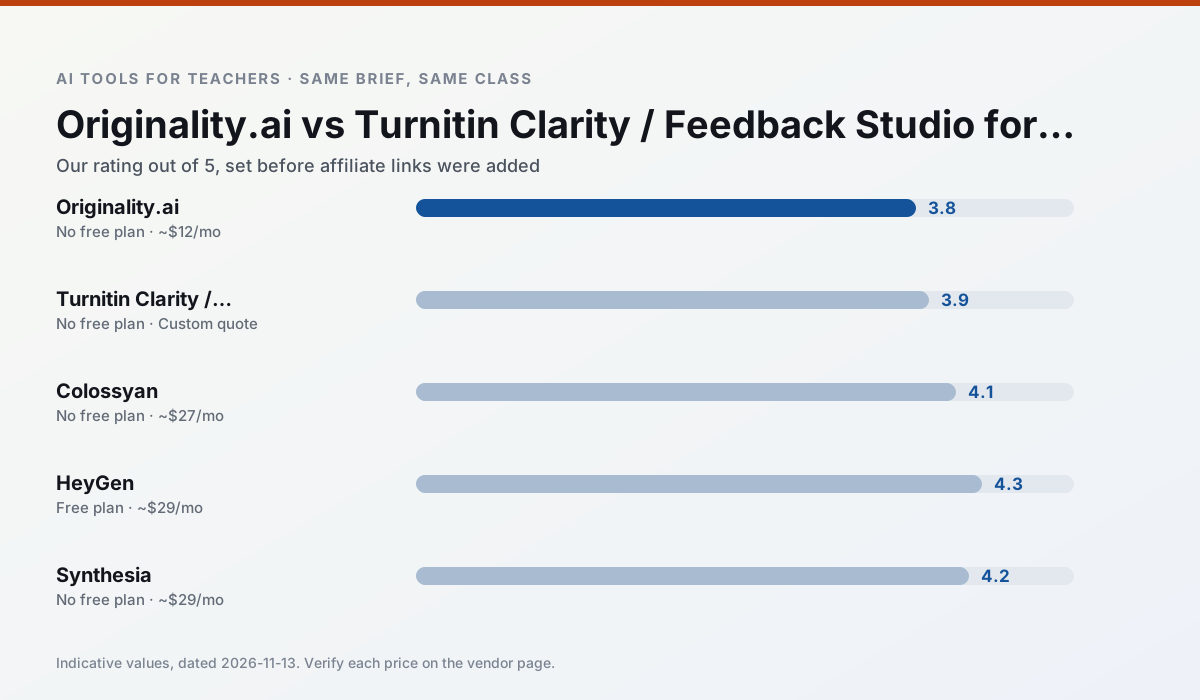
Side by side
Comparison table
Ratings reflect our timed classroom workflow, not vendor claims. Prices are indicative — verify on the vendor site.
| Tool | Best for | Free tier | Indicative paid plan | Standout feature | Our rating | Verdict | Try the tool |
|---|---|---|---|---|---|---|---|
| Originality.ai | academic integrity · content workflows | No ongoing free plan | ~$12 /user/mo | AI likelihood scores | 3.8 / 5 | Situational | Try free |
| Turnitin Clarity / Feedback Studio | feedback on writing · academic integrity | No ongoing free plan | Custom quote | Similarity reports | 3.9 / 5 | Situational | Try free |
| Colossyan | PD materials · video lessons | No ongoing free plan | ~$27 /user/mo | PDF/PPT-to-video | 4.1 / 5 | Situational | Try free |
| HeyGen | video lessons · translation | Yes — Limited credit plan | ~$29 /user/mo | Video translation | 4.3 / 5 | Strong option | Try free |
| Synthesia | flipped lessons · video lessons | No ongoing free plan | ~$29 /user/mo | 140+ languages | 4.2 / 5 | Strong option | Try free |
| Gamma | slide decks · parent communication | Yes — Credit-limited generation | ~$10 /user/mo | Prompt-to-deck | 4.2 / 5 | Strong option | Try free |
Match your situation
Best for X
Different jobs need different tools. Here is what we would open first in each case.
On the daily cycle, Originality.ai saves the most edit time per task; the paid tier mostly buys more runs rather than better ones.
Turnitin Clarity / Feedback Studio's free plan is the most usable in this comparison: a quota that survives a normal week. Not enough for a department, enough for one teacher to decide.
Colossyan answers the three questions a district actually asks: rostering, admin controls and a data-processing agreement. That is usually what decides a school purchase.
HeyGen has the shortest path from opening a tab to a usable draft, which matters more than the feature count on a Monday.
Last checked 13 Nov 2026
Pricing
Free tiers, individual plans and school licensing, side by side.
| Tool | Free plan | Individual / paid | School & district | Billing note | Verify |
|---|---|---|---|---|---|
| Originality.ai | No ongoing free tier | ~$12 /user/mo | Custom quote | Indicative — verify on vendor site | Vendor |
| Turnitin Clarity / Feedback Studio | No ongoing free tier | Custom quote | Custom quote | LMS-wide deployment | Vendor |
| Colossyan | No ongoing free tier | ~$27 /user/mo | Custom quote | Indicative — verify on vendor site | Vendor |
| HeyGen | $0 — Limited credit plan | ~$29 /user/mo | Custom quote | Indicative — verify on vendor site | Vendor |
| Synthesia | No ongoing free tier | ~$29 /user/mo | Custom quote | Indicative — verify on vendor site | Vendor |
| Gamma | $0 — Credit-limited generation | ~$10 /user/mo | ~$20 /user/mo | Indicative — verify on vendor site | Vendor |
Editorial rule: pricing is re-checked every 2–3 months and the top 50 pages are refreshed every 6 months. See our funding policy.
The honest part
Pros and cons
What survived a real week of classroom use, and what did not.
Pros
- Useful for content publishing QA
- Fast bulk scanning
- Transparent credit model
Cons
- AI detection produces false positives
- Should never be sole evidence of misconduct
- Not a teaching tool
Pros
- Already licensed at many schools
- Consistent institutional workflow
- Detailed revision history
Cons
- Individual teachers cannot buy it
- AI detection remains contested
- Heavy administrative setup
Pros
- Strong for staff training, not just lessons
- Good compliance/LMS export
- Fast document-to-video
Cons
- No permanent free plan
- Higher price point
- Less suited to K-12 student-facing content
Pros
- Best-in-class lip-sync translation
- Useful for multilingual families
- Generous trial credits
Cons
- Credit-based pricing is confusing
- Voice cloning raises consent questions
- Overkill for everyday lessons
Pros
- No camera or editing skills required
- Excellent multilingual voice output
- Easy updates to existing videos
Cons
- Cost is hard to justify for a single teacher
- Avatar video can feel impersonal
- No free ongoing tier
In the classroom
Use cases
Five concrete workflows, with the tool we would open for each one.
A weekly family newsletter from bullet notes
Newsletters fail on length, not tone. Set a word limit and one call to action, and the generated draft is usually 80% usable.
Recommended: Originality.aiRegrouping students after an assessment
Summarise anonymised results into skill groups, then generate one activity per group. Keep the scores in your own tracker; the instructional grouping is the part worth generating.
Recommended: Turnitin Clarity / Feedback StudioA Monday morning lesson plan in twelve minutes
The twelve minutes come from not rewriting the skeleton. Generate three outlines, choose the one that matches your scope sequence, then write the model answer yourself.
Recommended: ColossyanThree reading levels from one source text
Paste a vetted text, ask for supported, core and extension versions, then check the vocabulary list by hand. Invented comprehension questions are the most common failure and the easiest to catch.
Recommended: HeyGenRubric and feedback comments in one pass
Reorder the workflow so the rubric is yours and the comments are generated. Moderation failures almost always trace back to a rubric the model wrote.
Recommended: Synthesia
Questions teachers ask us
FAQ
Direct answers, also published as FAQPage structured data for search and AI assistants.
Originality.ai or Turnitin Clarity / Feedback Studio for lesson planning?
Which is cheaper for one teacher?
Do they produce the same output?
Sources & further reading
Our recommendation
Try Originality.ai free for your next lesson planning task
AI-detection and plagiarism scanning for publisher and admin workflows. Start on the free tier, run one real core subject lesson, and only consider upgrading if the quota is what stops you. Disclosure: we may earn a commission (25% recurring) at no extra cost to you.
Some links on this page are affiliate links. We may earn a commission at no extra cost to you. Our rankings are editorial and never pay-to-play. Never enter student PII into a free consumer account.
Keep reading
Related comparisons in this cluster.
Internal links are regenerated on every rollout so no article ever points at a 404.