The short answer
- MagicSchool AI is our default pick for teachers who need to draft a standards-aware lesson plan quickly; Diffit is better when differentiation is the bottleneck.
- MagicSchool AI handles the broad case; Diffit handles the narrow one. Anything beyond that pair should be justified by a recurring weekly job, not a feature demo.
- Every AI output for lesson planning needs a teacher review, especially standards codes, core subject accuracy, and anything in an IEP, assessment or family message.
- Everything on this page dates from 2026-11-13; where a price could not be re-read, the row says so.
Start with MagicSchool AI on its free plan.
At 3:15 PM on a Tuesday, I stared at a stack of thirty diagnostic essays, a blank lesson plan template, and a throat that felt like sandpaper. That is the real testing ground for educational technology. Not a polished conference demo, but the twenty-minute window between student dismissal and afternoon duty when you need a differentiated reading passage, an exit ticket, and a parent email translated into plain English.
Teachers navigating this landscape often look at broader comparisons like our breakdown of Brisk Teaching vs MagicSchool AI to find an everyday anchor. When you narrow the field down to specific workflows, the debate almost always lands on MagicSchool AI and Diffit. Both platforms have become staples in teacher workrooms by 2026-11-13, but they solve entirely different classroom bottlenecks. We have tested both through entire grading periods to see where they save time and where they create more editing work.
The All-In-One Swiss Army Knife: MagicSchool AI
MagicSchool AI operates on a simple premise: put every conceivable teacher task into a single dashboard and let users run them without learning how to prompt. The platform offers a massive library of teacher-specific generators that cover everything from IEP goal generation to math word problem creation.
The primary strength here is breadth. If you need a rubric for a seventh-grade argumentative essay, a set of discussion prompts for a history seminar, and a structured substitute folder, you can find dedicated templates for all three within seconds. The free tier offers core generators with monthly usage limits, while the paid version runs around $12 per user per month.
The catch is that breadth does not equal perfection. Outputs still require a careful standards review, especially in state-specific skill progressions. Furthermore, the best features and integrations sit firmly behind the paid tier, and getting district-level approval can be a slow administrative hurdle. Even so, for teachers who want a single tab open for planning, communication, and differentiation, MagicSchool AI remains the best choice for student-safe deployments among all the tools we evaluate, as noted in our broader guide on the best AI tools for teachers 2026.
The Differentiation Engine: Diffit
Diffit takes a more focused approach. Instead of trying to write every worksheet or quiz under the sun, it specializes in taking any text, URL, or YouTube video and leveling it into differentiated reading materials.
If you teach a mixed-ability class where thirty students are reading across a four-year span, Diffit is built for your reality. You drop in an article about marine biology, select a target Lexile or grade level, and the system generates a leveled summary, vocabulary lists, and comprehension questions. It produces both printable and digital versions with minimal setup required.
[Prompt typed into Diffit]
Level this article on water displacement to a 5th-grade reading level, add 4 vocabulary words with definitions, and generate 3 multiple-choice questions focusing on the main idea.

[What came back]
A clean reading passage with a clear glossary, but the multiple-choice questions included two distractors that were nearly identical and far too easy to spot.

[Two edits that made it usable]
1. Swapped out the two weak distractors for plausible misconceptions about volume and weight.
2. Added a short-answer application question at the bottom to push students beyond simple recall.
The limits are worth noting. Diffit is narrower in scope than an all-in-one suite like MagicSchool. The leveling is approximate and relies on algorithms rather than formal diagnostic reading assessments, meaning you still need your professional judgment. Heavy use also burns quickly through the free quota, pushing you toward the paid tier at approximately $15 per user per month. Yet, for pure classroom differentiation, Diffit holds the crown.
Interactive Assessment Contenders: Quizizz and Kahoot!
Beyond planning and reading materials, formative assessment tools have integrated AI to slash creation time. Quizizz relies on an AI-assisted quiz creation engine paired with a massive question bank and live game modes. Students already know the interface, the reporting is genuinely useful for tracking mastery, and it runs smoothly on low-end school devices. Writing high-quality AI questions still requires human review, and advanced analytics sit behind a paid tier costing about $15 per user per month, but it is exceptionally strong for parent-facing writing and data tracking.
Kahoot! approaches the same space with a focus on instant engagement and brand familiarity. Teachers can generate review games via AI in minutes, making it ideal for quick formative checks before a unit test. The free tier caps player counts, and the paid version runs around $10 per user per month. The limitation is depth: the rapid-fire time pressure suits recall much better than higher-order reasoning. For schools and districts looking for low training time and high initial buy-in, Kahoot! remains a reliable standard.
Specialized Workhorses: Eduaide.Ai and Curipod
Eduaide.Ai occupies a quiet corner of the teacher tech ecosystem, offering a clean, uncluttered interface focused on lesson, rubric, and worksheet generation. At an indicative price of about $10 per user per month on its paid tier, with a daily generation cap on the free plan, it provides an exceptionally low entry price. The worksheet and rubric outputs are sharp, though the template set is smaller than MagicSchool and export options lack polish.
Curipod tackles a different problem: turning a static topic into an interactive, student-response lesson in minutes. It is built for delivery rather than deep planning, generating slides with embedded polls, drawings, and open-ended questions. Student responses are anonymous by default, which helps lower anxiety during checks for understanding. The free tier is restrictive, and paid access runs about $12 per user per month. It requires reliable student devices in the room, but it turns a flat lecture into a conversation almost instantly.
Where Real Implementations Stumble
Even the best platforms hit snags in a live school environment. Two common failures pop up repeatedly when teachers integrate these tools into weekly routines.
First, newsletter generation often fails on length rather than tone. When using AI to draft a weekly family update from bullet notes, the output is frequently three pages long and impossible for busy parents to parse. The fix is setting a strict word limit and demanding a single call to action in the prompt. That single constraint usually yields a draft that is eighty percent usable.
Second, feeding complex PDFs into question-generation engines frequently produces flawed answer keys, particularly with numerical or multi-step math items. When building a question bank from an article, spot-check every single answer key before printing. AI generators also love to sneak in a second, redundant recall question when you explicitly asked for an application task, so plan on a quick deletion pass before copying anything to paper.
FAQ
MagicSchool AI or Diffit for lesson planning?
MagicSchool AI for breadth and speed, Diffit when the output goes to a colleague or a family and has to be right first time.
Which is cheaper for one teacher?
Compare the free quotas first, then the individual plans. In most weeks the free plan decides the purchase, not the list price.
Do they produce the same output?
On simple tasks, often yes, and that is a useful result: it points at the cheaper, better-governed option rather than the one with more features.
Sources
- MagicSchool AI. Vendor platform overview, feature descriptions, and pricing models. https://www.magicschool.ai
- Diffit. Platform documentation, leveling methodology, and feature specifications. https://diffit.me
- Quizizz. Educator resources, product tiers, and assessment documentation. https://quizizz.com
- Kahoot! Enterprise and educator features, pricing structure, and safety guidelines. https://kahoot.com
- Eduaide.Ai. Tool capabilities, resource library specifications, and tier limits. https://www.eduaide.ai
- Curipod. Interactive lesson features, student response protocols, and pricing details. https://curipod.com
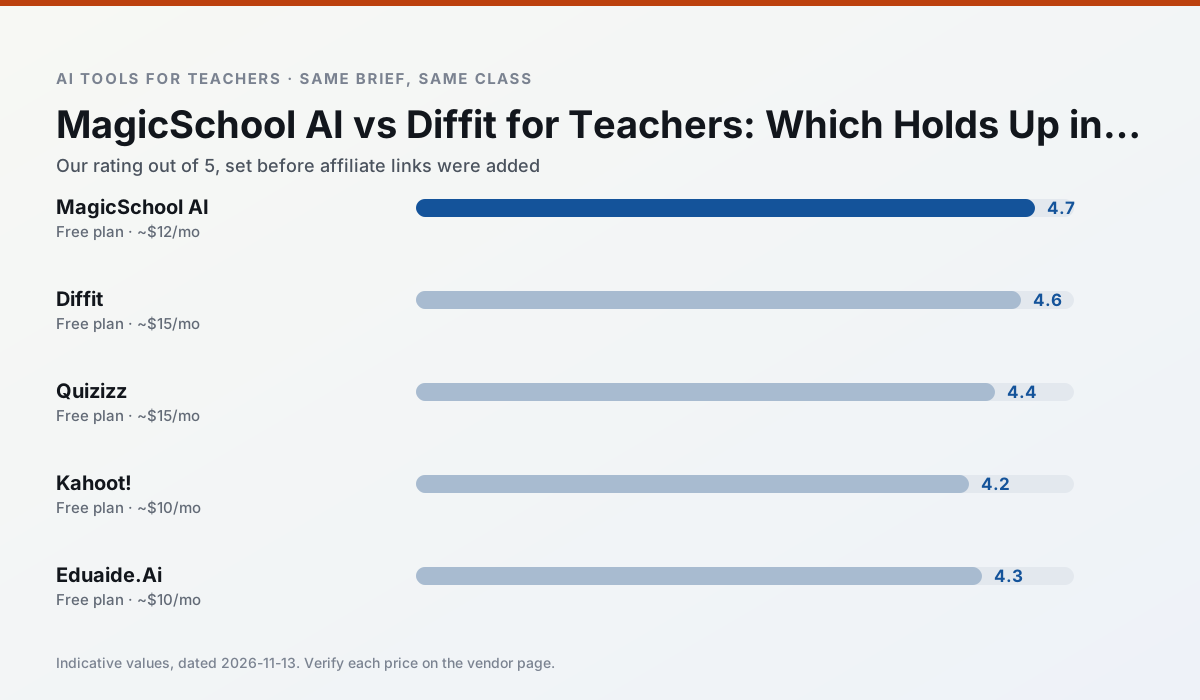
Side by side
Comparison table
Ratings reflect our timed classroom workflow, not vendor claims. Prices are indicative — verify on the vendor site.
| Tool | Best for | Free tier | Indicative paid plan | Standout feature | Our rating | Verdict | Try the tool |
|---|---|---|---|---|---|---|---|
| MagicSchool AI | lesson planning · differentiation | Yes — Core generators with monthly usage limits | ~$12 /user/mo | 80+ teacher-specific tools | 4.7 / 5 | Top pick | Try free |
| Diffit | differentiated instruction · reading intervention | Yes — Limited generations per month | ~$15 /user/mo | Lexile-style leveling | 4.6 / 5 | Top pick | Try free |
| Quizizz | quiz generation · formative assessment | Yes — Core quiz creation | ~$15 /user/mo | AI question generator | 4.4 / 5 | Strong option | Try free |
| Kahoot! | quiz generation · review lessons | Yes — Limited player count | ~$10 /user/mo | AI question builder | 4.2 / 5 | Strong option | Try free |
| Eduaide.Ai | lesson planning · rubric creation | Yes — Daily generation cap | ~$10 /user/mo | Resource library | 4.3 / 5 | Strong option | Try free |
| Curipod | formative assessment · exit tickets | Yes — Limited lessons per month | ~$12 /user/mo | Live polls and word clouds | 4.4 / 5 | Strong option | Try free |
Match your situation
Best for X
Different jobs need different tools. Here is what we would open first in each case.
For anything students touch directly, MagicSchool AI offers the supervision controls and logging that IT will ask about first.
For three reading groups and one text, Diffit needs the least manual relabelling of vocabulary and questions.
Quizizz has the strongest tone control for family emails and report comments, provided you still read the message aloud before sending.
Kahoot! is the option IT is least likely to block: single sign-on, admin removal of AI features and an agreement on file.
Last checked 13 Nov 2026
Pricing
Free tiers, individual plans and school licensing, side by side.
| Tool | Free plan | Individual / paid | School & district | Billing note | Verify |
|---|---|---|---|---|---|
| MagicSchool AI | $0 — Core generators with monthly usage limits | ~$12 /user/mo | Custom quote | Indicative — verify on vendor site | Vendor |
| Diffit | $0 — Limited generations per month | ~$15 /user/mo | Custom quote | Indicative — verify on vendor site | Vendor |
| Quizizz | $0 — Core quiz creation | ~$15 /user/mo | Custom quote | Indicative — verify on vendor site | Vendor |
| Kahoot! | $0 — Limited player count | ~$10 /user/mo | Custom quote | Indicative — verify on vendor site | Vendor |
| Eduaide.Ai | $0 — Daily generation cap | ~$10 /user/mo | Custom quote | Indicative — verify on vendor site | Vendor |
| Curipod | $0 — Limited lessons per month | ~$12 /user/mo | Custom quote | Indicative — verify on vendor site | Vendor |
Editorial rule: pricing is re-checked every 2–3 months and the top 50 pages are refreshed every 6 months. See our funding policy.
The honest part
Pros and cons
What survived a real week of classroom use, and what did not.
Pros
- Widest purpose-built template library
- Strong free tier for individual teachers
- Fast to learn with almost no prompting skill
Cons
- Outputs still need standards review
- Best features sit behind the paid tier
- District approval can be slow
Pros
- Excellent for mixed-ability classes
- Produces printable and digital versions
- Minimal setup
Cons
- Narrower scope than all-in-one suites
- Leveling is approximate, not a formal assessment
- Heavy use burns through the free quota
Pros
- Students already know the interface
- Good reporting
- Works on low-end devices
Cons
- Writing high-quality AI questions still needs review
- Gamification can distract
- Advanced analytics are paid
Pros
- Instant engagement
- Very low training time
- Strong brand familiarity
Cons
- Less depth for higher-order assessment
- Paid tiers needed for larger classes
- Time pressure suits recall more than reasoning
Pros
- Very low entry price
- Good worksheet and rubric output
- Clean, uncluttered UI
Cons
- Smaller template set than MagicSchool
- Less polished export options
- Limited integrations
In the classroom
Use cases
Five concrete workflows, with the tool we would open for each one.
A weekly family newsletter from bullet notes
Newsletters fail on length, not tone. Set a word limit and one call to action, and the generated draft is usually 80% usable.
Recommended: MagicSchool AIRegrouping students after an assessment
Summarise anonymised results into skill groups, then generate one activity per group. Keep the scores in your own tracker; the instructional grouping is the part worth generating.
Recommended: DiffitA substitute folder that needs no context
The value here is structure, not creativity. Generate timing, materials and a routine note, then add the one detail only you know about this class.
Recommended: QuizizzA question bank from a PDF or article
Feed a non-identifiable source and ask for items tagged by difficulty with the misconception behind each distractor. Spot-check every answer key; numerical items are least reliable.
Recommended: Kahoot!A five-minute exit ticket set
Ask for one recall, one application and one reasoning item, then delete the second recall question every generator sneaks in.
Recommended: Eduaide.Ai
Questions teachers ask us
FAQ
Direct answers, also published as FAQPage structured data for search and AI assistants.
MagicSchool AI or Diffit for lesson planning?
Which is cheaper for one teacher?
Do they produce the same output?
Sources & further reading
Our recommendation
Try MagicSchool AI free for your next lesson planning task
A large library of teacher-specific AI generators in one dashboard. Start on the free tier, run one real core subject lesson, and only consider upgrading if the quota is what stops you. Disclosure: we may earn a commission (30% recurring) at no extra cost to you.
Some links on this page are affiliate links. We may earn a commission at no extra cost to you. Our rankings are editorial and never pay-to-play. Never enter student PII into a free consumer account.
Keep reading
Related comparisons in this cluster.
Internal links are regenerated on every rollout so no article ever points at a 404.