The short answer
- Kahoot! is our default pick for teachers who need to draft a standards-aware lesson plan quickly; Formative is better when differentiation is the bottleneck.
- Free-tier reality for this shortlist: Kahoot!: Yes — Limited player count; Formative: Yes — Core assessment tools; Quizizz: Yes — Core quiz creation. Treat every paid figure as indicative until you have read the vendor page; only the free quota is something you can test yourself this week.
- Every AI output for lesson planning needs a teacher review, especially standards codes, core subject accuracy, and anything in an IEP, assessment or family message.
- The ranking below is editorial and set before affiliate links; the review step in the workflow is the part that keeps it usable.
Start with ElevenLabs on its free plan.
It was 2:15 on a Tuesday afternoon. Twenty-eight eighth-graders were vibrating in their seats, staring at the front board where a giant timer was ticking down from thirty seconds. A loud, jaunty digital bassline was pumping through the tinny laptop speakers, and Kevin was currently losing his mind because Sarah had just overtaken him for first place on the leaderboard. Ten minutes earlier, I had spent forty-five minutes trying to figure out which student actually understood the difference between cellular respiration and photosynthesis, and which one was just really fast at clicking the red triangle on a touch screen.
That is the daily friction of modern assessment. We need to know what our students know, but we are torn between tools that treat learning like an arcade game and tools that look like a CPA audit. When looking at Kahoot! vs Formative, you are not just choosing between two pieces of software. You are choosing a philosophy of classroom noise versus classroom data. If you are trying to figure out which tool deserves a slot in your browser tab rotation for the 2026-11-13 term, you have to look past the marketing deck and see how they handle a live room full of teenagers who haven't eaten enough protein.
The Reality of Fast Recall Games
Kahoot! has won the brand familiarity war in K-12 education, and for good reason. If you need instant engagement on a Friday review session, nothing gets a room of indifferent sophomores upright faster than the default lobby music. The AI-assisted question generation helps you pull together a review set from a topic in minutes, avoiding the late-night hunt through old shared drives. The free tier works fine if you have a tiny intervention group, but the moment you try to run it across three standard classes, you hit the player count wall and start looking at the paid tier at roughly $10 /user/mo (indicative).
The underlying problem remains the timer. When you grade a student based on how fast they can tap a triangle on a low-end Chromebook, you are testing their thumb reflexes and anxiety levels just as much as their mastery of the content. Younger students love it, but you should always have them use nicknames rather than real names to keep things light and avoid public humiliation when the leaderboard updates. It is a brilliant tool for recall, but it breaks down the second you ask a question that requires actual reasoning or multistep calculation.
Digging Into Standards and Diagnostics
Formative takes the exact opposite approach, trading the arcade lights for serious data tracking. If your professional learning community is obsessed with standards mastery and intervention groups, this is where you end up. It works wonderfully with existing PDFs and Docs you have spent years building, allowing you to layer questions directly over your own materials. The auto-grading feature saves hours of weekend penciling, and the LMS integrations do not require a degree in systems architecture to set up.
The catch is the learning curve and the cost. Setting up a robust tracker takes more time than throwing together a quick quiz game, and while the core assessment tools are free, the best data features and school-grade DPAs require a wider rollout. At roughly $15 /user/mo (indicative), it adds up fast if you are paying out of pocket. It also lacks the instant gamified buzz that makes students cheer when you project the screen. You use Formative when you need to know who is failing standard 7.RP.A.2 before the unit test, not when you need to burn off Friday afternoon energy.
Where Quizizz and Diffit Fit In
While the main bout is between those two giants, other tools crowd the ring for your attention. Quizizz offers a middle ground with a massive question bank and AI quiz creation that students already know how to navigate. At roughly $15 /user/mo (indicative) for advanced analytics, it is a sturdy backup option that runs smoothly on low-end hardware. Meanwhile, if you are wrestling with mixed-ability classes, Diffit remains the go-to utility for turning a single source text into three distinct reading levels for roughly $15 /user/mo (indicative). You can read more about how these platforms stack up against broader utility suites in our best AI tools for teachers 2026 guide.
Prompt fed into Diffit: "Take this article on watershed management and generate three reading levels (supported, core, extension) with five comprehension questions each for my sixth-grade science block."
What came back: Three clean text levels with adjusted Lexile bands, accompanied by multiple-choice questions for each tier.
Two edits that made it usable:
- Swapped out two invented multiple-choice questions that tested vocabulary context rather than actual watershed mechanics.
- Manually adjusted the glossary at the bottom of the supported text to match the exact anchor chart hanging on my classroom wall.
Supporting Players: Writing and Audio
Assessment is only half the battle of a teacher's work week. We also spend half our lives writing parent emails that sound like we are testifying in court. Grammarly steps in here with core grammar and tone checks for roughly $12 /user/mo (indicative). It catches tone shifts in high-stakes parent communications before you hit send, though you have to watch out that it doesn't scrub your natural teacher voice entirely. Make sure to disable text collection on school devices if your district requires strict privacy controls.
When you need accessible audio versions of your materials without spending your Sunday evening reading into a microphone, ElevenLabs provides natural-sounding text-to-speech for roughly $5 /user/mo (indicative) after you burn through the monthly free character quota. It generates clean voiceovers fast, though you should obviously never clone a student's or colleague's voice without explicit written consent. For a deeper look at how these specialized text tools compare to heavy-duty workflow assistants, check out our comparison on Brisk Teaching vs Diffit.
Two Classroom Fails and How We Fixed Them
Nothing works the way the demo video promises on the first try. Here is what went wrong in my room and how we adapted.
First, during a unit on ecosystems, I used an AI generator to spit out a five-minute exit ticket set. The tool predictably gave me two recall questions and three more that were practically identical clones of the first two. Instead of a balanced check for understanding, I had a redundant quiz that bored the advanced kids and confused the struggling ones. The fix was simple: I instituted a strict rule to delete the second and fourth questions on any auto-generated set before printing or pushing it live, forcing a mix of one recall, one application, and one reasoning item.
Second, I tried to run a fast Formative data session on a Friday when half our district network was crawling. The auto-grading dashboard stalled out, students couldn't submit their work, and the room dissolved into chaos while forty Chromebook screens spun their loading wheels. The fix was adopting a hybrid approach. I keep a physical backup copy of the core anchor questions printed on cardstock in my desk drawer. If the servers drop or the Wi-Fi blinks, we pivot to paper without missing a beat, and I enter the data manually during planning.
Making Your Final Choice
If your primary goal is parent-facing writing, you skip the quiz platforms entirely and lean on Grammarly. If your priority is mixed-ability classes where every kid needs access to the same core content at a different reading level, Formative and Diffit earn their keep. For pure, unadulterated student engagement where you just need to check if they were paying attention during the lecture, Kahoot! still holds the crown despite its limitations. Pick the tool that matches your actual pain point, not the one with the flashiest marketing pitch.
FAQ
Kahoot! or Formative for lesson planning?
Kahoot! for breadth and speed, Formative when the output goes to a colleague or a family and has to be right first time.
Which is cheaper for one teacher?
Compare the free quotas first, then the individual plans. In most weeks the free plan decides the purchase, not the list price.
Do they produce the same output?
On simple tasks, often yes, and that is a useful result: it points at the cheaper, better-governed option rather than the one with more features.
Sources
- Kahoot! vendor pricing and feature documentation at kahoot.com
- Formative vendor features and data tracking guides at goformative.com
- Quizizz platform specifications and tier breakdowns at quizizz.com
- ElevenLabs voice generation quotas and pricing at elevenlabs.io
- Grammarly educational use cases and security notes at grammarly.com
- Diffit leveling utilities and token structures at diffit.me
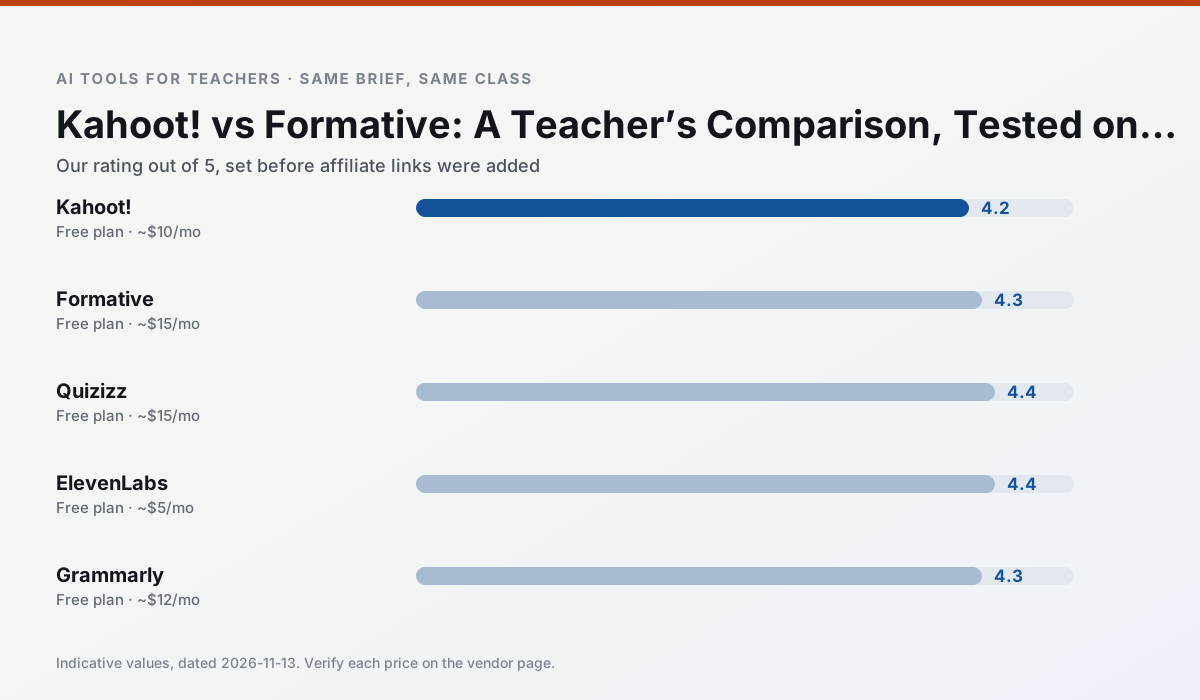
Side by side
Comparison table
Ratings reflect our timed classroom workflow, not vendor claims. Prices are indicative — verify on the vendor site.
| Tool | Best for | Free tier | Indicative paid plan | Standout feature | Our rating | Verdict | Try the tool |
|---|---|---|---|---|---|---|---|
| Kahoot! | quiz generation · review lessons | Yes — Limited player count | ~$10 /user/mo | AI question builder | 4.2 / 5 | Strong option | Try free |
| Formative | formative assessment · grading | Yes — Core assessment tools | ~$15 /user/mo | Live student responses | 4.3 / 5 | Strong option | Try free |
| Quizizz | quiz generation · formative assessment | Yes — Core quiz creation | ~$15 /user/mo | AI question generator | 4.4 / 5 | Strong option | Try free |
| ElevenLabs | accessibility · reading intervention | Yes — Monthly character quota | ~$5 /user/mo | Very natural voices | 4.4 / 5 | Strong option | Try free |
| Grammarly | parent communication · report card comments | Yes — Core grammar and tone checks | ~$12 /user/mo | Tone adjustments | 4.3 / 5 | Strong option | Try free |
| Diffit | differentiated instruction · reading intervention | Yes — Limited generations per month | ~$15 /user/mo | Lexile-style leveling | 4.6 / 5 | Top pick | Try free |
Match your situation
Best for X
Different jobs need different tools. Here is what we would open first in each case.
Kahoot! is the steadiest of this set at plain, respectful language; names and specific incidents still belong in your draft, not the prompt.
Formative produces levelled versions from one source in a single pass, which is the highest-value differentiation shortcut we tested at this level.
For anything students touch directly, Quizizz offers the supervision controls and logging that IT will ask about first.
ElevenLabs's free plan is the most usable in this comparison: a quota that survives a normal week. Not enough for a department, enough for one teacher to decide.
Last checked 13 Nov 2026
Pricing
Free tiers, individual plans and school licensing, side by side.
| Tool | Free plan | Individual / paid | School & district | Billing note | Verify |
|---|---|---|---|---|---|
| Kahoot! | $0 — Limited player count | ~$10 /user/mo | Custom quote | Indicative — verify on vendor site | Vendor |
| Formative | $0 — Core assessment tools | ~$15 /user/mo | Custom quote | Indicative — verify on vendor site | Vendor |
| Quizizz | $0 — Core quiz creation | ~$15 /user/mo | Custom quote | Indicative — verify on vendor site | Vendor |
| ElevenLabs | $0 — Monthly character quota | ~$5 /user/mo | ~$22 /user/mo | Indicative — verify on vendor site | Vendor |
| Grammarly | $0 — Core grammar and tone checks | ~$12 /user/mo | ~$15 /user/mo | Indicative — billed annually | Vendor |
| Diffit | $0 — Limited generations per month | ~$15 /user/mo | Custom quote | Indicative — verify on vendor site | Vendor |
Editorial rule: pricing is re-checked every 2–3 months and the top 50 pages are refreshed every 6 months. See our funding policy.
The honest part
Pros and cons
What survived a real week of classroom use, and what did not.
Pros
- Instant engagement
- Very low training time
- Strong brand familiarity
Cons
- Less depth for higher-order assessment
- Paid tiers needed for larger classes
- Time pressure suits recall more than reasoning
Pros
- Strong data for intervention groups
- Works with existing PDFs and Docs
- Good LMS integrations
Cons
- Steeper setup than quiz games
- Best value requires school-wide rollout
- Price adds up per teacher
Pros
- Students already know the interface
- Good reporting
- Works on low-end devices
Cons
- Writing high-quality AI questions still needs review
- Gamification can distract
- Advanced analytics are paid
Pros
- Excellent for accessible audio versions
- Low entry price
- Fast generation
Cons
- Quota-based billing
- Voice cloning consent considerations
- Not a teaching platform
Pros
- Catches errors in high-stakes parent emails
- Works everywhere you already write
- Very low learning curve
Cons
- Not education-specific
- Can flatten teacher voice
- Premium needed for tone rewriting
In the classroom
Use cases
Five concrete workflows, with the tool we would open for each one.
An IEP present-levels first draft
Use aggregated, anonymised data only. Ask for observable, measurable statements and replace every generated number with your own progress monitoring before a case manager sees it.
Recommended: Kahoot!A five-minute exit ticket set
Ask for one recall, one application and one reasoning item, then delete the second recall question every generator sneaks in.
Recommended: FormativeA question bank from a PDF or article
Feed a non-identifiable source and ask for items tagged by difficulty with the misconception behind each distractor. Spot-check every answer key; numerical items are least reliable.
Recommended: QuizizzA substitute folder that needs no context
The value here is structure, not creativity. Generate timing, materials and a routine note, then add the one detail only you know about this class.
Recommended: ElevenLabsThree reading levels from one source text
Paste a vetted text, ask for supported, core and extension versions, then check the vocabulary list by hand. Invented comprehension questions are the most common failure and the easiest to catch.
Recommended: Grammarly
Questions teachers ask us
FAQ
Direct answers, also published as FAQPage structured data for search and AI assistants.
Kahoot! or Formative for lesson planning?
Which is cheaper for one teacher?
Do they produce the same output?
Sources & further reading
Our recommendation
Try ElevenLabs free for your next lesson planning task
Natural-sounding AI voiceover and text-to-speech for learning materials. Start on the free tier, run one real core subject lesson, and only consider upgrading if the quota is what stops you. Disclosure: we may earn a commission (22% recurring) at no extra cost to you.
Some links on this page are affiliate links. We may earn a commission at no extra cost to you. Our rankings are editorial and never pay-to-play. Never enter student PII into a free consumer account.
Keep reading
Related comparisons in this cluster.
Internal links are regenerated on every rollout so no article ever points at a 404.