The short answer
- Synthesia is our default pick for teachers who need to draft a standards-aware lesson plan quickly; HeyGen is better when differentiation is the bottleneck.
- Free-tier reality for this shortlist: Synthesia: No ongoing free plan; HeyGen: Yes — Limited credit plan; Surfer SEO: No ongoing free plan. Treat every paid figure as indicative until you have read the vendor page; only the free quota is something you can test yourself this week.
- Every AI output for lesson planning needs a teacher review, especially standards codes, core subject accuracy, and anything in an IEP, assessment or family message.
- Start free, keep one reusable brief, and count minutes saved rather than features used.
Start with Synthesia on its free plan.
The Reality of AI Presenters in Front of a Real Classroom
Last Thursday, my third-period sophomores stared in dead silence at a digital clone of myself explaining the causes of the French Revolution. I did not record that video on Tuesday night. I typed a script into an interface, picked an avatar that vaguely resembled someone with my hair colour, and let software generate the whole thing. The kids did not care that the presenter was synthetic. They cared that the pacing was fast, the graphics were clean, and my voice sounded like I had actually slept the night before. But when I tried to use that same software on Friday to patch together a quick review for my ESL families, the cracks in the workflow started showing.
If you are looking at AI video generation tools this term, you are likely weighing Synthesia vs HeyGen for teachers trying to scale their content without losing their minds. Both platforms promise presenter-led videos without a camera, a ring light, or a quiet room. They both carry price tags that make a public school teacher wince. To figure out where these tools actually fit, I spent three weeks testing both platforms alongside a few other content creation staples like Writesonic, OpusClip, Murf AI, and Surfer SEO. Here is what happened when I took them out of the marketing decks and put them into my weekly routine.
Why Synthesia Wins on Quick Setup
Synthesia is built for people who want to type text and get a talking head video without clicking around fifty different menus. There is no free tier, and the paid plan sits at roughly $29 per user per month. For an individual teacher paying out of pocket, that price is hard to justify. If your department or grant budget covers it, though, the speed is undeniable.
The primary strength of Synthesia is its zero-friction approach to avatar generation. You pick a template, paste your introductory lecture notes, and the software handles the lip-sync and eye contact. I used it to spin up a Monday morning orientation video for my project-based learning unit. It took me ten minutes from blank screen to export.
Synthesia Prompt: "Generate a 60-second instructional overview for 9th-grade biology covering the basics of cellular respiration. Use a professional presenter, clean classroom background, and slow down the delivery on key vocabulary terms like mitochondria and ATP."
What came back: A smooth, professional video with a polished avatar. However, the pronunciation of 'ATP' sounded unnatural, and the visual background included a chemistry beaker instead of a microscope.
Two edits that made it usable:
- Changed the spelling of ATP to phonetic text prompts to fix the robotic audio glitch.
- Swapped the default background asset for a flat-coloured template to keep students focused on the text overlays rather than mismatched lab equipment.
The main limit is that avatar video can easily feel impersonal. High schoolers sniff out fake enthusiasm immediately. While the tool is great for quick setup when you need a standardized introduction, it cannot replace the live back-and-forth of teaching.
Where HeyGen Takes the Lead for Schools
HeyGen sits at a similar price point of roughly $29 per user per month, but it includes a limited credit plan to let you test the waters before committing your department funds. Where HeyGen pulls ahead of its competitors is its translation suite and lip-sync engine. If your school serves a large population of multilingual families, HeyGen is the more functional choice for district-wide communication.
The best feature here is the video translation capability. I took a recording of our back-to-school night overview and ran it through HeyGen to generate Spanish and Vietnamese versions. The software preserved my actual voice tone while translating the script and matching the lip movements to the new language. It is eerie to watch yourself speak fluent Spanish with correct mouth shapes when you barely scraped by in high school foreign language classes.
HeyGen Prompt:
"Translate this 2-minute parent update regarding our upcoming state testing schedule into Spanish. Maintain a warm, encouraging tone and ensure district compliance terminology for testing accommodations is preserved."

What came back:
A remarkably fluid translation with accurate lip-syncing. But the literal translation of 'accommodations' missed our specific district IEP phrasing.

Two edits that made it usable:
1. Manually edited the generated transcript text for local district phrasing before letting the avatar re-render the final video.
2. Swapped the auto-generated voice clone for a stock platform voice to avoid any awkward uncanny valley reactions from parents listening to my digitally altered pitch.
Voice cloning on HeyGen raises valid consent questions, especially in a school setting. You should never clone a student voice, and you need documented consent before cloning anyone else's likeness. Used carefully, HeyGen is best for schools and districts trying to bridge the language gap with parent communities.
Expanding Beyond Video: Writesonic and Murf AI
Not every instructional problem requires a talking head. Often, you just need clean audio or a fast way to organize notes. Murf AI handles studio-quality voiceovers for about $19 per user per month, with a trial-only output on the free side. It is fantastic if you want to narrate a slide deck without recording your own voice three times because the dog barked in the background. The pacing controls are precise, letting you add natural pauses where students need to digest a complex theorem.
For general writing tasks, Writesonic offers a budget-friendly option at roughly $16 per user per month with limited free credits. It is cheaper than enterprise writing suites and gives you dozens of templates. When I used it to draft a stack of reading comprehension questions, the output was decent, though it tended toward generic classroom phrasing that required significant human revision. It fits nicely into our broader look at AI tools for teachers as a quick brainstorming partner when you are staring at a blank lesson plan on Sunday night.
Repurposing Content with OpusClip and Surfer SEO
If you record your direct instruction or class discussions, OpusClip helps turn those long recordings into short, captioned clips for about $15 per user per month. It comes with a restrictive free plan, but it is fast. I fed it a twenty-minute lecture on poetry analysis, and it spat out three punchy sixty-second highlights with auto-generated captions. It is optimized for social formats, so it feels a bit flashy for daily classroom use, but it works well if you run a class Instagram or want to create bite-sized review reels for absent students. Never upload recordings containing identifiable students, of course.
For teacher-creators who publish resources online for extra income, Surfer SEO provides content optimization with clear scoring for roughly $79 per month with no free tier. It is expensive for an individual teacher, and it is explicitly not a classroom tool. However, if you sell lesson plans on Teachers Pay Teachers and want your product descriptions to rank on search engines, it is the best free option in spirit due to its clear on-page guidance, though it requires a basic understanding of SEO.
Finding the Right Fit for Your Workflow
Navigating these platforms requires keeping your pedagogical goals clear. If you need a quick setup for asynchronous modules, Synthesia gets the job done. If you are coordinating with multilingual families across a whole building, HeyGen provides unmatched translation depth. Just remember to protect student privacy, keep your humans in the loop for every content check, and never let an AI avatar replace the messy, necessary work of live classroom discussion. For more comparisons on how these utilities stack up against other classroom staples, read our guide on Brisk Teaching vs Diffit.
FAQ
Synthesia or HeyGen for lesson planning?
Synthesia for breadth and speed, HeyGen when the output goes to a colleague or a family and has to be right first time.
Which is cheaper for one teacher?
Compare the free quotas first, then the individual plans. In most weeks the free plan decides the purchase, not the list price.
Do they produce the same output?
On simple tasks, often yes, and that is a useful result: it points at the cheaper, better-governed option rather than the one with more features.
Sources
- Synthesia Pricing and Features. https://www.synthesia.io/
- HeyGen Platform Overview and Translation Tools. https://www.heygen.com/
- Surfer SEO Content Optimization Guide. https://surferseo.com/
- Writesonic Pricing and Credit Systems. https://writesonic.com/
- OpusClip Video Repurposing Documentation. https://www.opus.pro/
- Murf AI Voiceover Specifications. https://murf.ai/
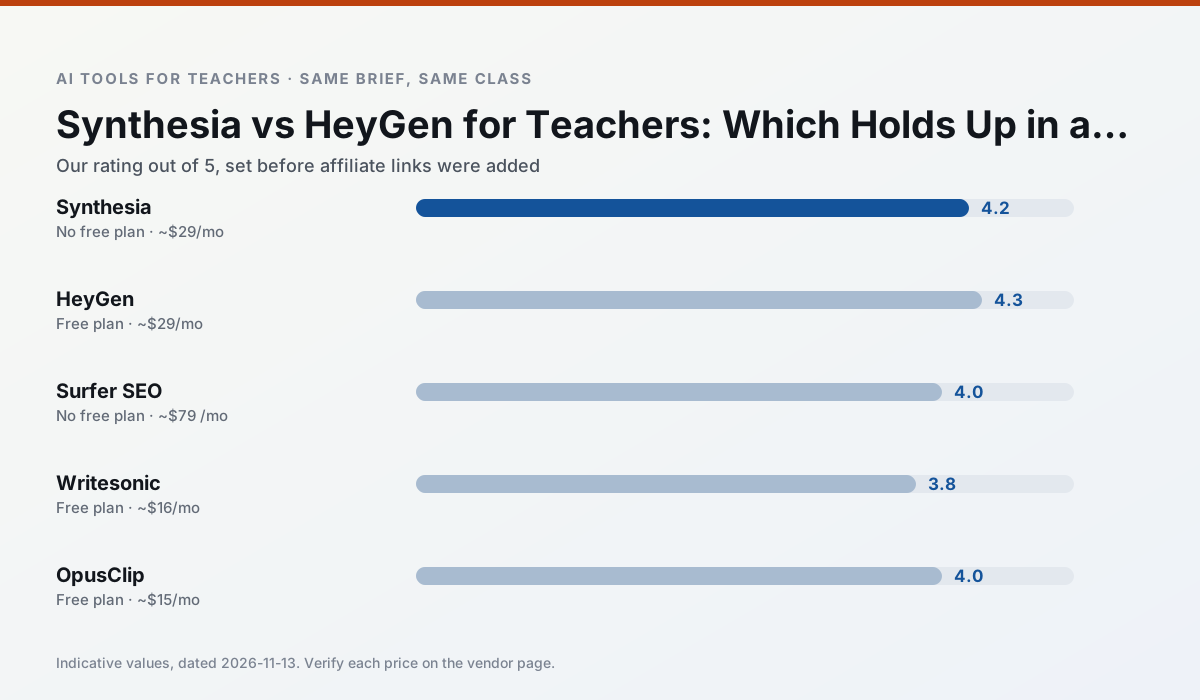
Side by side
Comparison table
Ratings reflect our timed classroom workflow, not vendor claims. Prices are indicative — verify on the vendor site.
| Tool | Best for | Free tier | Indicative paid plan | Standout feature | Our rating | Verdict | Try the tool |
|---|---|---|---|---|---|---|---|
| Synthesia | flipped lessons · video lessons | No ongoing free plan | ~$29 /user/mo | 140+ languages | 4.2 / 5 | Strong option | Try free |
| HeyGen | video lessons · translation | Yes — Limited credit plan | ~$29 /user/mo | Video translation | 4.3 / 5 | Strong option | Try free |
| Surfer SEO | teacher bloggers · resource sellers | No ongoing free plan | ~$79 /mo | Content Editor | 4.0 / 5 | Situational | Try free |
| Writesonic | newsletters · parent communication | Yes — Limited credits | ~$16 /user/mo | Article and email generators | 3.8 / 5 | Situational | Try free |
| OpusClip | PD materials · flipped lessons | Yes — Limited monthly clips | ~$15 /user/mo | Auto captions | 4.0 / 5 | Situational | Try free |
| Murf AI | audio lessons · accessibility | Yes — Trial-only output | ~$19 /user/mo | Voice fine-tuning | 4.1 / 5 | Situational | Try free |
Match your situation
Best for X
Different jobs need different tools. Here is what we would open first in each case.
Synthesia runs in a browser tab with no extension, no student accounts and no onboarding call, so you can test it in a free period.
HeyGen answers the three questions a district actually asks: rostering, admin controls and a data-processing agreement. That is usually what decides a school purchase.
If there is no budget, start with Surfer SEO: free plan with clearest quota is the least punishing free tier here.
Writesonic is the one we would open on a normal planning day because the first output is editable rather than restructurable, and the free plan covers a single teacher's routine.
Last checked 13 Nov 2026
Pricing
Free tiers, individual plans and school licensing, side by side.
| Tool | Free plan | Individual / paid | School & district | Billing note | Verify |
|---|---|---|---|---|---|
| Synthesia | No ongoing free tier | ~$29 /user/mo | Custom quote | Indicative — verify on vendor site | Vendor |
| HeyGen | $0 — Limited credit plan | ~$29 /user/mo | Custom quote | Indicative — verify on vendor site | Vendor |
| Surfer SEO | No ongoing free tier | ~$79 /mo | Custom quote | Indicative — verify on vendor site | Vendor |
| Writesonic | $0 — Limited credits | ~$16 /user/mo | ~$49 /user/mo | Indicative — verify on vendor site | Vendor |
| OpusClip | $0 — Limited monthly clips | ~$15 /user/mo | ~$29 /user/mo | Indicative — verify on vendor site | Vendor |
| Murf AI | $0 — Trial-only output | ~$19 /user/mo | ~$39 /user/mo | Indicative — verify on vendor site | Vendor |
Editorial rule: pricing is re-checked every 2–3 months and the top 50 pages are refreshed every 6 months. See our funding policy.
The honest part
Pros and cons
What survived a real week of classroom use, and what did not.
Pros
- No camera or editing skills required
- Excellent multilingual voice output
- Easy updates to existing videos
Cons
- Cost is hard to justify for a single teacher
- Avatar video can feel impersonal
- No free ongoing tier
Pros
- Best-in-class lip-sync translation
- Useful for multilingual families
- Generous trial credits
Cons
- Credit-based pricing is confusing
- Voice cloning raises consent questions
- Overkill for everyday lessons
Pros
- Best-in-class on-page guidance
- Useful for TpT / resource-shop content
- Clear scoring
Cons
- Expensive for individual teachers
- Not a classroom tool
- Requires SEO basics
Pros
- Cheaper than enterprise writing suites
- Many templates
- Reasonable free trial
Cons
- Generic classroom output
- Credit system is confusing
- Limited education context
Pros
- Turns a recorded lesson into review clips
- Excellent captions
- Fast
Cons
- Optimised for social formats
- Not a lesson design tool
- Free plan is restrictive
In the classroom
Use cases
Five concrete workflows, with the tool we would open for each one.
A parent email in two languages
Draft in plain, warm language with no names, translate, then back-translate the important sentences to check meaning. Keep specific incidents out of the prompt and add them yourself.
Recommended: SynthesiaRubric and feedback comments in one pass
Reorder the workflow so the rubric is yours and the comments are generated. Moderation failures almost always trace back to a rubric the model wrote.
Recommended: HeyGenThree reading levels from one source text
Paste a vetted text, ask for supported, core and extension versions, then check the vocabulary list by hand. Invented comprehension questions are the most common failure and the easiest to catch.
Recommended: Surfer SEOA Monday morning lesson plan in twelve minutes
The twelve minutes come from not rewriting the skeleton. Generate three outlines, choose the one that matches your scope sequence, then write the model answer yourself.
Recommended: WritesonicA question bank from a PDF or article
Feed a non-identifiable source and ask for items tagged by difficulty with the misconception behind each distractor. Spot-check every answer key; numerical items are least reliable.
Recommended: OpusClip
Questions teachers ask us
FAQ
Direct answers, also published as FAQPage structured data for search and AI assistants.
Synthesia or HeyGen for lesson planning?
Which is cheaper for one teacher?
Do they produce the same output?
Sources & further reading
Our recommendation
Try Synthesia free for your next lesson planning task
Turn a script into a presenter-led video with AI avatars. Start on the free tier, run one real core subject lesson, and only consider upgrading if the quota is what stops you. Disclosure: we may earn a commission (25% recurring) at no extra cost to you.
Some links on this page are affiliate links. We may earn a commission at no extra cost to you. Our rankings are editorial and never pay-to-play. Never enter student PII into a free consumer account.
Keep reading
Related comparisons in this cluster.
Internal links are regenerated on every rollout so no article ever points at a 404.