The short answer
- HeyGen is our default pick for teachers who need to draft a standards-aware lesson plan quickly; Murf AI is better when differentiation is the bottleneck.
- Free-tier reality for this shortlist: HeyGen: Yes — Limited credit plan; Murf AI: Yes — Trial-only output; Surfer SEO: No ongoing free plan. Treat every paid figure as indicative until you have read the vendor page; only the free quota is something you can test yourself this week.
- Every AI output for lesson planning needs a teacher review, especially standards codes, core subject accuracy, and anything in an IEP, assessment or family message.
- Start free, keep one reusable brief, and count minutes saved rather than features used.
Start with HeyGen on its free plan.
It was a Tuesday afternoon when I realized half my homeroom hadn't read the field trip permission slip because the dense English text was entirely impenetrable for their parents. I had a stack of fifty forms to translate into Spanish and Vietnamese, and my prep period was bleeding into my duty schedule. Translating everything by hand was impossible. I needed a reliable way to make my classroom materials accessible to multilingual families without spending my entire evening wrestling with clunky software. That afternoon kicked off a month-long trial of HeyGen and Murf AI, two heavy hitters in the AI audio and video space.
If you are trying to figure out which one deserves a spot on your browser bookmarks bar alongside our broader best AI tools for teachers in 2026 guide, you need to look past the marketing fluff. These platforms solve very different instructional problems. One builds talking digital avatars with translation superpowers, while the other focuses strictly on studio-grade voiceovers for your slide decks and digital lessons.
The Core Test: Running the Same Script
To see how they stack up, I fed both platforms the exact same parent communication script. I wanted to see how a text-to-audio workflow compares to a full video and translation pipeline when you are pressed for time.
Prompt fed to both tools: "Generate a warm, clear announcement for parents about our upcoming science museum field trip on Friday, November 13, 2026. Highlight departure times at 8:00 AM, sack lunch requirements, and chaperone needs. Keep the tone reassuring and accessible for families."
What came back from Murf AI: A pristine, ultra-clear audio file with natural pauses and professional pacing that sounded like a National Geographic narrator reading a permission slip.
What came back from HeyGen: A video of a generated digital avatar speaking the script with surprisingly fluid mouth movements, paired with a clean translated track in Spanish.
The two edits that made it usable: First, I had to manually adjust the pronunciation of a local street name that both tools initially mangled. Second, I stripped out the overly formal intro phrasing to match how I actually talk to my families.
HeyGen for Multilingual Outreach
HeyGen is best known for its AI avatar video generation and video translation capabilities. When you test it with a limited credit plan, you quickly notice its headline feature: best-in-class lip-sync translation. If you run a diverse classroom and need to send video updates or instructional tutorials to multilingual families, this tool handles the heavy lifting. The trial credits are generous enough to let you test a few iterations before you commit to the paid tier, which runs around $29 per user per month.
For quick setup, HeyGen is hard to beat. You type your text, pick an avatar or upload your own video, and let the system generate the output. However, it is remarkably easy to overcomplicate things. Voice and likeness cloning raise serious consent questions, and you should never use these features without documented, explicit permission from anyone whose voice or face you replicate. For everyday classroom lessons, HeyGen is often overkill. You do not need a synthetic anchor person to explain long division.
Murf AI for Polished Audio
Murf AI takes a completely different path by focusing entirely on studio-grade voiceover for presentations and audio materials. If you build digital slides or asynchronous video lessons for students who benefit from auditory support, this platform is built for you. The audio output is exceptionally clean, and the pacing controls let you adjust pauses so the computer voice actually sounds human. It easily integrates into slide decks, making it our top pick for schools and districts wanting to standardize audio resources.
The catch is that Murf AI is strictly single-purpose. It gives you great sound and nothing else. The free tier is limited to trial-only output, meaning you cannot rely on it long-term without paying the roughly $19 per user per month subscription. You also need to pay close attention to commercial licensing rules if you plan to distribute your audio materials outside of a closed learning management system. Check those license terms before uploading your narrated read-alouds to public video channels.
Where Other Content Tools Fit In
While HeyGen and Murf AI handle audio and video, you might also be looking at writing assistants or video clipping utilities for your workflow. If you publish teacher resources online to share with colleagues or sell on marketplaces, you might run into tools like Surfer SEO. It offers best-in-class on-page guidance and clear scoring, though at around $79 per month, it is quite expensive for individual teachers and requires basic SEO knowledge. It is not a classroom tool, and it never touches student data.
For budget-friendly writing, Writesonic offers many templates at roughly $16 per month, serving as a solid option if you want our pick for overall daily writing tasks. Meanwhile, OpusClip helps you repurpose long recordings into short, captioned clips for around $15 a month, which is great if you want to turn a recorded lecture into bite-sized review clips. Just remember to never upload recordings containing identifiable students. If you want a quick text-to-video builder without dealing with avatars, Fliki runs about $21 a month, though its minute-based limits can catch you off guard. For more workflow comparisons, take a look at our deep dive on Brisk Teaching vs Diffit.
Two Things That Went Wrong in Real Use
No software works out of the box without a few hiccups. During my testing, I hit two distinct roadblocks that forced me to change my workflow.
First, HeyGen's credit-based pricing proved deeply confusing. I ran out of rendering credits mid-project because I didn't realize that re-generating a single translated sentence consumed the same amount of credit as rendering a whole video clip. I had to strictly batch my edits in a text document first, finalize every single word, and only render the video once to preserve my balance.
Second, Murf AI's trial limitations caught me off guard when I tried to export a completed read-aloud for my struggling readers right before an observation. Because the free tier only allows trial-only output without downloads, I had to scramble to find my credit card and upgrade on the spot. Lesson learned: test and export your core materials well before you actually need to project them in front of an administrator.
Making Your Final Choice
If your primary bottleneck is communicating with families who speak different languages, the translation accuracy in HeyGen justifies the learning curve. If your goal is to add clean, professional narration to digital presentations without dealing with avatars, Murf AI gets the job done with fewer distractions. Both tools cost real money, so pick the one that solves your most persistent daily friction point.
FAQ
HeyGen or Murf AI for lesson planning?
HeyGen for breadth and speed, Murf AI when the output goes to a colleague or a family and has to be right first time.
Which is cheaper for one teacher?
Compare the free quotas first, then the individual plans. In most weeks the free plan decides the purchase, not the list price.
Do they produce the same output?
On simple tasks, often yes, and that is a useful result: it points at the cheaper, better-governed option rather than the one with more features.
Sources
- HeyGen Pricing and Feature Documentation. HeyGen Pricing
- Murf AI Product Overview and Licensing Guidelines. Murf AI Features
- Surfer SEO Content Optimization Overview. Surfer SEO
- Writesonic Content Generation Tools. Writesonic
- OpusClip Video Repurposing Platform. OpusClip
- Fliki Text-to-Video Creator. Fliki AI
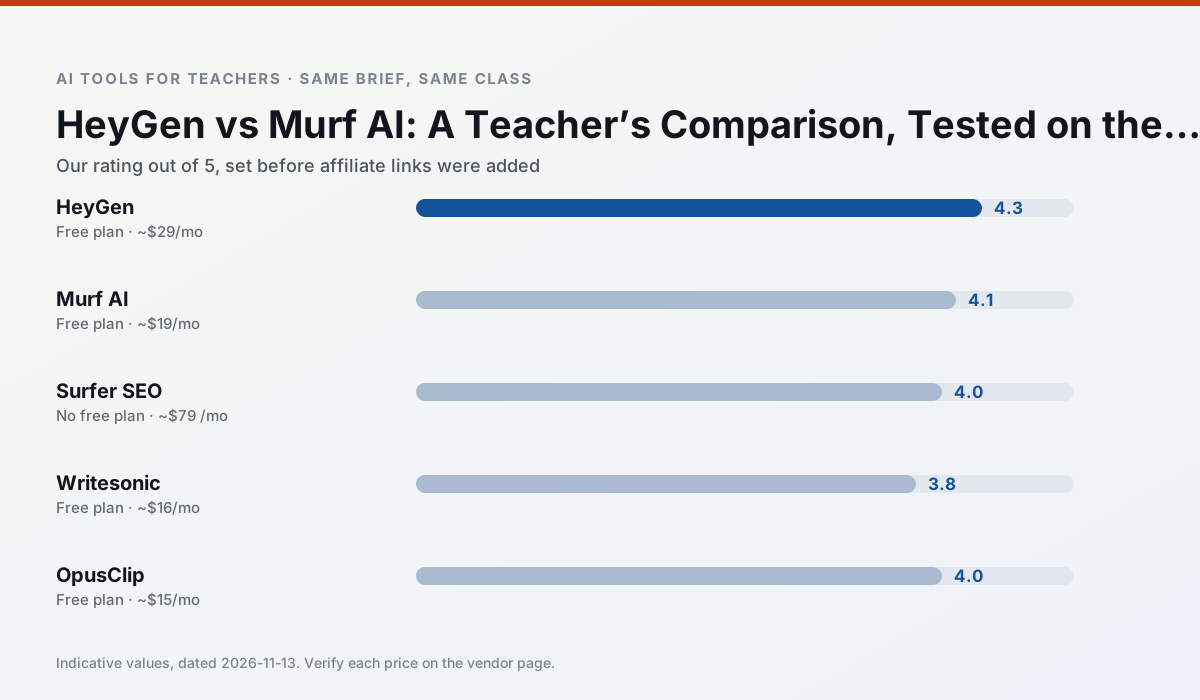
Side by side
Comparison table
Ratings reflect our timed classroom workflow, not vendor claims. Prices are indicative — verify on the vendor site.
| Tool | Best for | Free tier | Indicative paid plan | Standout feature | Our rating | Verdict | Try the tool |
|---|---|---|---|---|---|---|---|
| HeyGen | video lessons · translation | Yes — Limited credit plan | ~$29 /user/mo | Video translation | 4.3 / 5 | Strong option | Try free |
| Murf AI | audio lessons · accessibility | Yes — Trial-only output | ~$19 /user/mo | Voice fine-tuning | 4.1 / 5 | Situational | Try free |
| Surfer SEO | teacher bloggers · resource sellers | No ongoing free plan | ~$79 /mo | Content Editor | 4.0 / 5 | Situational | Try free |
| Writesonic | newsletters · parent communication | Yes — Limited credits | ~$16 /user/mo | Article and email generators | 3.8 / 5 | Situational | Try free |
| OpusClip | PD materials · flipped lessons | Yes — Limited monthly clips | ~$15 /user/mo | Auto captions | 4.0 / 5 | Situational | Try free |
| Fliki | video lessons · audio lessons | Yes — Watermarked, limited minutes | ~$21 /user/mo | Blog/text to video | 4.0 / 5 | Situational | Try free |
Match your situation
Best for X
Different jobs need different tools. Here is what we would open first in each case.
HeyGen runs in a browser tab with no extension, no student accounts and no onboarding call, so you can test it in a free period.
Murf AI answers the three questions a district actually asks: rostering, admin controls and a data-processing agreement. That is usually what decides a school purchase.
Nothing on Surfer SEO's free tier is a teaser demo; the limits are documented and a normal week fits inside them.
Writesonic wins on the default path: fewer clicks to a usable draft, and the interface does not get in the way at 7:40am.
Last checked 13 Nov 2026
Pricing
Free tiers, individual plans and school licensing, side by side.
| Tool | Free plan | Individual / paid | School & district | Billing note | Verify |
|---|---|---|---|---|---|
| HeyGen | $0 — Limited credit plan | ~$29 /user/mo | Custom quote | Indicative — verify on vendor site | Vendor |
| Murf AI | $0 — Trial-only output | ~$19 /user/mo | ~$39 /user/mo | Indicative — verify on vendor site | Vendor |
| Surfer SEO | No ongoing free tier | ~$79 /mo | Custom quote | Indicative — verify on vendor site | Vendor |
| Writesonic | $0 — Limited credits | ~$16 /user/mo | ~$49 /user/mo | Indicative — verify on vendor site | Vendor |
| OpusClip | $0 — Limited monthly clips | ~$15 /user/mo | ~$29 /user/mo | Indicative — verify on vendor site | Vendor |
| Fliki | $0 — Watermarked, limited minutes | ~$21 /user/mo | ~$66 /user/mo | Indicative — verify on vendor site | Vendor |
Editorial rule: pricing is re-checked every 2–3 months and the top 50 pages are refreshed every 6 months. See our funding policy.
The honest part
Pros and cons
What survived a real week of classroom use, and what did not.
Pros
- Best-in-class lip-sync translation
- Useful for multilingual families
- Generous trial credits
Cons
- Credit-based pricing is confusing
- Voice cloning raises consent questions
- Overkill for everyday lessons
Pros
- Very clean audio
- Good pacing controls
- Easy slide integration
Cons
- Commercial licensing rules matter
- Free tier is not usable long-term
- Single-purpose
Pros
- Best-in-class on-page guidance
- Useful for TpT / resource-shop content
- Clear scoring
Cons
- Expensive for individual teachers
- Not a classroom tool
- Requires SEO basics
Pros
- Cheaper than enterprise writing suites
- Many templates
- Reasonable free trial
Cons
- Generic classroom output
- Credit system is confusing
- Limited education context
Pros
- Turns a recorded lesson into review clips
- Excellent captions
- Fast
Cons
- Optimised for social formats
- Not a lesson design tool
- Free plan is restrictive
In the classroom
Use cases
Five concrete workflows, with the tool we would open for each one.
A parent email in two languages
Draft in plain, warm language with no names, translate, then back-translate the important sentences to check meaning. Keep specific incidents out of the prompt and add them yourself.
Recommended: HeyGenRubric and feedback comments in one pass
Reorder the workflow so the rubric is yours and the comments are generated. Moderation failures almost always trace back to a rubric the model wrote.
Recommended: Murf AIThree reading levels from one source text
Paste a vetted text, ask for supported, core and extension versions, then check the vocabulary list by hand. Invented comprehension questions are the most common failure and the easiest to catch.
Recommended: Surfer SEOA Monday morning lesson plan in twelve minutes
The twelve minutes come from not rewriting the skeleton. Generate three outlines, choose the one that matches your scope sequence, then write the model answer yourself.
Recommended: WritesonicA question bank from a PDF or article
Feed a non-identifiable source and ask for items tagged by difficulty with the misconception behind each distractor. Spot-check every answer key; numerical items are least reliable.
Recommended: OpusClip
Questions teachers ask us
FAQ
Direct answers, also published as FAQPage structured data for search and AI assistants.
HeyGen or Murf AI for lesson planning?
Which is cheaper for one teacher?
Do they produce the same output?
Sources & further reading
Our recommendation
Try HeyGen free for your next lesson planning task
AI avatar video and video translation for instructional content. Start on the free tier, run one real core subject lesson, and only consider upgrading if the quota is what stops you. Disclosure: we may earn a commission (35% recurring) at no extra cost to you.
Some links on this page are affiliate links. We may earn a commission at no extra cost to you. Our rankings are editorial and never pay-to-play. Never enter student PII into a free consumer account.
Keep reading
Related comparisons in this cluster.
Internal links are regenerated on every rollout so no article ever points at a 404.