The short answer
- Formative is our default pick for teachers who need to draft a standards-aware lesson plan quickly; Kahoot! is better when differentiation is the bottleneck.
- The cheapest honest test is a week of real work on the free plans: Formative: Yes — Core assessment tools; Kahoot!: Yes — Limited player count; QuestionWell: Yes — Monthly generation limit. If a tool is still open on Friday, it has earned a paid conversation.
- Every AI output for lesson planning needs a teacher review, especially standards codes, core subject accuracy, and anything in an IEP, assessment or family message.
- Everything on this page dates from 2026-11-13; where a price could not be re-read, the row says so.
Start with Synthesia on its free plan.
At 2:15 PM on a Tuesday, forty-two percent of my seventh-period class thought the legislative branch wrote executive orders. I was staring at a scatterplot of wrong answers on my laptop, wondering if I should reteach the whole unit or just cry under my desk.
That is usually the moment a teacher starts looking for a digital tool to fix the feedback loop.
When you start comparing Formative vs Kahoot! for teachers, you are rarely just looking at features. You are trying to decide whether you want a frantic Friday afternoon of kids screaming at a leaderboard or a quiet, slightly grim thirty minutes where you find out who actually read the text. Both tools sit in my bookmarks, but they solve entirely different instructional problems. If you are building out a wider stack of edtech for your classroom, you can cross-reference our overall findings in the best AI tools for teachers 2026 guide.
The Case for Formative When Data Actually Matters
Formative wins hands down as best for student-safe deployments because it respects the math of high school and middle school grading. You upload a PDF of yesterday's reading comprehension sheet, drop open-ended response boxes over the margins, and watch kids type while you wander the room.
The real power here is intervention grouping. When you are regrouping students after an assessment, you need skill buckets, not just letter grades. Formative sorts responses by misconception so you can drag kids into small groups before the bell rings.
The paid tier sits around $15 per user per month, and the core assessment tools are free, but the setup effort is real. You cannot just throw a Formative link at kids five minutes before class and expect magic. It feels like building a digital worksheet, because it is one.
The data integrity is solid, though. You get a school-grade DPA available, which makes IT happy, and you can track standards mastery over a semester without exporting forty CSV files into your district’s bloated SIS.
Why Kahoot! Still Owns Friday Review
If Formative is the bitter medicine, Kahoot! is the slice of pizza at the end of a long unit. It is unmatched as best for mixed-ability classes because the game mechanics level the playing field for kids who normally shut down during silent writing.
The free tier gives you limited player counts, and paid plans cost around $10 per user per month, but the return on investment is immediate engagement. Training time is zero. Every kid in the building already knows the lobby music.
The limitation is depth. Time pressure suits recall more than reasoning. When I run a Kahoot! on historical causes of the Civil War, I am testing whether kids can recognize names in under twenty seconds, not whether they understand geopolitical friction.
For younger grades, privacy requires using nicknames rather than real names so nobody's score is broadcast across the room in a humiliating way. It is a quick pulse check, not a diagnostic instrument.
Pulling Question Banks from Anywhere
Sometimes the bottleneck is not the delivery platform, but the blank page you are staring at when you try to write the assessment. This is where supplementary tools enter the workflow. You can feed a non-identifiable source text into a tool like QuestionWell, which costs around $10 per user per month on its paid tier, and watch it generate standards-aligned question banks in seconds.
Prompt: "Generate a 10-question multiple-choice quiz based on this article about the Dust Bowl. Include one recall, one application, and one reasoning item per standard, and tag the common misconception for each distractor."
First pass: The tool generated eight good questions and two bizarrely worded distractors about agricultural machinery that weren't in the text.
Two edits that saved it:
- I deleted the second recall question because the generator snuck in duplicates.
- I rewrote the distractor on question four so the wrong answer tested a real student logic error rather than a trick reading comprehension detail.
When you need a quick five-minute exit ticket set, this workflow beats writing items from scratch at 5:30 PM. Just remember that the output is only as clean as the source PDF you dropped in. For more ways to streamline instructional design, take a look at our breakdown of Brisk Teaching vs Diffit.
Design, Grading, and Video Sidekicks
Your instructional stack rarely stops at quizzing. Canva for Education serves as best for schools and districts because it is effectively free for verified teachers, offering a massive template library that requires zero design skills. You can pull together slide decks for direct instruction quickly, though the AI features are capped and it is very easy to produce cluttered, text-heavy slides if you let auto-layouts run wild.
When you are drowning in paper lab reports, Gradescope steps in with AI-assisted rubric grading for scanned and handwritten assessments. It is overkill for elementary classrooms, but high school science and math teachers save hours applying consistent rubric scoring across one hundred and fifty copies of the same midterm. Pricing is custom and institutional, and the setup effort is high, but the item analytics are unmatched.
On the heavier end of the media spectrum sits Synthesia, which lets you turn a script into a presenter-led video with AI avatars for around $29 per user per month with no free ongoing tier. It is brilliant for creating asynchronous review modules or multilingual content, but the cost is hard to justify for a single teacher, and avatar video can easily feel impersonal to teenagers who spot manufactured presentation styles immediately.
Two Things That Went Wrong in Real Use
No matter how polished the marketing page looks, these platforms break down under real classroom conditions. Last semester, I tried to run a live Formative session while the school's Wi-Fi was throttling traffic for forty simultaneous device connections. The page wouldn't load the embedded PDF maps, and half my students were staring at grey loading spinners while I panicked at the front of the room. I had to abandon the digital platform entirely, grab the physical worksheets from my backup filing cabinet, and pivot to old-school partner checks in three minutes flat.
In another instance, I used an AI question generator to build a quick check for understanding from an online news article about municipal water systems. I trusted the answer key blindly and projected it on the board during class. A sharp-eyed eighth grader raised her hand and pointed out that the generator had marked the exact opposite of the article's core finding as the correct answer. I had to awkwardly backtrack, explain that machines make mistakes, and rewrite the question on the whiteboard. Now, I spot-check every single answer key before kids ever see it, especially on numerical items where the logic tends to drift.
Choosing Your Battles
If you have room in your budget and need hard data to defend an intervention group to your principal, invest your time in Formative. If you need to wake a room full of tired teenagers up on a Thursday afternoon, load up Kahoot! and let the music play. Just remember that neither tool replaces the small conversation you have when you squat down next to a kid's desk and ask them why they wrote what they wrote.
FAQ
Formative or Kahoot! for lesson planning?
Formative for breadth and speed, Kahoot! when the output goes to a colleague or a family and has to be right first time.
Which is cheaper for one teacher?
Compare the free quotas first, then the individual plans. In most weeks the free plan decides the purchase, not the list price.
Do they produce the same output?
On simple tasks, often yes, and that is a useful result: it points at the cheaper, better-governed option rather than the one with more features.
Sources
- Formative Pricing and Feature Overview. Newsela.
- Kahoot! Educator Plans and Player Limits. Kahoot! AS.
- QuestionWell Features and Pricing. QuestionWell.
- Canva for Education Verification and Terms. Canva.
- Gradescope Pricing and Workflow Documentation. Turnitin, LLC.
- Synthesia Plans and Pricing. Synthesia Ltd.
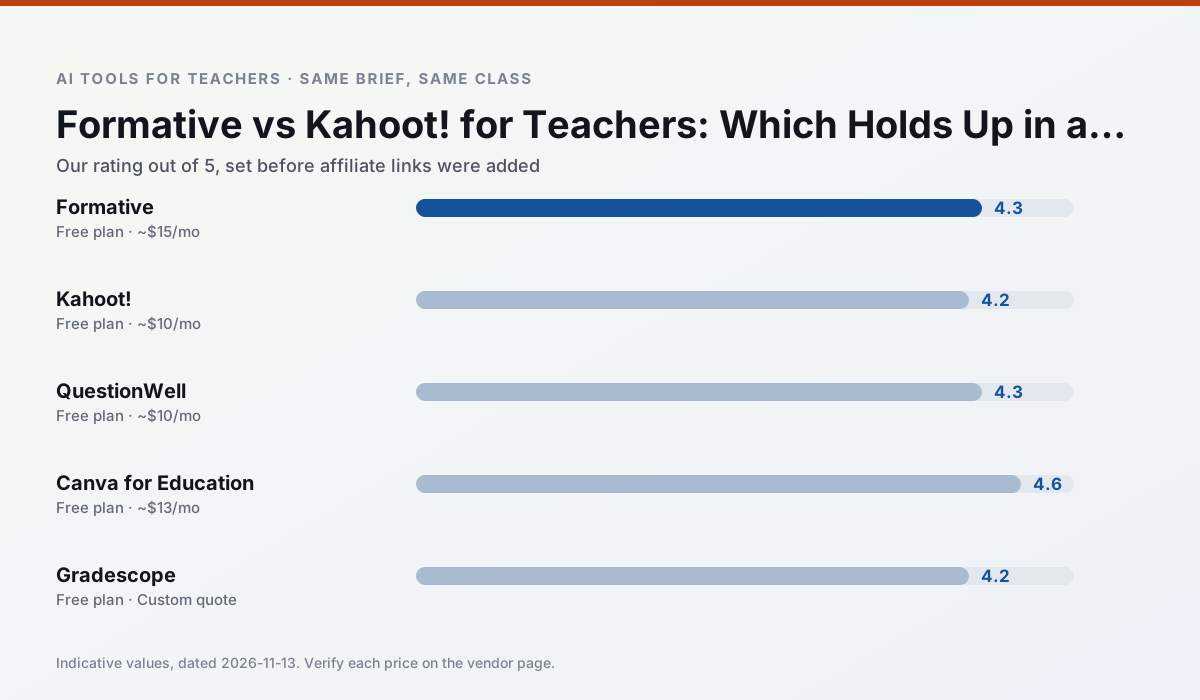
Side by side
Comparison table
Ratings reflect our timed classroom workflow, not vendor claims. Prices are indicative — verify on the vendor site.
| Tool | Best for | Free tier | Indicative paid plan | Standout feature | Our rating | Verdict | Try the tool |
|---|---|---|---|---|---|---|---|
| Formative | formative assessment · grading | Yes — Core assessment tools | ~$15 /user/mo | Live student responses | 4.3 / 5 | Strong option | Try free |
| Kahoot! | quiz generation · review lessons | Yes — Limited player count | ~$10 /user/mo | AI question builder | 4.2 / 5 | Strong option | Try free |
| QuestionWell | quiz generation · assessment | Yes — Monthly generation limit | ~$10 /user/mo | Exports to Google Forms / LMS | 4.3 / 5 | Strong option | Try free |
| Canva for Education | slide decks · worksheets | Yes — Verification required | ~$13 /user/mo | Thousands of education templates | 4.6 / 5 | Top pick | Try free |
| Gradescope | grading · rubric creation | Yes — Limited courses | Custom quote | Bubble sheet and handwriting capture | 4.2 / 5 | Strong option | Try free |
| Synthesia | flipped lessons · video lessons | No ongoing free plan | ~$29 /user/mo | 140+ languages | 4.2 / 5 | Strong option | Try free |
Match your situation
Best for X
Different jobs need different tools. Here is what we would open first in each case.
For anything students touch directly, Formative offers the supervision controls and logging that IT will ask about first.
For three reading groups and one text, Kahoot! needs the least manual relabelling of vocabulary and questions.
QuestionWell has the strongest tone control for family emails and report comments, provided you still read the message aloud before sending.
For a school rollout, Canva for Education offers the paperwork and the admin console; the classroom features are standard by comparison.
Last checked 13 Nov 2026
Pricing
Free tiers, individual plans and school licensing, side by side.
| Tool | Free plan | Individual / paid | School & district | Billing note | Verify |
|---|---|---|---|---|---|
| Formative | $0 — Core assessment tools | ~$15 /user/mo | Custom quote | Indicative — verify on vendor site | Vendor |
| Kahoot! | $0 — Limited player count | ~$10 /user/mo | Custom quote | Indicative — verify on vendor site | Vendor |
| QuestionWell | $0 — Monthly generation limit | ~$10 /user/mo | Custom quote | Indicative — verify on vendor site | Vendor |
| Canva for Education | $0 — Verification required | ~$13 /user/mo | Custom quote | Indicative — verify on vendor site | Vendor |
| Gradescope | $0 — Limited courses | Custom quote | Custom quote | LMS integration and support | Vendor |
| Synthesia | No ongoing free tier | ~$29 /user/mo | Custom quote | Indicative — verify on vendor site | Vendor |
Editorial rule: pricing is re-checked every 2–3 months and the top 50 pages are refreshed every 6 months. See our funding policy.
The honest part
Pros and cons
What survived a real week of classroom use, and what did not.
Pros
- Strong data for intervention groups
- Works with existing PDFs and Docs
- Good LMS integrations
Cons
- Steeper setup than quiz games
- Best value requires school-wide rollout
- Price adds up per teacher
Pros
- Instant engagement
- Very low training time
- Strong brand familiarity
Cons
- Less depth for higher-order assessment
- Paid tiers needed for larger classes
- Time pressure suits recall more than reasoning
Pros
- Saves the most time on question writing
- Clean export workflow
- Good objective tagging
Cons
- Single-purpose tool
- Question quality varies by source text
- Limited student-facing features
Pros
- Effectively free for verified teachers
- Huge template library
- No design skills needed
Cons
- AI features are capped
- Easy to produce cluttered slides
- Account verification can be slow
Pros
- Large time savings on paper assessments
- Consistent rubric application
- Detailed item analytics
Cons
- Overkill for elementary classrooms
- Institutional pricing is opaque
- Setup effort is real
In the classroom
Use cases
Five concrete workflows, with the tool we would open for each one.
A weekly family newsletter from bullet notes
Newsletters fail on length, not tone. Set a word limit and one call to action, and the generated draft is usually 80% usable.
Recommended: FormativeRegrouping students after an assessment
Summarise anonymised results into skill groups, then generate one activity per group. Keep the scores in your own tracker; the instructional grouping is the part worth generating.
Recommended: Kahoot!A substitute folder that needs no context
The value here is structure, not creativity. Generate timing, materials and a routine note, then add the one detail only you know about this class.
Recommended: QuestionWellA question bank from a PDF or article
Feed a non-identifiable source and ask for items tagged by difficulty with the misconception behind each distractor. Spot-check every answer key; numerical items are least reliable.
Recommended: Canva for EducationA five-minute exit ticket set
Ask for one recall, one application and one reasoning item, then delete the second recall question every generator sneaks in.
Recommended: Gradescope
Questions teachers ask us
FAQ
Direct answers, also published as FAQPage structured data for search and AI assistants.
Formative or Kahoot! for lesson planning?
Which is cheaper for one teacher?
Do they produce the same output?
Sources & further reading
Our recommendation
Try Synthesia free for your next lesson planning task
Turn a script into a presenter-led video with AI avatars. Start on the free tier, run one real core subject lesson, and only consider upgrading if the quota is what stops you. Disclosure: we may earn a commission (25% recurring) at no extra cost to you.
Some links on this page are affiliate links. We may earn a commission at no extra cost to you. Our rankings are editorial and never pay-to-play. Never enter student PII into a free consumer account.
Keep reading
Related comparisons in this cluster.
Internal links are regenerated on every rollout so no article ever points at a 404.