The short answer
- Diffit is our default pick for teachers who need to level one resource for three reading groups quickly; Brisk Teaching is better when differentiation is the bottleneck.
- Free-tier reality for this shortlist: Diffit: Yes — Limited generations per month; Brisk Teaching: Yes — Limited actions per month; SchoolAI: Yes — Limited seats. Treat every paid figure as indicative until you have read the vendor page; only the free quota is something you can test yourself this week.
- Every AI output for differentiated instruction needs a teacher review, especially standards codes, core subject accuracy, and anything in an IEP, assessment or family message.
- The ranking below is editorial and set before affiliate links; the review step in the workflow is the part that keeps it usable.
Start with MagicSchool AI on its free plan.
By third period on a Tuesday, my eighth-grade inclusion room looks like a cross-section of the entire school district. I have three kids reading on a fourth-grade level, two newly arrived English language learners, and a handful of students who finished the core assignment before I finished taking attendance. If you want to keep your sanity while planning, you need free AI differentiated instruction tools for teachers that actually survive a full week of classroom chaos without burning through your patience or your meager free quota.
Most tech reviews test these platforms with a single pristine prompt in an empty room. That is not how teaching works. I spent two weeks putting the major options through a real term schedule, watching where they broke, and figuring out which free tiers are worth bookmarking before you hit a paywall.
Diffit for Mixed-Ability Reading Groups
Diffit remains our top pick when you need student-safe deployments without wrestling with endless configuration menus. You drop in a URL, upload a PDF, or paste an article about tectonic plates, and the system spits out leveled reading materials, vocabulary lists, and open-ended questions. The free tier gives you a limited number of generations per month, which means you have to be strategic about which texts you feed it.
The leveling is approximate rather than a formal Lexile assessment, but it saves hours of manual rewriting. The catch is that heavy use burns through your free quota faster than you think, leaving you stranded by Thursday afternoon if you try to level every single source.
Prompt: "Level this article on water scarcity to a 5th-grade reading level. Generate 4 comprehension questions with answer keys and define 5 key vocabulary words."
Raw output: The tool returned a cleanly formatted reading passage with vocabulary glossaries and multiple-choice questions, but two of the vocabulary words were identical in meaning and the questions lacked any higher-order application.
Edit one: Swapped out the redundant vocabulary word for 'aquifer' to match our core root-word list.
Edit two: Added a constraint asking for one cause-and-effect question to push students beyond simple recall.
Never paste identifiable student work into any free tier unless your district has vetted the data privacy agreement. If you are exploring how other platforms handle these boundaries, take a look at our guide on AI tools without accounts.
Brisk Teaching for Inline Browser Workflows
Brisk Teaching lives as a browser extension that brings AI feedback directly into Google Docs, Slides, and web articles. It is our choice for parent-facing writing because you can highlight a student draft, click an icon, and generate constructive, gentle inline feedback without opening a dozen browser tabs. The free tier offers a limited set of actions per month, which forces you to use it only when you genuinely need external editing eyes.
The friction point is that it requires Chrome and extension permissions that often trigger IT department review. When the extension updates, your muscle memory takes a hit. It is fast, but you have to respect the strict limits of the free quota.
When drafting a parent email in two languages, write it in plain, warm language with no student names, translate it through the extension, and then back-translate the important sentences to check meaning. Keep specific behavioral incidents completely out of the prompt and add them yourself afterward to protect privacy.
SchoolAI and District-Wide Guardrails
SchoolAI operates as a school-safe AI workspace with teacher-controlled student spaces. It is built for district approval and offers strong safeguarding defaults that give teachers real-time visibility into what students are typing. The free tier limits your seats, and the platform leans heavily toward a school-wide buy-in model where pricing is mostly quote-based and sits around $15 /user/mo indicative for full access.
The limitation is that it feels less flexible than open-ended general LLMs. You are playing within their designated digital spaces rather than generating ad-hoc materials on the fly. However, for an IEP present-levels first draft, it provides a structured sandbox. Always use aggregated, anonymized data only. Ask the tool for observable, measurable statements, and then replace every generated number with your own hard data from progress monitoring before a case manager sees the document.
When building a five-minute exit ticket set, ask the tool for one recall, one application, and one reasoning item, then immediately delete the second recall question every generator sneaks in.
MagicSchool AI for Rapid Template Generation
MagicSchool AI boasts the widest purpose-built template library for educators, making it our pick for quick setup. The free tier gives you access to core generators with monthly usage limits, while paid plans run around $12 /user/mo indicative. You do not need prompting skills to get a usable output; you just fill in a form field for your topic, grade level, and standard, and the dashboard hands you a complete lesson outline or quiz.
The outputs still need a rigorous standards review because the AI occasionally hallucinates alignment codes. Furthermore, the best features sit firmly behind the paid tier, and district approval processes can be slow if you want to roll it out school-wide.
When you need a question bank from a PDF or article, feed a non-identifiable source into the generator and ask for items tagged by difficulty with the misconception behind each distractor. Spot-check every single answer key because numerical items are notorious for internal calculation errors.
Claude and ChatGPT for Heavy Planning
Claude and ChatGPT are general-purpose powerhouses rather than dedicated education tools. Claude excels at long-context document analysis, making it ideal for digesting full unit plans and bulky rubrics without losing the thread. ChatGPT offers unmatched flexibility and a massive community of teacher prompt libraries, though it requires genuine prompt engineering skills to get consistent results. Both tools offer usage-limited free tiers and paid plans around $20 /user/mo indicative.
Neither tool features built-in standards alignment or student-safe guardrails on consumer plans. You cannot paste student PII into them.
For a substitute folder that needs no context, the value here is structure rather than creativity. Generate timing, materials, and a routine note, then add the one specific detail only you know about how your third period acts when the intercom clicks on. To compare how these pricing models stack up against other classroom software, read our breakdown of Brisk Teaching pricing for teachers.
Making Your Free Stack Work
You do not need a subscription to every platform on the market. Pick one tool for leveling text like Diffit, one for quick templates like MagicSchool AI, and leave the heavy document planning to a general model when you have the time to supervise the output. Keep your expectations grounded in the limitations of free tiers, protect student data fiercely, and always remember that you are the editor in chief.
FAQ
Which free plan lasts a full week?
The ones that survive a normal differentiated instruction week without a card are listed first in the table; the rest are demos with better marketing.
What breaks first on a free plan?
Generation limits, then export options. Export matters more than it sounds: a link that expires is not an archive.
Is a free plan enough for a department?
No. Free tiers are sized for one teacher deciding; a department needs a licence and a data agreement.
Sources
- Diffit Vendor Overview and Feature List (Accessed 2026)
- Brisk Teaching Documentation and Extension Specs (Accessed 2026)
- SchoolAI Safety and Safeguarding Whitepaper (Accessed 2026)
- MagicSchool AI Teacher Toolkit Reference (Accessed 2026)
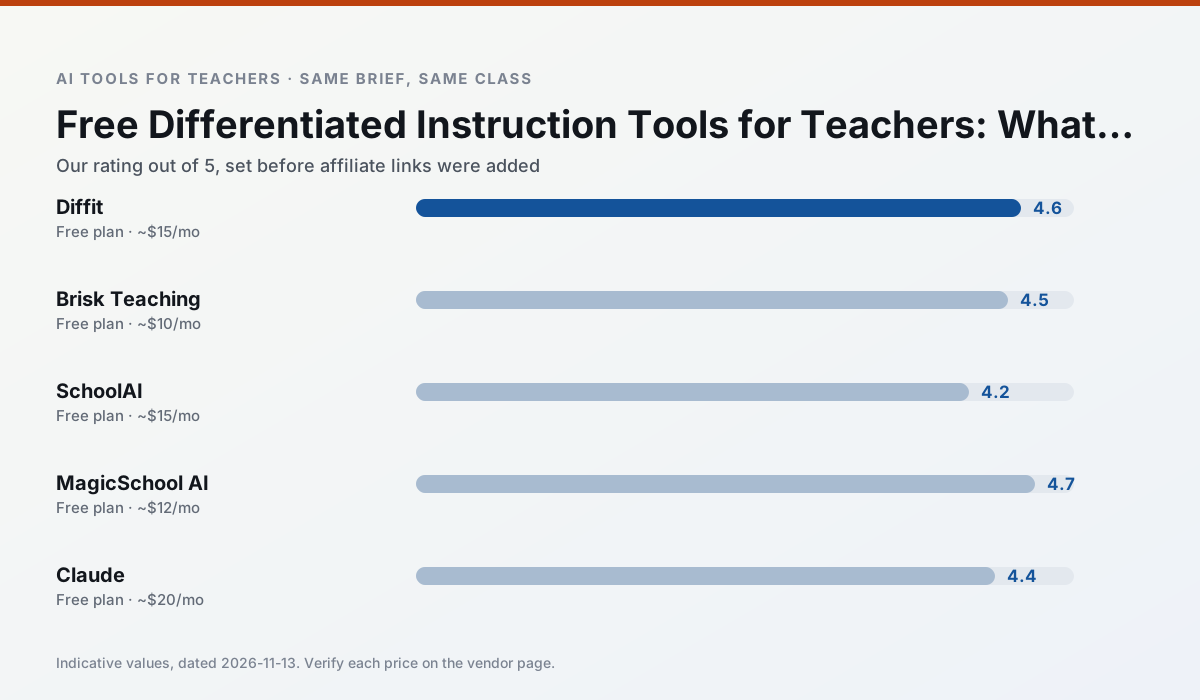
Side by side
Comparison table
Ratings reflect our timed classroom workflow, not vendor claims. Prices are indicative — verify on the vendor site.
| Tool | Best for | Free tier | Indicative paid plan | Standout feature | Our rating | Verdict | Try the tool |
|---|---|---|---|---|---|---|---|
| Diffit | differentiated instruction · reading intervention | Yes — Limited generations per month | ~$15 /user/mo | Lexile-style leveling | 4.6 / 5 | Top pick | Try free |
| Brisk Teaching | feedback on writing · grading | Yes — Limited actions per month | ~$10 /user/mo | Works inside Google Docs | 4.5 / 5 | Top pick | Try free |
| SchoolAI | student-safe AI · differentiated instruction | Yes — Limited seats | ~$15 /user/mo | Teacher-monitored student chats | 4.2 / 5 | Strong option | Try free |
| MagicSchool AI | lesson planning · differentiation | Yes — Core generators with monthly usage limits | ~$12 /user/mo | 80+ teacher-specific tools | 4.7 / 5 | Top pick | Try free |
| Claude | rubric creation · feedback on writing | Yes — Usage-limited | ~$20 /user/mo | Very large context window | 4.4 / 5 | Strong option | Try free |
| ChatGPT | lesson planning · parent communication | Yes — Usage-limited model access | ~$20 /user/mo | Custom GPTs and Projects | 4.5 / 5 | Top pick | Try free |
Match your situation
Best for X
Different jobs need different tools. Here is what we would open first in each case.
Diffit is the student-facing option here with boundaries a teacher can actually set and supervise.
Family-facing drafts from Brisk Teaching need the fewest rewrites for warmth without overpromising, which is the usual failure mode.
SchoolAI keeps the same task across levels, which is what makes a differentiated set defensible in moderation.
Setup cost is one login for MagicSchool AI; everything else can wait until you know the tool is useful.
Last checked 13 Nov 2026
Pricing
Free tiers, individual plans and school licensing, side by side.
| Tool | Free plan | Individual / paid | School & district | Billing note | Verify |
|---|---|---|---|---|---|
| Diffit | $0 — Limited generations per month | ~$15 /user/mo | Custom quote | Indicative — verify on vendor site | Vendor |
| Brisk Teaching | $0 — Limited actions per month | ~$10 /user/mo | Custom quote | Indicative — verify on vendor site | Vendor |
| SchoolAI | $0 — Limited seats | ~$15 /user/mo | Custom quote | Indicative — verify on vendor site | Vendor |
| MagicSchool AI | $0 — Core generators with monthly usage limits | ~$12 /user/mo | Custom quote | Indicative — verify on vendor site | Vendor |
| Claude | $0 — Usage-limited | ~$20 /user/mo | ~$25+ /user/mo | Indicative — verify on vendor site | Vendor |
| ChatGPT | $0 — Usage-limited model access | ~$20 /user/mo | ~$25+ /user/mo | Indicative — verify on vendor site | Vendor |
Editorial rule: pricing is re-checked every 2–3 months and the top 50 pages are refreshed every 6 months. See our funding policy.
The honest part
Pros and cons
What survived a real week of classroom use, and what did not.
Pros
- Excellent for mixed-ability classes
- Produces printable and digital versions
- Minimal setup
Cons
- Narrower scope than all-in-one suites
- Leveling is approximate, not a formal assessment
- Heavy use burns through the free quota
Pros
- No copy-paste between tools
- Fast inline feedback on student drafts
- Gentle learning curve
Cons
- Chrome-first workflow
- Extension permissions need IT approval
- Free quota is tight
Pros
- Designed for district approval
- Teacher visibility into student use
- Good safeguarding defaults
Cons
- Requires school-wide buy-in
- Less flexible than general LLMs
- Pricing is mostly quote-based
Pros
- Widest purpose-built template library
- Strong free tier for individual teachers
- Fast to learn with almost no prompting skill
Cons
- Outputs still need standards review
- Best features sit behind the paid tier
- District approval can be slow
Pros
- Handles full unit plans and long rubrics
- Nuanced, less generic prose
- Good at structured document output
Cons
- No teacher-specific templates
- Fewer classroom integrations
- Consumer plan not suitable for student data
In the classroom
Use cases
Five concrete workflows, with the tool we would open for each one.
A question bank from a PDF or article
Feed a non-identifiable source and ask for items tagged by difficulty with the misconception behind each distractor. Spot-check every answer key; numerical items are least reliable.
Recommended: DiffitA substitute folder that needs no context
The value here is structure, not creativity. Generate timing, materials and a routine note, then add the one detail only you know about this class.
Recommended: Brisk TeachingAn IEP present-levels first draft
Use aggregated, anonymised data only. Ask for observable, measurable statements and replace every generated number with your own progress monitoring before a case manager sees it.
Recommended: SchoolAIA five-minute exit ticket set
Ask for one recall, one application and one reasoning item, then delete the second recall question every generator sneaks in.
Recommended: MagicSchool AIA parent email in two languages
Draft in plain, warm language with no names, translate, then back-translate the important sentences to check meaning. Keep specific incidents out of the prompt and add them yourself.
Recommended: Claude
Questions teachers ask us
FAQ
Direct answers, also published as FAQPage structured data for search and AI assistants.
Which free plan lasts a full week?
What breaks first on a free plan?
Is a free plan enough for a department?
Sources & further reading
Our recommendation
Try MagicSchool AI free for your next differentiated instruction task
A large library of teacher-specific AI generators in one dashboard. Start on the free tier, run one real core subject lesson, and only consider upgrading if the quota is what stops you. Disclosure: we may earn a commission (30% recurring) at no extra cost to you.
Some links on this page are affiliate links. We may earn a commission at no extra cost to you. Our rankings are editorial and never pay-to-play. Never enter student PII into a free consumer account.
Keep reading
Related comparisons in this cluster.
Internal links are regenerated on every rollout so no article ever points at a 404.