The short answer
- Canva for Education is our default pick for teachers who need to draft a standards-aware lesson plan quickly; Brisk Teaching is better when differentiation is the bottleneck.
- Start with Canva for Education on its free plan, keep Brisk Teaching as the second opinion, and do not open a card until the quota, not the feature list, is what stops you.
- Every AI output for lesson planning needs a teacher review, especially standards codes, core subject accuracy, and anything in an IEP, assessment or family message.
- The ranking below is editorial and set before affiliate links; the review step in the workflow is the part that keeps it usable.
Start with MagicSchool AI on its free plan.
Thirty-four unverified student accounts, a dying projector bulb, and twenty-eight minutes until the bell. That was the morning I tried to build a slide deck about sedimentary rock formation while dodging three separate pop-up blockers. If you teach middle school, you already know why I turned to Canva for Education pricing for teachers by third period. I needed to know if the zero-dollar price tag was a trap or if my school's IT department was going to block half the templates before my first-period class walked in.
Canva for Education occupies a weird spot in our stack. It sits somewhere between a professional design studio and a digital playground where kids try to animate every single letter of their name in Comic Sans. For a deep dive into how these ecosystems fit together, check out our guide on best AI tools for teachers in 2026. But right now, let us look at the cost, the catches, and what you actually get when you stop using the free consumer version and jump through the verification hoops.
The Free Tier and the Verification Hurdle
The single biggest selling point of Canva for Education is that it is effectively free for verified educators and their students. That means no watermarks, full access to millions of premium graphics, and zero surprise credit card charges at the end of the month. However, the catch is the verification process itself. You have to prove you hold a valid teaching credential or school email address, and during peak back-to-school season in August and September, that approval queue can crawl.
When your account finally clears, you inherit a massive template library that requires almost zero design skills to make look professional. If you want a closer look at how subscription models stack up across the board, our breakdown on brisk teaching pricing teachers cost offers a helpful comparison for workspace tools. Yet, ease of use has a dark side. The AI writing and image features built into Canva are capped, meaning heavy users will hit usage walls right when they are trying to generate twenty different versions of a vocabulary worksheet.
When Visual Tools Hit the AI Wall
Canva is great for making things look pretty, but it is not built for heavy writing or nuanced lesson planning. If you try to build an entire curriculum inside a slide deck, you end up with cluttered visuals that overwhelm students with working memory limits. We have all seen those slides where a teacher tries to cram a graphic, a definition, a QR code, and a cartoon owl onto a single horizontal plane.
Prompt: Create a set of five instructional slides for 7th-grade science explaining the difference between intrusive and extrusive igneous rocks, using simple diagrams and a 3-question check for understanding.
Result: Canva generated a visually stunning deck with lovely rock textures, but the text was buried in decorative script and the quiz questions were far too advanced for the vocabulary level.
Edits:
- Swapped all body text back to a standard sans-serif font to protect readability for struggling readers.
- Deleted two of the decorative background illustrations and replaced the generated quiz questions with targeted prompts drawn directly from our district curriculum standards.
Where Paid Upgrades Fit In
Beyond the free educator tier, individual paid plans sit at roughly $13 per user per month if you step outside the K-12 parameters, though schools usually handle enterprise deployment differently. If you are comparing this against general-purpose assistants, our look at chatgpt pricing teachers cost breaks down the $20-per-month consumer tier. ChatGPT and Claude both run about $20 per user per month for paid access, while targeted classroom add-ons like Brisk Teaching hover around $10 per user per month, and Khanmigo offers student-facing tutoring at roughly $4 per learner per month. Curipod runs around $12 per user per month for its interactive lesson delivery features.
Of course, throwing money at software does not fix bad workflows. Two distinct things went wrong during my term trial of these blended toolsets. First, I tried using Canva's AI image generator to create historical figures for a social studies project, and the tool rendered Abraham Lincoln with six fingers and an impossible collar. I had to abandon the image generation entirely and swap to public domain photographs. Second, when I tried to export a massive interactive lesson to a district device that blocked third-party cookies, the entire presentation locked up mid-lesson. I kept a PDF backup on my desktop, which saved me from a complete instructional meltdown.
Choosing the Right Tool for the Job
Different tasks demand different software, and trying to force Canva to do the job of a long-context document planner or an interactive response tool is a fast track to burnout. Here is how the current landscape shakes out for daily classroom use:
- Canva for Education: Best for quick setup and visual design tasks when you need a polished worksheet or slide deck in under ten minutes.
- Brisk Teaching: Best for schools and districts that want inline feedback directly inside Google Docs without forcing teachers to juggle a dozen different browser tabs.
- Khanmigo: Best free option for US teachers looking for safe, nonprofit-backed math scaffolding and student tutoring.
- Claude: Best overall for daily use when you need to plan long units, parse messy rubrics, or draft nuanced parent communications without generic AI fluff.
Before you roll any of these out to an entire grade level, check your district's data privacy posture. The education tier of Canva carries specific student-data terms that require a careful read, especially if your state has strict compliance laws regarding minor data collection.
FAQ
What does Canva for Education cost per teacher?
The individual plan is the public number; the school plan is a quote. Both are shown with the date read, and neither is a live price.
Is there a free plan?
No ongoing free tier, only a trial. Check the free-tier column in the table for the current limits.
What does a district pay for?
Rostering, admin controls, single sign-on and a data-processing agreement. None of those can be trialled by an individual teacher.
Sources
- Canva Educator Resources and Program Overview. Canva.
- Brisk Teaching Extensions and Pricing Documentation. Brisk.
- Khanmigo for Teachers and Districts. Khan Academy.
- Claude Pricing and Plan Tiers. Anthropic.
- ChatGPT Educator Use Guidelines. OpenAI.
- Curipod Interactive Lesson Plans. Curipod.
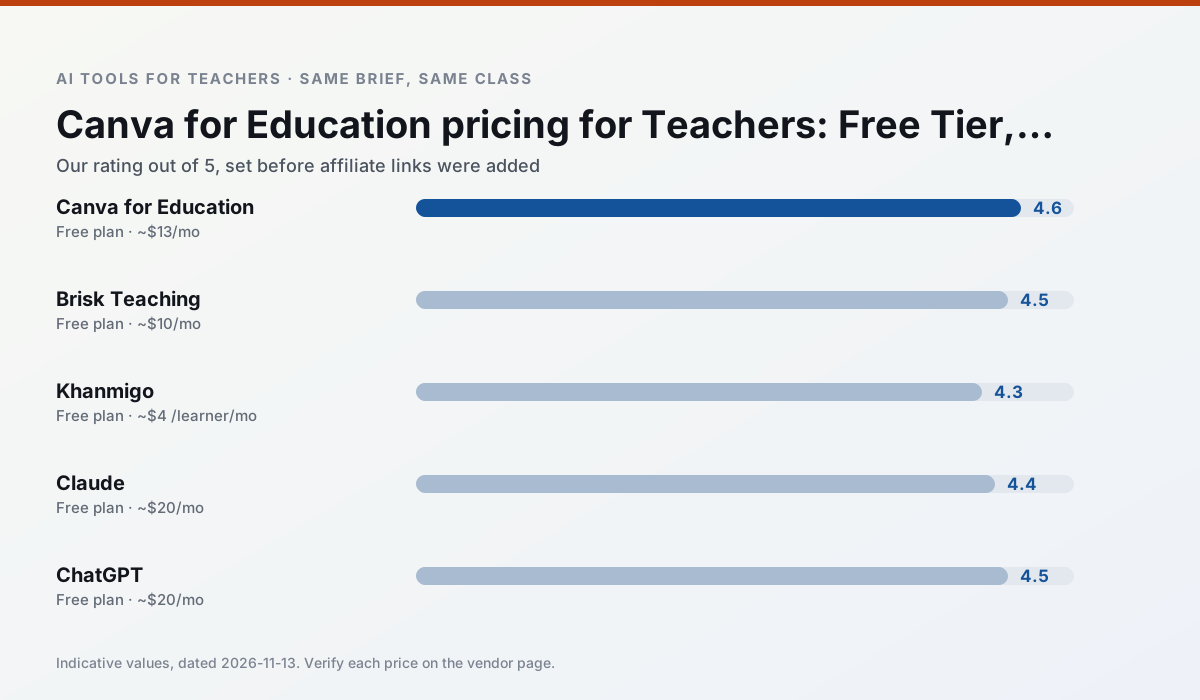
Side by side
Comparison table
Ratings reflect our timed classroom workflow, not vendor claims. Prices are indicative — verify on the vendor site.
| Tool | Best for | Free tier | Indicative paid plan | Standout feature | Our rating | Verdict | Try the tool |
|---|---|---|---|---|---|---|---|
| Canva for Education | slide decks · worksheets | Yes — Verification required | ~$13 /user/mo | Thousands of education templates | 4.6 / 5 | Top pick | Try free |
| Brisk Teaching | feedback on writing · grading | Yes — Limited actions per month | ~$10 /user/mo | Works inside Google Docs | 4.5 / 5 | Top pick | Try free |
| Khanmigo | math practice · student tutoring | Yes — US teacher accounts, subject to eligibility | ~$4 /learner/mo | Socratic tutoring rather than answers | 4.3 / 5 | Strong option | Try free |
| Claude | rubric creation · feedback on writing | Yes — Usage-limited | ~$20 /user/mo | Very large context window | 4.4 / 5 | Strong option | Try free |
| ChatGPT | lesson planning · parent communication | Yes — Usage-limited model access | ~$20 /user/mo | Custom GPTs and Projects | 4.5 / 5 | Top pick | Try free |
| Curipod | formative assessment · exit tickets | Yes — Limited lessons per month | ~$12 /user/mo | Live polls and word clouds | 4.4 / 5 | Strong option | Try free |
Match your situation
Best for X
Different jobs need different tools. Here is what we would open first in each case.
Canva for Education has the shortest path from opening a tab to a usable draft, which matters more than the feature count on a Monday.
For a school rollout, Brisk Teaching offers the paperwork and the admin console; the classroom features are standard by comparison.
Nothing on Khanmigo's free tier is a teaser demo; the limits are documented and a normal week fits inside them.
On the daily cycle, Claude saves the most edit time per task; the paid tier mostly buys more runs rather than better ones.
Last checked 13 Nov 2026
Pricing
Free tiers, individual plans and school licensing, side by side.
| Tool | Free plan | Individual / paid | School & district | Billing note | Verify |
|---|---|---|---|---|---|
| Canva for Education | $0 — Verification required | ~$13 /user/mo | Custom quote | Indicative — verify on vendor site | Vendor |
| Brisk Teaching | $0 — Limited actions per month | ~$10 /user/mo | Custom quote | Indicative — verify on vendor site | Vendor |
| Khanmigo | $0 — US teacher accounts, subject to eligibility | ~$4 /learner/mo | Custom quote | Indicative — verify on vendor site | Vendor |
| Claude | $0 — Usage-limited | ~$20 /user/mo | ~$25+ /user/mo | Indicative — verify on vendor site | Vendor |
| ChatGPT | $0 — Usage-limited model access | ~$20 /user/mo | ~$25+ /user/mo | Indicative — verify on vendor site | Vendor |
| Curipod | $0 — Limited lessons per month | ~$12 /user/mo | Custom quote | Indicative — verify on vendor site | Vendor |
Editorial rule: pricing is re-checked every 2–3 months and the top 50 pages are refreshed every 6 months. See our funding policy.
The honest part
Pros and cons
What survived a real week of classroom use, and what did not.
Pros
- Effectively free for verified teachers
- Huge template library
- No design skills needed
Cons
- AI features are capped
- Easy to produce cluttered slides
- Account verification can be slow
Pros
- No copy-paste between tools
- Fast inline feedback on student drafts
- Gentle learning curve
Cons
- Chrome-first workflow
- Extension permissions need IT approval
- Free quota is tight
Pros
- Education-first design
- Strong nonprofit trust signal
- Good math scaffolding
Cons
- Availability varies by region
- Less useful for admin paperwork
- Requires student accounts for full value
Pros
- Handles full unit plans and long rubrics
- Nuanced, less generic prose
- Good at structured document output
Cons
- No teacher-specific templates
- Fewer classroom integrations
- Consumer plan not suitable for student data
Pros
- Most flexible option available
- Huge community of teacher prompt libraries
- Strong multilingual support
Cons
- Requires prompt skills for consistent results
- No built-in standards alignment
- District privacy review usually required
In the classroom
Use cases
Five concrete workflows, with the tool we would open for each one.
Regrouping students after an assessment
Summarise anonymised results into skill groups, then generate one activity per group. Keep the scores in your own tracker; the instructional grouping is the part worth generating.
Recommended: Canva for EducationA weekly family newsletter from bullet notes
Newsletters fail on length, not tone. Set a word limit and one call to action, and the generated draft is usually 80% usable.
Recommended: Brisk TeachingA parent email in two languages
Draft in plain, warm language with no names, translate, then back-translate the important sentences to check meaning. Keep specific incidents out of the prompt and add them yourself.
Recommended: KhanmigoRubric and feedback comments in one pass
Reorder the workflow so the rubric is yours and the comments are generated. Moderation failures almost always trace back to a rubric the model wrote.
Recommended: ClaudeThree reading levels from one source text
Paste a vetted text, ask for supported, core and extension versions, then check the vocabulary list by hand. Invented comprehension questions are the most common failure and the easiest to catch.
Recommended: ChatGPT
Questions teachers ask us
FAQ
Direct answers, also published as FAQPage structured data for search and AI assistants.
What does Canva for Education cost per teacher?
Is there a free plan?
What does a district pay for?
Sources & further reading
Our recommendation
Try MagicSchool AI free for your next lesson planning task
A large library of teacher-specific AI generators in one dashboard. Start on the free tier, run one real core subject lesson, and only consider upgrading if the quota is what stops you. Disclosure: we may earn a commission (30% recurring) at no extra cost to you.
Some links on this page are affiliate links. We may earn a commission at no extra cost to you. Our rankings are editorial and never pay-to-play. Never enter student PII into a free consumer account.
Keep reading
Related comparisons in this cluster.
Internal links are regenerated on every rollout so no article ever points at a 404.