The short answer
- ChatGPT is our default pick for teachers who need to draft a standards-aware lesson plan quickly; Grammarly is better when differentiation is the bottleneck.
- ChatGPT handles the broad case; Grammarly handles the narrow one. Anything beyond that pair should be justified by a recurring weekly job, not a feature demo.
- Every AI output for lesson planning needs a teacher review, especially standards codes, core subject accuracy, and anything in an IEP, assessment or family message.
- Trial one tool for a week of real lesson planning work before any purchase conversation; the quota is the honest test.
Start with Grammarly on its free plan.
It was 4:15 PM on a Tuesday in November 2026, and I was staring at a blank attendance sheet while trying to draft an emergency sub folder for a sudden dental procedure the next morning. My coffee had gone cold three hours prior, and my desk looked like a paper recycling bin had exploded. That is the exact moment most of us stop trying to be pedagogical purists and start looking at subscription plans. When you are drowning in prep, you stop asking if AI is transformative and start asking whether twenty dollars a month will buy you your Sunday back.
We test these platforms with real lesson plans, real parent emails, and real exhausted teachers grading papers at the kitchen table. If you are trying to figure out where to spend your own money or what to ask your building admin for, you need to know what you actually get for the price. ChatGPT Plus for teachers for teachers and its ecosystem peers involve real costs, real privacy tradeoffs, and very different utility curves.
The Reality of General-Purpose AI and ChatGPT Plus
ChatGPT remains the most flexible assistant you can put on your browser, but it demands your time to make it useful. The free tier gives you usage-limited model access that hits a wall right when you are in the middle of writing a multi-part unit. The paid tier runs about $20 per user per month, giving you uninterrupted access to more capable reasoning models. Its strengths lie in its massive prompt library and exceptional multilingual support, which helps when you have newcomers who need translated texts instantly.
The catch is that it has no built-in standards alignment and requires real prompt engineering skills to get consistent results. If you ask it for a quiz, it gives you a generic quiz. You have to know how to constrain it.
Prompt: Write a sub plan for a 7th-grade science class covering plate tectonics. Include a reading, three questions, and an exit ticket.
Result: The model returned a generic, overly creative worksheet that took forty minutes to read through, complete with a group-work jigsaw activity that would have caused a riot in a sub-covered room.
Two Edits:
- Added explicit behavior constraints: "Write for a solo desk arrangement with no collaborative group work."
- Added a timing structure: "Assign explicit minutes to each block so a non-specialist sub can run it without checking a watch."
You also have to remember the privacy rules. Never enter student PII on consumer plans. If your district has not approved a workspace tier, keep student names, IEP goals, and disciplinary notes entirely out of the prompt box. For more options on zero-barrier tools, take a look at our guide on AI tools without accounts.
Writing Assistants and Professional Polish
When you are sending home an email about a failing grade or a delicate behavior incident, tone matters more than grammar. Grammarly handles this with a free tier for core checks and a paid tier running around $12 per user per month. It catches errors in high-stakes parent communications and works everywhere you already type, from your district email client to your LMS.
The downside is that it is not education-specific, meaning it can flatten your natural teacher voice into something that sounds like an insurance adjuster. You need the premium tier to get aggressive tone rewriting, which is where it helps soften a sharp message sent after a long day. Just remember to disable text collection on school devices and check your district's Data Processing Agreement first.
Content Generation and Question Banks
If your planning time vanishes into formatting multiple-choice questions, single-purpose tools change the math. QuestionWell costs about $10 per user per month with a free generation limit, and it saves more time on question writing than almost anything else. You paste in an article or a curriculum objective, and it spits out standards-aligned question banks with clean export workflows to Canvas or Google Classroom.
Two things went wrong in real use that taught me a hard lesson. First, I fed it a complex primary source document on the Reconstruction era without checking the text density, and the generated questions completely missed the nuance of the passage. Second, its numerical math items were unreliable, mixing up distractor logic. I had to manually edit every single answer key before handing it to students. To fix this, I stopped treating it as an oracle and started treating it as an intern who needs supervision: I only paste non-identifiable source text, and I always spot-check the math items myself.
If you are comparing specialized quiz generation costs, you might also want to read our breakdown of Brisk Teaching pricing.
Design Suites and Visual Literacy
Canva for Education is essentially free for verified teachers, though its paid tier sits around $13 per user per month if you are looking at enterprise additions. It is the best place to build slide decks, anchor charts, and parent newsletters without needing any graphic design background. The catch is that its AI writing and image features are heavily capped on the education tier, and account verification can drag on for weeks if your district domain isn't pre-approved. Furthermore, it is very easy to produce cluttered, visually overwhelming slides if you rely too heavily on the template library.
Formative Assessment and District Infrastructure
When schools move past individual subscriptions, they look at live formative assessment platforms like Formative. It runs about $15 per user per month for paid tiers, though its true value requires a school-wide rollout. It gives you strong data for intervention groups, lets you upload existing PDFs and Docs without recreating them, and integrates smoothly with major LMS platforms.
The setup is steeper than playing a gamified quiz app, and the per-teacher price adds up quickly if your department has to crowd-fund it out of pocket. For districts looking at student-safe deployments, Formative offers robust DPA frameworks, but you must confirm the rostering scope before you start uploading class rosters.
If you are balancing these subscriptions against your own classroom budget, remember our broader advice on the best AI tools for teachers. Never pay out of pocket for a tool that your district's IT department hasn't cleared for student data privacy, and always keep your human red pen handy.
FAQ
What does ChatGPT cost per teacher?
The individual plan is the public number; the school plan is a quote. Both are shown with the date read, and neither is a live price.
Is there a free plan?
No ongoing free tier, only a trial. Check the free-tier column in the table for the current limits.
What does a district pay for?
Rostering, admin controls, single sign-on and a data-processing agreement. None of those can be trialled by an individual teacher.
Sources
- OpenAI ChatGPT Pricing and Features: https://openai.com/chatgpt/pricing/
- Grammarly Education Plans: https://www.grammarly.com/edu
- ElevenLabs Pricing: https://elevenlabs.io/pricing
- Formative Pricing: https://www.smartick.com / Newsela Formative: https://newsela.com/
- QuestionWell Pricing: https://www.questionwell.org/
- Canva for Education: https://www.canva.com/education/
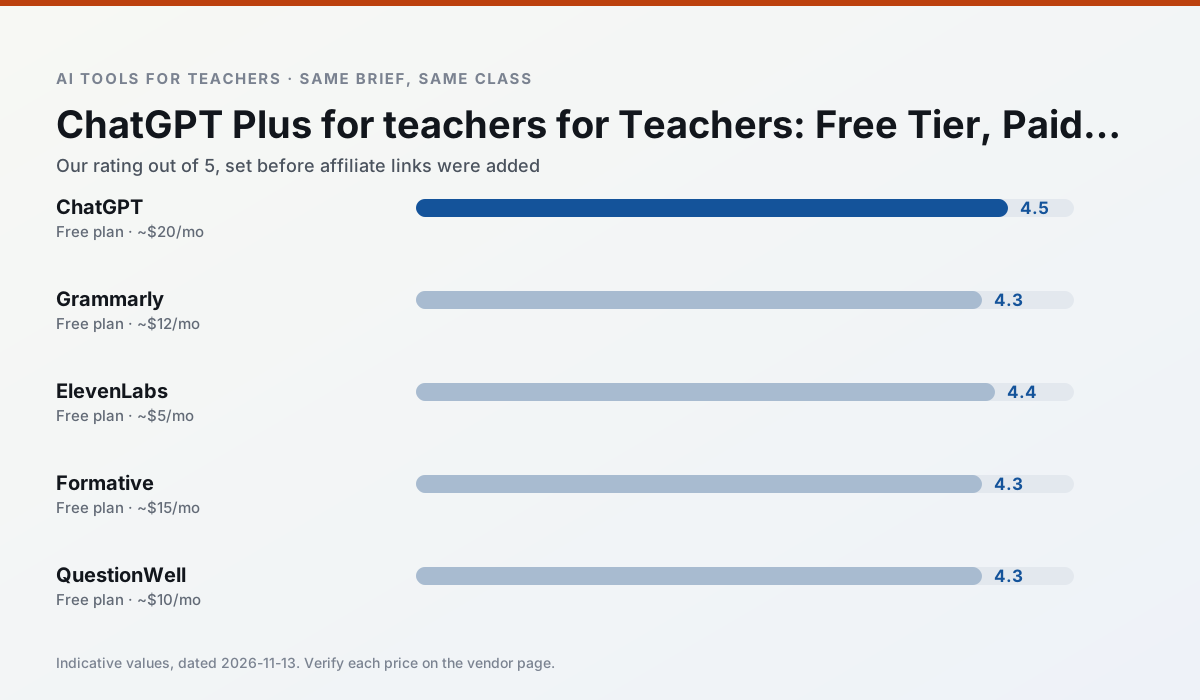
Side by side
Comparison table
Ratings reflect our timed classroom workflow, not vendor claims. Prices are indicative — verify on the vendor site.
| Tool | Best for | Free tier | Indicative paid plan | Standout feature | Our rating | Verdict | Try the tool |
|---|---|---|---|---|---|---|---|
| ChatGPT | lesson planning · parent communication | Yes — Usage-limited model access | ~$20 /user/mo | Custom GPTs and Projects | 4.5 / 5 | Top pick | Try free |
| Grammarly | parent communication · report card comments | Yes — Core grammar and tone checks | ~$12 /user/mo | Tone adjustments | 4.3 / 5 | Strong option | Try free |
| ElevenLabs | accessibility · reading intervention | Yes — Monthly character quota | ~$5 /user/mo | Very natural voices | 4.4 / 5 | Strong option | Try free |
| Formative | formative assessment · grading | Yes — Core assessment tools | ~$15 /user/mo | Live student responses | 4.3 / 5 | Strong option | Try free |
| QuestionWell | quiz generation · assessment | Yes — Monthly generation limit | ~$10 /user/mo | Exports to Google Forms / LMS | 4.3 / 5 | Strong option | Try free |
| Canva for Education | slide decks · worksheets | Yes — Verification required | ~$13 /user/mo | Thousands of education templates | 4.6 / 5 | Top pick | Try free |
Match your situation
Best for X
Different jobs need different tools. Here is what we would open first in each case.
ChatGPT is the student-facing option here with boundaries a teacher can actually set and supervise.
Grammarly produces levelled versions from one source in a single pass, which is the highest-value differentiation shortcut we tested at this level.
Family-facing drafts from ElevenLabs need the fewest rewrites for warmth without overpromising, which is the usual failure mode.
For a school rollout, Formative offers the paperwork and the admin console; the classroom features are standard by comparison.
Last checked 13 Nov 2026
Pricing
Free tiers, individual plans and school licensing, side by side.
| Tool | Free plan | Individual / paid | School & district | Billing note | Verify |
|---|---|---|---|---|---|
| ChatGPT | $0 — Usage-limited model access | ~$20 /user/mo | ~$25+ /user/mo | Indicative — verify on vendor site | Vendor |
| Grammarly | $0 — Core grammar and tone checks | ~$12 /user/mo | ~$15 /user/mo | Indicative — billed annually | Vendor |
| ElevenLabs | $0 — Monthly character quota | ~$5 /user/mo | ~$22 /user/mo | Indicative — verify on vendor site | Vendor |
| Formative | $0 — Core assessment tools | ~$15 /user/mo | Custom quote | Indicative — verify on vendor site | Vendor |
| QuestionWell | $0 — Monthly generation limit | ~$10 /user/mo | Custom quote | Indicative — verify on vendor site | Vendor |
| Canva for Education | $0 — Verification required | ~$13 /user/mo | Custom quote | Indicative — verify on vendor site | Vendor |
Editorial rule: pricing is re-checked every 2–3 months and the top 50 pages are refreshed every 6 months. See our funding policy.
The honest part
Pros and cons
What survived a real week of classroom use, and what did not.
Pros
- Most flexible option available
- Huge community of teacher prompt libraries
- Strong multilingual support
Cons
- Requires prompt skills for consistent results
- No built-in standards alignment
- District privacy review usually required
Pros
- Catches errors in high-stakes parent emails
- Works everywhere you already write
- Very low learning curve
Cons
- Not education-specific
- Can flatten teacher voice
- Premium needed for tone rewriting
Pros
- Excellent for accessible audio versions
- Low entry price
- Fast generation
Cons
- Quota-based billing
- Voice cloning consent considerations
- Not a teaching platform
Pros
- Strong data for intervention groups
- Works with existing PDFs and Docs
- Good LMS integrations
Cons
- Steeper setup than quiz games
- Best value requires school-wide rollout
- Price adds up per teacher
Pros
- Saves the most time on question writing
- Clean export workflow
- Good objective tagging
Cons
- Single-purpose tool
- Question quality varies by source text
- Limited student-facing features
In the classroom
Use cases
Five concrete workflows, with the tool we would open for each one.
A substitute folder that needs no context
The value here is structure, not creativity. Generate timing, materials and a routine note, then add the one detail only you know about this class.
Recommended: ChatGPTA question bank from a PDF or article
Feed a non-identifiable source and ask for items tagged by difficulty with the misconception behind each distractor. Spot-check every answer key; numerical items are least reliable.
Recommended: GrammarlyA five-minute exit ticket set
Ask for one recall, one application and one reasoning item, then delete the second recall question every generator sneaks in.
Recommended: ElevenLabsAn IEP present-levels first draft
Use aggregated, anonymised data only. Ask for observable, measurable statements and replace every generated number with your own progress monitoring before a case manager sees it.
Recommended: FormativeRubric and feedback comments in one pass
Reorder the workflow so the rubric is yours and the comments are generated. Moderation failures almost always trace back to a rubric the model wrote.
Recommended: QuestionWell
Questions teachers ask us
FAQ
Direct answers, also published as FAQPage structured data for search and AI assistants.
What does ChatGPT cost per teacher?
Is there a free plan?
What does a district pay for?
Sources & further reading
Our recommendation
Try Grammarly free for your next lesson planning task
Writing assistant for polished parent emails, newsletters and reports. Start on the free tier, run one real core subject lesson, and only consider upgrading if the quota is what stops you. Disclosure: we may earn a commission ($20 per paid upgrade + $0.20/signup) at no extra cost to you.
Some links on this page are affiliate links. We may earn a commission at no extra cost to you. Our rankings are editorial and never pay-to-play. Never enter student PII into a free consumer account.
Keep reading
Related comparisons in this cluster.
Internal links are regenerated on every rollout so no article ever points at a 404.