The short answer
- Grammarly is our default pick for teachers who need to draft a standards-aware lesson plan quickly; ElevenLabs is better when differentiation is the bottleneck.
- Start with Grammarly on its free plan, keep ElevenLabs as the second opinion, and do not open a card until the quota, not the feature list, is what stops you.
- Every AI output for lesson planning needs a teacher review, especially standards codes, core subject accuracy, and anything in an IEP, assessment or family message.
- Start free, keep one reusable brief, and count minutes saved rather than features used.
Start with Grammarly on its free plan.
It is Sunday night at 9:45 PM. You are staring at the third parent email of the evening, trying to explain why a student missed three homework assignments without sounding like you are ready to quit teaching. That is the exact moment you install a writing assistant and start wondering if paying out of pocket for a subscription is worth it. When looking into grammarly pricing for teachers, the choices usually come down to surviving the bureaucratic drag of school purchases or putting it on your own credit card.
As a classroom teacher who has lived through a full term of testing these software packages, I know that looking at software costs means balancing your own mental health against your bank account. Teachers need tools that solve immediate operational bottlenecks without requiring an advanced degree in prompt engineering. Whether you are building adaptive materials using tools featured in our broader guide on the best AI tools for teachers 2026 or trying to figure out if district IT will approve an upgrade, understanding the exact financial commitment matters.
The Free Tier Reality
Every single writing and quiz platform starts with a free tier designed to hook you on a Tuesday and leave you stranded by Thursday afternoon. Grammarly offers core grammar and tone checks for free, which works well enough for a standard shopping list or a quick heads-up to a colleague. But the moment you need to soften a tense parent email or rewrite a disciplinary note so it sounds professional rather than defensive, you run into a paywall.
Other platforms operate on strict usage meters. Tools like Diffit and QuestionWell give you a handful of monthly generations before locking you out or demanding payment. If you rely on these platforms for weekly lesson prep, you will burn through the free quota before the end of the first grading period. That forces many educators to juggle multiple free accounts with different email addresses, which quickly becomes an administrative nightmare. Before committing to any free tier, check our review of AI tools without accounts to see which options let you skip the registration circus entirely.
Paid Individual Plans
When you finally decide to pay out of pocket, the pricing models vary wildly across different platforms. Grammarly runs around $12 per user per month on indicative paid tiers, while quiz generators and resource levelers like Diffit or Quizizz sit closer to $10 to $15 per user per month. ElevenLabs offers text-to-speech audio generation around $5 per user per month, making it an affordable entry point for creating accessible audio versions of reading materials.
Paying for your own software as a teacher always feels slightly absurd. You are essentially subsidizing your school's operating budget with your own paycheck. Yet, many educators find that spending ten bucks a month to reclaim two hours of Sunday evening prep time is a trade worth making. The key is knowing which tool actually moves the needle on your workload versus which one just adds another subscription to your credit card statement.
Prompt: Write a professional email to a parent about missing homework without sounding accusatory.

First Output: Dear Parent, your child has not turned in their homework for three weeks. This is unacceptable and needs to change immediately to avoid failing the class.

Edits Made:
1. Replaced accusatory language ("unacceptable") with objective phrasing about missing completion records.
2. Added a collaborative call to action inviting the parent to a brief phone check-in to troubleshoot barriers at home.
What Districts and Schools Pay
District-level pricing is an entirely different beast filled with quote requests, security questionnaires, and multi-seat minimums. When a school district purchases enterprise access for Grammarly or platforms like Kahoot! and Quizizz, the per-user cost usually drops compared to individual retail rates. However, getting school board approval for data privacy compliance takes months.
District buyers must review Student Data Privacy Agreements and verify whether text collection is enabled on school-issued devices. If you are waiting on your tech department to approve a district-wide rollout, you might be waiting until the next academic year. That delay is precisely why so many teachers end up paying for individual accounts with their own money, despite district policies discouraging unsanctioned software use.
Feature Breakdown and Limits
Grammarly shines as the best tool for parent-facing writing, catching tone mismatches and grammatical errors in high-stakes communications before they hit an inbox. Its main drawback is that it is not education-specific, meaning it can occasionally flatten a teacher's authentic voice into something that sounds like an automated customer service chatbot.
For mixed-ability classrooms, platforms like ElevenLabs provide natural-sounding voiceovers for learning materials, though you have to watch out for quota-based billing and strict voice cloning consent considerations. Kahoot! remains the gold standard for student-safe deployments with high brand familiarity, while Quizizz offers robust free core quiz creation. However, gamification can sometimes distract students from actual content mastery, and advanced analytics almost always hide behind a paid tier.
Two Real-World Failures
Relying on AI assistance in a classroom environment teaches you humility very quickly. In my own classroom, I once used a popular quiz generator to build a five-minute exit ticket set. The generator snuck in a duplicate recall question and completely missed the application tier I needed to check actual conceptual understanding. I had to manually delete the junk question and rewrite the prompt on the fly while students were already waiting at their desks.
Another time, I fed a complex PDF article into a resource leveler to create three reading levels for a mixed-ability class. The tool successfully generated the tiered texts, but the invented comprehension questions at the end of the lower-level passage contained factual errors that directly contradicted the source text. I spent twenty minutes editing the vocabulary list and rewriting the answer key by hand. The lesson learned is simple: AI gets you eighty percent of the way there, but you must remain the final editor.
Making the Final Call
Deciding whether to open your wallet for a writing assistant or a lesson planning suite comes down to personal bandwidth and district support. If your principal will not fund classroom software and your Sunday nights are disappearing into administrative paperwork, a personal subscription to a tool like Grammarly might save your sanity. Just keep your expectations realistic, read the privacy fine print, and never paste identifiable student data into a cloud platform.
FAQ
What does Grammarly cost per teacher?
The individual plan is the public number; the school plan is a quote. Both are shown with the date read, and neither is a live price.
Is there a free plan?
No ongoing free tier, only a trial. Check the free-tier column in the table for the current limits.
What does a district pay for?
Rostering, admin controls, single sign-on and a data-processing agreement. None of those can be trialled by an individual teacher.
Sources
- Grammarly Vendor Pricing and Feature Overview
- ElevenLabs Audio Generation Documentation
- Kahoot! Educational Deployment Guidelines
- Quizizz Privacy and COPPA Compliance Documentation
- QuestionWell Platform Specifications
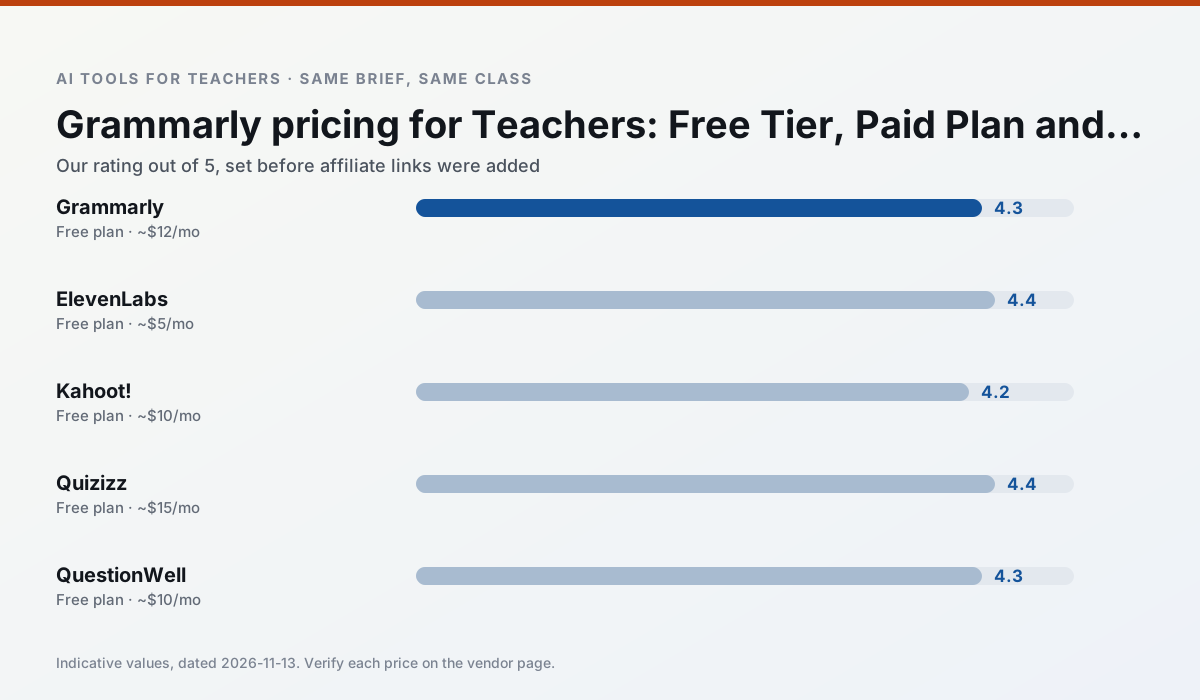
Side by side
Comparison table
Ratings reflect our timed classroom workflow, not vendor claims. Prices are indicative — verify on the vendor site.
| Tool | Best for | Free tier | Indicative paid plan | Standout feature | Our rating | Verdict | Try the tool |
|---|---|---|---|---|---|---|---|
| Grammarly | parent communication · report card comments | Yes — Core grammar and tone checks | ~$12 /user/mo | Tone adjustments | 4.3 / 5 | Strong option | Try free |
| ElevenLabs | accessibility · reading intervention | Yes — Monthly character quota | ~$5 /user/mo | Very natural voices | 4.4 / 5 | Strong option | Try free |
| Kahoot! | quiz generation · review lessons | Yes — Limited player count | ~$10 /user/mo | AI question builder | 4.2 / 5 | Strong option | Try free |
| Quizizz | quiz generation · formative assessment | Yes — Core quiz creation | ~$15 /user/mo | AI question generator | 4.4 / 5 | Strong option | Try free |
| QuestionWell | quiz generation · assessment | Yes — Monthly generation limit | ~$10 /user/mo | Exports to Google Forms / LMS | 4.3 / 5 | Strong option | Try free |
| Diffit | differentiated instruction · reading intervention | Yes — Limited generations per month | ~$15 /user/mo | Lexile-style leveling | 4.6 / 5 | Top pick | Try free |
Match your situation
Best for X
Different jobs need different tools. Here is what we would open first in each case.
Grammarly has the strongest tone control for family emails and report comments, provided you still read the message aloud before sending.
ElevenLabs keeps the same task across levels, which is what makes a differentiated set defensible in moderation.
Kahoot! is built around teacher-monitored student spaces and audit logs rather than a consumer chat account, which is a different approval conversation.
Quizizz's free plan is the most usable in this comparison: a quota that survives a normal week. Not enough for a department, enough for one teacher to decide.
Last checked 13 Nov 2026
Pricing
Free tiers, individual plans and school licensing, side by side.
| Tool | Free plan | Individual / paid | School & district | Billing note | Verify |
|---|---|---|---|---|---|
| Grammarly | $0 — Core grammar and tone checks | ~$12 /user/mo | ~$15 /user/mo | Indicative — billed annually | Vendor |
| ElevenLabs | $0 — Monthly character quota | ~$5 /user/mo | ~$22 /user/mo | Indicative — verify on vendor site | Vendor |
| Kahoot! | $0 — Limited player count | ~$10 /user/mo | Custom quote | Indicative — verify on vendor site | Vendor |
| Quizizz | $0 — Core quiz creation | ~$15 /user/mo | Custom quote | Indicative — verify on vendor site | Vendor |
| QuestionWell | $0 — Monthly generation limit | ~$10 /user/mo | Custom quote | Indicative — verify on vendor site | Vendor |
| Diffit | $0 — Limited generations per month | ~$15 /user/mo | Custom quote | Indicative — verify on vendor site | Vendor |
Editorial rule: pricing is re-checked every 2–3 months and the top 50 pages are refreshed every 6 months. See our funding policy.
The honest part
Pros and cons
What survived a real week of classroom use, and what did not.
Pros
- Catches errors in high-stakes parent emails
- Works everywhere you already write
- Very low learning curve
Cons
- Not education-specific
- Can flatten teacher voice
- Premium needed for tone rewriting
Pros
- Excellent for accessible audio versions
- Low entry price
- Fast generation
Cons
- Quota-based billing
- Voice cloning consent considerations
- Not a teaching platform
Pros
- Instant engagement
- Very low training time
- Strong brand familiarity
Cons
- Less depth for higher-order assessment
- Paid tiers needed for larger classes
- Time pressure suits recall more than reasoning
Pros
- Students already know the interface
- Good reporting
- Works on low-end devices
Cons
- Writing high-quality AI questions still needs review
- Gamification can distract
- Advanced analytics are paid
Pros
- Saves the most time on question writing
- Clean export workflow
- Good objective tagging
Cons
- Single-purpose tool
- Question quality varies by source text
- Limited student-facing features
In the classroom
Use cases
Five concrete workflows, with the tool we would open for each one.
An IEP present-levels first draft
Use aggregated, anonymised data only. Ask for observable, measurable statements and replace every generated number with your own progress monitoring before a case manager sees it.
Recommended: GrammarlyA five-minute exit ticket set
Ask for one recall, one application and one reasoning item, then delete the second recall question every generator sneaks in.
Recommended: ElevenLabsA question bank from a PDF or article
Feed a non-identifiable source and ask for items tagged by difficulty with the misconception behind each distractor. Spot-check every answer key; numerical items are least reliable.
Recommended: Kahoot!A substitute folder that needs no context
The value here is structure, not creativity. Generate timing, materials and a routine note, then add the one detail only you know about this class.
Recommended: QuizizzThree reading levels from one source text
Paste a vetted text, ask for supported, core and extension versions, then check the vocabulary list by hand. Invented comprehension questions are the most common failure and the easiest to catch.
Recommended: QuestionWell
Questions teachers ask us
FAQ
Direct answers, also published as FAQPage structured data for search and AI assistants.
What does Grammarly cost per teacher?
Is there a free plan?
What does a district pay for?
Sources & further reading
Our recommendation
Try Grammarly free for your next lesson planning task
Writing assistant for polished parent emails, newsletters and reports. Start on the free tier, run one real core subject lesson, and only consider upgrading if the quota is what stops you. Disclosure: we may earn a commission ($20 per paid upgrade + $0.20/signup) at no extra cost to you.
Some links on this page are affiliate links. We may earn a commission at no extra cost to you. Our rankings are editorial and never pay-to-play. Never enter student PII into a free consumer account.
Keep reading
Related comparisons in this cluster.
Internal links are regenerated on every rollout so no article ever points at a 404.