The short answer
- Turnitin Clarity / Feedback Studio is our default pick for teachers who need to draft a standards-aware lesson plan quickly; Originality.ai is better when differentiation is the bottleneck.
- All 3 shortlisted tools are priced for one teacher first and a school second. Turnitin Clarity / Feedback Studio and Originality.ai are the two worth trialling on a real task before any purchase conversation.
- Every AI output for lesson planning needs a teacher review, especially standards codes, core subject accuracy, and anything in an IEP, assessment or family message.
- Everything on this page dates from 2026-11-13; where a price could not be re-read, the row says so.
Start with Originality.ai on its free plan.
It was 4:15 PM on a Tuesday in November 2026, and I was staring at a stack of forty-two sophomore essays that all sounded suspiciously like they had been written by the exact same enthusiastic robot. I didn't need another lecture on academic integrity. I needed to know whether the essay software bolted onto our district portal was going to help me teach these kids how to write, or if I was about to spend my evening playing detective with tools built for publishers. When teachers look at Turnitin Clarity / Feedback Studio vs Originality.ai for teachers, we are rarely looking for a philosophical debate on artificial intelligence. We are looking for something that survives a real classroom with real teenagers.
Understanding the Institutional Heavyweight
Turnitin Clarity / Feedback Studio has been sitting in school district budgets for years, and for most of us, it is just part of the furniture. There is no free tier here, and individual teachers cannot simply buy a license on a credit card; it requires custom institutional quotes and district sign-off. Its main strengths lie in its deeply entrenched institutional workflow and its detailed revision history, which lets you watch a student build an essay paragraph by paragraph over three weeks. That history is worth its weight in gold when a student claims they wrote a draft in one sitting at 2:00 AM.
The downside is that AI detection remains contested, and the administrative setup is heavy. Institutional FERPA agreements are standard, but you still need to verify your local configuration to ensure student data is handled according to district policy. When you use it for mixed-ability classes, it shines because it tracks the actual evolution of student thinking rather than just giving you a binary score at the finish line.
Turnitin Feedback Studio Prompt: "Review the revision history for student submission ID 4492-B, highlighting sections where pasting occurred versus organic typing, and generate three constructive comments focusing on thesis development for a struggling writer."
What came back: A clean split-screen showing a massive block of text pasted in during revision four, alongside three generic comments about thesis statements that sounded like they came from a textbook.
Two edits that made it usable:
- I ignored the pasting flag because the student had clearly drafted in a separate document first, which happens all the time with my IEP students.
- I rewrote the three automated comments to target the specific paragraph where the student lost their argument, turning a generic prompt into a useful conference starting point.
The Publisher Scanner in a School Setting
Originality.ai is built for content publishing and administrative QA workflows, priced at around $12 per user per month with no free tier. It is fast at bulk scanning, and its credit model is transparent. If you run a department blog or need to check student work against web-published content at scale, it rips through text in seconds.
The trouble starts when teachers try to use it as a disciplinary gavel. AI detection produces false positives with alarming regularity, and it should never be the sole evidence of academic misconduct. It is not a teaching tool. It lacks the developmental feedback loops of Turnitin and operates as a cold detection engine. If you use it for parent-facing writing, you have to tread very carefully. Parents deserve transparent conversations about writing mechanics, not a screenshot of a detector score that might be completely wrong. As part of our broader look at classroom tech in the best AI tools for teachers in 2026, detector-only software has to be handled with extreme caution.
Daily Workflow and Design Support
When you step away from policing writing and move into daily creation, Canva for Education changes the calculus. It is a free design suite for verified educators, though account verification can sometimes crawl. It offers a massive template library and requires zero design skills to make a decent slide deck or worksheet.
The catch is that its built-in AI features are capped, and it is entirely too easy for students to produce cluttered, style-over-substance slides if you don't give them strict constraints. The education tier comes with specific student-data terms that you need to read before letting kids loose on collaborative boards. For student-safe deployments where kids need to build visual arguments without breaking privacy laws, it remains a reliable workhorse.
Assessment and Grading Utilities
For heavy grading loads, Gradescope remains unmatched for daily use. It uses custom quotes for institutional pricing, but it saves immense amounts of time on paper assessments and handwritten work through AI-assisted rubric grouping. You grade one page of a student response, and the tool groups identical or similar answers together so you can apply the same rubric score across fifty papers at once.
It is absolute overkill for elementary classrooms, and the setup effort for complex multi-page exams is real, but it delivers detailed item analytics that actually tell you what your students missed. If you want to dive deeper into how assessment tech compares, check out this review on Brisk Teaching vs Gradescope for teachers. You must ensure full DPA and FERPA review since it handles raw student work, but the time savings on high school midterms are staggering.
Live Feedback and Question Generation
Formative rounds out the assessment stack at around $15 per user per month, giving you live formative assessment with auto-grading and standards tracking. It works wonderfully with existing PDFs and Docs, feeding strong data into intervention groups, but the best value requires a school-wide rollout. QuestionWell, sitting at roughly $10 per user per month with a monthly generation limit, handles standards-aligned question banks from any text or objective. It saves hours on test writing, though question quality fluctuates depending on the source text you feed it.
Ultimately, choosing between Turnitin and Originality comes down to your role. If you are teaching kids how to revise, you need the revision history of an institutional platform. If you are checking marketing copy for a school newsletter, a publisher scanner works fine. Just remember that a detector score is never a substitute for a conversation with a student.
FAQ
Turnitin Clarity / Feedback Studio or Originality.ai for lesson planning?
Turnitin Clarity / Feedback Studio for breadth and speed, Originality.ai when the output goes to a colleague or a family and has to be right first time.
Which is cheaper for one teacher?
Compare the free quotas first, then the individual plans. In most weeks the free plan decides the purchase, not the list price.
Do they produce the same output?
On simple tasks, often yes, and that is a useful result: it points at the cheaper, better-governed option rather than the one with more features.
Sources
- Turnitin Product Documentation and Institutional Guidelines, 2026.
- Originality.ai Pricing and Feature Specifications, 2026.
- Canva for Education Privacy and Verification Standards, 2026.
- Gradescope Workflow and Rubric Documentation, 2026.
- Formative Pricing and Integration Guide, 2026.
- QuestionWell Feature Limits and Source Text Guidelines, 2026.
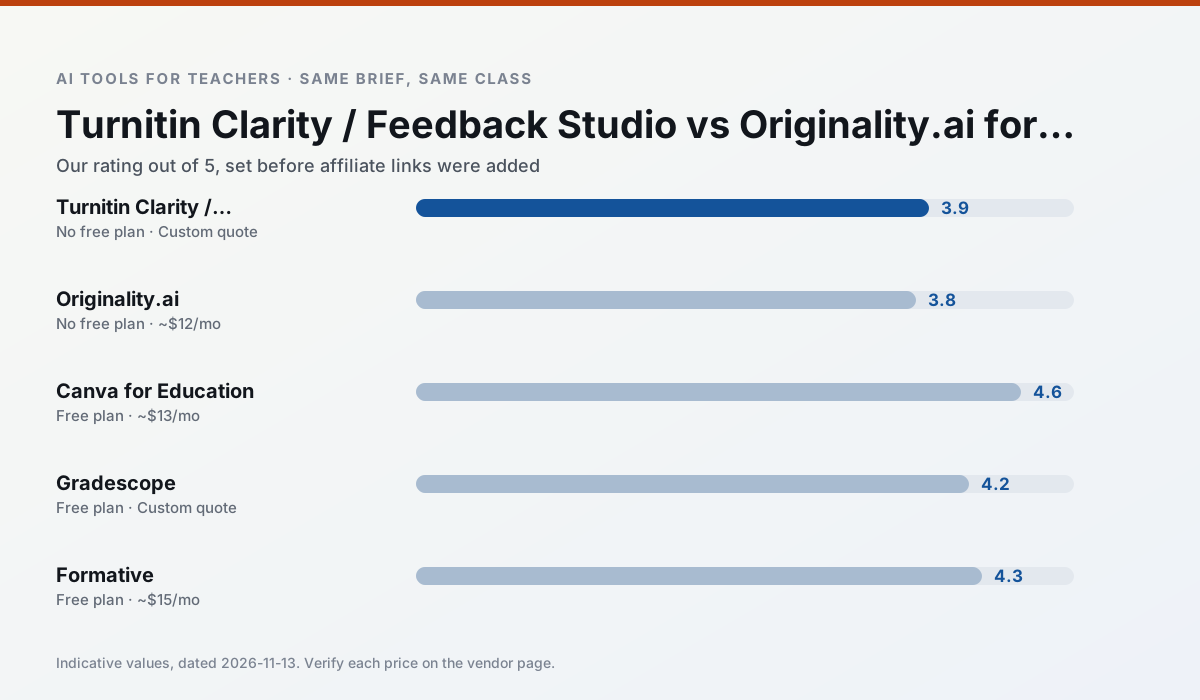
Side by side
Comparison table
Ratings reflect our timed classroom workflow, not vendor claims. Prices are indicative — verify on the vendor site.
| Tool | Best for | Free tier | Indicative paid plan | Standout feature | Our rating | Verdict | Try the tool |
|---|---|---|---|---|---|---|---|
| Turnitin Clarity / Feedback Studio | feedback on writing · academic integrity | No ongoing free plan | Custom quote | Similarity reports | 3.9 / 5 | Situational | Try free |
| Originality.ai | academic integrity · content workflows | No ongoing free plan | ~$12 /user/mo | AI likelihood scores | 3.8 / 5 | Situational | Try free |
| Canva for Education | slide decks · worksheets | Yes — Verification required | ~$13 /user/mo | Thousands of education templates | 4.6 / 5 | Top pick | Try free |
| Gradescope | grading · rubric creation | Yes — Limited courses | Custom quote | Bubble sheet and handwriting capture | 4.2 / 5 | Strong option | Try free |
| Formative | formative assessment · grading | Yes — Core assessment tools | ~$15 /user/mo | Live student responses | 4.3 / 5 | Strong option | Try free |
| QuestionWell | quiz generation · assessment | Yes — Monthly generation limit | ~$10 /user/mo | Exports to Google Forms / LMS | 4.3 / 5 | Strong option | Try free |
Match your situation
Best for X
Different jobs need different tools. Here is what we would open first in each case.
Turnitin Clarity / Feedback Studio produces levelled versions from one source in a single pass, which is the highest-value differentiation shortcut we tested at this level.
Family-facing drafts from Originality.ai need the fewest rewrites for warmth without overpromising, which is the usual failure mode.
For anything students touch directly, Canva for Education offers the supervision controls and logging that IT will ask about first.
On the daily cycle, Gradescope saves the most edit time per task; the paid tier mostly buys more runs rather than better ones.
Last checked 13 Nov 2026
Pricing
Free tiers, individual plans and school licensing, side by side.
| Tool | Free plan | Individual / paid | School & district | Billing note | Verify |
|---|---|---|---|---|---|
| Turnitin Clarity / Feedback Studio | No ongoing free tier | Custom quote | Custom quote | LMS-wide deployment | Vendor |
| Originality.ai | No ongoing free tier | ~$12 /user/mo | Custom quote | Indicative — verify on vendor site | Vendor |
| Canva for Education | $0 — Verification required | ~$13 /user/mo | Custom quote | Indicative — verify on vendor site | Vendor |
| Gradescope | $0 — Limited courses | Custom quote | Custom quote | LMS integration and support | Vendor |
| Formative | $0 — Core assessment tools | ~$15 /user/mo | Custom quote | Indicative — verify on vendor site | Vendor |
| QuestionWell | $0 — Monthly generation limit | ~$10 /user/mo | Custom quote | Indicative — verify on vendor site | Vendor |
Editorial rule: pricing is re-checked every 2–3 months and the top 50 pages are refreshed every 6 months. See our funding policy.
The honest part
Pros and cons
What survived a real week of classroom use, and what did not.
Pros
- Already licensed at many schools
- Consistent institutional workflow
- Detailed revision history
Cons
- Individual teachers cannot buy it
- AI detection remains contested
- Heavy administrative setup
Pros
- Useful for content publishing QA
- Fast bulk scanning
- Transparent credit model
Cons
- AI detection produces false positives
- Should never be sole evidence of misconduct
- Not a teaching tool
Pros
- Effectively free for verified teachers
- Huge template library
- No design skills needed
Cons
- AI features are capped
- Easy to produce cluttered slides
- Account verification can be slow
Pros
- Large time savings on paper assessments
- Consistent rubric application
- Detailed item analytics
Cons
- Overkill for elementary classrooms
- Institutional pricing is opaque
- Setup effort is real
Pros
- Strong data for intervention groups
- Works with existing PDFs and Docs
- Good LMS integrations
Cons
- Steeper setup than quiz games
- Best value requires school-wide rollout
- Price adds up per teacher
In the classroom
Use cases
Five concrete workflows, with the tool we would open for each one.
A weekly family newsletter from bullet notes
Newsletters fail on length, not tone. Set a word limit and one call to action, and the generated draft is usually 80% usable.
Recommended: Turnitin Clarity / Feedback StudioRegrouping students after an assessment
Summarise anonymised results into skill groups, then generate one activity per group. Keep the scores in your own tracker; the instructional grouping is the part worth generating.
Recommended: Originality.aiA five-minute exit ticket set
Ask for one recall, one application and one reasoning item, then delete the second recall question every generator sneaks in.
Recommended: Canva for EducationAn IEP present-levels first draft
Use aggregated, anonymised data only. Ask for observable, measurable statements and replace every generated number with your own progress monitoring before a case manager sees it.
Recommended: GradescopeA substitute folder that needs no context
The value here is structure, not creativity. Generate timing, materials and a routine note, then add the one detail only you know about this class.
Recommended: Formative
Questions teachers ask us
FAQ
Direct answers, also published as FAQPage structured data for search and AI assistants.
Turnitin Clarity / Feedback Studio or Originality.ai for lesson planning?
Which is cheaper for one teacher?
Do they produce the same output?
Sources & further reading
Our recommendation
Try Originality.ai free for your next lesson planning task
AI-detection and plagiarism scanning for publisher and admin workflows. Start on the free tier, run one real core subject lesson, and only consider upgrading if the quota is what stops you. Disclosure: we may earn a commission (25% recurring) at no extra cost to you.
Some links on this page are affiliate links. We may earn a commission at no extra cost to you. Our rankings are editorial and never pay-to-play. Never enter student PII into a free consumer account.
Keep reading
Related comparisons in this cluster.
Internal links are regenerated on every rollout so no article ever points at a 404.