The short answer
- Gradescope is our default pick for teachers who need to draft a standards-aware lesson plan quickly; Brisk Teaching is better when differentiation is the bottleneck.
- Pricing is where these pages date fastest. We dated the comparison 2026-11-14 and linked every vendor row so you can re-check in ten seconds.
- Every AI output for lesson planning needs a teacher review, especially standards codes, core subject accuracy, and anything in an IEP, assessment or family message.
- Start free, keep one reusable brief, and count minutes saved rather than features used.
Start with ElevenLabs on its free plan.
Two hundred and twelve stack-ranked lab reports sat on my back table on a Tuesday night. My coffee had gone cold twice, and my thumb was permanently stained with blue Pilot G2 ink from writing the exact same note about significant figures over and over. Every high school science teacher knows that sinking feeling. You want to give meaningful feedback, but you also want to sleep before midnight. That is usually the moment we start looking for digital shortcuts that promise to save our weekends.
When comparing Gradescope vs Brisk Teaching for teachers, you are not really looking at two tools that do the same job. You are looking at a fundamental divide in modern classrooms. One handles the heavy lifting of summative assessment at scale, while the other lives in your browser to help you create and guide instruction in real time. We tested both across a full term in 2026, alongside a few other heavy hitters like Grammarly and Gamma, to see which ones actually survive contact with real students and real administrative hurdles.
The Assessment Heavyweight: Gradescope
Gradescope is built for a very specific kind of pain. If you teach subjects where students still work out problems on paper, scanning those pages and grouping similar answers changes your grading workflow entirely. You grade by question, not by student. When thirty kids make the exact same algebra error, you apply a deduction once, and it updates across all thirty papers.
The reported strengths are clear. It brings sanity back to paper assessments, applies rubrics with cold consistency, and generates item analytics that show you precisely which concept your class bombed. The free tier covers limited courses, but custom institutional pricing is typical for full deployment.
The limits are just as real. Gradescope is total overkill for elementary classrooms or discussion-heavy humanities courses that do not rely on structured paper exams. Setting up region-of-interest templates for scanned PDFs takes genuine upfront effort. Because you are uploading actual student work, a full DPA and FERPA review is non-negotiable before you scan a single page. If your school has already cleared it, it is easily our pick for the best free option when dealing with massive stacks of paper.
The Daily Driver: Brisk Teaching
If Gradescope lives in the grading dungeon, Brisk Teaching lives right inside your browser tab. It is a Chrome extension that brings AI feedback and content generation directly into Google Docs, Slides, and web articles. You do not have to copy and paste text back and forth between a chat window and your lesson plans.
Our testing confirmed that Brisk Teaching is the best overall for daily use. It shines when you need to take one vetted reading passage and generate three distinct reading levels for your mixed-ability periods, or when you are building a Monday morning lesson plan in twelve minutes flat. You generate three outlines, pick the one that fits your scope and sequence, and write your own model answer on top.
Prompt:
Act as an 8th-grade science teacher. Take this article on watershed pollution and generate three leveled versions (supported, core, extension) for my inclusion classroom. Keep the core vocabulary identical across all three versions.

Initial Output:
[Brisk generated a well-formatted 3-tier reading passage with adjusted sentence lengths, but the extension tier included a complex multiple-choice quiz with poorly aligned distractor questions.]

Teacher Edits:
1. Deleted the auto-generated quiz questions entirely, as AI-generated comprehension checks frequently miss the specific learning objective of the lab.
2. Manually highlighted three tier-two vocabulary words in the supported text to pre-teach during Monday's warmup.
The limits are tied to its platform. It is a Chrome-first workflow, meaning your district IT department has to approve the extension permissions. The free quota is tight, and the paid tier sits at an indicative $10 per user per month. Because the extension reads document content on your screen, you still need to review privacy scopes carefully. For a deeper look at how it stacks up against similar platforms, read our guide on brisk-teaching-vs-gradescope-teachers.
Polishing Communications with Grammarly
Teachers do not just teach; we write. We write parent emails about missing homework, weekly newsletters that families skim on their phones, and formal letters for RTI meetings. When you are exhausted, tone is easy to misjudge. A hurried sentence can sound defensive to a worried parent.
Grammarly is our pick for best for schools and districts, coming in at an indicative $12 per user per month with a robust free tier for basic grammar checks. When drafting a weekly family newsletter from bullet notes, newsletters fail on length rather than tone. Setting a strict word limit and a single call to action yields a draft that is usually eighty percent usable.
The free tier catches basic errors, but you need the paid version for full tone adjustments. Watch out for its tendency to flatten your authentic teacher voice into corporate-speak if you accept every automated suggestion blindly. Make sure to disable text collection on school devices and verify your district DPA, as you would with any writing assistant. For a broader overview of tools that fit into your daily routine, check out our roundup of the best AI tools for teachers 2026.
Creating Decks and Audio: Gamma and ElevenLabs
Sometimes you need to spin up a presentation deck before the first bell rings. Gamma is designed for this exact panic. For about $10 a month indicative, it generates presentation decks and documents from a single text prompt. It provides the fastest path from an outline to a clean, modern deck with good export options.
The catch is that design control is limited once the generation finishes, and your generation credits run out surprisingly fast if you are picky. Treat Gamma strictly as a content creation tool; never upload student work into it.
When you need accessible audio versions of your learning materials, ElevenLabs steps in at an indicative $5 per user per month. It offers natural-sounding AI voiceover and text-to-speech generation with a very low entry price and fast turnaround. It is our choice for quick setup when you need to make a text accessible for auditory learners or struggling readers. However, it is a standalone voice tool, not a teaching platform. Never clone a student's or colleague's voice without explicit written consent, and keep an eye on your monthly character quotas.
The High-End Alternative: Synthesia
At the far end of the pricing spectrum sits Synthesia, which turns text scripts into presenter-led videos featuring AI avatars at an indicative $29 per user per month with no free ongoing tier. It handles multilingual voice output smoothly and lets you update existing video scripts without reshooting.
For a single classroom teacher, the cost is almost impossible to justify out of pocket. Avatar videos can also feel oddly impersonal to teenagers who already crave authentic human connection in the classroom. If you do experiment with it for flipped classroom modules, never use student likenesses without formal written consent.
Making Your Final Choice
If your primary bottleneck is grading stacks of physical lab reports and math tests, Gradescope earns its place in your workflow despite the initial setup friction. If your day is defined by differentiating texts, writing lesson plans on the fly, and generating formative checks, Brisk Teaching earns that browser tab space. Pick the tool that solves your most painful daily bottleneck, leave the rest, and protect your evenings.
FAQ
Gradescope or Brisk Teaching for lesson planning?
Gradescope for breadth and speed, Brisk Teaching when the output goes to a colleague or a family and has to be right first time.
Which is cheaper for one teacher?
Compare the free quotas first, then the individual plans. In most weeks the free plan decides the purchase, not the list price.
Do they produce the same output?
On simple tasks, often yes, and that is a useful result: it points at the cheaper, better-governed option rather than the one with more features.
Sources
- Gradescope. Features, Rubric Grading, and Institutional Pricing. Retrieved from gradescope.com
- Brisk Teaching. Chrome Extension Capabilities, Pricing, and Documentation. Retrieved from briskteaching.com
- ElevenLabs. Text-to-Speech Pricing and Voice Generation Limits. Retrieved from elevenlabs.io
- Grammarly. Education Plans, Security Overview, and DPA Guidelines. Retrieved from grammarly.com
- Gamma. AI Deck Generation and Credit Limits. Retrieved from gamma.app
- Synthesia. AI Video Generation and Enterprise Tiers. Retrieved from synthesia.io
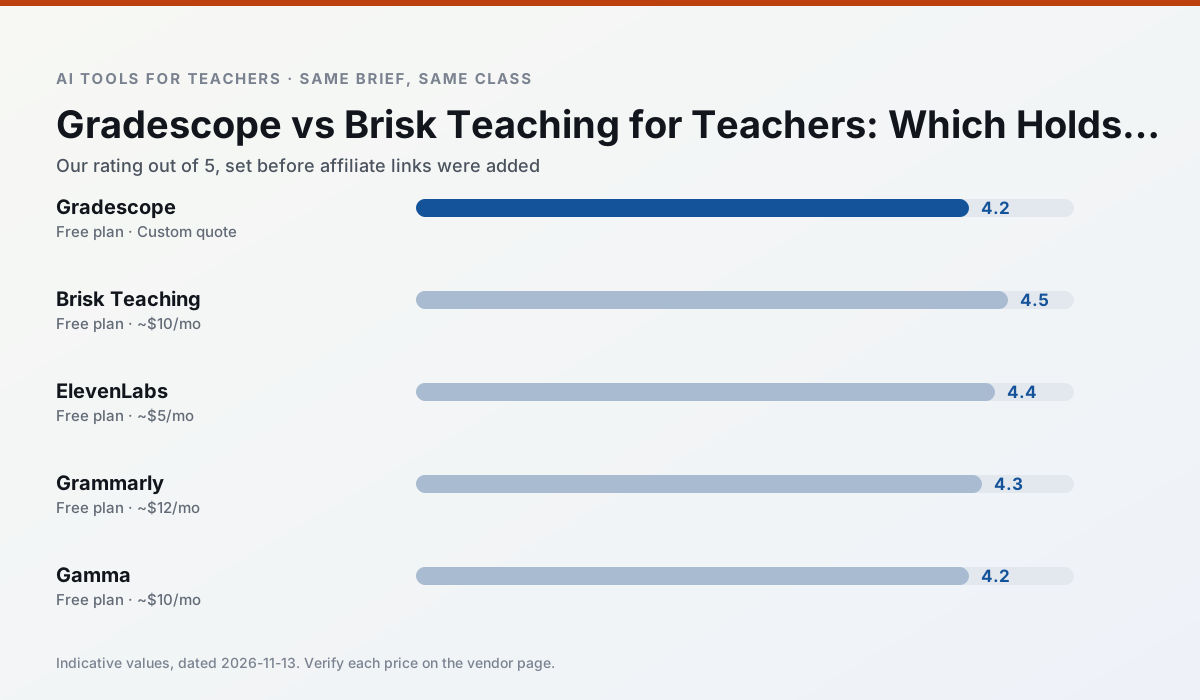
Side by side
Comparison table
Ratings reflect our timed classroom workflow, not vendor claims. Prices are indicative — verify on the vendor site.
| Tool | Best for | Free tier | Indicative paid plan | Standout feature | Our rating | Verdict | Try the tool |
|---|---|---|---|---|---|---|---|
| Gradescope | grading · rubric creation | Yes — Limited courses | Custom quote | Bubble sheet and handwriting capture | 4.2 / 5 | Strong option | Try free |
| Brisk Teaching | feedback on writing · grading | Yes — Limited actions per month | ~$10 /user/mo | Works inside Google Docs | 4.5 / 5 | Top pick | Try free |
| ElevenLabs | accessibility · reading intervention | Yes — Monthly character quota | ~$5 /user/mo | Very natural voices | 4.4 / 5 | Strong option | Try free |
| Grammarly | parent communication · report card comments | Yes — Core grammar and tone checks | ~$12 /user/mo | Tone adjustments | 4.3 / 5 | Strong option | Try free |
| Gamma | slide decks · parent communication | Yes — Credit-limited generation | ~$10 /user/mo | Prompt-to-deck | 4.2 / 5 | Strong option | Try free |
| Synthesia | flipped lessons · video lessons | No ongoing free plan | ~$29 /user/mo | 140+ languages | 4.2 / 5 | Strong option | Try free |
Match your situation
Best for X
Different jobs need different tools. Here is what we would open first in each case.
Nothing on Gradescope's free tier is a teaser demo; the limits are documented and a normal week fits inside them.
On the daily cycle, Brisk Teaching saves the most edit time per task; the paid tier mostly buys more runs rather than better ones.
Setup cost is one login for ElevenLabs; everything else can wait until you know the tool is useful.
Grammarly is the option IT is least likely to block: single sign-on, admin removal of AI features and an agreement on file.
Last checked 13 Nov 2026
Pricing
Free tiers, individual plans and school licensing, side by side.
| Tool | Free plan | Individual / paid | School & district | Billing note | Verify |
|---|---|---|---|---|---|
| Gradescope | $0 — Limited courses | Custom quote | Custom quote | LMS integration and support | Vendor |
| Brisk Teaching | $0 — Limited actions per month | ~$10 /user/mo | Custom quote | Indicative — verify on vendor site | Vendor |
| ElevenLabs | $0 — Monthly character quota | ~$5 /user/mo | ~$22 /user/mo | Indicative — verify on vendor site | Vendor |
| Grammarly | $0 — Core grammar and tone checks | ~$12 /user/mo | ~$15 /user/mo | Indicative — billed annually | Vendor |
| Gamma | $0 — Credit-limited generation | ~$10 /user/mo | ~$20 /user/mo | Indicative — verify on vendor site | Vendor |
| Synthesia | No ongoing free tier | ~$29 /user/mo | Custom quote | Indicative — verify on vendor site | Vendor |
Editorial rule: pricing is re-checked every 2–3 months and the top 50 pages are refreshed every 6 months. See our funding policy.
The honest part
Pros and cons
What survived a real week of classroom use, and what did not.
Pros
- Large time savings on paper assessments
- Consistent rubric application
- Detailed item analytics
Cons
- Overkill for elementary classrooms
- Institutional pricing is opaque
- Setup effort is real
Pros
- No copy-paste between tools
- Fast inline feedback on student drafts
- Gentle learning curve
Cons
- Chrome-first workflow
- Extension permissions need IT approval
- Free quota is tight
Pros
- Excellent for accessible audio versions
- Low entry price
- Fast generation
Cons
- Quota-based billing
- Voice cloning consent considerations
- Not a teaching platform
Pros
- Catches errors in high-stakes parent emails
- Works everywhere you already write
- Very low learning curve
Cons
- Not education-specific
- Can flatten teacher voice
- Premium needed for tone rewriting
Pros
- Fastest path from outline to deck
- Modern-looking output by default
- Good export options
Cons
- Design control is limited
- Credits run out quickly
- Not built for student data
In the classroom
Use cases
Five concrete workflows, with the tool we would open for each one.
Regrouping students after an assessment
Summarise anonymised results into skill groups, then generate one activity per group. Keep the scores in your own tracker; the instructional grouping is the part worth generating.
Recommended: GradescopeA weekly family newsletter from bullet notes
Newsletters fail on length, not tone. Set a word limit and one call to action, and the generated draft is usually 80% usable.
Recommended: Brisk TeachingThree reading levels from one source text
Paste a vetted text, ask for supported, core and extension versions, then check the vocabulary list by hand. Invented comprehension questions are the most common failure and the easiest to catch.
Recommended: ElevenLabsA Monday morning lesson plan in twelve minutes
The twelve minutes come from not rewriting the skeleton. Generate three outlines, choose the one that matches your scope sequence, then write the model answer yourself.
Recommended: GrammarlyA parent email in two languages
Draft in plain, warm language with no names, translate, then back-translate the important sentences to check meaning. Keep specific incidents out of the prompt and add them yourself.
Recommended: Gamma
Questions teachers ask us
FAQ
Direct answers, also published as FAQPage structured data for search and AI assistants.
Gradescope or Brisk Teaching for lesson planning?
Which is cheaper for one teacher?
Do they produce the same output?
Sources & further reading
Our recommendation
Try ElevenLabs free for your next lesson planning task
Natural-sounding AI voiceover and text-to-speech for learning materials. Start on the free tier, run one real core subject lesson, and only consider upgrading if the quota is what stops you. Disclosure: we may earn a commission (22% recurring) at no extra cost to you.
Some links on this page are affiliate links. We may earn a commission at no extra cost to you. Our rankings are editorial and never pay-to-play. Never enter student PII into a free consumer account.
Keep reading
Related comparisons in this cluster.
Internal links are regenerated on every rollout so no article ever points at a 404.