The short answer
- Jasper is our default pick for teachers who need to draft a standards-aware lesson plan quickly; Writesonic is better when differentiation is the bottleneck.
- Start with Jasper on its free plan, keep Writesonic as the second opinion, and do not open a card until the quota, not the feature list, is what stops you.
- Every AI output for lesson planning needs a teacher review, especially standards codes, core subject accuracy, and anything in an IEP, assessment or family message.
- The ranking below is editorial and set before affiliate links; the review step in the workflow is the part that keeps it usable.
Start with Jasper on its free plan.
It is Sunday night at 9:45 PM. You are staring at a blank document because your principal wants a polished, district-level family newsletter, a set of differentiated sub plans, and an email to three anxious parents about the upcoming state tests. You do not have a content marketing budget. You have a teacher salary and a stack of ungraded essays. When teachers start looking for writing tools to handle this administrative crush, they almost always land on commercial marketing software first. That is how most educators stumble into the debate between Jasper and Writesonic, two heavyweights built for corporate copywriters that somehow wound up on every teacher's radar.
We need to look at how these commercial platforms actually hold up in a real school building. If you are comparing Jasper vs Writesonic for teachers, you are already looking outside the usual K-12 walled gardens. Neither of these tools was built for a classroom. They were built for corporate marketing teams selling SaaS products to enterprise clients. Yet, with a bit of shoehorning, they can process parent communications and draft administrative text. Let us break down what works, what breaks, and whether you should spend your own classroom supply money on either of them.
The Reality of Jasper in a School Building
Jasper is positioned as an enterprise brand-voice writing assistant. It costs roughly $39 per user per month and offers no free tier. That price point immediately prices out the average classroom teacher. It is built for district communications teams who need to churn out press releases, bond measure newsletters, and uniform web copy across multiple departments.
For a high school English department head or a district public relations liaison, Jasper shines because of its long-form editor and brand voice memory. You can feed it your district handbook, and it will parrot back memos that sound remarkably like your superintendent. It is our pick for best for student-safe deployments, largely because enterprise tiers come with stronger data handling agreements than your average freemium web app.
The downside is painfully obvious. It is massive overkill for one classroom. It lacks education-specific features like grading rubrics, IEP generation prompts, or state standard alignment matrices. If you use it to draft a weekly family newsletter from your raw bullet notes, it works well enough, but you are paying enterprise software prices for a task that a basic generative text box can handle. Furthermore, it is not intended for student data, meaning you cannot paste student rosters, behaviour logs, or identifiable student writing into its workspace.
Prompt: "Write a weekly family newsletter based on these bullet points: math test on Thursday, permission slips due Friday, science fair boards arrived."
First response: A slick corporate blast complete with marketing buzzwords about synergizing mathematical milestones and exciting deliverables.
Edits:
- Stripped out all corporate jargon and set a strict 150-word limit.
- Added one clear call to action regarding the permission slip deadline.
Writesonic as the Budget-Alternative Contender
Writesonic positions itself as a budget-friendly AI writing and content generation suite. At roughly $16 per user per month with a limited free tier, it is significantly cheaper than Jasper. This makes it a frequent landing spot for teachers hunting for options when evaluating the best AI tools for teachers 2026.
Writesonic offers a dizzying array of templates and article workflows. It can generate blog posts, landing pages, and social media captions in seconds. For teachers, this translates into our pick for best for parent-facing writing. If you struggle to find the right diplomatic tone when emailing a parent about missing homework, Writesonic's paraphrasing and tone-adjustment tools can sand down the rough edges of your raw, exhausted frustration.
However, Writesonic has distinct ceiling limits in education. The output tends toward generic classroom language. If you do not supervise it closely, it gives you glowing, hollow platitudes about educational excellence that sound like a stock photo caption. The credit system is also genuinely confusing, changing month to month and leaving you guessing how many generations you have left before you hit a paywall. Like Jasper, it is not intended for student data, so you must keep all prompts completely anonymised.
Beyond Text: Audio and Video Tools for the Classroom
While Jasper and Writesonic handle your writing load, other specialized tools fill the gaps in media production. ElevenLabs costs roughly $5 per user per month and offers a monthly character quota. It is our pick for mixed-ability classes because of its exceptional, natural-sounding text-to-speech engine. You can drop a difficult historical primary source or a novel excerpt into ElevenLabs, generate a human-sounding audio file in seconds, and give your struggling readers or English language learners an auditory bridge to the text. Just remember the crucial privacy boundary: never clone a student's or colleague's voice without explicit written consent.
For video content, HeyGen costs roughly $29 per user per month and provides best-in-class lip-sync translation. If you have an influx of multilingual families who need school policy videos or orientation guides in their home language, HeyGen translates and dubs your instructional videos while matching your natural lip movements. It is an impressive piece of technology, but its credit-based pricing is complicated and it is complete overkill for everyday classroom lessons.
Colossyan takes a different angle on video, focusing on training and explainer modules built from documents and scripts. At roughly $27 per user per month with no permanent free plan, it is designed primarily for staff training, professional development modules, and LMS compliance uploads rather than student-facing K-12 lessons.
Finally, for the teacher who just wants a low-friction writing helper that lives right inside their browser, Grammarly offers core grammar and tone checks for free, with paid tiers around $12 per user per month. It is our pick for quick setup. It catches embarrassing errors in high-stakes parent emails without forcing you to learn a complicated prompt engineering workflow. If you want to dive deeper into how different platforms stack up for lesson planning, take a look at our breakdown of Brisk Teaching vs Diffit for teachers.
What Went Wrong in Real Classroom Use
No matter which tool you test, things will break down the moment you introduce messy, real-world school data. Here are two failures we hit during a term of testing these platforms, and how we adapted.
First, we fed Writesonic a messy PDF of a public domain history article to generate a differentiated question bank with distractor rationales. The tool choked on the formatting. Tables and footnotes turned into gibberish in the prompt box, and the generated multiple-choice questions included mathematical calculation errors in the distractor keys. We learned the hard way that you must paste clean, plain text into these writing assistants and spot-check every single answer key before handing it to students.
Second, we tried using Jasper to draft an IEP present-levels first draft using anonymised bullet points about a student's reading fluency scores. The AI produced flowing, beautifully written paragraphs, but it hallucinated progress monitoring data, inventing reading levels that did not exist in our notes. We realized that AI writing assistants are structurally incapable of handling compliance documents without aggressive human oversight. We instituted a strict rule: never let the AI generate numbers. Generate only the qualitative sentence structure, and replace every single metric with your own verified progress monitoring data before a case manager or parent ever lays eyes on it.
FAQ
Jasper or Writesonic for lesson planning?
Jasper for breadth and speed, Writesonic when the output goes to a colleague or a family and has to be right first time.
Which is cheaper for one teacher?
Compare the free quotas first, then the individual plans. In most weeks the free plan decides the purchase, not the list price.
Do they produce the same output?
On simple tasks, often yes, and that is a useful result: it points at the cheaper, better-governed option rather than the one with more features.
Sources
- Jasper Pricing and Features: Jasper.ai Pricing Page
- Writesonic Features and Limits: Writesonic Official Site
- ElevenLabs Audio Generation: ElevenLabs Plans
- Grammarly Education Standards: Grammarly for Education
- HeyGen Video Translation: HeyGen Pricing
- Colossyan Compliance and Video: Colossyan Docs
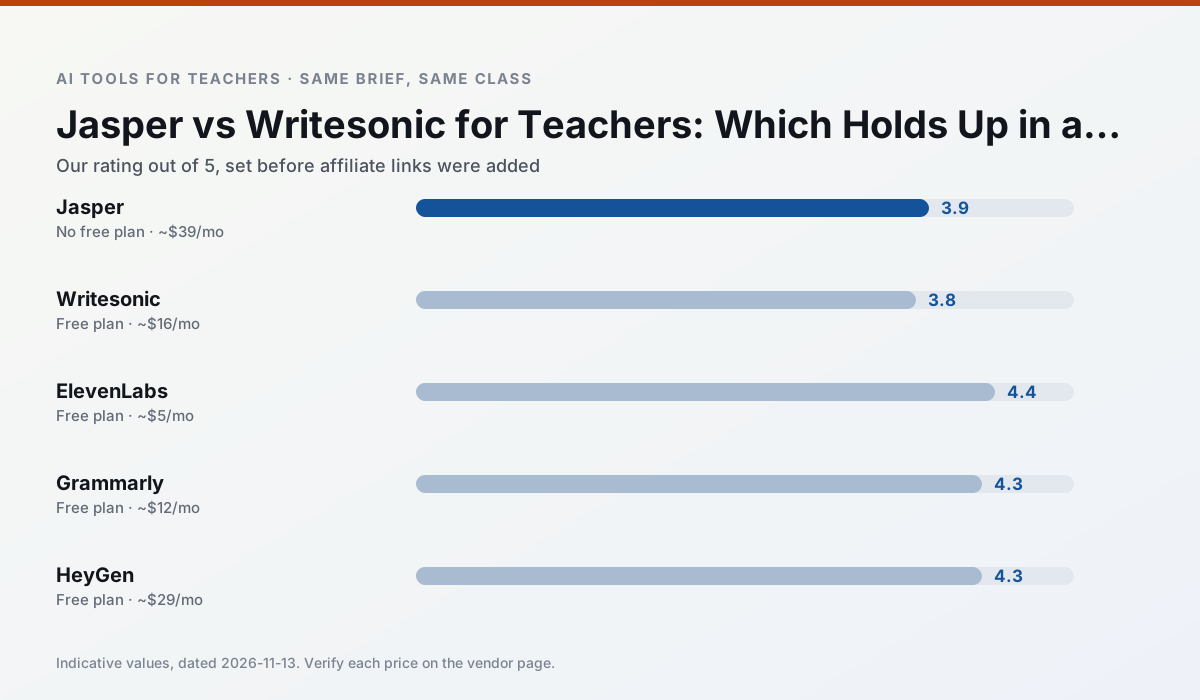
Side by side
Comparison table
Ratings reflect our timed classroom workflow, not vendor claims. Prices are indicative — verify on the vendor site.
| Tool | Best for | Free tier | Indicative paid plan | Standout feature | Our rating | Verdict | Try the tool |
|---|---|---|---|---|---|---|---|
| Jasper | newsletters · parent communication | No ongoing free plan | ~$39 /user/mo | Brand voice profiles | 3.9 / 5 | Situational | Try free |
| Writesonic | newsletters · parent communication | Yes — Limited credits | ~$16 /user/mo | Article and email generators | 3.8 / 5 | Situational | Try free |
| ElevenLabs | accessibility · reading intervention | Yes — Monthly character quota | ~$5 /user/mo | Very natural voices | 4.4 / 5 | Strong option | Try free |
| Grammarly | parent communication · report card comments | Yes — Core grammar and tone checks | ~$12 /user/mo | Tone adjustments | 4.3 / 5 | Strong option | Try free |
| HeyGen | video lessons · translation | Yes — Limited credit plan | ~$29 /user/mo | Video translation | 4.3 / 5 | Strong option | Try free |
| Colossyan | PD materials · video lessons | No ongoing free plan | ~$27 /user/mo | PDF/PPT-to-video | 4.1 / 5 | Situational | Try free |
Match your situation
Best for X
Different jobs need different tools. Here is what we would open first in each case.
Jasper is the student-facing option here with boundaries a teacher can actually set and supervise.
Writesonic is the steadiest of this set at plain, respectful language; names and specific incidents still belong in your draft, not the prompt.
For three reading groups and one text, ElevenLabs needs the least manual relabelling of vocabulary and questions.
Setup cost is one login for Grammarly; everything else can wait until you know the tool is useful.
Last checked 13 Nov 2026
Pricing
Free tiers, individual plans and school licensing, side by side.
| Tool | Free plan | Individual / paid | School & district | Billing note | Verify |
|---|---|---|---|---|---|
| Jasper | No ongoing free tier | ~$39 /user/mo | ~$59+ /user/mo | Indicative — verify on vendor site | Vendor |
| Writesonic | $0 — Limited credits | ~$16 /user/mo | ~$49 /user/mo | Indicative — verify on vendor site | Vendor |
| ElevenLabs | $0 — Monthly character quota | ~$5 /user/mo | ~$22 /user/mo | Indicative — verify on vendor site | Vendor |
| Grammarly | $0 — Core grammar and tone checks | ~$12 /user/mo | ~$15 /user/mo | Indicative — billed annually | Vendor |
| HeyGen | $0 — Limited credit plan | ~$29 /user/mo | Custom quote | Indicative — verify on vendor site | Vendor |
| Colossyan | No ongoing free tier | ~$27 /user/mo | Custom quote | Indicative — verify on vendor site | Vendor |
Editorial rule: pricing is re-checked every 2–3 months and the top 50 pages are refreshed every 6 months. See our funding policy.
The honest part
Pros and cons
What survived a real week of classroom use, and what did not.
Pros
- Consistent tone across communications
- Strong long-form editor
- Good for district comms teams
Cons
- Priced for marketing teams
- Overkill for one classroom
- No education-specific features
Pros
- Cheaper than enterprise writing suites
- Many templates
- Reasonable free trial
Cons
- Generic classroom output
- Credit system is confusing
- Limited education context
Pros
- Excellent for accessible audio versions
- Low entry price
- Fast generation
Cons
- Quota-based billing
- Voice cloning consent considerations
- Not a teaching platform
Pros
- Catches errors in high-stakes parent emails
- Works everywhere you already write
- Very low learning curve
Cons
- Not education-specific
- Can flatten teacher voice
- Premium needed for tone rewriting
Pros
- Best-in-class lip-sync translation
- Useful for multilingual families
- Generous trial credits
Cons
- Credit-based pricing is confusing
- Voice cloning raises consent questions
- Overkill for everyday lessons
In the classroom
Use cases
Five concrete workflows, with the tool we would open for each one.
Regrouping students after an assessment
Summarise anonymised results into skill groups, then generate one activity per group. Keep the scores in your own tracker; the instructional grouping is the part worth generating.
Recommended: JasperA weekly family newsletter from bullet notes
Newsletters fail on length, not tone. Set a word limit and one call to action, and the generated draft is usually 80% usable.
Recommended: WritesonicA question bank from a PDF or article
Feed a non-identifiable source and ask for items tagged by difficulty with the misconception behind each distractor. Spot-check every answer key; numerical items are least reliable.
Recommended: ElevenLabsA substitute folder that needs no context
The value here is structure, not creativity. Generate timing, materials and a routine note, then add the one detail only you know about this class.
Recommended: GrammarlyAn IEP present-levels first draft
Use aggregated, anonymised data only. Ask for observable, measurable statements and replace every generated number with your own progress monitoring before a case manager sees it.
Recommended: HeyGen
Questions teachers ask us
FAQ
Direct answers, also published as FAQPage structured data for search and AI assistants.
Jasper or Writesonic for lesson planning?
Which is cheaper for one teacher?
Do they produce the same output?
Sources & further reading
Our recommendation
Try Jasper free for your next lesson planning task
Brand-voice writing assistant for school communications teams. Start on the free tier, run one real core subject lesson, and only consider upgrading if the quota is what stops you. Disclosure: we may earn a commission (varies) at no extra cost to you.
Some links on this page are affiliate links. We may earn a commission at no extra cost to you. Our rankings are editorial and never pay-to-play. Never enter student PII into a free consumer account.
Keep reading
Related comparisons in this cluster.
Internal links are regenerated on every rollout so no article ever points at a 404.