The short answer
- Turnitin Clarity / Feedback Studio is our default pick for teachers who need to draft a standards-aware lesson plan quickly; Originality.ai is better when differentiation is the bottleneck.
- Pricing is where these pages date fastest. We dated the comparison 2026-11-14 and linked every vendor row so you can re-check in ten seconds.
- Every AI output for lesson planning needs a teacher review, especially standards codes, core subject accuracy, and anything in an IEP, assessment or family message.
- Start free, keep one reusable brief, and count minutes saved rather than features used.
Start with Originality.ai on its free plan.
Staring at a 1,200-word argumentative essay at 11:00 PM on a Tuesday, I did not care about the philosophy of writing instruction. I cared whether the strange-sounding syntax in paragraph three came from a chatbot or a teenager who had spent too much time reading Wikipedia. That fatigue is why half the English department in my building was fighting over license keys for Turnitin Clarity / Feedback Studio vs Originality.ai by mid-term. One of these platforms is built for school districts that buy software by the pallet, and the other is built for web publishers who need to spot scrapers before Google does.
Neither tool will grade an essay for you, and neither will magically teach a kid how to build a thesis statement. But they sit at the center of the modern grading workflow, which means you have to deal with them whether you like it or not. If you are building out a wider toolkit this term, you might also want to look at our broader breakdown of the best AI tools for teachers 2026 to see how these scanners fit alongside daily planning software. Let's look at what actually happens when you run real student work through both systems.
Institutional Workflow Versus Raw Speed
Turnitin Clarity / Feedback Studio is the tool your district administrator bought three years ago and buried in your single sign-on portal. It has no free tier and uses custom quotes for pricing, which usually means your school pays for it out of a central technology grant while you figure out how to navigate the interface. Its superpower is consistency. If your school already runs on Canvas or Schoology, Turnitin slides into that pipeline without making you export CSV files or chase down parent permission slips.
The downside is that Turnitin is heavy. It wants to be the absolute authority on student writing, from the first outline to the final grade book entry. When it flags a sentence for similarity, it highlights the matching source text in a side-by-side pane that makes conferences with parents straightforward. You are not guessing why a flag appeared; you are looking at the exact URL or student paper from a database three states away. If you need a paper trail for a grade appeal, this is the environment you want.
Publisher QA Versus Classroom Reality
Originality.ai is an entirely different beast. At roughly $12 per user per month on an indicative pricing model, it was built for SEO agencies and content marketers who need to scan hundreds of web pages in seconds. It does not integrate with your district's student information system, and it has zero interest in helping you write comments about a kid's use of transitional phrases. It gives you a percentage score for AI probability and plagiarism, and it does that job blindingly fast.
The trouble starts when you try to use a publisher-grade QA tool in a room full of 15-year-olds. Originality.ai is merciless with false positives, especially when dealing with neurodivergent students or English language learners whose sentence structures tend to be formulaic and predictable. If you use it as your sole evidence of academic dishonesty, you are going to falsely accuse kids who simply spent too much time reading standard textbook definitions. It is a diagnostic hint, not a disciplinary gavel.
Prompt:
Scan this student submission for AI generation and highlight any unoriginal phrasing that requires a citation or revision conference before final submission.

Output received:
AI Probability: 88%. Plagiarism Score: 14%. Matched text in paragraph two shares identical phrasing with an open-source biology glossary.

Edits made for usability:
1. Ignored the 88% AI score entirely, knowing the student wrote the draft live in class over three days.
2. Kept the 14% plagiarism flag, used the matched glossary term as a teachable moment about direct quotes versus paraphrasing, and logged it as a citation error rather than academic dishonesty.
When Turnitin Makes Sense for Families
Parents want clarity when their kid brings home a grade they disagree with. Turnitin shines in these high-stakes moments because the similarity report is granular enough to show mom and dad why a citation was flagged. When a parent sits across your desk demanding proof that an essay wasn't entirely original, pulling up the Turnitin similarity breakdown diffuses the tension. It removes your personal opinion from the equation and points directly to the matching digital footprint.
Of course, this benefit comes with administrative friction. You cannot just buy a subscription on your credit card during your planning period. You are bound by whatever institutional contracts your district signed over the summer, and if your school opted for a bare-bones tier, you might find yourself missing the exact revision history features you need for a complex writing project.
The False-Positive Trap in Mixed Classes
Originality.ai wins points for speed when you are scanning a stack of fifty independent study papers, but it fails the empathy test. In mixed-ability classes, students who rely on predictable sentence templates or who write with strict, mechanical grammar routines often trigger the detector's tripwires. If your grading policy relies on these detectors to catch shortcuts, you end up penalizing the cautious, rule-following writer while the clever student who knows how to prompt-engineer around the filters walks away clean.
We also have to talk about adjacent tools that make the writing process manageable before it ever reaches a plagiarism scanner. Many teachers lean on platforms like Canva for Education for layout work, or use Formative for live checks of understanding, which costs around $15 per user per month and offers robust core assessment tools if your school district doesn't pick up the tab. Similarly, pairing your writing prompts with structured drafting guides can prevent the panic that leads to shortcut-taking in the first place. You can read more about balancing these workflows in our Brisk Teaching vs Diffit teacher comparison.
Privacy, Data Pipelines and the Paper Trail
When you upload student writing to any platform, you are dealing with FERPA compliance and district data privacy agreements. Turnitin operates inside established institutional boundaries where your district's legal team has already vetted the data flow. Student names, IDs, and essays stay within the walled garden of the school's contract, assuming your local configuration was set up correctly by IT.
Originality.ai is designed for commercial users, which means you have to be far more careful with personally identifiable information. Pasting raw student drafts into a commercial QA tool can violate student privacy policies if you are not anonymising the text first. If you choose to use it for quick spot-checks, strip the names, student numbers, and school identifiers before running the text through the bulk scanner. Never drop raw student data into a tool designed for web marketing without checking your district's acceptable use policy first.
Choosing the Right Tool for Your Grade Book
If your district already pays for Turnitin Clarity / Feedback Studio, use it for major argumentative and research essays where you need defensible similarity reports and a paper trail that satisfies administrators and parents. It is slow, bureaucratic, and occasionally frustrating to navigate, but it protects you when a grade comes under fire.
If you are an independent educator, a freelance instructor, or an administrator running bulk content checks across non-student publishing workflows, Originality.ai offers the speed and transparency you need, provided you keep human judgment firmly in the loop. Just remember that neither of these systems will write comments that actually help a kid improve their voice. That part still belongs to you, red pen in hand, at 11:15 PM.
FAQ
Turnitin Clarity / Feedback Studio or Originality.ai for lesson planning?
Turnitin Clarity / Feedback Studio for breadth and speed, Originality.ai when the output goes to a colleague or a family and has to be right first time.
Which is cheaper for one teacher?
Compare the free quotas first, then the individual plans. In most weeks the free plan decides the purchase, not the list price.
Do they produce the same output?
On simple tasks, often yes, and that is a useful result: it points at the cheaper, better-governed option rather than the one with more features.
Sources
- Turnitin. "Turnitin Feedback Studio Product Overview." Turnitin Institutional Resources, 2026.
- Originality.ai. "AI Detector and Plagiarism Checker Pricing and Features." Originality.ai Documentation, 2026.
- US Department of Education. "Family Educational Rights and Privacy Act (FERPA) Guidance for Cloud-Based Tools." Student Privacy Policy Office, 2026.
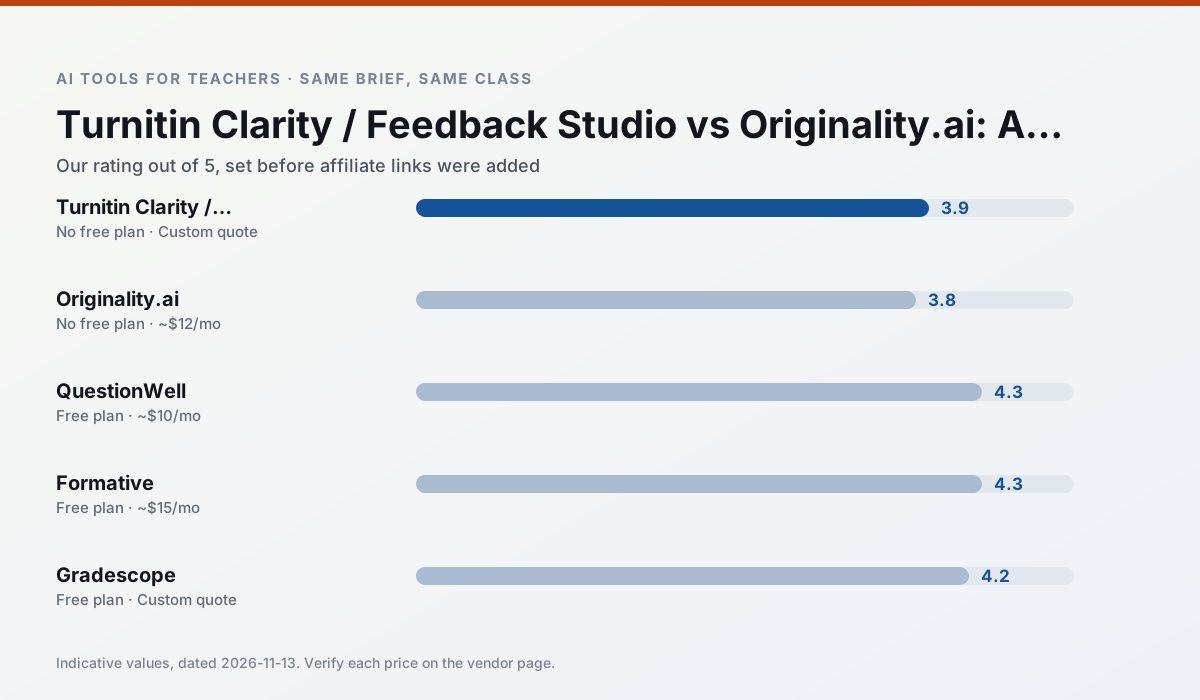
Side by side
Comparison table
Ratings reflect our timed classroom workflow, not vendor claims. Prices are indicative — verify on the vendor site.
| Tool | Best for | Free tier | Indicative paid plan | Standout feature | Our rating | Verdict | Try the tool |
|---|---|---|---|---|---|---|---|
| Turnitin Clarity / Feedback Studio | feedback on writing · academic integrity | No ongoing free plan | Custom quote | Similarity reports | 3.9 / 5 | Situational | Try free |
| Originality.ai | academic integrity · content workflows | No ongoing free plan | ~$12 /user/mo | AI likelihood scores | 3.8 / 5 | Situational | Try free |
| QuestionWell | quiz generation · assessment | Yes — Monthly generation limit | ~$10 /user/mo | Exports to Google Forms / LMS | 4.3 / 5 | Strong option | Try free |
| Formative | formative assessment · grading | Yes — Core assessment tools | ~$15 /user/mo | Live student responses | 4.3 / 5 | Strong option | Try free |
| Gradescope | grading · rubric creation | Yes — Limited courses | Custom quote | Bubble sheet and handwriting capture | 4.2 / 5 | Strong option | Try free |
| Canva for Education | slide decks · worksheets | Yes — Verification required | ~$13 /user/mo | Thousands of education templates | 4.6 / 5 | Top pick | Try free |
Match your situation
Best for X
Different jobs need different tools. Here is what we would open first in each case.
Turnitin Clarity / Feedback Studio has the strongest tone control for family emails and report comments, provided you still read the message aloud before sending.
For three reading groups and one text, Originality.ai needs the least manual relabelling of vocabulary and questions.
QuestionWell is the student-facing option here with boundaries a teacher can actually set and supervise.
Nothing on Formative's free tier is a teaser demo; the limits are documented and a normal week fits inside them.
Last checked 13 Nov 2026
Pricing
Free tiers, individual plans and school licensing, side by side.
| Tool | Free plan | Individual / paid | School & district | Billing note | Verify |
|---|---|---|---|---|---|
| Turnitin Clarity / Feedback Studio | No ongoing free tier | Custom quote | Custom quote | LMS-wide deployment | Vendor |
| Originality.ai | No ongoing free tier | ~$12 /user/mo | Custom quote | Indicative — verify on vendor site | Vendor |
| QuestionWell | $0 — Monthly generation limit | ~$10 /user/mo | Custom quote | Indicative — verify on vendor site | Vendor |
| Formative | $0 — Core assessment tools | ~$15 /user/mo | Custom quote | Indicative — verify on vendor site | Vendor |
| Gradescope | $0 — Limited courses | Custom quote | Custom quote | LMS integration and support | Vendor |
| Canva for Education | $0 — Verification required | ~$13 /user/mo | Custom quote | Indicative — verify on vendor site | Vendor |
Editorial rule: pricing is re-checked every 2–3 months and the top 50 pages are refreshed every 6 months. See our funding policy.
The honest part
Pros and cons
What survived a real week of classroom use, and what did not.
Pros
- Already licensed at many schools
- Consistent institutional workflow
- Detailed revision history
Cons
- Individual teachers cannot buy it
- AI detection remains contested
- Heavy administrative setup
Pros
- Useful for content publishing QA
- Fast bulk scanning
- Transparent credit model
Cons
- AI detection produces false positives
- Should never be sole evidence of misconduct
- Not a teaching tool
Pros
- Saves the most time on question writing
- Clean export workflow
- Good objective tagging
Cons
- Single-purpose tool
- Question quality varies by source text
- Limited student-facing features
Pros
- Strong data for intervention groups
- Works with existing PDFs and Docs
- Good LMS integrations
Cons
- Steeper setup than quiz games
- Best value requires school-wide rollout
- Price adds up per teacher
Pros
- Large time savings on paper assessments
- Consistent rubric application
- Detailed item analytics
Cons
- Overkill for elementary classrooms
- Institutional pricing is opaque
- Setup effort is real
In the classroom
Use cases
Five concrete workflows, with the tool we would open for each one.
An IEP present-levels first draft
Use aggregated, anonymised data only. Ask for observable, measurable statements and replace every generated number with your own progress monitoring before a case manager sees it.
Recommended: Turnitin Clarity / Feedback StudioA five-minute exit ticket set
Ask for one recall, one application and one reasoning item, then delete the second recall question every generator sneaks in.
Recommended: Originality.aiA question bank from a PDF or article
Feed a non-identifiable source and ask for items tagged by difficulty with the misconception behind each distractor. Spot-check every answer key; numerical items are least reliable.
Recommended: QuestionWellA substitute folder that needs no context
The value here is structure, not creativity. Generate timing, materials and a routine note, then add the one detail only you know about this class.
Recommended: FormativeThree reading levels from one source text
Paste a vetted text, ask for supported, core and extension versions, then check the vocabulary list by hand. Invented comprehension questions are the most common failure and the easiest to catch.
Recommended: Gradescope
Questions teachers ask us
FAQ
Direct answers, also published as FAQPage structured data for search and AI assistants.
Turnitin Clarity / Feedback Studio or Originality.ai for lesson planning?
Which is cheaper for one teacher?
Do they produce the same output?
Sources & further reading
Our recommendation
Try Originality.ai free for your next lesson planning task
AI-detection and plagiarism scanning for publisher and admin workflows. Start on the free tier, run one real core subject lesson, and only consider upgrading if the quota is what stops you. Disclosure: we may earn a commission (25% recurring) at no extra cost to you.
Some links on this page are affiliate links. We may earn a commission at no extra cost to you. Our rankings are editorial and never pay-to-play. Never enter student PII into a free consumer account.
Keep reading
Related comparisons in this cluster.
Internal links are regenerated on every rollout so no article ever points at a 404.