The short answer
- Synthesia is our default pick for teachers who need to draft a standards-aware lesson plan quickly; HeyGen is better when differentiation is the bottleneck.
- Free-tier reality for this shortlist: Synthesia: No ongoing free plan; HeyGen: Yes — Limited credit plan; Canva for Education: Yes — Verification required. Treat every paid figure as indicative until you have read the vendor page; only the free quota is something you can test yourself this week.
- Every AI output for Testing accommodations needs a teacher review, especially standards codes, core subject accuracy, and anything in an IEP, assessment or family message.
- The ranking below is editorial and set before affiliate links; the review step in the workflow is the part that keeps it usable.
Start with Synthesia on its free plan.
At 3:15 on a Tuesday, I stared at a stack of modified quizzes, three different audio recording apps, and a pile of graphic organizer requests from case managers. Testing accommodations with AI used to feel like another administrative hurdle I didn't have time to climb. Then I started using tools like Canva for Education and Gamma to build accessible layouts, while relying on Formative and Gradescope to manage the actual scoring load without drowning in paperwork.
When you manage an inclusion classroom, differentiation isn't a buzzword. It's the difference between a student demonstrating what they know and a student staring at a wall of text they cannot decode. AI helps build those bridges, provided you keep the steering wheel firmly in your own hands. If you are looking at broader workflows, take a look at our comprehensive guide on best AI tools for teachers 2026.
Building Scaffolded Question Banks Without the Tears
Creating alternate versions of an assessment for students with reading accommodations usually means cutting, pasting, and rewriting until midnight. Now, I feed a sanitized text or a PDF into an AI generator and ask it to break the content down by cognitive demand. The trick is asking for the reasoning behind the wrong answers, which helps you catch conceptual gaps before they hit the test paper.
Prompt: "Take this source text about cellular respiration. Generate 5 multiple-choice questions tagged by difficulty level (Low, Med, High). For each question, provide 4 options and state the specific misconception behind each distractor."
First output: The AI gave solid question stems, but two of the numerical calculation items had flawed math in the answer key, and the distractors were too obviously absurd.
Two edits that fixed it: First, I ran a strict manual spot-check on all math and science data points, because generative tools fail on numbers. Second, I added a prompt constraint: "Make distractors plausible based on common student errors in middle school biology."
Generating Fast Exit Tickets for Mixed-Ability Groups
When you need a quick check for understanding that accommodates varied processing speeds, you need structure rather than endless options. Canva for Education is best for mixed-ability classes because you can quickly pull clean templates and pair them with AI-generated prompts that match different reading levels. I usually ask for a strict set: one recall, one application, and one reasoning item.
The catch is that AI love generators always sneak in a second recall question because it defaults to low-level Bloom's taxonomy. I delete that extra recall item immediately to keep the cognitive load balanced. For tracking these responses live without adding to the grading pile, tools like Formative let you ingest existing PDFs and Docs while giving you strong data for intervention groups at about $15 /user/mo (indicative).
Producing Parent-Facing Updates in Multiple Languages
Reaching families who speak languages other than English used to mean waiting days for district translation services. HeyGen, which runs about ~$29 /user/mo (indicative), stands out as best for parent-facing writing and translation because of its advanced multilingual capabilities. When I draft a message about upcoming testing accommodations, I keep student names entirely out of the prompt.
Prompt: "Draft a warm, plain-language email to a parent explaining that their student will receive extended time and reduced-distraction seating for the upcoming science unit test. Avoid educational jargon."
First output: The tone was a bit too corporate and stiff, and it included placeholder brackets that didn't match our school's actual testing dates.
Two edits that fixed it: I stripped out the robotic phrasing by adding "Write like a friendly middle school teacher speaking face-to-face," and I manually inserted the precise dates and specific testing room numbers before sending anything out.
Drafting IEP Present-Levels Statements Safely
Writing Individualized Education Program updates requires clinical precision and absolute data privacy. You should never upload identifiable student data into public-facing models. Gamma, which costs about ~$10 /user/mo (indicative), provides the fastest path from a bulleted outline to a structured presentation or document when you need quick setup for team meetings.
I feed the tool anonymized, aggregated category percentages—such as spelling accuracy ranges or reading fluency benchmarks—to generate objective, measurable statements. Before a case manager or a parent ever sees the draft, I replace every single generated percentage or timeline with the exact metrics from my physical grade book. For schools ready to invest in paperless workflows, Gradescope handles rubric grading for scanned assessments, though its institutional pricing requires a custom quote and full FERPA review.
Managing Substitute Folders With No Context
When you wake up sick, writing sub plans that account for specific student accommodations is exhausting. The secret is treating the generator as a structural layout artist rather than a creative writer. I use Gamma to organize the timing, materials list, and transition routines, and then I layer in the one crucial accommodation detail only I know about that specific class period.
For video-based instruction within sub plans, Synthesia costs about ~$29 /user/mo (indicative) and is best for student-safe deployments because it turns a written script into a clean presenter-led video without requiring a camera. Just remember never to use student likenesses or real student voices without documented consent. You can also explore how support staff utilize these workflows in our guide on AI accommodations for paraprofessionals.
FAQ
Can AI do Testing accommodations at mixed-grade level?
It can produce a first draft and a structure. The level judgement, the standards check and the tone are teacher decisions.
Which tool is best for Testing accommodations?
Synthesia on the evidence in this article, with HeyGen as the second opinion. Neither replaces the review step.
What is the biggest risk?
A confident, plausible output that nobody checked. The five checks below exist for that reason.
Sources
- Synthesia Pricing and Features: https://www.synthesia.io/
- HeyGen Feature Overview: https://www.heygen.com/
- Canva for Education Guidelines: https://www.canva.com/education/
- Gamma Documentation: https://gamma.app/
- Formative Assessment Platform: https://www.formative.com/
- Gradescope Data Privacy and Features: https://www.gradescope.com/
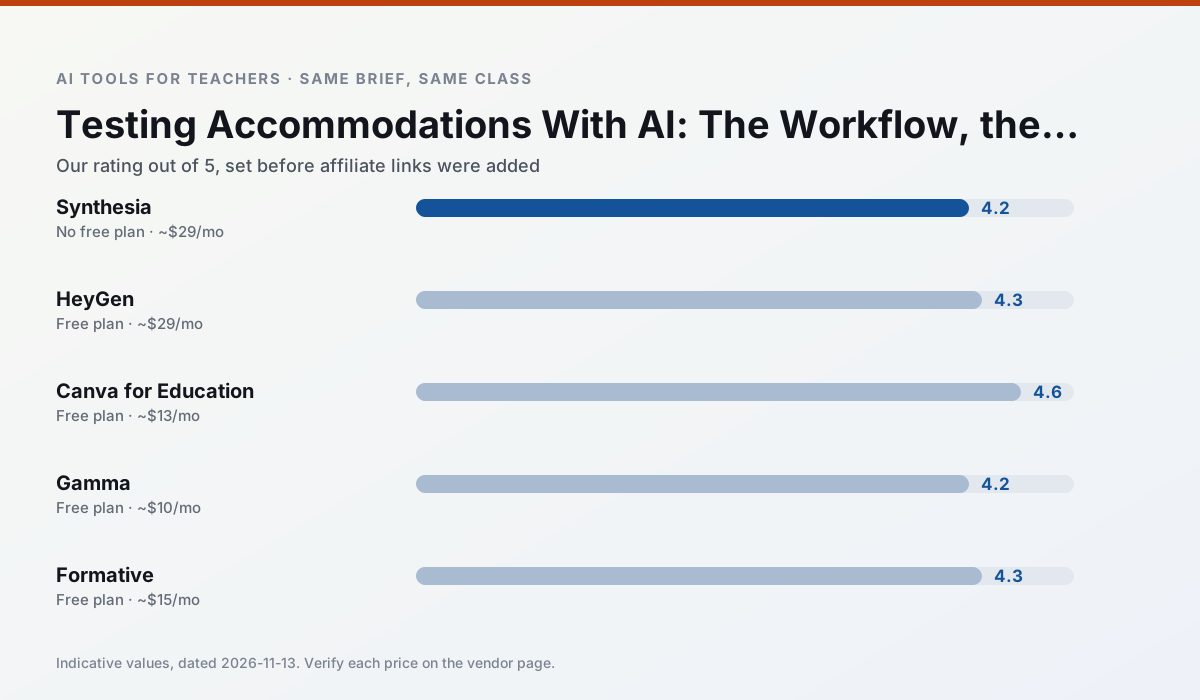
Side by side
Comparison table
Ratings reflect our timed classroom workflow, not vendor claims. Prices are indicative — verify on the vendor site.
| Tool | Best for | Free tier | Indicative paid plan | Standout feature | Our rating | Verdict | Try the tool |
|---|---|---|---|---|---|---|---|
| Synthesia | flipped lessons · video lessons | No ongoing free plan | ~$29 /user/mo | 140+ languages | 4.2 / 5 | Strong option | Try free |
| HeyGen | video lessons · translation | Yes — Limited credit plan | ~$29 /user/mo | Video translation | 4.3 / 5 | Strong option | Try free |
| Canva for Education | slide decks · worksheets | Yes — Verification required | ~$13 /user/mo | Thousands of education templates | 4.6 / 5 | Top pick | Try free |
| Gamma | slide decks · parent communication | Yes — Credit-limited generation | ~$10 /user/mo | Prompt-to-deck | 4.2 / 5 | Strong option | Try free |
| Formative | formative assessment · grading | Yes — Core assessment tools | ~$15 /user/mo | Live student responses | 4.3 / 5 | Strong option | Try free |
| Gradescope | grading · rubric creation | Yes — Limited courses | Custom quote | Bubble sheet and handwriting capture | 4.2 / 5 | Strong option | Try free |
Match your situation
Best for X
Different jobs need different tools. Here is what we would open first in each case.
Synthesia is the student-facing option here with boundaries a teacher can actually set and supervise.
HeyGen is the steadiest of this set at plain, respectful language; names and specific incidents still belong in your draft, not the prompt.
For three reading groups and one text, Canva for Education needs the least manual relabelling of vocabulary and questions.
Gamma runs in a browser tab with no extension, no student accounts and no onboarding call, so you can test it in a free period.
Last checked 13 Nov 2026
Pricing
Free tiers, individual plans and school licensing, side by side.
| Tool | Free plan | Individual / paid | School & district | Billing note | Verify |
|---|---|---|---|---|---|
| Synthesia | No ongoing free tier | ~$29 /user/mo | Custom quote | Indicative — verify on vendor site | Vendor |
| HeyGen | $0 — Limited credit plan | ~$29 /user/mo | Custom quote | Indicative — verify on vendor site | Vendor |
| Canva for Education | $0 — Verification required | ~$13 /user/mo | Custom quote | Indicative — verify on vendor site | Vendor |
| Gamma | $0 — Credit-limited generation | ~$10 /user/mo | ~$20 /user/mo | Indicative — verify on vendor site | Vendor |
| Formative | $0 — Core assessment tools | ~$15 /user/mo | Custom quote | Indicative — verify on vendor site | Vendor |
| Gradescope | $0 — Limited courses | Custom quote | Custom quote | LMS integration and support | Vendor |
Editorial rule: pricing is re-checked every 2–3 months and the top 50 pages are refreshed every 6 months. See our funding policy.
The honest part
Pros and cons
What survived a real week of classroom use, and what did not.
Pros
- No camera or editing skills required
- Excellent multilingual voice output
- Easy updates to existing videos
Cons
- Cost is hard to justify for a single teacher
- Avatar video can feel impersonal
- No free ongoing tier
Pros
- Best-in-class lip-sync translation
- Useful for multilingual families
- Generous trial credits
Cons
- Credit-based pricing is confusing
- Voice cloning raises consent questions
- Overkill for everyday lessons
Pros
- Effectively free for verified teachers
- Huge template library
- No design skills needed
Cons
- AI features are capped
- Easy to produce cluttered slides
- Account verification can be slow
Pros
- Fastest path from outline to deck
- Modern-looking output by default
- Good export options
Cons
- Design control is limited
- Credits run out quickly
- Not built for student data
Pros
- Strong data for intervention groups
- Works with existing PDFs and Docs
- Good LMS integrations
Cons
- Steeper setup than quiz games
- Best value requires school-wide rollout
- Price adds up per teacher
In the classroom
Use cases
Five concrete workflows, with the tool we would open for each one.
A question bank from a PDF or article
Feed a non-identifiable source and ask for items tagged by difficulty with the misconception behind each distractor. Spot-check every answer key; numerical items are least reliable.
Recommended: SynthesiaA substitute folder that needs no context
The value here is structure, not creativity. Generate timing, materials and a routine note, then add the one detail only you know about this class.
Recommended: HeyGenAn IEP present-levels first draft
Use aggregated, anonymised data only. Ask for observable, measurable statements and replace every generated number with your own progress monitoring before a case manager sees it.
Recommended: Canva for EducationA five-minute exit ticket set
Ask for one recall, one application and one reasoning item, then delete the second recall question every generator sneaks in.
Recommended: GammaA parent email in two languages
Draft in plain, warm language with no names, translate, then back-translate the important sentences to check meaning. Keep specific incidents out of the prompt and add them yourself.
Recommended: Formative
Questions teachers ask us
FAQ
Direct answers, also published as FAQPage structured data for search and AI assistants.
Can AI do Testing accommodations at mixed-grade level?
Which tool is best for Testing accommodations?
What is the biggest risk?
Sources & further reading
Our recommendation
Try Synthesia free for your next Testing accommodations task
Turn a script into a presenter-led video with AI avatars. Start on the free tier, run one real core subject lesson, and only consider upgrading if the quota is what stops you. Disclosure: we may earn a commission (25% recurring) at no extra cost to you.
Some links on this page are affiliate links. We may earn a commission at no extra cost to you. Our rankings are editorial and never pay-to-play. Never enter student PII into a free consumer account.
Keep reading
Related comparisons in this cluster.
Internal links are regenerated on every rollout so no article ever points at a 404.