The short answer
- Diffit is our default pick for Resource intervention who need to build levelled passages and word work quickly; ElevenLabs is better when differentiation is the bottleneck.
- Diffit handles the broad case; ElevenLabs handles the narrow one. Anything beyond that pair should be justified by a recurring weekly job, not a feature demo.
- Every AI output for reading intervention needs a teacher review, especially standards codes, core subject accuracy, and anything in an IEP, assessment or family message.
- Trial one tool for a week of real reading intervention work before any purchase conversation; the quota is the honest test.
Start with ElevenLabs on its free plan.
By third period on a Tuesday, my resource room looks like a waiting room at an urgent care clinic. Seven kids, five reading levels, three distinct IEP goals, and one tired teacher trying to find a text that won't make the eighth grader roll his eyes or make the fifth grader burst into tears. Finding materials that bridge that gap used to eat my Sunday planning block whole. That is why I started looking seriously at AI reading intervention for resource intervention this term, testing tools that promised to take the heavy lifting out of text leveling and audio support.
The reality of intervention planning is that you rarely have a room full of kids reading the exact same paragraph at the exact same pace. If you hand out an unadapted article on marine biology to a mixed group, your decoding struggles drown out the comprehension work entirely. I needed a tool that could adapt content without flattening the subject matter into babyish language. That search is what makes selecting the right utility for your room so critical, especially when you are trying to align with broader classroom strategies like those detailed in our guide on the best AI tools for teachers 2026.
Leveling Content Without Losing Rigor
When you need to pull an article about deep-sea vents and make it accessible for a kid reading two grades behind, manual rewriting takes twenty minutes per page. Diffit handles this by taking text or video and leveling it into differentiated reading materials with minimal setup. It is our top pick for student-safe deployments because it focuses on educational texts rather than general web scraping. You paste an URL or a chunk of text, select the target grade level, and it spits out a leveled passage alongside vocabulary definitions and comprehension checks.
The catch is that leveling is approximate, not a formal clinical assessment. You still have to read through the output to ensure the syntax matches your students' actual decoding abilities. The free tier gives you a limited number of generations per month, and heavy use will burn through that quota before the unit is half over. At around $15 a user per month for the paid tier, it sits at a typical software price point for schools. Never paste identifiable student work into these prompts, as you always need to keep PII off third-party servers and check your district's privacy policies.
Prompt: "Take this 800-word article on local watersheds and adapt it for a 4th-grade reading level. Keep the core concepts of runoff and pollution, but simplify the sentence structure. Add four comprehension questions: two literal, one inferential, and one vocabulary-in-context."
Output: Diffit returned a clean 300-word passage with short sentences and bulleted vocabulary words. The literal questions were spot on, but the inferential question asked about a concept not mentioned in the simplified text.
Edit 1: Replaced the unsupported inferential question with one drawn directly from the new paragraph about storm drains.
Edit 2: Shortened the sentence about chemical runoff to eliminate a clunky passive construction that tripped up my struggling decoders.
Adding Audio Support for Struggling Decoders
Some kids can comprehend complex themes just fine if their eyes are not stumbling over every third word. That is where listening to the text changes the entire dynamic of an intervention session. ElevenLabs provides natural-sounding AI voiceover and text-to-speech, making it our choice for best for mixed-ability classes when you need instant, high-quality audio versions of your leveled passages. The entry price sits around $5 a user per month, and the speed of generation is fast enough to do on the fly while kids are transitioning to small groups.
Billing is entirely quota-based on character counts, meaning long chapter books will drain your monthly allowance fast. Furthermore, you have to be vigilant about consent considerations regarding voice cloning. Never clone a student's or a colleague's voice without explicit written consent. This tool is a text-to-speech engine, not a teaching platform, so it will not track student progress or build lesson plans for you. It simply gives your decoding-heavy worksheets a clear, human-sounding voice so kids can follow along with their fingers while listening through headphones.
Streamlining Parent Communication and Reports
Intervention teachers spend an absurd amount of time writing progress notes and explaining interventions to parents who feel anxious about their child's reading scores. When you are exhausted at the end of the day, drafting these emails without sounding defensive or overly clinical is tough. Grammarly acts as a writing assistant for polished parent emails, newsletters, and reports, catching errors before they hit the send button. At around $12 a user per month, it works right inside your browser where you already write.
Weekly family newsletters often fail because teachers try to include every single detail of the reading curriculum. Set a strict word limit and one clear call to action, and the generated draft is usually eighty percent usable.
The free tier handles core grammar and tone checks, but you need the paid version for advanced tone rewriting. It is not an education-specific tool, meaning it can sometimes flatten your natural teacher voice into generic corporate speak if you accept every automated suggestion blindly. If you need to manage paraprofessional workflows or coordinate reading accommodations across a larger support team, you might also look at our resource on AI accommodations for paraprofessionals to keep everyone on the same page. Always disable text collection on school devices and verify your district's data privacy agreement before letting a writing assistant touch sensitive student progress notes.
Managing Administrative Workflows and Content QA
Sometimes the biggest hurdle in an intervention program is not the kids, but the administrative overhead of organizing curriculum documents across a special education department. Notion AI offers AI-assisted notes, databases, and curriculum planning in one workspace for roughly $10 a user per month. It is fantastic for long-term curriculum records and team collaboration, but the initial setup time is significant. It is not purpose-built for quick lesson generation, and the AI pricing model has shifted more than once over the past year.
For district-level communications or broad public-facing policies, Jasper steps in as a brand-voice writing assistant priced at around $39 a user per month. It is our pick for schools and districts that need consistent tone across heavy publishing schedules. However, it is fundamentally priced for marketing teams and is complete overkill for a single classroom teacher. Meanwhile, if you are vetting outside content or checking submissions for originality, Originality.ai provides AI-detection and plagiarism scanning for publisher workflows at about $12 a user per month with a transparent credit model.
The important thing to remember with detection tools is that AI detectors produce false positives. Never use a detector score as the sole evidence of disciplinary misconduct or academic dishonesty. These tools are QA scanners for content publishing, not disciplinary judges. As you build out your intervention suite, keeping your data secure and your workflows simple will save you from software fatigue. Stick to the tools that solve an immediate bottleneck in your room, protect student privacy fiercely, and leave the marketing platforms to the district office.
FAQ
Can AI do reading intervention at mixed-grade level?
It can produce a first draft and a structure. The level judgement, the standards check and the tone are teacher decisions.
Which tool is best for reading intervention?
Diffit on the evidence in this article, with ElevenLabs as the second opinion. Neither replaces the review step.
What is the biggest risk?
A confident, plausible output that nobody checked. The five checks below exist for that reason.
Sources
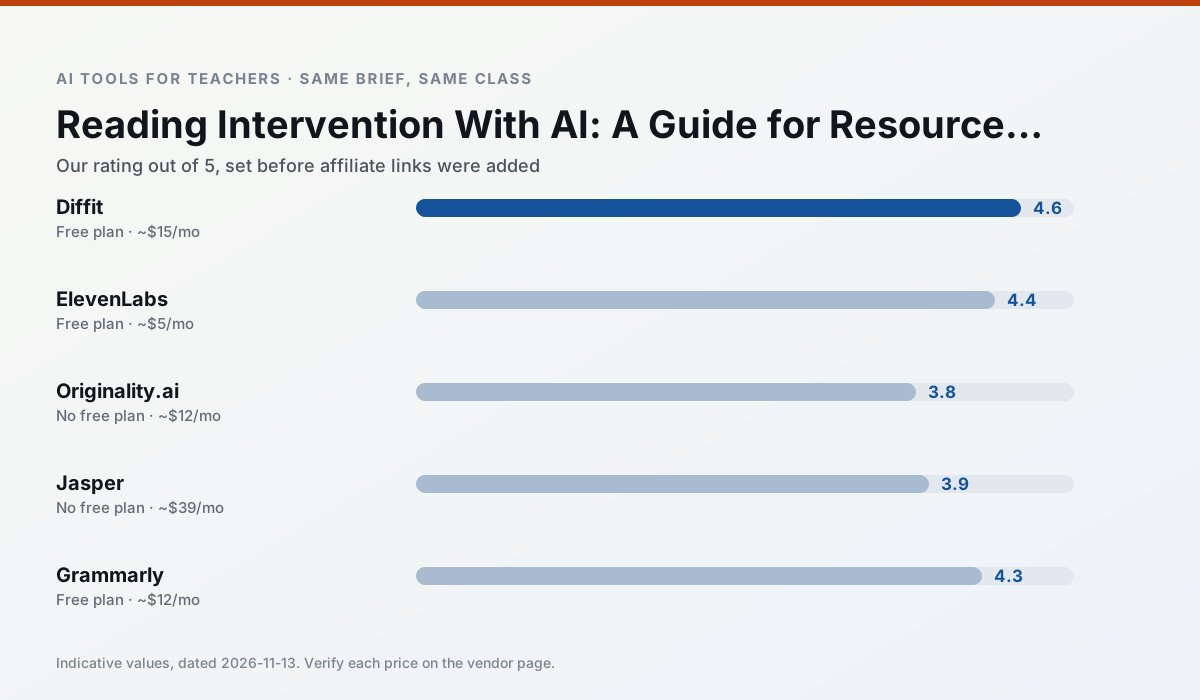
Side by side
Comparison table
Ratings reflect our timed classroom workflow, not vendor claims. Prices are indicative — verify on the vendor site.
| Tool | Best for | Free tier | Indicative paid plan | Standout feature | Our rating | Verdict | Try the tool |
|---|---|---|---|---|---|---|---|
| Diffit | differentiated instruction · reading intervention | Yes — Limited generations per month | ~$15 /user/mo | Lexile-style leveling | 4.6 / 5 | Top pick | Try free |
| ElevenLabs | accessibility · reading intervention | Yes — Monthly character quota | ~$5 /user/mo | Very natural voices | 4.4 / 5 | Strong option | Try free |
| Originality.ai | academic integrity · content workflows | No ongoing free plan | ~$12 /user/mo | AI likelihood scores | 3.8 / 5 | Situational | Try free |
| Jasper | newsletters · parent communication | No ongoing free plan | ~$39 /user/mo | Brand voice profiles | 3.9 / 5 | Situational | Try free |
| Grammarly | parent communication · report card comments | Yes — Core grammar and tone checks | ~$12 /user/mo | Tone adjustments | 4.3 / 5 | Strong option | Try free |
| Notion AI | curriculum mapping · unit planning | Yes — Limited AI usage | ~$10 /user/mo | Linked databases | 4.1 / 5 | Situational | Try free |
Match your situation
Best for X
Different jobs need different tools. Here is what we would open first in each case.
Diffit is the student-facing option here with boundaries a teacher can actually set and supervise.
For three reading groups and one text, ElevenLabs needs the least manual relabelling of vocabulary and questions.
Originality.ai has the strongest tone control for family emails and report comments, provided you still read the message aloud before sending.
Jasper is the option IT is least likely to block: single sign-on, admin removal of AI features and an agreement on file.
Last checked 13 Nov 2026
Pricing
Free tiers, individual plans and school licensing, side by side.
| Tool | Free plan | Individual / paid | School & district | Billing note | Verify |
|---|---|---|---|---|---|
| Diffit | $0 — Limited generations per month | ~$15 /user/mo | Custom quote | Indicative — verify on vendor site | Vendor |
| ElevenLabs | $0 — Monthly character quota | ~$5 /user/mo | ~$22 /user/mo | Indicative — verify on vendor site | Vendor |
| Originality.ai | No ongoing free tier | ~$12 /user/mo | Custom quote | Indicative — verify on vendor site | Vendor |
| Jasper | No ongoing free tier | ~$39 /user/mo | ~$59+ /user/mo | Indicative — verify on vendor site | Vendor |
| Grammarly | $0 — Core grammar and tone checks | ~$12 /user/mo | ~$15 /user/mo | Indicative — billed annually | Vendor |
| Notion AI | $0 — Limited AI usage | ~$10 /user/mo | ~$8 /user/mo | Indicative — verify on vendor site | Vendor |
Editorial rule: pricing is re-checked every 2–3 months and the top 50 pages are refreshed every 6 months. See our funding policy.
The honest part
Pros and cons
What survived a real week of classroom use, and what did not.
Pros
- Excellent for mixed-ability classes
- Produces printable and digital versions
- Minimal setup
Cons
- Narrower scope than all-in-one suites
- Leveling is approximate, not a formal assessment
- Heavy use burns through the free quota
Pros
- Excellent for accessible audio versions
- Low entry price
- Fast generation
Cons
- Quota-based billing
- Voice cloning consent considerations
- Not a teaching platform
Pros
- Useful for content publishing QA
- Fast bulk scanning
- Transparent credit model
Cons
- AI detection produces false positives
- Should never be sole evidence of misconduct
- Not a teaching tool
Pros
- Consistent tone across communications
- Strong long-form editor
- Good for district comms teams
Cons
- Priced for marketing teams
- Overkill for one classroom
- No education-specific features
Pros
- Catches errors in high-stakes parent emails
- Works everywhere you already write
- Very low learning curve
Cons
- Not education-specific
- Can flatten teacher voice
- Premium needed for tone rewriting
In the classroom
Use cases
Five concrete workflows, with the tool we would open for each one.
A weekly family newsletter from bullet notes
Newsletters fail on length, not tone. Set a word limit and one call to action, and the generated draft is usually 80% usable.
Recommended: DiffitRegrouping students after an assessment
Summarise anonymised results into skill groups, then generate one activity per group. Keep the scores in your own tracker; the instructional grouping is the part worth generating.
Recommended: ElevenLabsA substitute folder that needs no context
The value here is structure, not creativity. Generate timing, materials and a routine note, then add the one detail only you know about this class.
Recommended: Originality.aiA question bank from a PDF or article
Feed a non-identifiable source and ask for items tagged by difficulty with the misconception behind each distractor. Spot-check every answer key; numerical items are least reliable.
Recommended: JasperA five-minute exit ticket set
Ask for one recall, one application and one reasoning item, then delete the second recall question every generator sneaks in.
Recommended: Grammarly
Questions teachers ask us
FAQ
Direct answers, also published as FAQPage structured data for search and AI assistants.
Can AI do reading intervention at mixed-grade level?
Which tool is best for reading intervention?
What is the biggest risk?
Sources & further reading
Our recommendation
Try ElevenLabs free for your next reading intervention task
Natural-sounding AI voiceover and text-to-speech for learning materials. Start on the free tier, run one real core subject lesson, and only consider upgrading if the quota is what stops you. Disclosure: we may earn a commission (22% recurring) at no extra cost to you.
Some links on this page are affiliate links. We may earn a commission at no extra cost to you. Our rankings are editorial and never pay-to-play. Never enter student PII into a free consumer account.
Keep reading
Related comparisons in this cluster.
Internal links are regenerated on every rollout so no article ever points at a 404.