The short answer
- Surfer SEO is our default pick for teachers who need to draft a standards-aware lesson plan quickly; Originality.ai is better when differentiation is the bottleneck.
- Start with Surfer SEO on its free plan, keep Originality.ai as the second opinion, and do not open a card until the quota, not the feature list, is what stops you.
- Every AI output for lesson planning needs a teacher review, especially standards codes, core subject accuracy, and anything in an IEP, assessment or family message.
- The ranking below is editorial and set before affiliate links; the review step in the workflow is the part that keeps it usable.
Start with Surfer SEO on its free plan.
Last Tuesday, I sat at my desk with thirty-four draft lesson summaries for our teacher-author shop and zero energy left to guess what keywords would help other educators find them on Teachers Pay Teachers. I had forty minutes before conference hours started. My usual workflow involved staring at a blinking cursor, trying to remember what terms people actually type into search bars when they need a civil war DBQ bundle. That is the exact moment I stopped treating web publishing tools like classroom apps and started looking closely at how professional content platforms handle the heavy lifting.
If you publish resources online, run a teacher blog, or manage parent-facing communications that need to reach an audience outside your school walls, standard lesson planners will not cut it. We need to look at Surfer SEO vs Originality.ai alongside other writing and publishing platforms to see which ones actually justify their subscription costs. These are not tools for handing out worksheets to eighth graders. They are publishing utilities for teacher-creators, department chairs, and curriculum leads who produce public-facing material.
The Content Optimisation Engine
Surfer SEO is built for one main job: making sure the stuff you write online gets found by people searching for it. For teacher-creators publishing resources on external marketplaces, at roughly $79 per month, it is an investment that hurts the wallet. There is no free tier to test the waters. You pay for best-in-class on-page guidance and a content score that tells you whether your resource description covers the topics teachers are actually searching for.
It is completely useless as a classroom tool, and you should never feed student data into it. However, if your side hustle involves selling curriculum units or running an education blog, the real-time feedback on word count, heading structures, and semantic keywords takes the guesswork out of publishing. You write your resource description, the tool scores it from zero to one hundred, and you adjust your terminology until the algorithm gives you the green light.
Plagiarism Scanning and Publishing QA
Originality.ai attacks the publishing workflow from a different angle. Coming in at roughly $12 per user per month with no free tier, this platform focuses on AI detection and plagiarism scanning for publisher and admin workflows. If you manage a school district blog, write district-wide curriculum guides, or need to verify the originality of parent-facing publications, it offers fast bulk scanning and a transparent credit model.
The catch is well-documented: AI detection produces false positives and should never serve as the sole evidence of misconduct. When used for its intended purpose—ensuring that public-facing articles or school newsletters are genuinely human-crafted before hitting the web—it is reasonably quick. If you are looking for a classroom management or grading assistant, look elsewhere.
Prompt: Write a brief blog post introduction explaining a new digital citizenship unit for high school parents, keeping the tone reassuring and strictly under 150 words.
Output: "Welcome back to another school year! We know digital citizenship sounds scary, but your teens are ready for it."
Edits:
- Removed the cliché opening line about welcoming parents back.
- Replaced the vague claim about teens being ready with a specific reference to our upcoming Friday parent workshop on screen-time boundaries.
Budget-Friendly Writing Assistants
Writing newsletters, parent updates, and blog posts can drain your Sunday evenings faster than grading essays. Writesonic sits at roughly $16 per user per month with a limited free trial, offering a cheaper alternative to enterprise writing suites. It provides numerous templates and helps generate content when you are staring at a blank screen.
The downside is that its output leans generic, and the credit system can feel confusing if you are not tracking every generation. When drafting a weekly family newsletter from bullet notes, newsletters usually fail on length rather than tone. Setting a strict word limit and one clear call to action yields a generated draft that is about eighty percent usable. You still have to inject your own voice, but it beats starting from scratch. For teachers who want to explore broader AI capabilities, our roundup of the best AI tools for teachers provides a deeper look at how these writing platforms compare to dedicated classroom software.
Interactive Lessons and Quick Checks
While publishing tools handle the web, platforms like Curipod handle the room. Priced at roughly $12 per user per month with a restrictive free tier, Curipod turns any topic into an interactive, student-response lesson in minutes. Teachers love it for high student engagement right out of the box and quick checks for understanding that do not require student accounts for basic use.
The limitation is that it focuses entirely on delivery rather than long-term planning, and it requires reliable classroom devices for every student. When regrouping students after an assessment, you can summarise anonymised results into skill groups and then generate one activity per group using these types of dynamic delivery tools. Keep the actual scores in your own tracker; the instructional grouping is the part worth generating.
Lesson Design and Resource Libraries
Eduaide.Ai steps into the planning space with a very low entry price of roughly $10 per user per month and a daily generation cap on its free tier. It offers good worksheet and rubric output through a clean, uncluttered user interface. While its template set is smaller than some competitors, it gets straight to the point when you need to build a question bank from a PDF or article.
Feed a non-identifiable source and ask for items tagged by difficulty, making sure to request the specific misconception behind each distractor. You must spot-check every answer key because numerical items remain the least reliable part of any generated assessment. If you are comparing this workflow to other rapid lesson-design utilities, our breakdown of Brisk Teaching vs Diffit offers a helpful perspective on how different interfaces handle source material.
Differentiated Reading Materials
Diffit rounds out the workflow by leveling any text or video into differentiated reading materials for roughly $15 per user per month with a limited free tier. It shines in mixed-ability classes by producing both printable and digital versions with minimal setup. Heavy use burns through your monthly quota quickly, and the leveling is always approximate rather than a formal Lexile assessment.
When building a substitute folder that needs no context, the real value lies in structure rather than creativity. You can generate timing, materials, and a routine note, then add the one detail only you know about this class. Always avoid pasting identifiable student work into these platforms, and check your district's specific data privacy policies before uploading any proprietary curriculum materials.
FAQ
Surfer SEO or Originality.ai for lesson planning?
Surfer SEO for breadth and speed, Originality.ai when the output goes to a colleague or a family and has to be right first time.
Which is cheaper for one teacher?
Compare the free quotas first, then the individual plans. In most weeks the free plan decides the purchase, not the list price.
Do they produce the same output?
On simple tasks, often yes, and that is a useful result: it points at the cheaper, better-governed option rather than the one with more features.
Sources
- Surfer SEO Pricing and Features: https://surferseo.com/pricing/
- Originality.ai Platform Overview: https://originality.ai/
- Writesonic Plans and Credits: https://writesonic.com/pricing
- Curipod Interactive Lesson Features: https://curipod.com/
- Eduaide.Ai Resource Library: https://eduaide.ai/
- Diffit Differentiated Learning Tool: https://diffit.me/
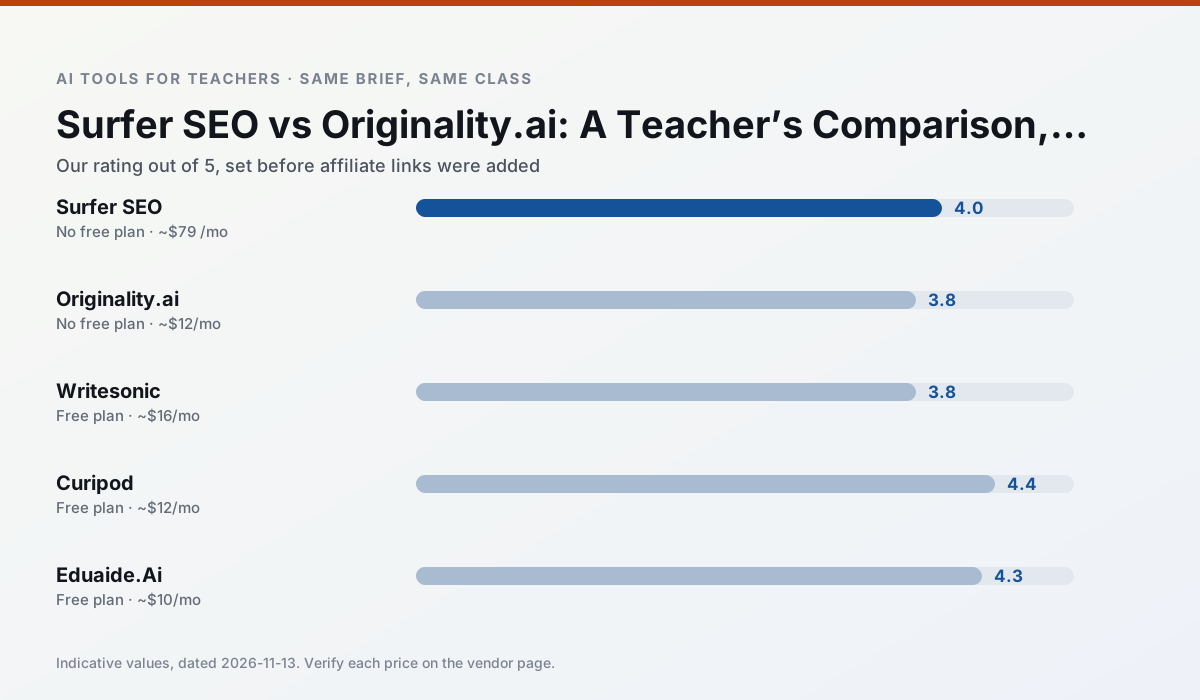
Side by side
Comparison table
Ratings reflect our timed classroom workflow, not vendor claims. Prices are indicative — verify on the vendor site.
| Tool | Best for | Free tier | Indicative paid plan | Standout feature | Our rating | Verdict | Try the tool |
|---|---|---|---|---|---|---|---|
| Surfer SEO | teacher bloggers · resource sellers | No ongoing free plan | ~$79 /mo | Content Editor | 4.0 / 5 | Situational | Try free |
| Originality.ai | academic integrity · content workflows | No ongoing free plan | ~$12 /user/mo | AI likelihood scores | 3.8 / 5 | Situational | Try free |
| Writesonic | newsletters · parent communication | Yes — Limited credits | ~$16 /user/mo | Article and email generators | 3.8 / 5 | Situational | Try free |
| Curipod | formative assessment · exit tickets | Yes — Limited lessons per month | ~$12 /user/mo | Live polls and word clouds | 4.4 / 5 | Strong option | Try free |
| Eduaide.Ai | lesson planning · rubric creation | Yes — Daily generation cap | ~$10 /user/mo | Resource library | 4.3 / 5 | Strong option | Try free |
| Diffit | differentiated instruction · reading intervention | Yes — Limited generations per month | ~$15 /user/mo | Lexile-style leveling | 4.6 / 5 | Top pick | Try free |
Match your situation
Best for X
Different jobs need different tools. Here is what we would open first in each case.
Surfer SEO is built around teacher-monitored student spaces and audit logs rather than a consumer chat account, which is a different approval conversation.
Family-facing drafts from Originality.ai need the fewest rewrites for warmth without overpromising, which is the usual failure mode.
For three reading groups and one text, Writesonic needs the least manual relabelling of vocabulary and questions.
Curipod has the shortest path from opening a tab to a usable draft, which matters more than the feature count on a Monday.
Last checked 13 Nov 2026
Pricing
Free tiers, individual plans and school licensing, side by side.
| Tool | Free plan | Individual / paid | School & district | Billing note | Verify |
|---|---|---|---|---|---|
| Surfer SEO | No ongoing free tier | ~$79 /mo | Custom quote | Indicative — verify on vendor site | Vendor |
| Originality.ai | No ongoing free tier | ~$12 /user/mo | Custom quote | Indicative — verify on vendor site | Vendor |
| Writesonic | $0 — Limited credits | ~$16 /user/mo | ~$49 /user/mo | Indicative — verify on vendor site | Vendor |
| Curipod | $0 — Limited lessons per month | ~$12 /user/mo | Custom quote | Indicative — verify on vendor site | Vendor |
| Eduaide.Ai | $0 — Daily generation cap | ~$10 /user/mo | Custom quote | Indicative — verify on vendor site | Vendor |
| Diffit | $0 — Limited generations per month | ~$15 /user/mo | Custom quote | Indicative — verify on vendor site | Vendor |
Editorial rule: pricing is re-checked every 2–3 months and the top 50 pages are refreshed every 6 months. See our funding policy.
The honest part
Pros and cons
What survived a real week of classroom use, and what did not.
Pros
- Best-in-class on-page guidance
- Useful for TpT / resource-shop content
- Clear scoring
Cons
- Expensive for individual teachers
- Not a classroom tool
- Requires SEO basics
Pros
- Useful for content publishing QA
- Fast bulk scanning
- Transparent credit model
Cons
- AI detection produces false positives
- Should never be sole evidence of misconduct
- Not a teaching tool
Pros
- Cheaper than enterprise writing suites
- Many templates
- Reasonable free trial
Cons
- Generic classroom output
- Credit system is confusing
- Limited education context
Pros
- High student engagement out of the box
- Great for quick checks for understanding
- No student accounts required for basic use
Cons
- Focused on delivery, not planning
- Requires reliable classroom devices
- Free tier is restrictive
Pros
- Very low entry price
- Good worksheet and rubric output
- Clean, uncluttered UI
Cons
- Smaller template set than MagicSchool
- Less polished export options
- Limited integrations
In the classroom
Use cases
Five concrete workflows, with the tool we would open for each one.
Regrouping students after an assessment
Summarise anonymised results into skill groups, then generate one activity per group. Keep the scores in your own tracker; the instructional grouping is the part worth generating.
Recommended: Surfer SEOA weekly family newsletter from bullet notes
Newsletters fail on length, not tone. Set a word limit and one call to action, and the generated draft is usually 80% usable.
Recommended: Originality.aiA question bank from a PDF or article
Feed a non-identifiable source and ask for items tagged by difficulty with the misconception behind each distractor. Spot-check every answer key; numerical items are least reliable.
Recommended: WritesonicA substitute folder that needs no context
The value here is structure, not creativity. Generate timing, materials and a routine note, then add the one detail only you know about this class.
Recommended: CuripodAn IEP present-levels first draft
Use aggregated, anonymised data only. Ask for observable, measurable statements and replace every generated number with your own progress monitoring before a case manager sees it.
Recommended: Eduaide.Ai
Questions teachers ask us
FAQ
Direct answers, also published as FAQPage structured data for search and AI assistants.
Surfer SEO or Originality.ai for lesson planning?
Which is cheaper for one teacher?
Do they produce the same output?
Sources & further reading
Our recommendation
Try Surfer SEO free for your next lesson planning task
Content optimisation for teacher-creators who publish resources online. Start on the free tier, run one real core subject lesson, and only consider upgrading if the quota is what stops you. Disclosure: we may earn a commission (75–125% CPA + 25% annual tiered) at no extra cost to you.
Some links on this page are affiliate links. We may earn a commission at no extra cost to you. Our rankings are editorial and never pay-to-play. Never enter student PII into a free consumer account.
Keep reading
Related comparisons in this cluster.
Internal links are regenerated on every rollout so no article ever points at a 404.