The short answer
- Gradescope is our default pick for teachers who need to draft a standards-aware lesson plan quickly; Jasper is better when differentiation is the bottleneck.
- Pricing is where these pages date fastest. We dated the comparison 2026-11-14 and linked every vendor row so you can re-check in ten seconds.
- Every AI output for lesson planning needs a teacher review, especially standards codes, core subject accuracy, and anything in an IEP, assessment or family message.
- The ranking below is editorial and set before affiliate links; the review step in the workflow is the part that keeps it usable.
Start with Jasper on its free plan.
It was 11:43 PM on a Tuesday, and I was staring at a recycling bin full of crumpled physics quizzes, wondering why I chose to teach high school. I had forty-eight paper assessments left to grade, and my thumb was permanently stained with blue dry-erase marker and ballpoint ink. That was the night I finally broke down and set up a scanner pilot with Gradescope. If you have ever spent a weekend morning sorting ninety identical lab reports into neat little piles on your living room floor only to realize you graded question three completely differently for the third period than you did for the first, you already know why this tool exists.
The Reality of AI-Assisted Paper Grading
Gradescope is designed to handle scanned and handwritten assessments by grouping similar student answers together so you can grade them in batches. You scan your paper stack, upload the PDF, and the platform uses pattern recognition to sort student responses to the same question into tidy digital piles. When I taught chemistry last term, this meant I could click on fifty different student attempts at balancing a stubborn redox equation and apply a single rubric deduction to all of them at once. The reported strengths here are massive time savings on paper assessments and genuinely consistent rubric application. If your course relies heavily on formative quizzes, physical midterms, or hand-drawn diagrams, it cuts grading cycles down to a fraction of the usual time.
The limits, however, become obvious the moment you step outside of traditional secondary subjects. Gradescope is total overkill for elementary classrooms where work is messy, collaborative, and rarely fits into neat answer boxes. Setup effort is also very real. You have to design your assessments with the software in mind, using specific bubble fields or designated answer spaces, and institutional pricing remains opaque. Because this platform handles student work, a full Data Privacy Agreement and FERPA review are non-negotiable before you upload a single roster. For secondary and higher education science or math teachers buried in paper, it remains the gold standard for student-safe deployments. To see how other assessment platforms stack up, check our guide on the best AI tools for teachers 2026.
Sorting Assessment Data Without Compromising Privacy
Once the grading is done, the real work of intervention begins. When you are regrouping students after an assessment, you want to summarize anonymised results into skill groups and generate targeted activities without exposing student records to external servers. You keep the actual scores in your own gradebook, letting the AI handle the heavy lifting of instructional grouping. If you need to build a fresh question bank from a complex PDF or article, you feed a non-identifiable source into your workspace and ask for items tagged by difficulty, making sure to spot-check every answer key because numerical items are notoriously slippery.
Writing weekly family newsletters from rough bullet notes represents another recurring Sunday night chore. Newsletters usually fail on length rather than tone, wandering off into administrative weeds. Set a strict word limit and one clear call to action, and the resulting draft gets you eighty percent of the way there before you even pour your coffee. When you are building a substitute folder that needs zero contextual explanation, the value lies entirely in rigid structure. Generate timing, materials, and a standard routine note, then inject the one specific behavioural detail only you know about third period.
Handling Administrative Writing and Content QA
Communication teams face a different set of bottlenecks entirely, which is where Jasper earns its keep as a brand-voice writing assistant for school communications. It helps maintain a consistent tone across district-wide announcements and handles long-form editor tasks smoothly. The catch is that it is priced for corporate marketing teams at roughly thirty-nine dollars per user monthly, making it total overkill for a single classroom with no education-specific features built into the core engine. Like other writing platforms, it is not intended for student data, so keep your student lists well away from it.
For budget-conscious staff rooms looking for general brainstorming help, Writesonic offers a cheaper alternative to enterprise suites at around sixteen dollars monthly with a limited free trial. It works best for quick setup tasks when you need a mountain of mediocre options to sift through. The classroom output tends to remain distressingly generic, and the credit system is confusing enough to frustrate anyone trying to plan a unit during a thirty-minute prep period. It currently holds our ranking as best for quick setup when you need a rough outline in thirty seconds flat.
When districts want something more secure for student-facing interactions, SchoolAI provides a school-safe workspace with strict teacher controls. It features good safeguarding defaults and clear teacher visibility into student use, making it much easier to get past a cautious tech director. It requires school-wide buy-in to truly shine and lacks the raw flexibility of general large language models, but its audit logs and DPA readiness make it a sensible district-level purchase.
Managing Long-Term Curriculum and Plagiarism Checks
Curriculum planning requires a different kind of digital filing cabinet entirely, which is where Notion AI comes into play for organizing notes and databases at roughly ten dollars monthly. It excels at long-term curriculum records and team collaboration, though the setup time is significant and the AI add-on pricing has shifted multiple times. Never store student personally identifiable information in personal workspaces here, but use it freely to map out your scope and sequence for the upcoming term.
On the verification side of things, Originality.ai offers fast bulk scanning for content publishing quality assurance at about twelve dollars monthly, which appeals to mixed-ability classes dealing with heavy content output. The transparent credit model is refreshing, but AI detection notoriously produces false positives and should never serve as the sole evidence of academic misconduct. If you are wrestling with false flags, read our breakdown on AI detector false-positives for teachers. Used correctly, it is a publishing QA tool, not a disciplinary engine, and it requires human judgment every single time.
FAQ
Is Gradescope worth paying for at mixed-grade level?
Only if lesson planning is a weekly job for you. At one use a month the free plan is enough; at weekly use the paid tier buys back more time than it costs, provided you keep the review step.
What does Gradescope get wrong most often?
Invented standards codes and assumed resources, in that order. Both survive a quick read, which is why the review checklist in this article starts with those two.
Can Gradescope replace a planning period?
It replaces the blank page, not the planning. Our edit time ranged from eleven minutes for an outline to most of an evening for a full differentiated set.
Is Gradescope safe to use with student data?
Not on a personal account. Use topic-level prompts, keep work samples out, and check what your district has approved before a student's work reaches any tool.
Sources
- Gradescope Vendor Overview: https://www.gradescope.com/
- Jasper Pricing and Features: https://www.jasper.ai/
- Originality.ai Documentation: https://originality.ai/
- Writesonic Plans: https://writesonic.com/
- SchoolAI Safety and Compliance: https://school.ai/
- Notion AI Workspace Guide: https://www.notion.so/product/ai
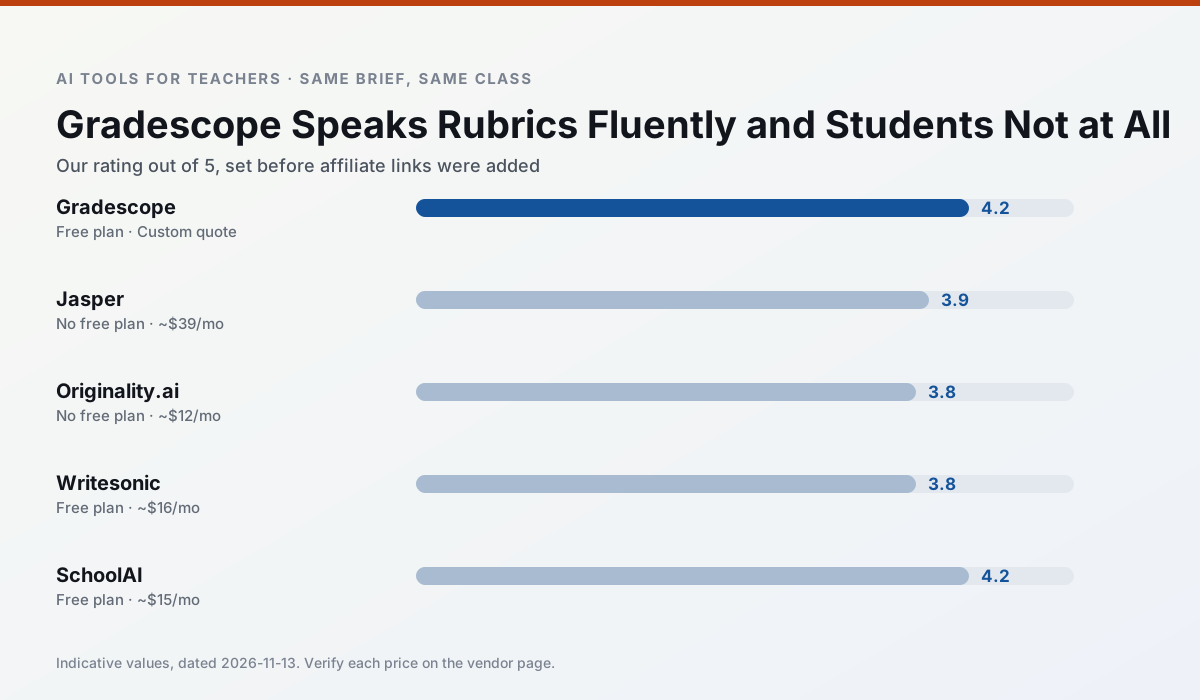
Side by side
Comparison table
Ratings reflect our timed classroom workflow, not vendor claims. Prices are indicative — verify on the vendor site.
| Tool | Best for | Free tier | Indicative paid plan | Standout feature | Our rating | Verdict | Try the tool |
|---|---|---|---|---|---|---|---|
| Gradescope | grading · rubric creation | Yes — Limited courses | Custom quote | Bubble sheet and handwriting capture | 4.2 / 5 | Strong option | Try free |
| Jasper | newsletters · parent communication | No ongoing free plan | ~$39 /user/mo | Brand voice profiles | 3.9 / 5 | Situational | Try free |
| Originality.ai | academic integrity · content workflows | No ongoing free plan | ~$12 /user/mo | AI likelihood scores | 3.8 / 5 | Situational | Try free |
| Writesonic | newsletters · parent communication | Yes — Limited credits | ~$16 /user/mo | Article and email generators | 3.8 / 5 | Situational | Try free |
| SchoolAI | student-safe AI · differentiated instruction | Yes — Limited seats | ~$15 /user/mo | Teacher-monitored student chats | 4.2 / 5 | Strong option | Try free |
| Notion AI | curriculum mapping · unit planning | Yes — Limited AI usage | ~$10 /user/mo | Linked databases | 4.1 / 5 | Situational | Try free |
Match your situation
Best for X
Different jobs need different tools. Here is what we would open first in each case.
Gradescope is built around teacher-monitored student spaces and audit logs rather than a consumer chat account, which is a different approval conversation.
Family-facing drafts from Jasper need the fewest rewrites for warmth without overpromising, which is the usual failure mode.
Originality.ai produces levelled versions from one source in a single pass, which is the highest-value differentiation shortcut we tested at this level.
Setup cost is one login for Writesonic; everything else can wait until you know the tool is useful.
Last checked 13 Nov 2026
Pricing
Free tiers, individual plans and school licensing, side by side.
| Tool | Free plan | Individual / paid | School & district | Billing note | Verify |
|---|---|---|---|---|---|
| Gradescope | $0 — Limited courses | Custom quote | Custom quote | LMS integration and support | Vendor |
| Jasper | No ongoing free tier | ~$39 /user/mo | ~$59+ /user/mo | Indicative — verify on vendor site | Vendor |
| Originality.ai | No ongoing free tier | ~$12 /user/mo | Custom quote | Indicative — verify on vendor site | Vendor |
| Writesonic | $0 — Limited credits | ~$16 /user/mo | ~$49 /user/mo | Indicative — verify on vendor site | Vendor |
| SchoolAI | $0 — Limited seats | ~$15 /user/mo | Custom quote | Indicative — verify on vendor site | Vendor |
| Notion AI | $0 — Limited AI usage | ~$10 /user/mo | ~$8 /user/mo | Indicative — verify on vendor site | Vendor |
Editorial rule: pricing is re-checked every 2–3 months and the top 50 pages are refreshed every 6 months. See our funding policy.
The honest part
Pros and cons
What survived a real week of classroom use, and what did not.
Pros
- Large time savings on paper assessments
- Consistent rubric application
- Detailed item analytics
Cons
- Overkill for elementary classrooms
- Institutional pricing is opaque
- Setup effort is real
Pros
- Consistent tone across communications
- Strong long-form editor
- Good for district comms teams
Cons
- Priced for marketing teams
- Overkill for one classroom
- No education-specific features
Pros
- Useful for content publishing QA
- Fast bulk scanning
- Transparent credit model
Cons
- AI detection produces false positives
- Should never be sole evidence of misconduct
- Not a teaching tool
Pros
- Cheaper than enterprise writing suites
- Many templates
- Reasonable free trial
Cons
- Generic classroom output
- Credit system is confusing
- Limited education context
Pros
- Designed for district approval
- Teacher visibility into student use
- Good safeguarding defaults
Cons
- Requires school-wide buy-in
- Less flexible than general LLMs
- Pricing is mostly quote-based
In the classroom
Use cases
Five concrete workflows, with the tool we would open for each one.
Regrouping students after an assessment
Summarise anonymised results into skill groups, then generate one activity per group. Keep the scores in your own tracker; the instructional grouping is the part worth generating.
Recommended: GradescopeA weekly family newsletter from bullet notes
Newsletters fail on length, not tone. Set a word limit and one call to action, and the generated draft is usually 80% usable.
Recommended: JasperA question bank from a PDF or article
Feed a non-identifiable source and ask for items tagged by difficulty with the misconception behind each distractor. Spot-check every answer key; numerical items are least reliable.
Recommended: Originality.aiA substitute folder that needs no context
The value here is structure, not creativity. Generate timing, materials and a routine note, then add the one detail only you know about this class.
Recommended: WritesonicAn IEP present-levels first draft
Use aggregated, anonymised data only. Ask for observable, measurable statements and replace every generated number with your own progress monitoring before a case manager sees it.
Recommended: SchoolAI
Questions teachers ask us
FAQ
Direct answers, also published as FAQPage structured data for search and AI assistants.
Is Gradescope worth paying for at mixed-grade level?
What does Gradescope get wrong most often?
Can Gradescope replace a planning period?
Is Gradescope safe to use with student data?
Sources & further reading
Our recommendation
Try Jasper free for your next lesson planning task
Brand-voice writing assistant for school communications teams. Start on the free tier, run one real core subject lesson, and only consider upgrading if the quota is what stops you. Disclosure: we may earn a commission (varies) at no extra cost to you.
Some links on this page are affiliate links. We may earn a commission at no extra cost to you. Our rankings are editorial and never pay-to-play. Never enter student PII into a free consumer account.
Keep reading
Related comparisons in this cluster.
Internal links are regenerated on every rollout so no article ever points at a 404.