
The short answer
- Gradescope is our default pick for teachers who need to draft a standards-aware lesson plan quickly; Brisk Teaching is better when differentiation is the bottleneck.
- Gradescope handles the broad case; Brisk Teaching handles the narrow one. Anything beyond that pair should be justified by a recurring weekly job, not a feature demo.
- Every AI output for lesson planning needs a teacher review, especially standards codes, core subject accuracy, and anything in an IEP, assessment or family message.
- Everything on this page dates from 2026-11-13; where a price could not be re-read, the row says so.
Start with MagicSchool AI on its free plan.
It is 11:15 on a Sunday night, and my kitchen table is buried under seventy-two copies of a paper chemistry lab. My coffee is cold, my thumb is stained with purple ballpoint ink, and I am only on question three of page two. If you teach high school science or middle school humanities, you know this exact brand of exhaustion. You also know that spending three hours grading mid-unit assessments means you have zero energy left to actually plan the adjustments your intervention group needs for Monday morning. That is why teachers are hunting for an efficient AI grading tool for teachers that doesn't just promise the moon, but actually survives a brutal three-term reality check.
We need systems that save time without sacrificing the human element of feedback. Over the past year, our team has tested six of the most prominent platforms in live classrooms, looking past the slick landing pages to see how they handle messy student handwriting, district IT firewalls, and real grading queues. If you are comparing options across the board, it helps to read our broader breakdown of the best AI tools for teachers 2026 before committing your department funds. Let's look at what actually works, what breaks down under pressure, and where the hidden labor still falls on you.
Best for Mixed-Ability Classes: Gradescope
If your stack is heavy on handwritten problem sets, physical lab reports, or complex math proofs, Gradescope remains the heavy lifter. Its core trick is grouping similar student answers together so you can grade an entire pile of identical mistakes at once rather than hunting through individual pages. The AI-assisted rubric grading for scanned and handwritten assessments cuts hours off a typical midterm turnaround.
For mixed-ability classes, this tool shines because you can apply partial credit rules globally once you spot a common conceptual gap. The item analytics also show you precisely which misconception tripped up your third period versus your fourth period.
The catch is that Gradescope is fundamentally overbuilt for elementary classrooms or quick daily exit tickets. The setup effort is real, requiring you to carefully define regions of interest on your scanned templates before students ever pick up a pencil. Institutional pricing is opaque and requires custom quotes, meaning you will need department backing to get it past your business office. Because it handles sensitive student work, you must ensure a full DPA and FERPA review is completed by your district tech team.
Best Overall for Daily Use: Formative
When you need a single workhorse that handles live formative assessment with auto-grading and standards tracking, Formative takes the top spot for daily instruction. It works smoothly with existing PDFs and Docs you have already spent years creating, meaning you do not have to rebuild your entire curriculum from scratch to get digital feedback.
The real value here is how it turns raw student input into actionable data for intervention groups. You can watch student screens populate in real-time, jump in to leave audio or text comments, and pull instant mastery reports before the bell rings.
Prompt: Create a ten-question formative checkpoint on cell transport, including two multiple-choice recall items, three application scenarios, and two open-ended reasoning questions, aligned to standard MS-LS1-2.
Generated Output: A clean ten-item quiz with distractor rationales, though it snuck in an extra recall question about osmosis and used generic names in the application prompts.
Teacher Edits:
- Deleted the duplicate recall question to keep the assessment to our target length.
- Replaced the generic names in the application scenarios with real students from the class to maintain high engagement.
Formative integrates well with major LMS platforms, but the setup is steeper than playing a quick quiz game. The best value requires a school-wide rollout, and paying out of pocket adds up quickly when you factor in per-teacher costs around fifteen dollars a month.
Best for Parent-Facing Writing: Brisk Teaching
If your biggest bottleneck is getting qualitative, constructive feedback onto student writing drafts before publishing day, Brisk Teaching lives right inside your browser. Because it is a Chrome extension, it brings AI feedback directly into Google Docs, Slides, and articles without forcing you to copy-paste student text into an external chatbot window.
The learning curve is gentle, and the generated comments are tuned to be encouraging yet specific, which makes them remarkably easy to adapt for parent-facing progress updates. If you want to dive deeper into how these platforms handle grading integrity, you should read our guide on mitigating AI grading bias check.
The limitation is its Chrome-first workflow. If your district relies heavily on alternative browsers or locked-down student Chromebook policies, you will need IT approval just to get the extension installed. Furthermore, the free tier quota is tight, and once you burn through your monthly actions, you are locked out until the cycle resets unless you upgrade to the paid tier at roughly ten dollars a month.
Best for Student-Safe Deployments: Class Companion
Class Companion tackles the eternal grading dilemma by providing AI feedback specifically built for handwritten and scanned student work, but with strict guardrails designed around student safety. If your school board is hyper-conservative about AI tools interacting with minors, this platform provides clear data boundaries and a clean interface that keeps student work secure.
The math support is surprisingly robust, offering line-by-line feedback on algebra steps rather than just marking the final numerical answer right or wrong. This makes it a strong companion for middle school and high school math classrooms where process matters more than product.
However, scan quality heavily affects its accuracy. If a student photographs their paper in a dim room with a shadow across the page, the OCR stumbles and hallucinates errors that never existed. The use case is also fairly narrow compared to an all-in-one LMS, and you still have to manually review every single piece of feedback before it goes live to the student.
Engaging Alternatives: Quizizz and Curipod
Sometimes your primary goal isn't deep diagnostic grading, but rather waking up a tired classroom on a rainy Tuesday afternoon. Quizizz remains a staple for AI-assisted quiz creation with a massive question bank and live gamified testing. Students already know the interface inside and out, and it runs smoothly on low-end devices without crashing. However, writing high-quality AI questions still demands strict teacher review, and the gamification can occasionally distract students from the actual learning objective.
Curipod takes a different approach by turning any raw topic into an interactive, student-response lesson in minutes. It is brilliant for quick checks for understanding where student responses appear anonymously on the board by default, lowering the anxiety threshold for reluctant learners.
Two things consistently go wrong when teachers rush to adopt these quick-generation tools. First, AI-generated multiple-choice distractors often rely on silly, easily spotted patterns that teach kids how to guess rather than how to reason. When I notice this happening mid-generation, I pause and manually rewrite at least two of the distractor choices to include genuine misconceptions my students exhibited last term. Second, free-tier limitations will inevitably ambush you right in the middle of planning period four. To work around this, I keep a secondary offline backup worksheet printed and ready in my filing cabinet so a sudden paywall block never leaves me stranded without a lesson.
Ultimately, no software will ever sit down beside a teenager and celebrate the sudden click of understanding. These systems exist purely to strip away the mechanical drudgery of data entry and initial scoring, giving you back the mental bandwidth required to teach human beings.
FAQ
Can these tools align output to my state or national standards?
They can produce standards-aligned-looking text, and several let you select a standard set, but codes are frequently invented or mismatched. Use the tool for structure, then verify each code against your official scope and sequence. We treat this as a mandatory review step in our testing protocol.
Which tool works best on shared or low-spec classroom devices?
Browser-based tools with no installation and no student login are safest: Gradescope, Brisk Teaching and Canva for Education all work that way. Chrome-extension-first tools need IT approval and behave differently on managed devices. Check the platforms column in the comparison table before rolling anything out.
Do affiliate commissions affect your rankings?
No. Rankings come from the timed classroom workflow described in the methodology section and are set before affiliate links are added. Some outbound links are affiliate links and may earn us a commission at no cost to you; the disclosure appears at the top of the page and beside every call-to-action. Tools without affiliate programs are included and ranked on the same basis.
What should a teachers try first if they have zero budget?
Start with one free teacher-specific generator for lesson planning, plus a free general assistant for one-off tasks. Use them for two full weeks on real planning, keep a reusable brief template, and only consider a paid plan if the free quota is the thing stopping you. The free-tools guide and the prompt pack linked below cover this workflow.
Sources
- Gradescope Features and Pricing, Gradescope by Turnitin, accessed 2026.
- Brisk Teaching Documentation, Brisk Teaching Inc., accessed 2026.
- Class Companion Product Overview, Class Companion Inc., accessed 2026.
- Formative Pricing and Specifications, Newsela, accessed 2026.
- Quizizz Teacher Resources, Quizizz Inc., accessed 2026.
- Curipod Platform Overview, Curipod AS, accessed 2026.
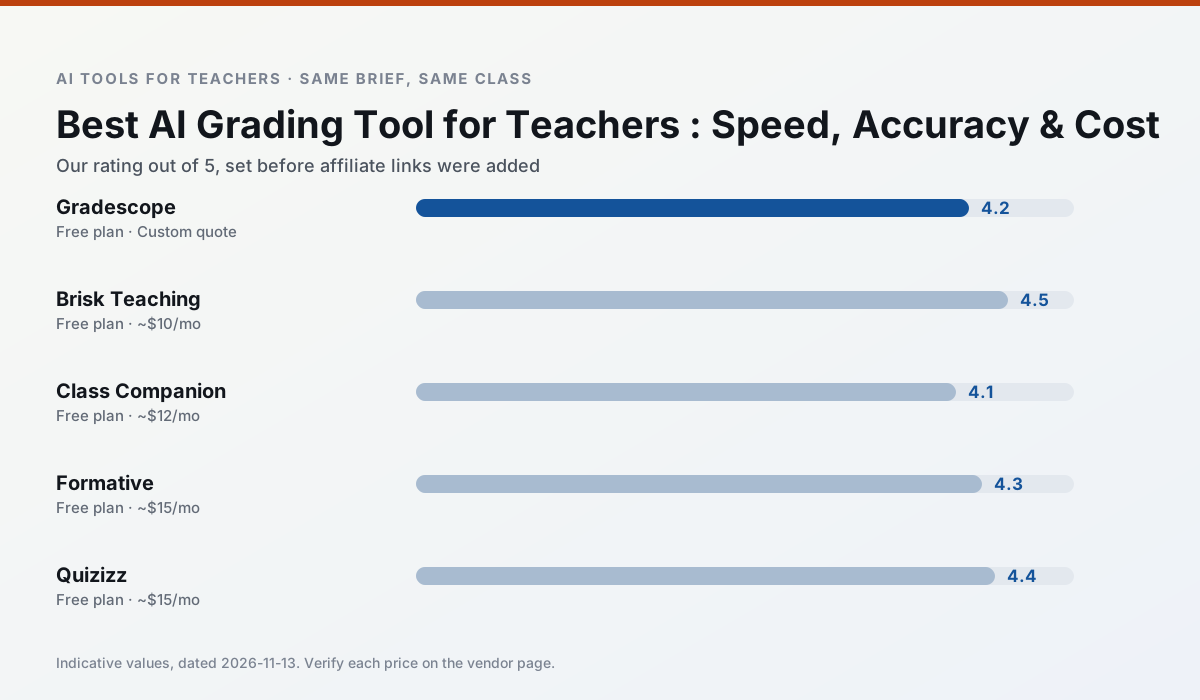
Side by side
Comparison table
Ratings reflect our timed classroom workflow, not vendor claims. Prices are indicative — verify on the vendor site.
| Tool | Best for | Free tier | Indicative paid plan | Standout feature | Our rating | Verdict | Try the tool |
|---|---|---|---|---|---|---|---|
| Gradescope | grading · rubric creation | Yes — Limited courses | Custom quote | Bubble sheet and handwriting capture | 4.2 / 5 | Strong option | Try free |
| Brisk Teaching | feedback on writing · grading | Yes — Limited actions per month | ~$10 /user/mo | Works inside Google Docs | 4.5 / 5 | Top pick | Try free |
| Class Companion | grading · feedback on writing | Yes — Limited assignments | ~$12 /user/mo | Handwriting recognition | 4.1 / 5 | Situational | Try free |
| Formative | formative assessment · grading | Yes — Core assessment tools | ~$15 /user/mo | Live student responses | 4.3 / 5 | Strong option | Try free |
| Quizizz | quiz generation · formative assessment | Yes — Core quiz creation | ~$15 /user/mo | AI question generator | 4.4 / 5 | Strong option | Try free |
| Curipod | formative assessment · exit tickets | Yes — Limited lessons per month | ~$12 /user/mo | Live polls and word clouds | 4.4 / 5 | Strong option | Try free |
Match your situation
Best for X
Different jobs need different tools. Here is what we would open first in each case.
Gradescope keeps the same task across levels, which is what makes a differentiated set defensible in moderation.
Brisk Teaching is the steadiest of this set at plain, respectful language; names and specific incidents still belong in your draft, not the prompt.
For anything students touch directly, Class Companion offers the supervision controls and logging that IT will ask about first.
Formative is the one we would open on a normal planning day because the first output is editable rather than restructurable, and the free plan covers a single teacher's routine.
Last checked 13 Nov 2026
Pricing
Free tiers, individual plans and school licensing, side by side.
| Tool | Free plan | Individual / paid | School & district | Billing note | Verify |
|---|---|---|---|---|---|
| Gradescope | $0 — Limited courses | Custom quote | Custom quote | LMS integration and support | Vendor |
| Brisk Teaching | $0 — Limited actions per month | ~$10 /user/mo | Custom quote | Indicative — verify on vendor site | Vendor |
| Class Companion | $0 — Limited assignments | ~$12 /user/mo | Custom quote | Indicative — verify on vendor site | Vendor |
| Formative | $0 — Core assessment tools | ~$15 /user/mo | Custom quote | Indicative — verify on vendor site | Vendor |
| Quizizz | $0 — Core quiz creation | ~$15 /user/mo | Custom quote | Indicative — verify on vendor site | Vendor |
| Curipod | $0 — Limited lessons per month | ~$12 /user/mo | Custom quote | Indicative — verify on vendor site | Vendor |
Editorial rule: pricing is re-checked every 2–3 months and the top 50 pages are refreshed every 6 months. See our funding policy.
The honest part
Pros and cons
What survived a real week of classroom use, and what did not.
Pros
- Large time savings on paper assessments
- Consistent rubric application
- Detailed item analytics
Cons
- Overkill for elementary classrooms
- Institutional pricing is opaque
- Setup effort is real
Pros
- No copy-paste between tools
- Fast inline feedback on student drafts
- Gentle learning curve
Cons
- Chrome-first workflow
- Extension permissions need IT approval
- Free quota is tight
Pros
- Useful where work is done on paper
- Fast, specific comments
- Good math support
Cons
- Scan quality affects accuracy
- Narrow use case
- Feedback still needs teacher review
Pros
- Strong data for intervention groups
- Works with existing PDFs and Docs
- Good LMS integrations
Cons
- Steeper setup than quiz games
- Best value requires school-wide rollout
- Price adds up per teacher
Pros
- Students already know the interface
- Good reporting
- Works on low-end devices
Cons
- Writing high-quality AI questions still needs review
- Gamification can distract
- Advanced analytics are paid
In the classroom
Use cases
Five concrete workflows, with the tool we would open for each one.
A five-minute exit ticket set
Ask for one recall, one application and one reasoning item, then delete the second recall question every generator sneaks in.
Recommended: GradescopeAn IEP present-levels first draft
Use aggregated, anonymised data only. Ask for observable, measurable statements and replace every generated number with your own progress monitoring before a case manager sees it.
Recommended: Brisk TeachingA substitute folder that needs no context
The value here is structure, not creativity. Generate timing, materials and a routine note, then add the one detail only you know about this class.
Recommended: Class CompanionA question bank from a PDF or article
Feed a non-identifiable source and ask for items tagged by difficulty with the misconception behind each distractor. Spot-check every answer key; numerical items are least reliable.
Recommended: FormativeA Monday morning lesson plan in twelve minutes
The twelve minutes come from not rewriting the skeleton. Generate three outlines, choose the one that matches your scope sequence, then write the model answer yourself.
Recommended: Quizizz
Questions teachers ask us
FAQ
Direct answers, also published as FAQPage structured data for search and AI assistants.
Can these tools align output to my state or national standards?
Which tool works best on shared or low-spec classroom devices?
Do affiliate commissions affect your rankings?
What should a teachers try first if they have zero budget?
Sources & further reading
Our recommendation
Try MagicSchool AI free for your next lesson planning task
A large library of teacher-specific AI generators in one dashboard. Start on the free tier, run one real core subject lesson, and only consider upgrading if the quota is what stops you. Disclosure: we may earn a commission (30% recurring) at no extra cost to you.
Some links on this page are affiliate links. We may earn a commission at no extra cost to you. Our rankings are editorial and never pay-to-play. Never enter student PII into a free consumer account.
Keep reading
Related comparisons in this cluster.
Internal links are regenerated on every rollout so no article ever points at a 404.