The short answer
- Canva for Education is our default pick for teachers who need to draft a standards-aware lesson plan quickly; QuestionWell is better when differentiation is the bottleneck.
- The cheapest honest test is a week of real work on the free plans: Canva for Education: Yes — Verification required; QuestionWell: Yes — Monthly generation limit; Kahoot!: Yes — Limited player count. If a tool is still open on Friday, it has earned a paid conversation.
- Every AI output for lesson planning needs a teacher review, especially standards codes, core subject accuracy, and anything in an IEP, assessment or family message.
- Everything on this page dates from 2026-11-13; where a price could not be re-read, the row says so.
Start with MagicSchool AI on its free plan.
It is 7:40 AM on a Tuesday, and my homeroom smells faintly of damp coats and sanitizer. I have twelve minutes before forty eighth-graders walk through the door demanding to know why their mid-unit essays are not graded yet, and my coffee is still burning hot on the desk. This is the exact moment when most teacher tech reviews fall apart. Nobody wants a lecture on workflow transformation when they are trying to print a worksheet before the bell rings.
Over the past term, I put a half-dozen popular platforms through the wringer to see what actually survives a standard 180-day school year. Some promised the moon and delivered formatting nightmares. Others quietly hid their best features behind enterprise paywalls. What follows is an honest look at what works, what breaks, and where you should actually spend your prep period. For a broader look at how these fit into your stack, check our roundup of the best AI tools for teachers.
Canva for Education: Best for Schools and Districts
Canva for Education has completely shifted how my department handles visual media, mostly because it is effectively free once your school email gets verified. The paid secret that tech vendors do not want you to know is that you rarely need to upgrade to premium tiers for basic classroom tasks. The template library is massive, requiring almost zero design skills to churn out anchor charts or slide decks that do not look like they were pulled from a 2004 PowerPoint graveyard.
The catch is that its AI features are heavily capped compared to dedicated text generators, and it is entirely too easy for students to produce cluttered slides that prioritize sparkly graphics over actual content. Furthermore, account verification can occasionally drag on for weeks if your district domain is obscure. Despite those hiccups, it remains the gold standard for institutional deployment.
Let us look at a weekly family newsletter scenario. Newsletters usually fail on length, not tone. If you give an AI an open-ended prompt, you get a novel.
Prompt: "Write a weekly parent update for 8th-grade science based on these bullet points: finish ecology unit, test on Friday, permission slips due Thursday. Max 150 words. One clear call to action."
First Response: The model generated a surprisingly warm, upbeat note, but included an awkward paragraph about the changing fall leaves that took up valuable reading space.
Two Edits: I stripped out the seasonal fluff and replaced the generic closing with a bolded reminder about the permission slip deadline. The resulting draft took sixty seconds and saved me twenty minutes of staring at a blank cursor.
QuestionWell: Best for Quick Setup
If your main bottleneck is writing standard-aligned question banks, QuestionWell is the tool you actually need. You paste in any text or a specific learning objective, and it spits out clean multiple-choice options with decent objective tagging. It is a single-purpose utility, meaning it does not try to be a grading assistant or a gradebook, which keeps the interface lightning-fast.
The downside is that the question quality varies wildly depending on the source text you feed it. If you drop in dense, poorly formatted PDF excerpts, the output requires heavy editing. It also lacks robust student-facing features, so you are mostly exporting the text to other platforms. Remember to only paste non-identifiable source text to protect student privacy.
When dealing with post-assessment data, I use a specific triage method. Instead of letting the AI touch student records, I summarize anonymised score distributions into skill groups. I then feed those groups back into QuestionWell or a similar text tool to generate one targeted review activity per tier. Keep the actual scores in your own tracker; the instructional grouping is the only part worth generating.
Kahoot!: Best Overall for Daily Use
Kahoot! needs almost no introduction, but its newer AI-assisted question generation features have made it much faster to spin up review games on the fly. Students already know the interface, meaning training time is practically zero on day one. It delivers instant engagement that can wake up even the sleepiest afternoon class.
However, it is less useful for deep, higher-order assessment. The time pressure inherently suits quick recall much more than complex reasoning. The free tier limits player counts, pushing you toward paid options that sit at roughly ten dollars per user monthly if your school does not already have a site license. For younger students, make sure they use fun nicknames rather than real names to keep data privacy intact.
Khanmigo: Best Free Option
Powered by a trusted nonprofit, Khanmigo acts as a tutor-style AI assistant with robust teacher support tools built right in. Its strongest asset is an education-first design philosophy, particularly when it comes to math scaffolding. It refuses to just give students the answer, walking them through the logic instead.
Availability can vary heavily depending on your region, and it is less useful for heavy administrative paperwork like writing long narrative report card comments. To get its full value, students need their own accounts, which requires navigating district digital citizenship approvals. Still, for a zero-cost option supported by an established educational institution, it punches well above its weight.
For routine parent communication, I rely on a structured translation workflow. When I need to send a message home in two languages, I draft it in plain, warm English with no student names. I translate it, and then I back-translate the most important sentences to double-check that the meaning held up. For a deeper dive into handling student writing specifically, take a look at our guide on AI exit tickets for ELA teachers.
Claude: Long-Context Planning and Feedback
Claude is not an education-specific tool, but its massive context window makes it exceptional for heavy document analysis. If you need to upload an entire sixty-page curriculum guide, a sprawling rubric, and three student samples all at once, Claude handles it without breaking a sweat. The prose is noticeably less generic than competing consumer models.
The catch is that it features zero teacher-specific templates and lacks classroom integrations. Furthermore, the standard consumer plan is not suitable for handling identifiable student data, meaning you must ensure you are using an approved workspace tier if your school provides one.
When grading, never let the AI write your rubric from scratch. Reorder your workflow so the rubric is strictly yours, and the feedback comments are generated to match it. Moderation failures and hallucinated grades almost always trace back to a sloppy rubric that the model wrote itself.
Quizizz: Large Question Banks and Live Games
Quizizz rounds out our list as a familiar heavy-hitter for gamified formative assessment. Students love the self-paced meme mode, and the platform works smoothly even on low-end school-issued Chromebooks that choke on heavier web apps. The reporting dashboard is clean enough to scan in five seconds while students are packing up their backpacks.
Just like Kahoot!, writing high-quality AI questions still requires a careful human review before you deploy them to a live session. Gamification can occasionally distract students who focus entirely on the leaderboards rather than the underlying concepts. Advanced analytics are locked behind paid tiers, which cost around fifteen dollars per user monthly.
If you are trying to piece together a Monday morning lesson plan in under twelve minutes, do not try to reinvent the wheel. The secret to speed is refusing to rewrite the foundational skeleton. Generate three distinct outlines, choose the single option that matches your scope and sequence, and then write the model answer yourself. It keeps your pedagogical voice intact while outsourcing the tedious structural drafting.
FAQ
Is Canva for Education worth paying for at mixed-grade level?
Only if lesson planning is a weekly job for you. At one use a month the free plan is enough; at weekly use the paid tier buys back more time than it costs, provided you keep the review step.
What does Canva for Education get wrong most often?
Invented standards codes and assumed resources, in that order. Both survive a quick read, which is why the review checklist in this article starts with those two.
Can Canva for Education replace a planning period?
It replaces the blank page, not the planning. Our edit time ranged from eleven minutes for an outline to most of an evening for a full differentiated set.
Is Canva for Education safe to use with student data?
Not on a personal account. Use topic-level prompts, keep work samples out, and check what your district has approved before a student's work reaches any tool.
Sources
- Canva for Education: Free design suite and account verification guidelines. Canva for Education
- QuestionWell: Standards-aligned question generation and export workflows. QuestionWell
- Kahoot!: Game-based learning and AI quiz generation tools. Kahoot!
- Khanmigo: Nonprofit AI tutor and educator assistant platform. Khan Academy
- Claude: Long-context document analysis and assistant by Anthropic. Anthropic Claude
- Quizizz: Gamified learning platform and formative assessment tools. Quizizz
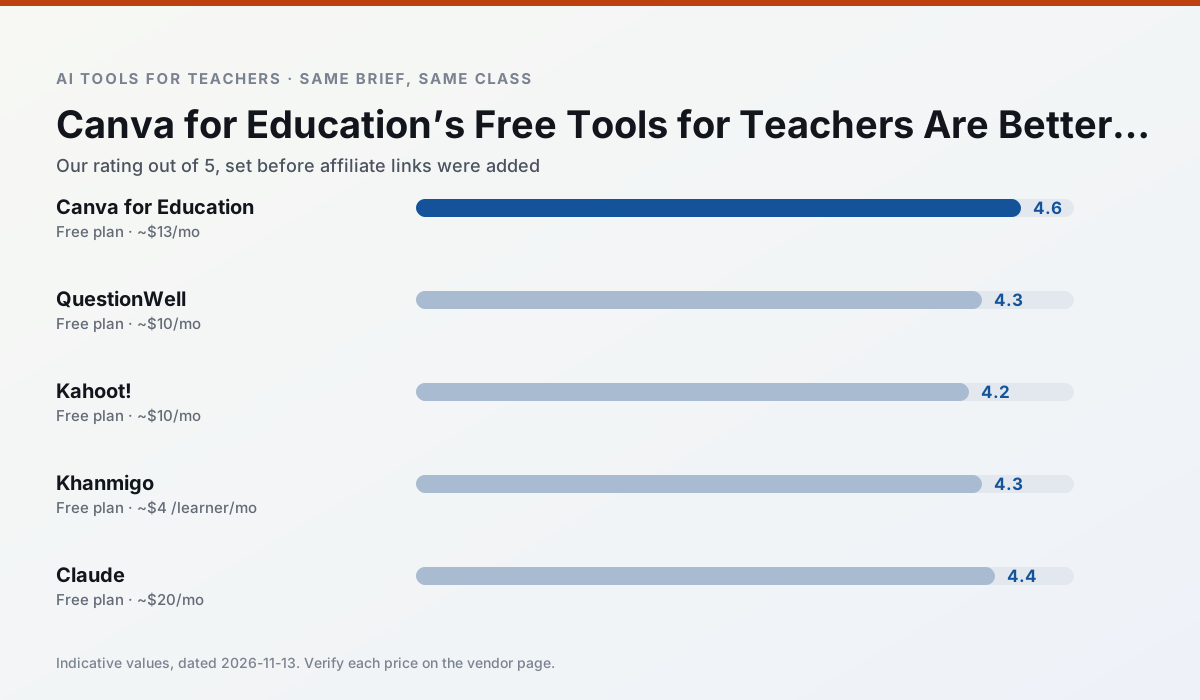
Side by side
Comparison table
Ratings reflect our timed classroom workflow, not vendor claims. Prices are indicative — verify on the vendor site.
| Tool | Best for | Free tier | Indicative paid plan | Standout feature | Our rating | Verdict | Try the tool |
|---|---|---|---|---|---|---|---|
| Canva for Education | slide decks · worksheets | Yes — Verification required | ~$13 /user/mo | Thousands of education templates | 4.6 / 5 | Top pick | Try free |
| QuestionWell | quiz generation · assessment | Yes — Monthly generation limit | ~$10 /user/mo | Exports to Google Forms / LMS | 4.3 / 5 | Strong option | Try free |
| Kahoot! | quiz generation · review lessons | Yes — Limited player count | ~$10 /user/mo | AI question builder | 4.2 / 5 | Strong option | Try free |
| Khanmigo | math practice · student tutoring | Yes — US teacher accounts, subject to eligibility | ~$4 /learner/mo | Socratic tutoring rather than answers | 4.3 / 5 | Strong option | Try free |
| Claude | rubric creation · feedback on writing | Yes — Usage-limited | ~$20 /user/mo | Very large context window | 4.4 / 5 | Strong option | Try free |
| Quizizz | quiz generation · formative assessment | Yes — Core quiz creation | ~$15 /user/mo | AI question generator | 4.4 / 5 | Strong option | Try free |
Match your situation
Best for X
Different jobs need different tools. Here is what we would open first in each case.
For a school rollout, Canva for Education offers the paperwork and the admin console; the classroom features are standard by comparison.
Setup cost is one login for QuestionWell; everything else can wait until you know the tool is useful.
Kahoot! wins on the default path: fewer clicks to a usable draft, and the interface does not get in the way at 7:40am.
If there is no budget, start with Khanmigo: free plan with clearest quota is the least punishing free tier here.
Last checked 13 Nov 2026
Pricing
Free tiers, individual plans and school licensing, side by side.
| Tool | Free plan | Individual / paid | School & district | Billing note | Verify |
|---|---|---|---|---|---|
| Canva for Education | $0 — Verification required | ~$13 /user/mo | Custom quote | Indicative — verify on vendor site | Vendor |
| QuestionWell | $0 — Monthly generation limit | ~$10 /user/mo | Custom quote | Indicative — verify on vendor site | Vendor |
| Kahoot! | $0 — Limited player count | ~$10 /user/mo | Custom quote | Indicative — verify on vendor site | Vendor |
| Khanmigo | $0 — US teacher accounts, subject to eligibility | ~$4 /learner/mo | Custom quote | Indicative — verify on vendor site | Vendor |
| Claude | $0 — Usage-limited | ~$20 /user/mo | ~$25+ /user/mo | Indicative — verify on vendor site | Vendor |
| Quizizz | $0 — Core quiz creation | ~$15 /user/mo | Custom quote | Indicative — verify on vendor site | Vendor |
Editorial rule: pricing is re-checked every 2–3 months and the top 50 pages are refreshed every 6 months. See our funding policy.
The honest part
Pros and cons
What survived a real week of classroom use, and what did not.
Pros
- Effectively free for verified teachers
- Huge template library
- No design skills needed
Cons
- AI features are capped
- Easy to produce cluttered slides
- Account verification can be slow
Pros
- Saves the most time on question writing
- Clean export workflow
- Good objective tagging
Cons
- Single-purpose tool
- Question quality varies by source text
- Limited student-facing features
Pros
- Instant engagement
- Very low training time
- Strong brand familiarity
Cons
- Less depth for higher-order assessment
- Paid tiers needed for larger classes
- Time pressure suits recall more than reasoning
Pros
- Education-first design
- Strong nonprofit trust signal
- Good math scaffolding
Cons
- Availability varies by region
- Less useful for admin paperwork
- Requires student accounts for full value
Pros
- Handles full unit plans and long rubrics
- Nuanced, less generic prose
- Good at structured document output
Cons
- No teacher-specific templates
- Fewer classroom integrations
- Consumer plan not suitable for student data
In the classroom
Use cases
Five concrete workflows, with the tool we would open for each one.
A weekly family newsletter from bullet notes
Newsletters fail on length, not tone. Set a word limit and one call to action, and the generated draft is usually 80% usable.
Recommended: Canva for EducationRegrouping students after an assessment
Summarise anonymised results into skill groups, then generate one activity per group. Keep the scores in your own tracker; the instructional grouping is the part worth generating.
Recommended: QuestionWellRubric and feedback comments in one pass
Reorder the workflow so the rubric is yours and the comments are generated. Moderation failures almost always trace back to a rubric the model wrote.
Recommended: Kahoot!A parent email in two languages
Draft in plain, warm language with no names, translate, then back-translate the important sentences to check meaning. Keep specific incidents out of the prompt and add them yourself.
Recommended: KhanmigoA Monday morning lesson plan in twelve minutes
The twelve minutes come from not rewriting the skeleton. Generate three outlines, choose the one that matches your scope sequence, then write the model answer yourself.
Recommended: Claude
Questions teachers ask us
FAQ
Direct answers, also published as FAQPage structured data for search and AI assistants.
Is Canva for Education worth paying for at mixed-grade level?
What does Canva for Education get wrong most often?
Can Canva for Education replace a planning period?
Is Canva for Education safe to use with student data?
Sources & further reading
Our recommendation
Try MagicSchool AI free for your next lesson planning task
A large library of teacher-specific AI generators in one dashboard. Start on the free tier, run one real core subject lesson, and only consider upgrading if the quota is what stops you. Disclosure: we may earn a commission (30% recurring) at no extra cost to you.
Some links on this page are affiliate links. We may earn a commission at no extra cost to you. Our rankings are editorial and never pay-to-play. Never enter student PII into a free consumer account.
Keep reading
Related comparisons in this cluster.
Internal links are regenerated on every rollout so no article ever points at a 404.