The short answer
- Curipod is our default pick for teachers who need to write five-minute wrap-up prompts quickly; Quizizz is better when differentiation is the bottleneck.
- Start with Curipod on its free plan, keep Quizizz as the second opinion, and do not open a card until the quota, not the feature list, is what stops you.
- Every AI output for exit tickets needs a teacher review, especially standards codes, ELA accuracy, and anything in an IEP, assessment or family message.
- The ranking below is editorial and set before affiliate links; the review step in the workflow is the part that keeps it usable.
Start with Surfer SEO on its free plan.
At 3:14 on a Tuesday, I am staring at thirty damp paper slips on my desk. Half of them contain the sentence "The theme is family" without a single detail from The Crucible, and the other half are blank because the bell rang before Timmy finished writing his name. ELA exit tickets are supposed to give us a clean read on who understood subtext and who just copied the board, but the reality of collecting, sorting, and grading them by the next morning is a fast track to burnout.
That is why teachers have started turning to AI exit tickets for ela teachers to handle the mechanical lifting of formative assessment. We are not looking for a machine to teach the novels for us. We just want a faster way to turn a messy room of student thinking into actionable groups before first period tomorrow.
Building a Five-Minute Formative Check
The single biggest trap with AI lesson builders is asking them to write an entire assessment from scratch. If you type "make an exit ticket for Act 2," you will get five generic comprehension questions about who talked to whom. You need to constrain the output strictly to your actual learning targets.
Prompt: Act as an ELA curriculum writer. Create a three-item exit ticket for 11th-grade students on Arthur Miller's use of foil characters in Act 2 of The Crucible. Include exactly one recall item on Proctor and Hale, one application item identifying a new foil dynamic, and one reasoning item about why Miller uses these contrasts.
First pass: The generator gave me the recall item, two application items, and a reasoning question that read like a seminar essay prompt.
Two edits for usability:
- Cut the second application item and explicitly re-prompt: "Limit to three questions total: one factual check, one short application, one paragraph reasoning."
- Add a constraint for the distractors: "For the multiple-choice items, make sure each incorrect option targets a specific student misconception about dramatic foils."
Tools like Curipod are genuinely useful here because they let you spin up an interactive lesson in minutes without requiring student accounts for basic use. The free tier is restrictive, but paid plans run around $12 per user per month if your department chips in. Student responses are anonymous by default, which takes the pressure off reluctant writers. The catch is that it is built for delivery rather than deep planning, and you still need a room full of reliable devices to make it work smoothly.
Sorting the Wreckage into Groups
Once you have your responses, the real bottleneck begins. You cannot fix fifteen different misunderstandings of character motivation in a forty-minute block. You need groups.
When you feed anonymized results into an AI workspace, you can ask it to summarize the data into three distinct skill buckets: those who missed the literal plot, those who found the plot but missed the subtext, and those who nailed the analysis. Do not let the tool touch your gradebook or touch student names. Ask it solely to generate one targeted mini-lesson activity for each group based on the error patterns.
For strict data privacy, SchoolAI provides a school-safe workspace with teacher-controlled student spaces and audit logs that pass district muster. It costs about $15 per user per month with quote-based district pricing, and it gives you clear visibility into what kids are typing. It requires school-wide buy-in, but it solves the administrative headache of unapproved third-party tools.
Pulling Quick Checks from Complex Texts
Sometimes you finish reading a complex article or a short story and realize you have zero assessment items prepared for the end of the block. Feeding a non-identifiable source text into a generation tool saves an enormous amount of prep time, provided you know its failure modes.
Prompt: Read this excerpt from Frederick Douglass. Generate four reading comprehension questions tagged by difficulty level. Include the specific student misconception behind each incorrect multiple-choice distractor.
First pass: The AI generated great conceptual questions, but completely butchered the line numbers and invented a quote that wasn't in the source text.
Two edits for usability:
- Spot-check every single answer key against the actual text before printing or projecting.
- Strip out any numerical or line-reference items, as these are the least reliable when generated by an LLM parsing unstructured text.
For gamified delivery that students already know how to navigate, Quizizz remains a heavy favorite. At roughly $15 per user per month for the paid tier, it offers robust reporting and works well on low-end school Chromebooks. The caveat is that high-quality AI question generation still requires a careful human review, and the flashy gamification can easily distract kids from deep reading if you use it every single day.
Writing the Weekly Family Dispatch
If exit tickets consume your afternoons, family communication steals your weekends. A weekly ELA update fails not because your tone is wrong, but because you try to explain every single reading standard, vocabulary list, and missing assignment in four long paragraphs.
You fix this by dumping raw bullet notes into a writing assistant, setting a strict word count, and demanding a single call to action. For district communications teams and school publishing workflows, Jasper provides strong brand-voice control and long-form editing at around $39 per user per month. It is heavy overkill for a single classroom teacher, but it illustrates how AI handles volume when given strict structural guardrails.
If you are a teacher-author publishing your own reading units or exit ticket bundles on digital marketplaces, Surfer SEO offers best-in-class on-page optimization at about $79 a month. It is strictly an authoring tool rather than a classroom assistant, meaning it has zero student data risks, but it is far too expensive for day-to-day lesson planning.
Where We Draw the Line
We also need to talk about Originality.ai. Priced around $12 per user per month, it is designed for publishers and admin workflows to scan bulk content for plagiarism and machine generation. It is entirely inappropriate for grading student writing. AI detectors produce frequent false positives on neurodivergent writers and English language learners whose syntax matches algorithmic patterns. You can read more about balancing automated feedback with human judgment in our guide on AI essay feedback for history teachers.
Never let a detector score serve as the sole evidence of academic misconduct. If a student turns in an exit ticket that sounds suspiciously polished, talk to them in person. Ask them to explain what their chosen quote means in their own words. The conversation takes thirty seconds, and it preserves the trust you spent the whole term building.
AI exit tickets for ela teachers should save you from administrative drowning, not replace your professional intuition. Use the tools to sort the misconceptions, build the quick practice groups, and free up your evenings so you can actually read what your students are trying to say. For a broader look at how these tools fit into daily routines, see our roundup of the best AI tools for teachers.
FAQ
Can AI do exit tickets at mixed-grade level?
It can produce a first draft and a structure. The level judgement, the standards check and the tone are teacher decisions.
Which tool is best for exit tickets?
Curipod on the evidence in this article, with Quizizz as the second opinion. Neither replaces the review step.
What is the biggest risk?
A confident, plausible output that nobody checked. The five checks below exist for that reason.
Sources
- Curipod Pricing and Features, curipod.com
- Quizizz Educator Plans, quizizz.com
- Surfer SEO Content Guidance, surferseo.com
- SchoolAI Safe Workspace Documentation, schoolai.com
- Jasper AI Comms Platform, jasper.ai
- Originality.ai Detection and Scanning, originality.ai
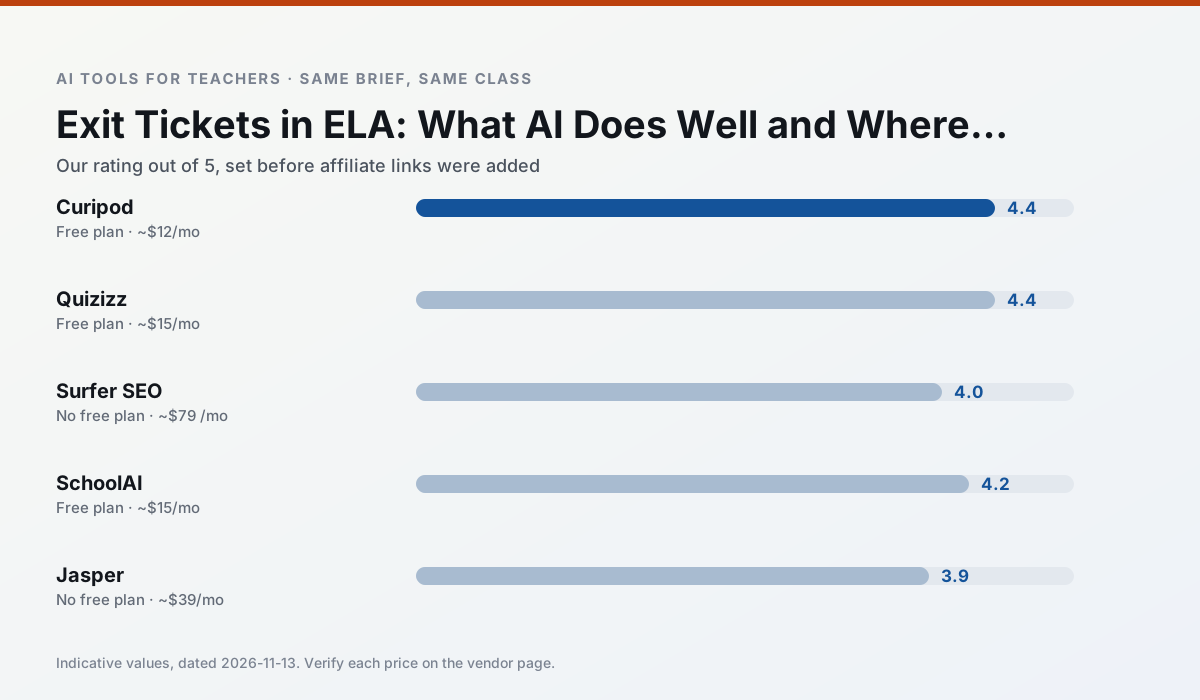
Side by side
Comparison table
Ratings reflect our timed classroom workflow, not vendor claims. Prices are indicative — verify on the vendor site.
| Tool | Best for | Free tier | Indicative paid plan | Standout feature | Our rating | Verdict | Try the tool |
|---|---|---|---|---|---|---|---|
| Curipod | formative assessment · exit tickets | Yes — Limited lessons per month | ~$12 /user/mo | Live polls and word clouds | 4.4 / 5 | Strong option | Try free |
| Quizizz | quiz generation · formative assessment | Yes — Core quiz creation | ~$15 /user/mo | AI question generator | 4.4 / 5 | Strong option | Try free |
| Surfer SEO | teacher bloggers · resource sellers | No ongoing free plan | ~$79 /mo | Content Editor | 4.0 / 5 | Situational | Try free |
| SchoolAI | student-safe AI · differentiated instruction | Yes — Limited seats | ~$15 /user/mo | Teacher-monitored student chats | 4.2 / 5 | Strong option | Try free |
| Jasper | newsletters · parent communication | No ongoing free plan | ~$39 /user/mo | Brand voice profiles | 3.9 / 5 | Situational | Try free |
| Originality.ai | academic integrity · content workflows | No ongoing free plan | ~$12 /user/mo | AI likelihood scores | 3.8 / 5 | Situational | Try free |
Match your situation
Best for X
Different jobs need different tools. Here is what we would open first in each case.
Curipod is the steadiest of this set at plain, respectful language; names and specific incidents still belong in your draft, not the prompt.
Quizizz produces levelled versions from one source in a single pass, which is the highest-value differentiation shortcut we tested at this level.
Surfer SEO is built around teacher-monitored student spaces and audit logs rather than a consumer chat account, which is a different approval conversation.
Nothing on SchoolAI's free tier is a teaser demo; the limits are documented and a normal week fits inside them.
Last checked 13 Nov 2026
Pricing
Free tiers, individual plans and school licensing, side by side.
| Tool | Free plan | Individual / paid | School & district | Billing note | Verify |
|---|---|---|---|---|---|
| Curipod | $0 — Limited lessons per month | ~$12 /user/mo | Custom quote | Indicative — verify on vendor site | Vendor |
| Quizizz | $0 — Core quiz creation | ~$15 /user/mo | Custom quote | Indicative — verify on vendor site | Vendor |
| Surfer SEO | No ongoing free tier | ~$79 /mo | Custom quote | Indicative — verify on vendor site | Vendor |
| SchoolAI | $0 — Limited seats | ~$15 /user/mo | Custom quote | Indicative — verify on vendor site | Vendor |
| Jasper | No ongoing free tier | ~$39 /user/mo | ~$59+ /user/mo | Indicative — verify on vendor site | Vendor |
| Originality.ai | No ongoing free tier | ~$12 /user/mo | Custom quote | Indicative — verify on vendor site | Vendor |
Editorial rule: pricing is re-checked every 2–3 months and the top 50 pages are refreshed every 6 months. See our funding policy.
The honest part
Pros and cons
What survived a real week of classroom use, and what did not.
Pros
- High student engagement out of the box
- Great for quick checks for understanding
- No student accounts required for basic use
Cons
- Focused on delivery, not planning
- Requires reliable classroom devices
- Free tier is restrictive
Pros
- Students already know the interface
- Good reporting
- Works on low-end devices
Cons
- Writing high-quality AI questions still needs review
- Gamification can distract
- Advanced analytics are paid
Pros
- Best-in-class on-page guidance
- Useful for TpT / resource-shop content
- Clear scoring
Cons
- Expensive for individual teachers
- Not a classroom tool
- Requires SEO basics
Pros
- Designed for district approval
- Teacher visibility into student use
- Good safeguarding defaults
Cons
- Requires school-wide buy-in
- Less flexible than general LLMs
- Pricing is mostly quote-based
Pros
- Consistent tone across communications
- Strong long-form editor
- Good for district comms teams
Cons
- Priced for marketing teams
- Overkill for one classroom
- No education-specific features
In the classroom
Use cases
Five concrete workflows, with the tool we would open for each one.
Regrouping students after an assessment
Summarise anonymised results into skill groups, then generate one activity per group. Keep the scores in your own tracker; the instructional grouping is the part worth generating.
Recommended: CuripodA weekly family newsletter from bullet notes
Newsletters fail on length, not tone. Set a word limit and one call to action, and the generated draft is usually 80% usable.
Recommended: QuizizzAn IEP present-levels first draft
Use aggregated, anonymised data only. Ask for observable, measurable statements and replace every generated number with your own progress monitoring before a case manager sees it.
Recommended: Surfer SEOA five-minute exit ticket set
Ask for one recall, one application and one reasoning item, then delete the second recall question every generator sneaks in.
Recommended: SchoolAIA question bank from a PDF or article
Feed a non-identifiable source and ask for items tagged by difficulty with the misconception behind each distractor. Spot-check every answer key; numerical items are least reliable.
Recommended: Jasper
Questions teachers ask us
FAQ
Direct answers, also published as FAQPage structured data for search and AI assistants.
Can AI do exit tickets at mixed-grade level?
Which tool is best for exit tickets?
What is the biggest risk?
Sources & further reading
Our recommendation
Try Surfer SEO free for your next exit tickets task
Content optimisation for teacher-creators who publish resources online. Start on the free tier, run one real ELA lesson, and only consider upgrading if the quota is what stops you. Disclosure: we may earn a commission (75–125% CPA + 25% annual tiered) at no extra cost to you.
Some links on this page are affiliate links. We may earn a commission at no extra cost to you. Our rankings are editorial and never pay-to-play. Never enter student PII into a free consumer account.
Keep reading
Related comparisons in this cluster.
Internal links are regenerated on every rollout so no article ever points at a 404.