The short answer
- Jasper is our default pick for teachers who need to draft a standards-aware lesson plan quickly; Originality.ai is better when differentiation is the bottleneck.
- Free-tier reality for this shortlist: Jasper: No ongoing free plan; Originality.ai: No ongoing free plan; Gradescope: Yes — Limited courses. Treat every paid figure as indicative until you have read the vendor page; only the free quota is something you can test yourself this week.
- Every AI output for Lab report feedback needs a teacher review, especially standards codes, science accuracy, and anything in an IEP, assessment or family message.
- Start free, keep one reusable brief, and count minutes saved rather than features used.
Start with Jasper on its free plan.
At 11:42 on a Tuesday night, my kitchen table was covered in seventy-four chemistry lab reports. Each one contained the exact same catastrophe: a student writing "the beaker got hot" instead of describing an exothermic reaction, combined with a conclusion that read like a fortune cookie. I was drowning in the sheer volume of science writing, looking for any workflow that didn't involve spending my entire Tuesday night marking formatting errors on a Conclusion and Discussion section. That is the moment most of us go looking for AI lab report feedback for science teachers.
We want a co-pilot that can read seventy different attempts at the scientific method and help us point kids back toward actual evidence without writing the fix for them. But automated science grading is a minefield of false positives, formatting mismatches, and data privacy traps. Let us look at what works, what breaks, and where we have to draw a hard pedagogical line.
Where Grading Tools Actually Save Time
If you are teaching high school biology or middle school general science, paper assessments and lab sheets still dominate the workflow. Tools like Gradescope help cut down the physical sorting by using AI-assisted rubric grading for scanned and handwritten assessments. If your school has the budget for it, Gradescope delivers large time savings on paper assessments and applies your rubric with consistent rigor across all seventy lab books, while providing detailed item analytics so you can see if the whole class missed the titration endpoint.
The catch is setup effort. Building out the zone mapping for a scanned lab report takes real prep time before you ever grade a single page. It is definitely overkill for elementary classrooms, and because institutional pricing is opaque, you will likely need department backing to get it past admin. Most importantly, since it handles student work directly, a full DPA and FERPA review is mandatory before you upload anything with student names attached. If you want a more flexible digital option for live formative work, Formative offers core assessment tools for free, with paid tiers around $15 /user/mo (indicative). It works wonderfully with existing PDFs and Docs, gives you strong data for intervention groups, and hooks right into your LMS. The setup is steeper than a basic quiz game, and the price adds up if you are buying it out of pocket, but it remains the best free option on the market for standards tracking.
Handling the Data Privacy Minefield
Science teachers love to experiment with workflow apps, but lab reports often contain student reflections, names, and specific experimental details that trigger privacy laws. Notion AI is brilliant for long-term curriculum records and team collaboration, costing around $10 /user/mo (indicative) with limited free usage. You can build sprawling science databases and store your lab safety protocols there, but it is not purpose-built for lesson generation, and setup time is significant. Never store student PII in personal workspaces.
The same caution applies when trying to verify if student writing is authentic. Some science teachers reach for Originality.ai, priced at around $12 /user/mo (indicative), which provides fast bulk scanning for publisher and admin workflows. While it is useful for content publishing QA, its AI detection produces false positives consistently. It should never be your sole evidence of academic misconduct, and you should never use detector scores as a disciplinary decision on its own. It is simply not a teaching tool for the classroom trenches. For a broader look at how writing tools fit into other humanities classrooms, check our guide on AI essay feedback for history teachers.
Crafting Effective Prompts for Science Writing
When you are trying to give formative feedback on a lab report, pasting student text into a general model can be helpful if you constrain the output tightly. You cannot just ask the AI to "grade this lab." You have to force it to look for specific rubric criteria like data representation, error analysis, and claim-evidence-reasoning structures.
Prompt: "Act as a high school chemistry teacher. Review this student conclusion section for a titration lab: [Paste anonymous text]. Do not rewrite the text for the student. Provide two bullet points praising where they used quantitative data and two guiding questions that push them to explain why their experimental molarity differed from the theoretical value."
First-pass output: The model generated generic praise about neat paragraphs and suggested the student recalculate using the formula M1V1 = M2V2, which gave away the answer.
The two edits that made it usable:
- Added a strict negative constraint: "Do not mention formulas or give numerical hints."
- Added a pedagogical constraint: "Focus only on the link between their titration curve plateau and their stoichiometry claim."
If you need a quick review of how these prompting strategies compare to other subjects, our overview of best AI tools for teachers in 2026 breaks down the major categories.
Communicating with Parents and Staff
Lab reports are only half the battle. We also spend endless hours writing IEP progress notes, parent emails about missing safety goggles, and department newsletters. This is where general writing assistants shine, provided you pick the right tool for the job. Jasper operates as a brand-voice writing assistant for school communications teams at roughly $39 /user/mo (indicative). It has a strong long-form editor and maintains a consistent tone across district comms teams, but it is completely priced for marketing teams, is massive overkill for a single classroom, has no education-specific features, and is certainly not intended for student data.
For everyday teacher writing like polished parent emails, newsletters, and end-of-term behavior reports, Grammarly is a safer bet at around $12 /user/mo (indicative) with a free tier covering core grammar and tone checks. It catches errors in high-stakes parent emails and works everywhere you already write on your laptop. The learning curve is practically zero, though you need the premium tier for tone rewriting, and you have to remember that it is not education-specific and can flatten your authentic teacher voice if you accept every single suggestion.
Two things went wrong when I tried using these communication tools in my first term. First, I pasted a student behavior incident into Grammarly on a school device without checking the text collection settings, realizing too late that I had violated basic confidentiality. I immediately disabled text collection in the settings and switched to drafting sensitive notes locally. Second, I tried using Jasper to generate a blanket science department update for parents, but the tone came out sounding like a corporate tech startup announcing a new product launch. I ended up rewriting the entire thing by hand because parents want to hear from us, not a brand-voice engine.
Drawing the Line
AI can help you format a rubric, scan a stack of paper, or draft an email home after a long day in the prep room. But it cannot smell the vinegar in the titration flask, it cannot watch a student carefully measure out copper sulfate, and it cannot replace the conversation you have at the lab bench when a kid finally realizes why their data point is an outlier. Use the tools for the administrative friction, but keep your eyes on the students doing the actual science.
FAQ
Can AI do Lab report feedback at mixed-grade level?
It can produce a first draft and a structure. The level judgement, the standards check and the tone are teacher decisions.
Which tool is best for Lab report feedback?
Jasper on the evidence in this article, with Originality.ai as the second opinion. Neither replaces the review step.
What is the biggest risk?
A confident, plausible output that nobody checked. The five checks below exist for that reason.
Sources
- Jasper Pricing and Features. Jasper.ai Pricing
- Originality.ai Platform Specifications. Originality.ai
- Gradescope Workflow and Security. Gradescope Help Center
- Formative Assessment Features. SmartFormative
- Notion AI Workspace Documentation. Notion.so/ai
- Grammarly Education and Privacy Standards. Grammarly Trust Center
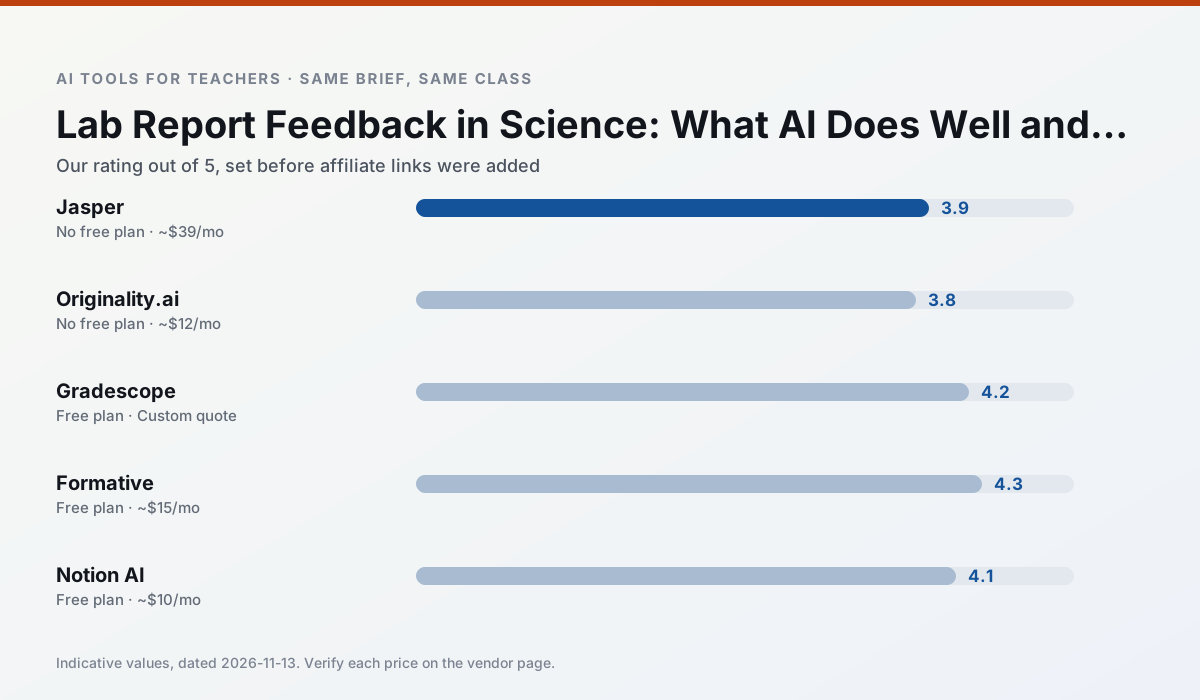
Side by side
Comparison table
Ratings reflect our timed classroom workflow, not vendor claims. Prices are indicative — verify on the vendor site.
| Tool | Best for | Free tier | Indicative paid plan | Standout feature | Our rating | Verdict | Try the tool |
|---|---|---|---|---|---|---|---|
| Jasper | newsletters · parent communication | No ongoing free plan | ~$39 /user/mo | Brand voice profiles | 3.9 / 5 | Situational | Try free |
| Originality.ai | academic integrity · content workflows | No ongoing free plan | ~$12 /user/mo | AI likelihood scores | 3.8 / 5 | Situational | Try free |
| Gradescope | grading · rubric creation | Yes — Limited courses | Custom quote | Bubble sheet and handwriting capture | 4.2 / 5 | Strong option | Try free |
| Formative | formative assessment · grading | Yes — Core assessment tools | ~$15 /user/mo | Live student responses | 4.3 / 5 | Strong option | Try free |
| Notion AI | curriculum mapping · unit planning | Yes — Limited AI usage | ~$10 /user/mo | Linked databases | 4.1 / 5 | Situational | Try free |
| Grammarly | parent communication · report card comments | Yes — Core grammar and tone checks | ~$12 /user/mo | Tone adjustments | 4.3 / 5 | Strong option | Try free |
Match your situation
Best for X
Different jobs need different tools. Here is what we would open first in each case.
Family-facing drafts from Jasper need the fewest rewrites for warmth without overpromising, which is the usual failure mode.
Originality.ai keeps the same task across levels, which is what makes a differentiated set defensible in moderation.
Gradescope is built around teacher-monitored student spaces and audit logs rather than a consumer chat account, which is a different approval conversation.
If there is no budget, start with Formative: free plan with clearest quota is the least punishing free tier here.
Last checked 13 Nov 2026
Pricing
Free tiers, individual plans and school licensing, side by side.
| Tool | Free plan | Individual / paid | School & district | Billing note | Verify |
|---|---|---|---|---|---|
| Jasper | No ongoing free tier | ~$39 /user/mo | ~$59+ /user/mo | Indicative — verify on vendor site | Vendor |
| Originality.ai | No ongoing free tier | ~$12 /user/mo | Custom quote | Indicative — verify on vendor site | Vendor |
| Gradescope | $0 — Limited courses | Custom quote | Custom quote | LMS integration and support | Vendor |
| Formative | $0 — Core assessment tools | ~$15 /user/mo | Custom quote | Indicative — verify on vendor site | Vendor |
| Notion AI | $0 — Limited AI usage | ~$10 /user/mo | ~$8 /user/mo | Indicative — verify on vendor site | Vendor |
| Grammarly | $0 — Core grammar and tone checks | ~$12 /user/mo | ~$15 /user/mo | Indicative — billed annually | Vendor |
Editorial rule: pricing is re-checked every 2–3 months and the top 50 pages are refreshed every 6 months. See our funding policy.
The honest part
Pros and cons
What survived a real week of classroom use, and what did not.
Pros
- Consistent tone across communications
- Strong long-form editor
- Good for district comms teams
Cons
- Priced for marketing teams
- Overkill for one classroom
- No education-specific features
Pros
- Useful for content publishing QA
- Fast bulk scanning
- Transparent credit model
Cons
- AI detection produces false positives
- Should never be sole evidence of misconduct
- Not a teaching tool
Pros
- Large time savings on paper assessments
- Consistent rubric application
- Detailed item analytics
Cons
- Overkill for elementary classrooms
- Institutional pricing is opaque
- Setup effort is real
Pros
- Strong data for intervention groups
- Works with existing PDFs and Docs
- Good LMS integrations
Cons
- Steeper setup than quiz games
- Best value requires school-wide rollout
- Price adds up per teacher
Pros
- Great for long-term curriculum records
- Strong team collaboration
- Flexible structure
Cons
- Setup time is significant
- AI add-on pricing changed more than once
- Not purpose-built for lesson generation
In the classroom
Use cases
Five concrete workflows, with the tool we would open for each one.
An IEP present-levels first draft
Use aggregated, anonymised data only. Ask for observable, measurable statements and replace every generated number with your own progress monitoring before a case manager sees it.
Recommended: JasperA five-minute exit ticket set
Ask for one recall, one application and one reasoning item, then delete the second recall question every generator sneaks in.
Recommended: Originality.aiA question bank from a PDF or article
Feed a non-identifiable source and ask for items tagged by difficulty with the misconception behind each distractor. Spot-check every answer key; numerical items are least reliable.
Recommended: GradescopeA substitute folder that needs no context
The value here is structure, not creativity. Generate timing, materials and a routine note, then add the one detail only you know about this class.
Recommended: FormativeThree reading levels from one source text
Paste a vetted text, ask for supported, core and extension versions, then check the vocabulary list by hand. Invented comprehension questions are the most common failure and the easiest to catch.
Recommended: Notion AI
Questions teachers ask us
FAQ
Direct answers, also published as FAQPage structured data for search and AI assistants.
Can AI do Lab report feedback at mixed-grade level?
Which tool is best for Lab report feedback?
What is the biggest risk?
Sources & further reading
Our recommendation
Try Jasper free for your next Lab report feedback task
Brand-voice writing assistant for school communications teams. Start on the free tier, run one real science lesson, and only consider upgrading if the quota is what stops you. Disclosure: we may earn a commission (varies) at no extra cost to you.
Some links on this page are affiliate links. We may earn a commission at no extra cost to you. Our rankings are editorial and never pay-to-play. Never enter student PII into a free consumer account.
Keep reading
Related comparisons in this cluster.
Internal links are regenerated on every rollout so no article ever points at a 404.