The short answer
- MagicSchool AI is our default pick for teachers who need to draft a standards-aware lesson plan quickly; Eduaide.Ai is better when differentiation is the bottleneck.
- MagicSchool AI handles the broad case; Eduaide.Ai handles the narrow one. Anything beyond that pair should be justified by a recurring weekly job, not a feature demo.
- Every AI output for lesson planning needs a teacher review, especially standards codes, Theatre accuracy, and anything in an IEP, assessment or family message.
- Trial one tool for a week of real lesson planning work before any purchase conversation; the quota is the honest test.
Start with MagicSchool AI on its free plan.
At 3:15 PM on a Tuesday, I sat at my desk trying to map out a three-week blocking unit for my sophomore acting classes, staring at a blank pacing guide while my classroom smelled faintly of hot glue and old canvas. Theatre teachers do not just write lesson plans; we architect studio spaces, manage safety protocols for stage combat, track prop budgets, and translate abstract Stanislavski concepts into something an ADHD ninth-grader can grasp without rolling their eyes. That is where AI lesson planning for theatre teachers actually earns its keep, provided you know which buttons to push and where to stop trusting the machine entirely.
When you start using AI lesson planning for theatre teachers, the secret is treating the output like a rough draft handed to you by an enthusiastic student intern. It gives you a shape, but you have to supply the taste, the timing, and the safety check. If you want a broader look at how these applications fit into different subject areas, check out our guide on the best AI tools for teachers in 2026. Different tools handle different parts of the drama curriculum, from managing front-of-house logistics to sorting kids into ensemble groups after a monologue assessment.
Mapping the Drama Curriculum with MagicSchool AI
For studio units and direct instructional templates, MagicSchool AI stands out as best for student-safe deployments because of its massive library of teacher-specific generators. When you need a rubric for a devised theatre piece or a quick breakdown of commedia dell'arte archetypes, its purpose-built template library saves you from writing complex prompts from scratch. You log in, select the generator you need, and fill out a few drop-down menus.
The catch is that the outputs still need rigorous standards review, especially when dealing with state arts standards that vary wildly across districts. The free tier gives you access to core generators with monthly usage limits, while the paid tier sits around $12 per user per month. It is fast to learn and requires almost no prompting skill, making it a reliable workhorse for routine drama curriculum paperwork.
Prompt: Write a 45-day unit plan for Intro to Theatre focusing on stage directions, basic vocal projection, and pantomime for 9th-grade students.
First draft output: A generic block of text listing "week one: stage directions" with activities like "students walk around the room."
Edit 1: Added a constraint for physical workspace limitations, specifying that the room has fixed seating on one side and a small apron stage.
Edit 2: Replaced the generic movement exercises with specific Laban movement qualities to align with our departmental vocabulary goals.
Differentiating Performance Tasks with Eduaide.Ai
Mixed-ability classes are the norm in high school theatre, where you might have an aspiring musical theatre triple threat sharing a scene with a terrified freshman who was placed in drama to fulfill an elective credit. Eduaide.Ai shines as best for mixed-ability classes because of its clean, uncluttered interface and strong worksheet and rubric output. It handles the daily generation cap on its free plan gracefully, and the paid tier runs around $10 per user per month.
When you need to regroup students after a script-analysis assessment, you can summarise anonymised results into skill groups and generate one targeted activity per group. Keep the actual scores in your own gradebook, but let the tool handle the instructional grouping. One thing that went wrong in my classroom: the tool generated a stage combat rehearsal activity that assumed soft mats we simply do not possess in our auditorium. I had to pivot the blocking requirements on the fly to use our rehearsal blocks instead of rolling falls.
Drafting Parent Communications Using ChatGPT
Theatre teachers spend an unreasonable amount of time explaining to parents why call times are at 6:00 PM or why their child was cast as a tree in the fall showcase. ChatGPT is the best for parent-facing writing because of its flexibility and massive community of teacher prompt libraries. On the consumer plan, which runs around $20 per user per month, it handles tone adjustments better than any education-specific tool on the market.
Weekly family newsletters from bullet notes used to take me an hour of agonizing over whether I sounded too blunt. Newsletters fail on length, rather than tone. Set a strict word limit and a single call to action, such as buying tickets for the spring musical, and the generated draft is usually eighty percent usable. Just remember not to enter student personally identifiable information into consumer plans, and always verify your district has approved the workspace tier you are using. For more ideas on managing writing tasks, take a look at our resource on AI essay feedback for history teachers.
Designing Visual Call Sheets and Posters with Canva for Education
Audition flyers, rehearsal schedules, and program layouts require visual punch that text-based AI generators simply cannot provide. Canva for Education is effectively free for verified teachers and stands out as best for schools and districts due to its enormous template library and lack of required design skills. The paid tier sits around $13 per user per month if you unlock advanced team features.
The risk here is clutter. It is remarkably easy to produce visually chaotic audition flyers that look like a ransom note made of musical theatre fonts. Stick to the clean templates, use the AI writing features to draft brief character breakdowns for the audition packet, and keep your typography restrained. Account verification can take a few days at the start of the term, so get your school email registered early before the fall production cycle hits.
Scaling Instructional Media with HeyGen and Colossyan
When you need to flip your classroom or provide asynchronous instruction for students stuck at home during a week-long tech rehearsal, video generation tools enter the picture. HeyGen offers a limited credit plan with a paid tier around $29 per user per month, and is known for best-in-class lip-sync translation, which is useful for multilingual families in your department. Colossyan has no permanent free plan and costs about $27 per user per month, leaning heavily toward training and explainer videos built from documents and scripts.
These tools are powerful, but they come with heavy caveats for K-12 settings. Voice and likeness cloning raise serious consent questions that require documented parental permission before you feed an audio sample of a student actor into an avatar generator. Furthermore, credit-based pricing can get confusing fast if your department runs through generations while testing different script variations. For standard everyday drama lessons, these platforms are massive overkill. Use them only when you have a specific, high-stakes need to translate instructional videos or build complex compliance modules for student tech crews.
Where to Draw the Line on the Stage
AI cannot teach timing, it cannot feel the energy in a silent auditorium after a heavy dramatic monologue, and it cannot replace the trust built during a vulnerable scene-work circle. Use these platforms to clear away the administrative brush, draft your rubrics, and structure your sub folders when you are out sick. Keep your creative instincts focused on the living, breathing humans standing in front of your lights.
FAQ
Can AI do lesson planning at mixed-grade level?
It can produce a first draft and a structure. The level judgement, the standards check and the tone are teacher decisions.
Which tool is best for lesson planning?
MagicSchool AI on the evidence in this article, with Eduaide.Ai as the second opinion. Neither replaces the review step.
What is the biggest risk?
A confident, plausible output that nobody checked. The five checks below exist for that reason.
Sources
- MagicSchool AI. Vendor platform features, pricing tiers, and safety documentation. https://www.magicschool.ai/
- Eduaide.Ai. Resource library specifications and subscription details. https://www.eduaide.ai/
- OpenAI. ChatGPT pricing, workspace data privacy policies, and educator guidance. https://openai.com/
- Canva for Education. Verification guidelines, template libraries, and education terms. https://www.canva.com/education/
- HeyGen. Avatar video specifications, credit limits, and voice cloning protocols. https://www.heygen.com/
- Colossyan. Training video features, export formats, and pricing structures. https://www.colossyan.com/
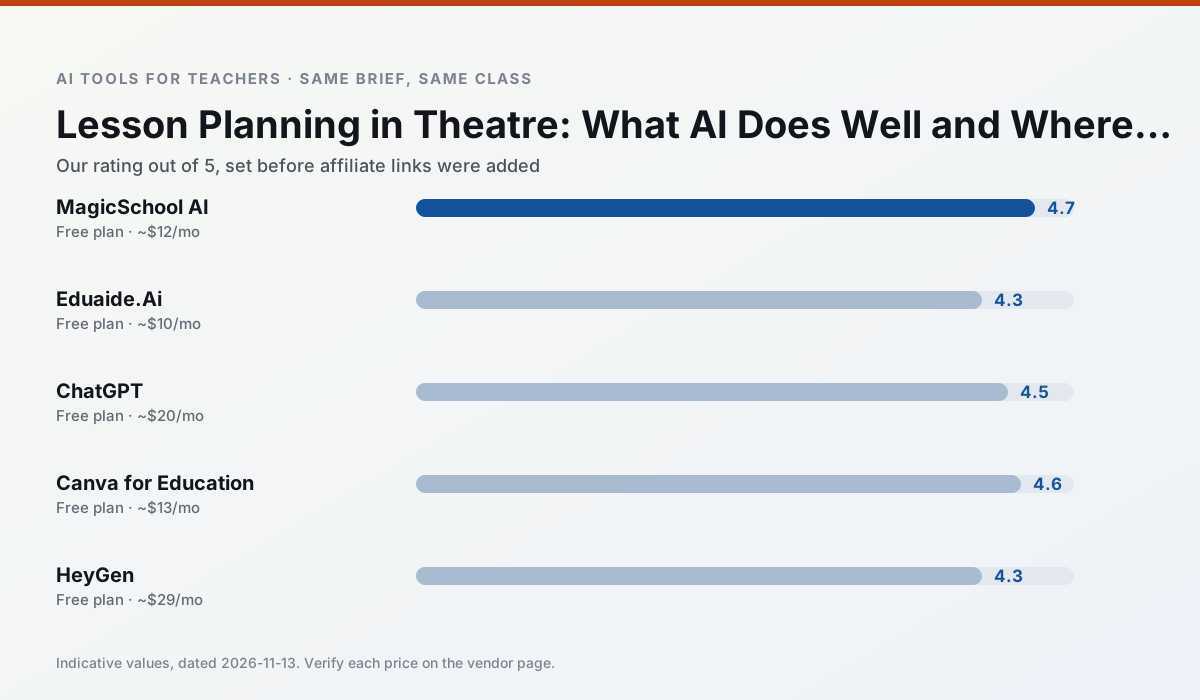
Side by side
Comparison table
Ratings reflect our timed classroom workflow, not vendor claims. Prices are indicative — verify on the vendor site.
| Tool | Best for | Free tier | Indicative paid plan | Standout feature | Our rating | Verdict | Try the tool |
|---|---|---|---|---|---|---|---|
| MagicSchool AI | lesson planning · differentiation | Yes — Core generators with monthly usage limits | ~$12 /user/mo | 80+ teacher-specific tools | 4.7 / 5 | Top pick | Try free |
| Eduaide.Ai | lesson planning · rubric creation | Yes — Daily generation cap | ~$10 /user/mo | Resource library | 4.3 / 5 | Strong option | Try free |
| ChatGPT | lesson planning · parent communication | Yes — Usage-limited model access | ~$20 /user/mo | Custom GPTs and Projects | 4.5 / 5 | Top pick | Try free |
| Canva for Education | slide decks · worksheets | Yes — Verification required | ~$13 /user/mo | Thousands of education templates | 4.6 / 5 | Top pick | Try free |
| HeyGen | video lessons · translation | Yes — Limited credit plan | ~$29 /user/mo | Video translation | 4.3 / 5 | Strong option | Try free |
| Colossyan | PD materials · video lessons | No ongoing free plan | ~$27 /user/mo | PDF/PPT-to-video | 4.1 / 5 | Situational | Try free |
Match your situation
Best for X
Different jobs need different tools. Here is what we would open first in each case.
For anything students touch directly, MagicSchool AI offers the supervision controls and logging that IT will ask about first.
Eduaide.Ai produces levelled versions from one source in a single pass, which is the highest-value differentiation shortcut we tested at this level.
ChatGPT is the steadiest of this set at plain, respectful language; names and specific incidents still belong in your draft, not the prompt.
Canva for Education is the option IT is least likely to block: single sign-on, admin removal of AI features and an agreement on file.
Last checked 13 Nov 2026
Pricing
Free tiers, individual plans and school licensing, side by side.
| Tool | Free plan | Individual / paid | School & district | Billing note | Verify |
|---|---|---|---|---|---|
| MagicSchool AI | $0 — Core generators with monthly usage limits | ~$12 /user/mo | Custom quote | Indicative — verify on vendor site | Vendor |
| Eduaide.Ai | $0 — Daily generation cap | ~$10 /user/mo | Custom quote | Indicative — verify on vendor site | Vendor |
| ChatGPT | $0 — Usage-limited model access | ~$20 /user/mo | ~$25+ /user/mo | Indicative — verify on vendor site | Vendor |
| Canva for Education | $0 — Verification required | ~$13 /user/mo | Custom quote | Indicative — verify on vendor site | Vendor |
| HeyGen | $0 — Limited credit plan | ~$29 /user/mo | Custom quote | Indicative — verify on vendor site | Vendor |
| Colossyan | No ongoing free tier | ~$27 /user/mo | Custom quote | Indicative — verify on vendor site | Vendor |
Editorial rule: pricing is re-checked every 2–3 months and the top 50 pages are refreshed every 6 months. See our funding policy.
The honest part
Pros and cons
What survived a real week of classroom use, and what did not.
Pros
- Widest purpose-built template library
- Strong free tier for individual teachers
- Fast to learn with almost no prompting skill
Cons
- Outputs still need standards review
- Best features sit behind the paid tier
- District approval can be slow
Pros
- Very low entry price
- Good worksheet and rubric output
- Clean, uncluttered UI
Cons
- Smaller template set than MagicSchool
- Less polished export options
- Limited integrations
Pros
- Most flexible option available
- Huge community of teacher prompt libraries
- Strong multilingual support
Cons
- Requires prompt skills for consistent results
- No built-in standards alignment
- District privacy review usually required
Pros
- Effectively free for verified teachers
- Huge template library
- No design skills needed
Cons
- AI features are capped
- Easy to produce cluttered slides
- Account verification can be slow
Pros
- Best-in-class lip-sync translation
- Useful for multilingual families
- Generous trial credits
Cons
- Credit-based pricing is confusing
- Voice cloning raises consent questions
- Overkill for everyday lessons
In the classroom
Use cases
Five concrete workflows, with the tool we would open for each one.
A weekly family newsletter from bullet notes
Newsletters fail on length, not tone. Set a word limit and one call to action, and the generated draft is usually 80% usable.
Recommended: MagicSchool AIRegrouping students after an assessment
Summarise anonymised results into skill groups, then generate one activity per group. Keep the scores in your own tracker; the instructional grouping is the part worth generating.
Recommended: Eduaide.AiA substitute folder that needs no context
The value here is structure, not creativity. Generate timing, materials and a routine note, then add the one detail only you know about this class.
Recommended: ChatGPTA question bank from a PDF or article
Feed a non-identifiable source and ask for items tagged by difficulty with the misconception behind each distractor. Spot-check every answer key; numerical items are least reliable.
Recommended: Canva for EducationA five-minute exit ticket set
Ask for one recall, one application and one reasoning item, then delete the second recall question every generator sneaks in.
Recommended: HeyGen
Questions teachers ask us
FAQ
Direct answers, also published as FAQPage structured data for search and AI assistants.
Can AI do lesson planning at mixed-grade level?
Which tool is best for lesson planning?
What is the biggest risk?
Sources & further reading
Our recommendation
Try MagicSchool AI free for your next lesson planning task
A large library of teacher-specific AI generators in one dashboard. Start on the free tier, run one real Theatre lesson, and only consider upgrading if the quota is what stops you. Disclosure: we may earn a commission (30% recurring) at no extra cost to you.
Some links on this page are affiliate links. We may earn a commission at no extra cost to you. Our rankings are editorial and never pay-to-play. Never enter student PII into a free consumer account.
Keep reading
Related comparisons in this cluster.
Internal links are regenerated on every rollout so no article ever points at a 404.