The short answer
- Eduaide.Ai is our default pick for teachers who need to write criterion-referenced rubrics quickly; Claude is better when differentiation is the bottleneck.
- Free-tier reality for this shortlist: Eduaide.Ai: Yes — Daily generation cap; Claude: Yes — Usage-limited; Gradescope: Yes — Limited courses. Treat every paid figure as indicative until you have read the vendor page; only the free quota is something you can test yourself this week.
- Every AI output for rubric creation needs a teacher review, especially standards codes, history accuracy, and anything in an IEP, assessment or family message.
- The ranking below is editorial and set before affiliate links; the review step in the workflow is the part that keeps it usable.
Start with Colossyan on its free plan.
It was a Tuesday evening during mid-term grading, and I was staring at forty 9th-grade paragraphs arguing whether the New Deal prolonged the Great Depression. My rubric lived in a Word document from 2021, and every single student had found a loophole in it. Some kids wrote brilliant prose that failed to cite primary sources, while others pasted a wall of FDR statistics with zero historical analysis. My grading criteria rewarded word count over historical thinking, and I knew it. That is the exact moment most history teachers turn to AI rubric creation for history teachers, hoping an algorithm will finally make standard-aligned assessment painless.
The reality is messier than the product demos suggest. If you let an AI write your rubric from scratch, you get generic nonsense like "shows good understanding of the historical period." That is useless for grading, and it is even worse for students trying to understand why they earned a C-plus. AI rubric creation for history teachers only works when you treat the machine as an administrative assistant, not the head of the department. You bring the state standards and the specific historical skills, and the tool builds the grid.
Why General Rubrics Fail in History Classrooms
History is not math. A right answer is rarely right without context, sourcing, and corroboration. When you ask a generic AI tool to build a rubric for a document-based question, it defaults to evaluating grammar, length, and surface-level facts. It misses the core of historical inquiry.
To get around this, you have to constrain the output. Tools like Eduaide.Ai, which costs around $10 a user per month on its paid tier and offers a daily generation cap on its free plan, excel at quick setup. It has a clean, uncluttered user interface that gets you a draft in under sixty seconds. The catch is that its template set is smaller than some competitors, meaning you still have to supply the historical rigor.
Prompt: "Create a 4-level analytic rubric for a 10th-grade historical sourcing paragraph about the Tonkin Gulf Resolution. Criteria must include: sourcing (reliability and point of view), corroboration, and historical context. Avoid generic terms like 'good effort'."
First AI Output: The model returned a clean table with criteria for Sourcing, Context, and Mechanics. However, the top tier for Sourcing required students to "flawlessly evaluate the provenance of every document," which is an impossible standard for a 15-year-old.
Two Edits That Saved It:
- Changed the top tier language from "flawlessly evaluate" to "explains how the author's point of view limits or enhances their reliability."
- Dropped the 'Mechanics' row entirely and replaced it with a 'Historical Claim' criterion to keep the focus on historical thinking rather than comma splices.
Using Long-Context Assistants for Complex Assessment Frameworks
When you are designing an entire rubric for a semester-long historical investigation or a complex DBQ, consumer chat interfaces fall short. Claude, operating at roughly $20 a user per month on its paid tier, handles long-context inputs remarkably well. It is our top pick for schools and districts that need nuanced, less generic prose. It does not use teacher-specific templates, but it can read an entire state curriculum framework and draft a multi-tiered rubric that matches your exact pacing guide.
The danger with Claude is data privacy. You cannot paste student work or identifiable rosters into a consumer plan. For general planning and rubric design, it is unmatched at producing structured document output. If you need to map a series of essays to AP World History historical reasoning skills, Claude can parse the College Board rubric weights and generate a custom formative assessment grid in one pass.
When Assessment Scale Demands Institutional Tools
If your grading bottleneck is not the design of the rubric, but the physical application of it across one hundred and fifty paper exams, rubric generators stop helping. That is where Gradescope steps in as the best free option, though it also offers paid institutional tiers with custom quotes. Gradescope handles AI-assisted rubric grading for scanned and handwritten assessments.
What went wrong in real use: The setup effort is genuinely punishing. The first time I tried to use Gradescope for a unit exam, I spent two hours scanning papers, defining regions of interest, and training the grouping algorithm to recognize different student handwritings of the word "containment." For a single teacher with two prep periods, the front-loaded time cost felt like a trap.
How I fixed it: I abandoned trying to grade five different essay prompts at once and limited the tool to a structured short-answer section where all students answered the same three questions. Once the AI clustered similar answers together, I could apply rubric deductions across twenty papers at a time instead of writing "see margin" on every single page.
Remember that Gradescope handles student work, meaning a full DPA and FERPA review is required by your district before you upload anything. It is definitely overkill for elementary classrooms, but for high school social studies teachers drowning in paper midterms, the item analytics are unmatched.
Exploring Video and Multimedia Assessment Contexts
Sometimes history instruction requires students to produce digital artifacts rather than written essays. This is where tools like Colossyan, priced around $27 a user per month with no permanent free plan, come into play. It is our best overall tool for daily use when branching into staff training or explainer video creation, allowing fast document-to-video conversion with strong compliance and LMS export features.
Similarly, HeyGen and Synthesia, both hovering around $29 a user per month with limited free tiers or trial credits, let you turn a script into a presenter-led video using AI avatars. While these tools are primarily designed for instructional delivery rather than rubric creation, they introduce unique challenges in history classrooms. If you ask students to build historical documentary explainers using avatar generation, or if you use these tools to translate primary source background videos for multilingual families, you run straight into consent questions. Voice and likeness cloning require documented parental consent, and the credit-based pricing models can be deeply confusing when planning a departmental budget. For a deeper dive into managing student writing workflows, see our guide on AI essay feedback for history teachers.
Two Failures Every Teacher Hits
The first major failure mode in AI rubric creation is the "phantom standard." The AI will invent a historical skill that your state standards do not actually assess, such as grading students on their ability to create visual timelines within a written essay rubric. When I used Eduaide.Ai to quickly spin up a French Revolution rubric, it included a criterion for "geographical accuracy of battle maps." My assignment was a rhetorical analysis of Robespierre’s speech. I caught it before printing, but only because I read the fine print of the generated grid. Always cross-check the AI's criteria against your actual learning objectives.
The second failure mode is grade inflation baked into the descriptions. AI models are pathologically optimistic. Their rubric descriptions for a 'C' grade often sound like an 'A' paper from ten years ago, using phrases like "demonstrates adequate engagement with the broader narrative." When students challenge their grades, pointing to an AI-generated rubric that praises their lack of evidence hurts your grading credibility. You have to manually sharpen the negative descriptors so that failing to cite a source explicitly drops the score into the developing tier. If you are looking for ways to streamline other parts of your workflow, our breakdown of AI exit tickets for Ela teachers offers parallel lessons on keeping AI honest.
AI rubric creation for history teachers is a time-saver only if you view the first draft as clay. Mold it, cut out the fluff, and anchor every single point value to a skill your students actually practiced in class.
FAQ
Can AI do rubric creation at mixed-grade level?
It can produce a first draft and a structure. The level judgement, the standards check and the tone are teacher decisions.
Which tool is best for rubric creation?
Eduaide.Ai on the evidence in this article, with Claude as the second opinion. Neither replaces the review step.
What is the biggest risk?
A confident, plausible output that nobody checked. The five checks below exist for that reason.
Sources
- Eduaide.Ai features, pricing, and functional limits. Available: https://www.eduaide.ai
- Anthropic Claude usage tiers and structural document output documentation. Available: https://www.anthropic.com/claude
- Gradescope pricing, course limits, and FERPA compliance overview. Available: https://www.gradescope.com
- Colossyan platform capabilities and video generation specifications. Available: https://www.colossyan.com
- HeyGen translation features and credit-based pricing models. Available: https://www.heygen.com
- Synthesia avatar generation and enterprise pricing details. Available: https://www.synthesia.io
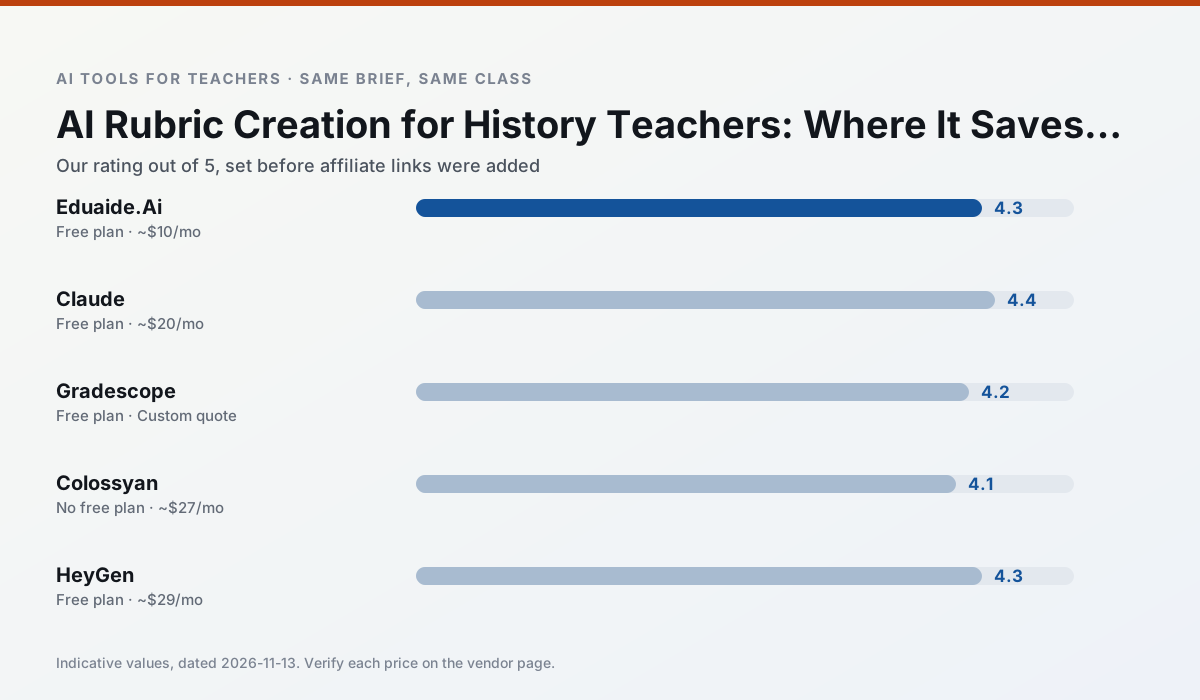
Side by side
Comparison table
Ratings reflect our timed classroom workflow, not vendor claims. Prices are indicative — verify on the vendor site.
| Tool | Best for | Free tier | Indicative paid plan | Standout feature | Our rating | Verdict | Try the tool |
|---|---|---|---|---|---|---|---|
| Eduaide.Ai | lesson planning · rubric creation | Yes — Daily generation cap | ~$10 /user/mo | Resource library | 4.3 / 5 | Strong option | Try free |
| Claude | rubric creation · feedback on writing | Yes — Usage-limited | ~$20 /user/mo | Very large context window | 4.4 / 5 | Strong option | Try free |
| Gradescope | grading · rubric creation | Yes — Limited courses | Custom quote | Bubble sheet and handwriting capture | 4.2 / 5 | Strong option | Try free |
| Colossyan | PD materials · video lessons | No ongoing free plan | ~$27 /user/mo | PDF/PPT-to-video | 4.1 / 5 | Situational | Try free |
| HeyGen | video lessons · translation | Yes — Limited credit plan | ~$29 /user/mo | Video translation | 4.3 / 5 | Strong option | Try free |
| Synthesia | flipped lessons · video lessons | No ongoing free plan | ~$29 /user/mo | 140+ languages | 4.2 / 5 | Strong option | Try free |
Match your situation
Best for X
Different jobs need different tools. Here is what we would open first in each case.
Setup cost is one login for Eduaide.Ai; everything else can wait until you know the tool is useful.
Claude is the option IT is least likely to block: single sign-on, admin removal of AI features and an agreement on file.
If there is no budget, start with Gradescope: free plan with clearest quota is the least punishing free tier here.
Colossyan is the one we would open on a normal planning day because the first output is editable rather than restructurable, and the free plan covers a single teacher's routine.
Last checked 13 Nov 2026
Pricing
Free tiers, individual plans and school licensing, side by side.
| Tool | Free plan | Individual / paid | School & district | Billing note | Verify |
|---|---|---|---|---|---|
| Eduaide.Ai | $0 — Daily generation cap | ~$10 /user/mo | Custom quote | Indicative — verify on vendor site | Vendor |
| Claude | $0 — Usage-limited | ~$20 /user/mo | ~$25+ /user/mo | Indicative — verify on vendor site | Vendor |
| Gradescope | $0 — Limited courses | Custom quote | Custom quote | LMS integration and support | Vendor |
| Colossyan | No ongoing free tier | ~$27 /user/mo | Custom quote | Indicative — verify on vendor site | Vendor |
| HeyGen | $0 — Limited credit plan | ~$29 /user/mo | Custom quote | Indicative — verify on vendor site | Vendor |
| Synthesia | No ongoing free tier | ~$29 /user/mo | Custom quote | Indicative — verify on vendor site | Vendor |
Editorial rule: pricing is re-checked every 2–3 months and the top 50 pages are refreshed every 6 months. See our funding policy.
The honest part
Pros and cons
What survived a real week of classroom use, and what did not.
Pros
- Very low entry price
- Good worksheet and rubric output
- Clean, uncluttered UI
Cons
- Smaller template set than MagicSchool
- Less polished export options
- Limited integrations
Pros
- Handles full unit plans and long rubrics
- Nuanced, less generic prose
- Good at structured document output
Cons
- No teacher-specific templates
- Fewer classroom integrations
- Consumer plan not suitable for student data
Pros
- Large time savings on paper assessments
- Consistent rubric application
- Detailed item analytics
Cons
- Overkill for elementary classrooms
- Institutional pricing is opaque
- Setup effort is real
Pros
- Strong for staff training, not just lessons
- Good compliance/LMS export
- Fast document-to-video
Cons
- No permanent free plan
- Higher price point
- Less suited to K-12 student-facing content
Pros
- Best-in-class lip-sync translation
- Useful for multilingual families
- Generous trial credits
Cons
- Credit-based pricing is confusing
- Voice cloning raises consent questions
- Overkill for everyday lessons
In the classroom
Use cases
Five concrete workflows, with the tool we would open for each one.
A parent email in two languages
Draft in plain, warm language with no names, translate, then back-translate the important sentences to check meaning. Keep specific incidents out of the prompt and add them yourself.
Recommended: Eduaide.AiRubric and feedback comments in one pass
Reorder the workflow so the rubric is yours and the comments are generated. Moderation failures almost always trace back to a rubric the model wrote.
Recommended: ClaudeThree reading levels from one source text
Paste a vetted text, ask for supported, core and extension versions, then check the vocabulary list by hand. Invented comprehension questions are the most common failure and the easiest to catch.
Recommended: GradescopeA Monday morning lesson plan in twelve minutes
The twelve minutes come from not rewriting the skeleton. Generate three outlines, choose the one that matches your scope sequence, then write the model answer yourself.
Recommended: ColossyanA question bank from a PDF or article
Feed a non-identifiable source and ask for items tagged by difficulty with the misconception behind each distractor. Spot-check every answer key; numerical items are least reliable.
Recommended: HeyGen
Questions teachers ask us
FAQ
Direct answers, also published as FAQPage structured data for search and AI assistants.
Can AI do rubric creation at mixed-grade level?
Which tool is best for rubric creation?
What is the biggest risk?
Sources & further reading
Our recommendation
Try Colossyan free for your next rubric creation task
Training and explainer videos built from documents and scripts. Start on the free tier, run one real history lesson, and only consider upgrading if the quota is what stops you. Disclosure: we may earn a commission (25–50% recurring) at no extra cost to you.
Some links on this page are affiliate links. We may earn a commission at no extra cost to you. Our rankings are editorial and never pay-to-play. Never enter student PII into a free consumer account.
Keep reading
Related comparisons in this cluster.
Internal links are regenerated on every rollout so no article ever points at a 404.