The short answer
- Quizizz is our default pick for teachers who need to build a balanced question set quickly; Kahoot! is better when differentiation is the bottleneck.
- The cheapest honest test is a week of real work on the free plans: Quizizz: Yes — Core quiz creation; Kahoot!: Yes — Limited player count; QuestionWell: Yes — Monthly generation limit. If a tool is still open on Friday, it has earned a paid conversation.
- Every AI output for quiz generation needs a teacher review, especially standards codes, math accuracy, and anything in an IEP, assessment or family message.
- Everything on this page dates from 2026-11-13; where a price could not be re-read, the row says so.
Start with OpusClip on its free plan.
At 3:15 on a Tuesday afternoon, my desk is covered in half-graded quadratic equation quizzes and three different versions of an upcoming unit test. I needed forty standards-aligned questions with plausible distractors, and I needed them before the bell rang the next morning. That is usually when teachers start looking for shortcuts, which is why AI quiz generation for math teachers has become such a hot topic in the staff room. Some tools promise a complete assessment in thirty seconds, but anyone who has run an unedited AI math quiz knows the machine will happily generate a question where the answer is the square root of a negative number in the real number domain.
Using AI for math assessment is less about letting the computer do the work and more about treating the output like a rough draft written by an enthusiastic student who skipped the prerequisite classes. If you want to see how other departments are tackling these workflows, take a look at the broader landscape outlined in our guide on the best AI tools for teachers 2026. This review focuses specifically on what works, what breaks, and which platforms actually save time when you are knee-deep in algebra units.
Building Question Banks Without Losing Your Mind
When it comes to generating clean question banks from an existing standard or textbook chapter, QuestionWell is the standout tool. It saves the most time on question writing by taking a specific learning objective or pasted text and turning it into standards-aligned multiple-choice items with clean export workflows. The paid tier sits at about $10 per user per month, while the free tier imposes a monthly generation limit. The main limitation is that it is a single-purpose tool, and question quality varies wildly depending on the quality of your source text. When using it, remember the golden rule: only paste non-identifiable source text.
The real value of a tool like QuestionWell isn't just spitting out four numbers and a letter. It is the distractor rationale. If the generator cannot explicitly name the misconception a wrong answer tests, you delete that option.
Prompt: "Generate 5 multiple-choice questions for 8th-grade math on solving systems of linear equations by substitution. Align to standard 8.EE.C.8c. Include distractor rationales for every wrong answer."
First output: The AI generated five standard equations, but two of the distractors were just random integers with no mathematical logic behind them.
Two edits for usability:
- Edited the prompt to demand that every distractor target a specific arithmetic sign error or failure to distribute.
- Swapped out one fraction-heavy problem because the numbers were too messy for a ten-minute formative check.
For parent communication related to these assessments, you can also adapt workflows from sibling resources like the ai-essay-feedback-for-history-teachers-guide to keep your grading transparent and fast.
High-Energy Review and Student Engagement
Once you have your questions, deployment is the next hurdle. Kahoot! remains a staple for instant engagement with very low training time and strong brand familiarity, though its free tier has a limited player count and paid tiers run around $10 per user per month. It excels at quick review sessions where kids already know the interface. The catch is that its time pressure suits rapid recall far more than deep mathematical reasoning. If you are pushing students through multi-step word problems, Kahoot! can encourage random guessing just to beat the timer. For younger students, privacy is managed best by using nicknames rather than real names.
Quizizz offers a slightly different flavor of gamification with a large question bank and live games that work well on low-end devices. At roughly $15 per user per month with core quiz creation on the free tier, it stands as our pick for student-safe deployments due to its COPPA and FERPA documentation. Students already know the interface, and the reporting features are solid. However, writing high-quality AI questions still needs careful human review, the built-in gamification can distract easily from complex problem-solving, and advanced analytics are locked behind the paid wall.
Adapting Materials for Mixed-Ability Classrooms
Math classes are rarely homogeneous, meaning differentiation is a daily battle. Diffit is an effective option for mixed-ability classes, letting you level any text or video into differentiated reading materials with minimal setup. The paid tier is roughly $15 per user per month, and heavy use will burn through the free generational quota quickly. It produces both printable and digital versions, but the automated leveling is an estimate rather than a formal assessment.
Three reading levels from one source text: One source, three versions, same three questions in each. Automatic leveling is an estimate; read the supported version aloud to a colleague before it reaches a reading group. Avoid pasting identifiable student work, and always check district privacy policies.
If you need to supplement these texts with audio instructions or word problems read aloud for accommodations, Murf AI provides studio-quality voiceover for presentations and audio materials. At about $19 per user per month with a trial-only free output, it delivers very clean audio and easy slide integration. The pacing controls are impressive, but commercial licensing rules matter, the free tier is not usable long-term, and it remains a single-purpose tool. Always check license terms before distributing audio publicly.
Video Review and Professional Workflow Limits
Sometimes teachers record their own worked examples or direct instruction for absent students. OpusClip helps here by turning long recordings into short, captioned clips, making it useful for schools and districts wanting to repurpose lessons. Priced at roughly $15 per user per month with a limited free tier, it is fast and boasts excellent captions. The limitation is that it is optimized for social formats rather than instructional design, and you must never upload recordings containing identifiable students.
When things go wrong in AI quiz generation, they usually fail in two predictable ways. First, the AI loses track of mathematical constraints and creates impossible word problems, such as a rectangle with a negative perimeter. Second, the formatting breaks during export, turning exponents into unreadable code strings. When these failures happen, I abandon the export, fix the core template manually, and rely on QuestionWell or Quizizz strictly for distractor inspiration rather than final production. AI is a useful assistant for the heavy lifting of drafting, but the math department still needs a human eye to make sure the numbers add up.
FAQ
Can AI do quiz generation at mixed-grade level?
It can produce a first draft and a structure. The level judgement, the standards check and the tone are teacher decisions.
Which tool is best for quiz generation?
Quizizz on the evidence in this article, with Kahoot! as the second opinion. Neither replaces the review step.
What is the biggest risk?
A confident, plausible output that nobody checked. The five checks below exist for that reason.
Sources
- Quizizz Vendor Pricing and Features. https://quizizz.com/
- Kahoot! Educational Plans and Safety Guidelines. https://kahoot.com/
- QuestionWell Documentation and Standard Alignments. https://www.questionwell.ai/
- OpusClip Video Repurposing Specifications. https://www.opus.pro/
- Murf AI Voice Generation Terms and Licensing. https://murf.ai/
- Diffit Educational Levelling Tool Overview. https://diffit.me/
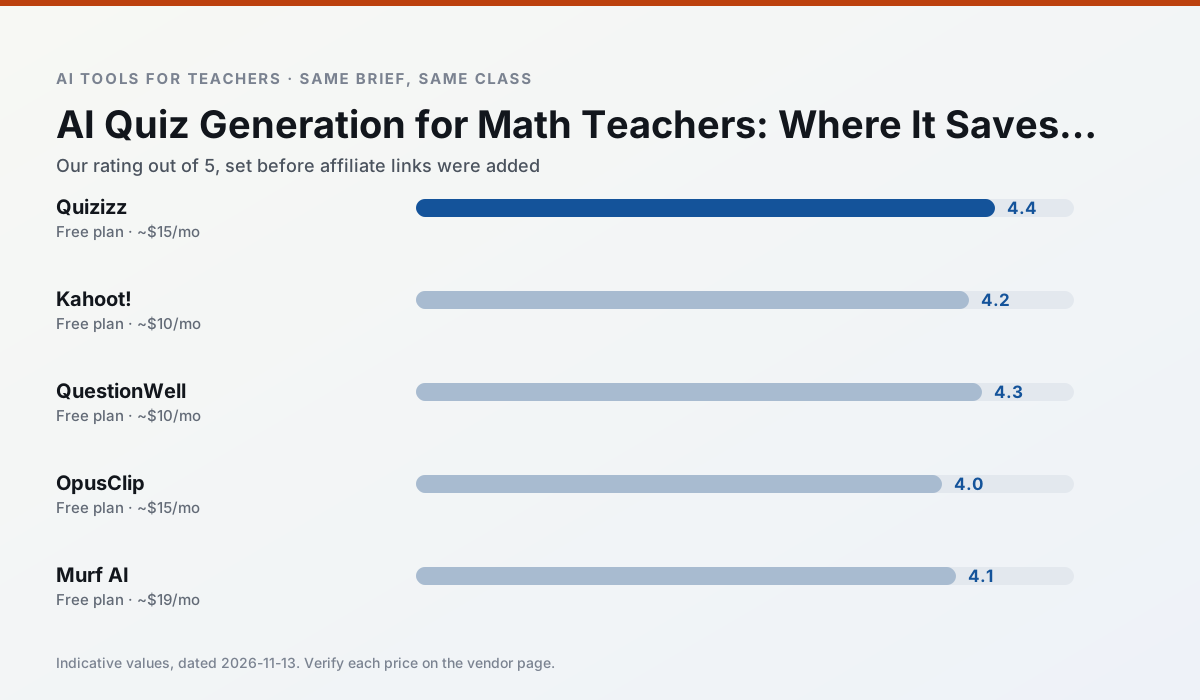
Side by side
Comparison table
Ratings reflect our timed classroom workflow, not vendor claims. Prices are indicative — verify on the vendor site.
| Tool | Best for | Free tier | Indicative paid plan | Standout feature | Our rating | Verdict | Try the tool |
|---|---|---|---|---|---|---|---|
| Quizizz | quiz generation · formative assessment | Yes — Core quiz creation | ~$15 /user/mo | AI question generator | 4.4 / 5 | Strong option | Try free |
| Kahoot! | quiz generation · review lessons | Yes — Limited player count | ~$10 /user/mo | AI question builder | 4.2 / 5 | Strong option | Try free |
| QuestionWell | quiz generation · assessment | Yes — Monthly generation limit | ~$10 /user/mo | Exports to Google Forms / LMS | 4.3 / 5 | Strong option | Try free |
| OpusClip | PD materials · flipped lessons | Yes — Limited monthly clips | ~$15 /user/mo | Auto captions | 4.0 / 5 | Situational | Try free |
| Murf AI | audio lessons · accessibility | Yes — Trial-only output | ~$19 /user/mo | Voice fine-tuning | 4.1 / 5 | Situational | Try free |
| Diffit | differentiated instruction · reading intervention | Yes — Limited generations per month | ~$15 /user/mo | Lexile-style leveling | 4.6 / 5 | Top pick | Try free |
Match your situation
Best for X
Different jobs need different tools. Here is what we would open first in each case.
Quizizz is built around teacher-monitored student spaces and audit logs rather than a consumer chat account, which is a different approval conversation.
Kahoot! keeps the same task across levels, which is what makes a differentiated set defensible in moderation.
Family-facing drafts from QuestionWell need the fewest rewrites for warmth without overpromising, which is the usual failure mode.
OpusClip is the option IT is least likely to block: single sign-on, admin removal of AI features and an agreement on file.
Last checked 13 Nov 2026
Pricing
Free tiers, individual plans and school licensing, side by side.
| Tool | Free plan | Individual / paid | School & district | Billing note | Verify |
|---|---|---|---|---|---|
| Quizizz | $0 — Core quiz creation | ~$15 /user/mo | Custom quote | Indicative — verify on vendor site | Vendor |
| Kahoot! | $0 — Limited player count | ~$10 /user/mo | Custom quote | Indicative — verify on vendor site | Vendor |
| QuestionWell | $0 — Monthly generation limit | ~$10 /user/mo | Custom quote | Indicative — verify on vendor site | Vendor |
| OpusClip | $0 — Limited monthly clips | ~$15 /user/mo | ~$29 /user/mo | Indicative — verify on vendor site | Vendor |
| Murf AI | $0 — Trial-only output | ~$19 /user/mo | ~$39 /user/mo | Indicative — verify on vendor site | Vendor |
| Diffit | $0 — Limited generations per month | ~$15 /user/mo | Custom quote | Indicative — verify on vendor site | Vendor |
Editorial rule: pricing is re-checked every 2–3 months and the top 50 pages are refreshed every 6 months. See our funding policy.
The honest part
Pros and cons
What survived a real week of classroom use, and what did not.
Pros
- Students already know the interface
- Good reporting
- Works on low-end devices
Cons
- Writing high-quality AI questions still needs review
- Gamification can distract
- Advanced analytics are paid
Pros
- Instant engagement
- Very low training time
- Strong brand familiarity
Cons
- Less depth for higher-order assessment
- Paid tiers needed for larger classes
- Time pressure suits recall more than reasoning
Pros
- Saves the most time on question writing
- Clean export workflow
- Good objective tagging
Cons
- Single-purpose tool
- Question quality varies by source text
- Limited student-facing features
Pros
- Turns a recorded lesson into review clips
- Excellent captions
- Fast
Cons
- Optimised for social formats
- Not a lesson design tool
- Free plan is restrictive
Pros
- Very clean audio
- Good pacing controls
- Easy slide integration
Cons
- Commercial licensing rules matter
- Free tier is not usable long-term
- Single-purpose
In the classroom
Use cases
Five concrete workflows, with the tool we would open for each one.
Three reading levels from one source text
One source, three versions, same three questions in each. Automatic levelling is an estimate; read the supported version aloud to a colleague before it reaches a reading group.
Recommended: QuizizzA weekly family newsletter from bullet notes
Give the tool bullet notes only, never a class list. Ask for a short structure with one action item, then read it aloud once; canned phrasing is obvious when spoken.
Recommended: Kahoot!Regrouping students after an assessment
Use exported, de-identified data and treat the grouping as a hypothesis. The second look should be a teacher's, not a model's.
Recommended: QuestionWellA substitute folder that needs no context
Say "no prior context, no devices, 40 minutes, printable" in the prompt. Everything else about substitute plans follows from those four constraints.
Recommended: OpusClipA question bank from a PDF or article
The distractor rationale is the part worth keeping. If the generator cannot name the misconception an option tests, delete that option.
Recommended: Murf AI
Questions teachers ask us
FAQ
Direct answers, also published as FAQPage structured data for search and AI assistants.
Can AI do quiz generation at mixed-grade level?
Which tool is best for quiz generation?
What is the biggest risk?
Sources & further reading
Our recommendation
Try OpusClip free for your next quiz generation task
Repurpose long recordings into short, captioned clips. Start on the free tier, run one real math lesson, and only consider upgrading if the quota is what stops you. Disclosure: we may earn a commission (varies) at no extra cost to you.
Some links on this page are affiliate links. We may earn a commission at no extra cost to you. Our rankings are editorial and never pay-to-play. Never enter student PII into a free consumer account.
Keep reading
Related comparisons in this cluster.
Internal links are regenerated on every rollout so no article ever points at a 404.