The short answer
- OpusClip is our default pick for teachers who need to draft a standards-aware lesson plan quickly; Curipod is better when differentiation is the bottleneck.
- Pricing is where these pages date fastest. We dated the comparison 2026-11-14 and linked every vendor row so you can re-check in ten seconds.
- Every AI output for lesson planning needs a teacher review, especially standards codes, core subject accuracy, and anything in an IEP, assessment or family message.
- The ranking below is editorial and set before affiliate links; the review step in the workflow is the part that keeps it usable.
Start with OpusClip on its free plan.
At 3:15 on a Tuesday afternoon, my desk looked like a paper recycling bin had exploded over it. I was trying to edit a forty-minute lecture recording down into a three-minute recap for students who had missed class, and my video editor was crashing for the third time. That was the moment I realized I was spending more time fighting software than teaching. If you are looking at the landscape of AI tools for teachers right now, you know the exhaustion of sorting through hype to find something that actually saves planning periods without requiring a computer science degree.
Why Video Repurposing Belongs in the Classroom
When we talk about video tools, most people think about creating TikTok dances or viral explainers. But in education, repurposing long-form content is an accessibility issue and a revision lifesaver. OpusClip takes a recorded lesson and chops it into short, captioned clips. The free tier gives you a limited number of monthly clips, while the paid tier runs around $15 per user per month. It turns a rambling, fifty-minute direct instruction block into punchy review highlights almost instantly. The captions are exceptionally accurate, which helps English language learners and students who process auditory information better with text support.
The catch is that OpusClip is built for social formats, meaning it aggressively pursues hooks and fast cuts that can feel breathless if you do not filter the output. More importantly, you must never upload recordings containing identifiable students. Stick strictly to your own voice and your own whiteboard work. It is not a lesson design tool, but for turning recorded tutorials into revision Shorts, it sits firmly as our best overall tool for daily media workflows. If you need a broader look at how these systems fit into your routine, check out our guide on the best AI tools for teachers 2026.
Interactive Lessons and Instant Feedback
If your biggest bottleneck is keeping students awake during direct instruction, presentation-heavy tools deserve a look. Curipod turns a simple topic into an interactive, student-response lesson in minutes. It runs about $12 per user per month, with a restrictive free tier. The standout feature is that students do not need individual accounts to participate in basic sessions, which saves ten minutes of password-reset chaos at the start of class. Anonymous student responses come through by default, making it brilliant for quick checks for understanding. Just remember it is purely a delivery mechanism, not a planning suite, and it dies instantly if your classroom Wi-Fi drops.
When you want AI embedded directly where students and teachers already work, browser extensions change the game. Brisk Teaching operates right inside Google Docs, Slides, and web articles to provide inline feedback on student drafts without requiring twenty tabs open at once. At roughly $10 per user per month with a tight free quota, it removes the friction of copy-pasting text back and forth.
Prompt: Act as an instructional coach. Read this student paragraph about the water cycle and provide three inline comments that praise specific evidence and ask one probing question about condensation.
First response: The AI wrote comments that sounded like a corporate marketing team reviewing a quarterly report ("Synergy is evident in your precipitation metrics!").
Edit 1: Added a negative constraint: "Write in the voice of a supportive middle school science teacher with zero corporate jargon."
Edit 2: Restricted length to under twenty words per comment so students actually read them.
Differentiation and General Assistants
Mixed-ability classrooms break standard lesson plans every single day. Diffit takes any text or video and generates differentiated reading materials across multiple levels, running around $15 per user per month for the paid tier. It produces both printable and digital versions with minimal setup, making it invaluable for station rotations. The leveling is approximate, so you still need to scan the vocabulary list by hand before printing. Heavy use burns through the free quota very quickly, but it remains our top pick for mixed-ability classes because it respects the cognitive load of text adaptation.
For broader administrative tasks, ChatGPT remains the heavy lifter. At roughly $20 per user per month for paid access, it adapts to almost any classroom task from parent emails to quiz generation. It requires real prompt engineering skill to get consistent results, and it lacks built-in standards alignment.
Prompt: Draft a weekly family newsletter from these bullet points: science fair next Thursday, permission slips due Friday, pizza lunch volunteers needed. Word limit 150 words. One clear call to action.
First response: The draft was warm and conversational, but completely missed the permission slip deadline and hallucinated a bake sale.
Edit 1: Pasted the exact dates from the school calendar into the prompt as hard constraints.
Edit 2: Stripped out three adjectives per sentence to match normal human email length.
Parent communication often requires delicate handling, especially across language barriers. When writing home, keep specific student incidents out of the prompt entirely and add them yourself afterward. For a deeper dive into specific writing tasks, see our guide on AI exit tickets for ELA teachers.
Budget Options and District Realities
Not every school budget can stretch to fifteen dollars a seat. Eduaide.Ai offers lesson, rubric, and worksheet generation backed by a solid resource library for about $10 per user per month, alongside a daily generation cap on its free tier. The user interface is clean and uncluttered, avoiding the kitchen-sink approach of larger platforms. It has a smaller template set than competitors, but its worksheet and rubric outputs are remarkably practical.
Two things went wrong during my term testing these tools that no vendor manual mentions. First, I tried using Brisk Teaching on a batch of student essays without verifying our district's data privacy agreement scope, which gave our tech department immediate heartburn. I had to pause my workflow for three days while IT sorted the extension permissions. Second, I trusted ChatGPT to write a grading rubric from scratch, and the resulting grade distributions were a complete mess because the AI prioritized word count over actual mastery. Now, I always write my own rubric first and let the AI generate the specific feedback comments in a separate pass.
Keep your student data anonymized, check your district's approved software lists, and treat every AI output as a rough first draft rather than gospel truth.
FAQ
Is OpusClip worth paying for at mixed-grade level?
Only if lesson planning is a weekly job for you. At one use a month the free plan is enough; at weekly use the paid tier buys back more time than it costs, provided you keep the review step.
What does OpusClip get wrong most often?
Invented standards codes and assumed resources, in that order. Both survive a quick read, which is why the review checklist in this article starts with those two.
Can OpusClip replace a planning period?
It replaces the blank page, not the planning. Our edit time ranged from eleven minutes for an outline to most of an evening for a full differentiated set.
Is OpusClip safe to use with student data?
Not on a personal account. Use topic-level prompts, keep work samples out, and check what your district has approved before a student's work reaches any tool.
Sources
- OpusClip Pricing and Feature Overview. https://www.opus.pro/
- Curipod Interactive Lesson Platform. https://curipod.com/
- OpenAI ChatGPT Pricing and Model Access. https://openai.com/chatgpt/
- Diffit Differentiated Learning Platform. https://diffit.me/
- Eduaide.Ai Resource Library and Generator. https://eduaide.ai/
- Brisk Teaching Chrome Extension. https://briskteaching.com/
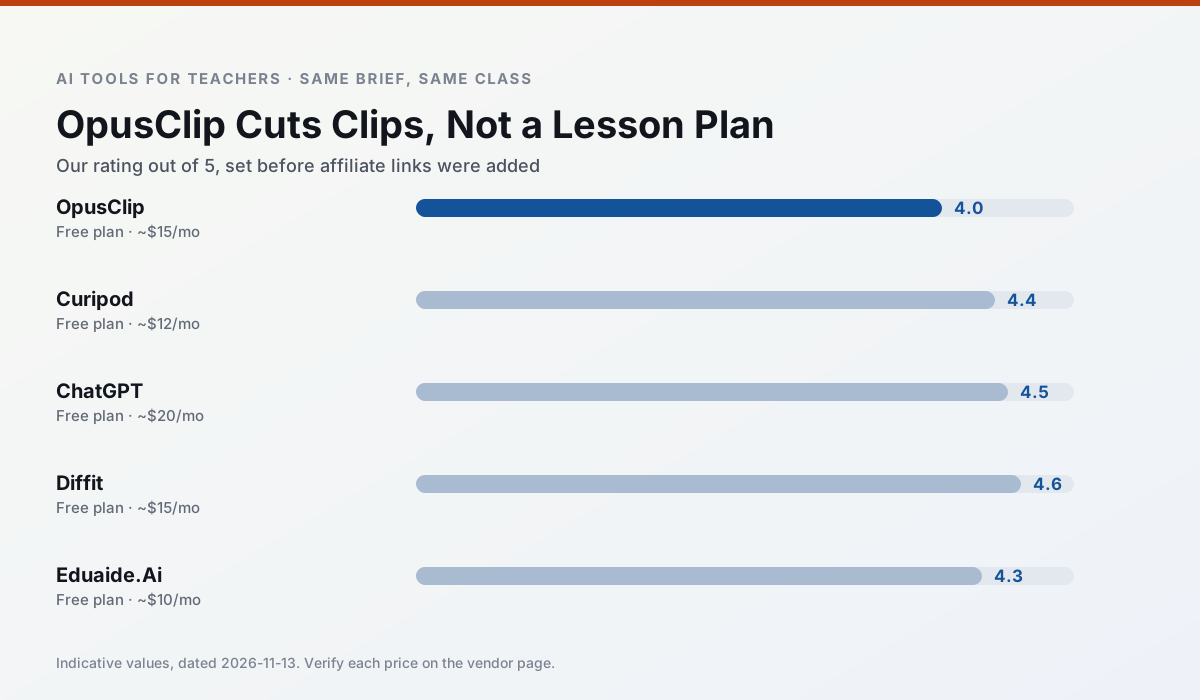
Side by side
Comparison table
Ratings reflect our timed classroom workflow, not vendor claims. Prices are indicative — verify on the vendor site.
| Tool | Best for | Free tier | Indicative paid plan | Standout feature | Our rating | Verdict | Try the tool |
|---|---|---|---|---|---|---|---|
| OpusClip | PD materials · flipped lessons | Yes — Limited monthly clips | ~$15 /user/mo | Auto captions | 4.0 / 5 | Situational | Try free |
| Curipod | formative assessment · exit tickets | Yes — Limited lessons per month | ~$12 /user/mo | Live polls and word clouds | 4.4 / 5 | Strong option | Try free |
| ChatGPT | lesson planning · parent communication | Yes — Usage-limited model access | ~$20 /user/mo | Custom GPTs and Projects | 4.5 / 5 | Top pick | Try free |
| Diffit | differentiated instruction · reading intervention | Yes — Limited generations per month | ~$15 /user/mo | Lexile-style leveling | 4.6 / 5 | Top pick | Try free |
| Eduaide.Ai | lesson planning · rubric creation | Yes — Daily generation cap | ~$10 /user/mo | Resource library | 4.3 / 5 | Strong option | Try free |
| Brisk Teaching | feedback on writing · grading | Yes — Limited actions per month | ~$10 /user/mo | Works inside Google Docs | 4.5 / 5 | Top pick | Try free |
Match your situation
Best for X
Different jobs need different tools. Here is what we would open first in each case.
OpusClip wins on the default path: fewer clicks to a usable draft, and the interface does not get in the way at 7:40am.
Curipod is the student-facing option here with boundaries a teacher can actually set and supervise.
ChatGPT has the strongest tone control for family emails and report comments, provided you still read the message aloud before sending.
Diffit produces levelled versions from one source in a single pass, which is the highest-value differentiation shortcut we tested at this level.
Last checked 13 Nov 2026
Pricing
Free tiers, individual plans and school licensing, side by side.
| Tool | Free plan | Individual / paid | School & district | Billing note | Verify |
|---|---|---|---|---|---|
| OpusClip | $0 — Limited monthly clips | ~$15 /user/mo | ~$29 /user/mo | Indicative — verify on vendor site | Vendor |
| Curipod | $0 — Limited lessons per month | ~$12 /user/mo | Custom quote | Indicative — verify on vendor site | Vendor |
| ChatGPT | $0 — Usage-limited model access | ~$20 /user/mo | ~$25+ /user/mo | Indicative — verify on vendor site | Vendor |
| Diffit | $0 — Limited generations per month | ~$15 /user/mo | Custom quote | Indicative — verify on vendor site | Vendor |
| Eduaide.Ai | $0 — Daily generation cap | ~$10 /user/mo | Custom quote | Indicative — verify on vendor site | Vendor |
| Brisk Teaching | $0 — Limited actions per month | ~$10 /user/mo | Custom quote | Indicative — verify on vendor site | Vendor |
Editorial rule: pricing is re-checked every 2–3 months and the top 50 pages are refreshed every 6 months. See our funding policy.
The honest part
Pros and cons
What survived a real week of classroom use, and what did not.
Pros
- Turns a recorded lesson into review clips
- Excellent captions
- Fast
Cons
- Optimised for social formats
- Not a lesson design tool
- Free plan is restrictive
Pros
- High student engagement out of the box
- Great for quick checks for understanding
- No student accounts required for basic use
Cons
- Focused on delivery, not planning
- Requires reliable classroom devices
- Free tier is restrictive
Pros
- Most flexible option available
- Huge community of teacher prompt libraries
- Strong multilingual support
Cons
- Requires prompt skills for consistent results
- No built-in standards alignment
- District privacy review usually required
Pros
- Excellent for mixed-ability classes
- Produces printable and digital versions
- Minimal setup
Cons
- Narrower scope than all-in-one suites
- Leveling is approximate, not a formal assessment
- Heavy use burns through the free quota
Pros
- Very low entry price
- Good worksheet and rubric output
- Clean, uncluttered UI
Cons
- Smaller template set than MagicSchool
- Less polished export options
- Limited integrations
In the classroom
Use cases
Five concrete workflows, with the tool we would open for each one.
Regrouping students after an assessment
Summarise anonymised results into skill groups, then generate one activity per group. Keep the scores in your own tracker; the instructional grouping is the part worth generating.
Recommended: OpusClipA weekly family newsletter from bullet notes
Newsletters fail on length, not tone. Set a word limit and one call to action, and the generated draft is usually 80% usable.
Recommended: CuripodA parent email in two languages
Draft in plain, warm language with no names, translate, then back-translate the important sentences to check meaning. Keep specific incidents out of the prompt and add them yourself.
Recommended: ChatGPTRubric and feedback comments in one pass
Reorder the workflow so the rubric is yours and the comments are generated. Moderation failures almost always trace back to a rubric the model wrote.
Recommended: DiffitThree reading levels from one source text
Paste a vetted text, ask for supported, core and extension versions, then check the vocabulary list by hand. Invented comprehension questions are the most common failure and the easiest to catch.
Recommended: Eduaide.Ai
Questions teachers ask us
FAQ
Direct answers, also published as FAQPage structured data for search and AI assistants.
Is OpusClip worth paying for at mixed-grade level?
What does OpusClip get wrong most often?
Can OpusClip replace a planning period?
Is OpusClip safe to use with student data?
Sources & further reading
Our recommendation
Try OpusClip free for your next lesson planning task
Repurpose long recordings into short, captioned clips. Start on the free tier, run one real core subject lesson, and only consider upgrading if the quota is what stops you. Disclosure: we may earn a commission (varies) at no extra cost to you.
Some links on this page are affiliate links. We may earn a commission at no extra cost to you. Our rankings are editorial and never pay-to-play. Never enter student PII into a free consumer account.
Keep reading
Related comparisons in this cluster.
Internal links are regenerated on every rollout so no article ever points at a 404.