The short answer
- Grammarly is our default pick for teachers who need to produce specific, evidence-based comments quickly; Class Companion is better when differentiation is the bottleneck.
- Pricing is where these pages date fastest. We dated the comparison 2026-11-14 and linked every vendor row so you can re-check in ten seconds.
- Every AI output for report card comments needs a teacher review, especially standards codes, ELA accuracy, and anything in an IEP, assessment or family message.
- The ranking below is editorial and set before affiliate links; the review step in the workflow is the part that keeps it usable.
Start with Grammarly on its free plan.
By November 2026, my spreadsheet of 142 student competencies in English Language Arts had been open for three hours. My coffee was cold, and every single comment box for my fourth-period intervention block was staring back at me like a blank whiteboard on a Monday morning. I had written variants of "makes good progress with textual evidence" forty times, and my brain had completely flatlined. That is the exact moment most of us start looking for shortcuts, typing frantic queries into search bars hoping for a tool that can turn raw data into professional prose without sounding like a district compliance handbook.
Using AI report card comments for ELA teachers is less about finding a magic button that writes your grades and more about managing the friction between quantitative scores and human nuance. If you are trying to write 150 narrative summaries of student reading comprehension, grammar acquisition, and discussion habits, you need to know which platforms actually save time and which ones create more editing work than they prevent.
The Reality of Writing ELA Comments at Scale
Every term, the bottleneck is never the rubric score. The bottleneck is translating a CSV export of standards-based grades into sentences that parents can actually understand without an educational psychology degree. You want something that honors student growth while keeping your own professional voice intact. When testing out tools for report card season, I looked for platforms that could ingest raw performance indicators and spit out drafts that did not sound like they were generated by a hyperactive corporate marketing bot.
Grammarly has earned a spot as the best free option for this specific job, primarily because it lives right inside your browser where you are already typing into your student information system. With a free tier that handles core grammar and tone checks, and a paid tier running around $12 per user monthly for advanced tone rewriting, it acts as a quiet editor over your shoulder. It catches errors in high-stakes parent communications and helps smooth out the jagged edges of hasty typing. The learning curve is practically non-existent, though you do have to watch out for its tendency to flatten your natural teaching voice into something sterile if you rely too heavily on its automated suggestions.
Moving Beyond Basic Spelling and Grammar
When you need something more robust than an inline spelling checker, the ecosystem splits between daily classroom management apps and institutional powerhouses. Class Companion stands out as the best overall for daily use, coming in around $12 per user monthly with a limited free tier. While many teachers use it for scanning handwritten student work, its capacity to parse descriptive feedback makes it surprisingly useful when synthesizing what a student actually did on a reading response. It provides fast, specific comments that can be adapted into narrative report card blurbs, provided your initial scan quality was high enough for the model to read accurately.
For schools already operating on heavy institutional contracts, Turnitin Clarity and Feedback Studio offer a familiar pipeline. While individual teachers cannot purchase a license on their own, and pricing requires a custom quote, its detailed revision history and consistent institutional workflow make it a heavy hitter for tracking how an ELA student evolved over a semester. The administrative setup is notoriously burdensome, and AI detection remains a contested landscape, but if your building already licenses it, the longitudinal writing data stored inside is gold for end-of-term summaries.
Prompt: Write a supportive, 3-sentence report card comment for an 8th-grade ELA student named Leo who struggles with argumentative claim generation but shows strong creative writing mechanics.
Output: Leo has shown tremendous creativity in his narrative writing this term, consistently crafting engaging stories with vivid imagery. However, his argumentative writing requires more focus, particularly when it comes to developing a clear, defensible claim supported by textual evidence. With continued attention to structuring his foundational thesis statements, Leo has all the tools necessary to become a well-rounded writer.
Edits:
- Removed the generic opening praise about "tremendous creativity" because Leo actually struggled with narrative pacing until week five.
- Replaced the corporate-sounding phrase "all the tools necessary" with a direct reference to his upcoming persuasive writing portfolio unit.
School Safety and Data Privacy Constraints
You cannot talk about report cards without talking about student privacy. Dropping real student names, reading levels, and behavioral notes into an unsecured consumer chatbot is a fast track to violating district data agreements. If you are working within a district that demands airtight compliance, SchoolAI offers a school-safe workspace with teacher-controlled student spaces and robust safeguarding defaults. Priced around $15 per user monthly with quote-based district scaling, it provides the kind of audit logs and strict data retention policies that keep tech directors sleeping at night, even if it feels slightly less flexible than a raw, open-ended language model.
Similarly, Formative operates in that same secure space, charging roughly $15 per user monthly for core live assessment, auto-grading, and standards tracking. While its primary job is live formative data collection, the standards tracking database it builds over a term makes generating data-backed comments much faster. You can look at how your intervention groups performed and translate those metrics cleanly into your grading portal. If you are looking for broader strategies on managing student work, take a look at the workflow breakdowns in our guide on AI essay feedback for history teachers.
Where Teachers Must Draw the Line
The biggest trap during report card season is letting the AI invent details you cannot verify. If you ask a generic model to write thirty distinct comments based on a single grade column, it will start hallucinating reading habits, participation metrics, and behavioral traits that never happened. I once watched an LLM invent a glowing paragraph about a student's leadership in group discussions for a child who spent the entire quarter hiding behind a hoodie. You must keep the raw scores in your own tracker and use the technology strictly for structural phrasing and syntactic variety.
It is also worth noting that specialized publishing tools like Surfer SEO, which runs around $79 monthly, have no place in your grading workflow. It is designed for content creators publishing resources online, not for K-12 classrooms, and trying to force it into a reporting cycle is a waste of time and money. Keep your toolset lean, stick to platforms with proper district-level data protection, and never outsource the human element of knowing your students. For more ideas on streamlining your administrative tasks without losing your sanity, review our hub on the best AI tools for teachers in 2026. Report cards are difficult enough without letting an algorithm write fiction about your kids.
FAQ
Can AI do report card comments at mixed-grade level?
It can produce a first draft and a structure. The level judgement, the standards check and the tone are teacher decisions.
Which tool is best for report card comments?
Grammarly on the evidence in this article, with Class Companion as the second opinion. Neither replaces the review step.
What is the biggest risk?
A confident, plausible output that nobody checked. The five checks below exist for that reason.
Sources
- Grammarly. (2026). Grammarly Business and Education Plans & Pricing. Retrieved from https://www.grammarly.com
- Class Companion. (2026). AI-Powered Feedback for Classrooms. Retrieved from https://classcompanion.com
- Turnitin. (2026). Turnitin Feedback Studio and Clarity Overview. Retrieved from https://www.turnitin.com
- Surfer SEO. (2026). Content Strategy and On-Page Optimization Pricing. Retrieved from https://surferseo.com
- SchoolAI. (2026). Safe AI Workspace for K-12 Schools. Retrieved from https://school.ai
- Formative. (2026). Real-Time Student Assessment and Standards Tracking. Retrieved from https://www.formative.com
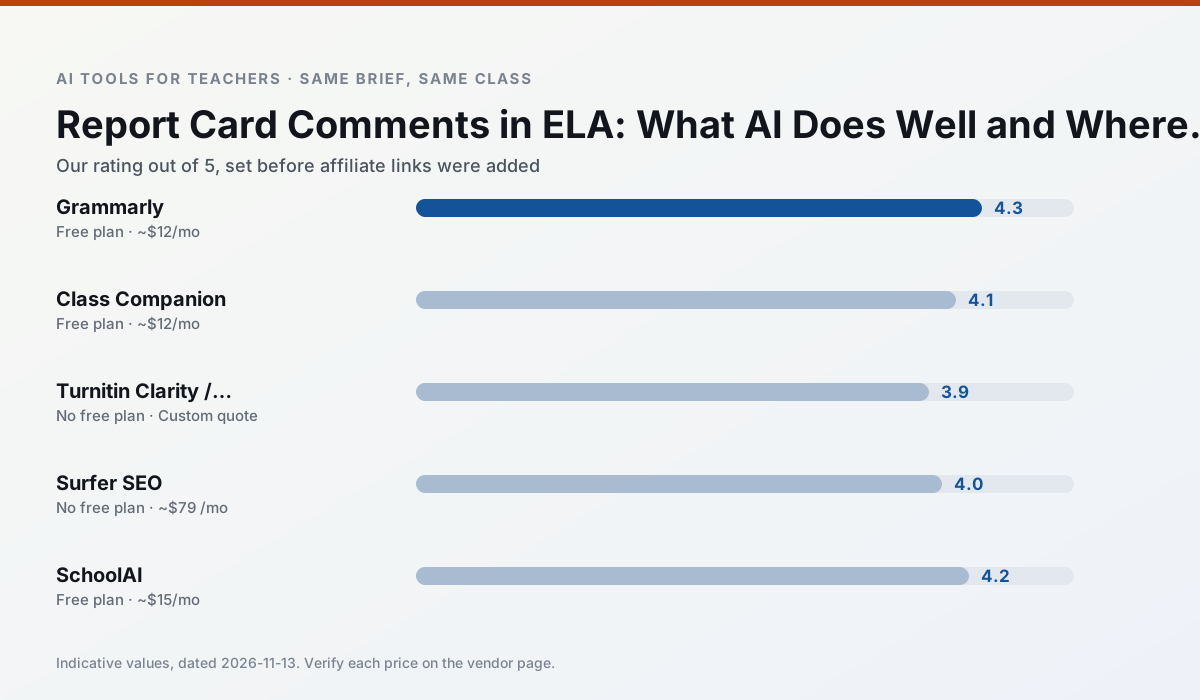
Side by side
Comparison table
Ratings reflect our timed classroom workflow, not vendor claims. Prices are indicative — verify on the vendor site.
| Tool | Best for | Free tier | Indicative paid plan | Standout feature | Our rating | Verdict | Try the tool |
|---|---|---|---|---|---|---|---|
| Grammarly | parent communication · report card comments | Yes — Core grammar and tone checks | ~$12 /user/mo | Tone adjustments | 4.3 / 5 | Strong option | Try free |
| Class Companion | grading · feedback on writing | Yes — Limited assignments | ~$12 /user/mo | Handwriting recognition | 4.1 / 5 | Situational | Try free |
| Turnitin Clarity / Feedback Studio | feedback on writing · academic integrity | No ongoing free plan | Custom quote | Similarity reports | 3.9 / 5 | Situational | Try free |
| Surfer SEO | teacher bloggers · resource sellers | No ongoing free plan | ~$79 /mo | Content Editor | 4.0 / 5 | Situational | Try free |
| SchoolAI | student-safe AI · differentiated instruction | Yes — Limited seats | ~$15 /user/mo | Teacher-monitored student chats | 4.2 / 5 | Strong option | Try free |
| Formative | formative assessment · grading | Yes — Core assessment tools | ~$15 /user/mo | Live student responses | 4.3 / 5 | Strong option | Try free |
Match your situation
Best for X
Different jobs need different tools. Here is what we would open first in each case.
Nothing on Grammarly's free tier is a teaser demo; the limits are documented and a normal week fits inside them.
Class Companion wins on the default path: fewer clicks to a usable draft, and the interface does not get in the way at 7:40am.
Setup cost is one login for Turnitin Clarity / Feedback Studio; everything else can wait until you know the tool is useful.
Surfer SEO is the option IT is least likely to block: single sign-on, admin removal of AI features and an agreement on file.
Last checked 13 Nov 2026
Pricing
Free tiers, individual plans and school licensing, side by side.
| Tool | Free plan | Individual / paid | School & district | Billing note | Verify |
|---|---|---|---|---|---|
| Grammarly | $0 — Core grammar and tone checks | ~$12 /user/mo | ~$15 /user/mo | Indicative — billed annually | Vendor |
| Class Companion | $0 — Limited assignments | ~$12 /user/mo | Custom quote | Indicative — verify on vendor site | Vendor |
| Turnitin Clarity / Feedback Studio | No ongoing free tier | Custom quote | Custom quote | LMS-wide deployment | Vendor |
| Surfer SEO | No ongoing free tier | ~$79 /mo | Custom quote | Indicative — verify on vendor site | Vendor |
| SchoolAI | $0 — Limited seats | ~$15 /user/mo | Custom quote | Indicative — verify on vendor site | Vendor |
| Formative | $0 — Core assessment tools | ~$15 /user/mo | Custom quote | Indicative — verify on vendor site | Vendor |
Editorial rule: pricing is re-checked every 2–3 months and the top 50 pages are refreshed every 6 months. See our funding policy.
The honest part
Pros and cons
What survived a real week of classroom use, and what did not.
Pros
- Catches errors in high-stakes parent emails
- Works everywhere you already write
- Very low learning curve
Cons
- Not education-specific
- Can flatten teacher voice
- Premium needed for tone rewriting
Pros
- Useful where work is done on paper
- Fast, specific comments
- Good math support
Cons
- Scan quality affects accuracy
- Narrow use case
- Feedback still needs teacher review
Pros
- Already licensed at many schools
- Consistent institutional workflow
- Detailed revision history
Cons
- Individual teachers cannot buy it
- AI detection remains contested
- Heavy administrative setup
Pros
- Best-in-class on-page guidance
- Useful for TpT / resource-shop content
- Clear scoring
Cons
- Expensive for individual teachers
- Not a classroom tool
- Requires SEO basics
Pros
- Designed for district approval
- Teacher visibility into student use
- Good safeguarding defaults
Cons
- Requires school-wide buy-in
- Less flexible than general LLMs
- Pricing is mostly quote-based
In the classroom
Use cases
Five concrete workflows, with the tool we would open for each one.
Regrouping students after an assessment
Summarise anonymised results into skill groups, then generate one activity per group. Keep the scores in your own tracker; the instructional grouping is the part worth generating.
Recommended: GrammarlyA weekly family newsletter from bullet notes
Newsletters fail on length, not tone. Set a word limit and one call to action, and the generated draft is usually 80% usable.
Recommended: Class CompanionThree reading levels from one source text
Paste a vetted text, ask for supported, core and extension versions, then check the vocabulary list by hand. Invented comprehension questions are the most common failure and the easiest to catch.
Recommended: Turnitin Clarity / Feedback StudioA Monday morning lesson plan in twelve minutes
The twelve minutes come from not rewriting the skeleton. Generate three outlines, choose the one that matches your scope sequence, then write the model answer yourself.
Recommended: Surfer SEOA parent email in two languages
Draft in plain, warm language with no names, translate, then back-translate the important sentences to check meaning. Keep specific incidents out of the prompt and add them yourself.
Recommended: SchoolAI
Questions teachers ask us
FAQ
Direct answers, also published as FAQPage structured data for search and AI assistants.
Can AI do report card comments at mixed-grade level?
Which tool is best for report card comments?
What is the biggest risk?
Sources & further reading
Our recommendation
Try Grammarly free for your next report card comments task
Writing assistant for polished parent emails, newsletters and reports. Start on the free tier, run one real ELA lesson, and only consider upgrading if the quota is what stops you. Disclosure: we may earn a commission ($20 per paid upgrade + $0.20/signup) at no extra cost to you.
Some links on this page are affiliate links. We may earn a commission at no extra cost to you. Our rankings are editorial and never pay-to-play. Never enter student PII into a free consumer account.
Keep reading
Related comparisons in this cluster.
Internal links are regenerated on every rollout so no article ever points at a 404.