The short answer
- QuestionWell is our default pick for teachers who need to draft a standards-aware lesson plan quickly; Kahoot! is better when differentiation is the bottleneck.
- QuestionWell handles the broad case; Kahoot! handles the narrow one. Anything beyond that pair should be justified by a recurring weekly job, not a feature demo.
- Every AI output for Essay feedback needs a teacher review, especially standards codes, history accuracy, and anything in an IEP, assessment or family message.
- Trial one tool for a week of real Essay feedback work before any purchase conversation; the quota is the honest test.
Start with Originality.ai on its free plan.
Seventy-two essays sit in a stack by your coffee mug, and it is Sunday night at nine. You are staring at the third paragraph of Kevin’s paper on the New Deal, where he has somehow conflated the Works Progress Administration with the Supreme Court packing scheme. Your margin comment is the same one you wrote on Sarah's paper ten minutes ago: "Need a clear historical claim here, not just a summary of the event." This is the reality of teaching history. We spend hours circling missing thesis statements and fixing chronological slips, leaving precious little energy for actual instruction. If you are exploring options for AI essay feedback for history teachers, you already know the grading cycle is broken.
Using generative models for student writing requires drawing a hard line between mechanics and thinking. History essays are not like five-paragraph essays in English class. They demand source integration, contextualization, and argumentation based on incomplete evidence. When we use AI to help shoulder this load, we have to protect the student voice while saving our weekends. Let us look at what works, what fails, and how different tools handle the burden of historical prose.
The Limits of Generic Feedback in History
General-purpose assistants like ChatGPT (~$20 /user/mo indicative) are the most flexible option available for drafting comments, but they require strict guardrails. If you feed an unprompted model a student history essay, it tends to offer vague praise or rewrite the student's voice entirely. You end up with prose that sounds like an encyclopedia rather than an adolescent learning to argue.
The trick is treating the model as a rubric-checking assistant rather than a copyeditor. When we look at student-safe deployments, consumer plans demand caution with PII, so you must strip names and identifying details before pasting text. ChatGPT shines when you feed it your exact grading rubric and ask it to flag missing source attribution. It will not write a better paper for the student, but it can highlight where the argument drifts from the primary documents.
Prompt: Act as a high school AP US History reader. Using the attached rubric for a DBQ paragraph, check Student A's text for a clear thesis, use of at least two documents, and historical context. Do not rewrite the text. List one strength and two specific gaps in evidence.
First output: The model provided a generic summary of the paragraph and suggested replacing the entire opening sentence with a more academic phrasing that completely erased the student's tone.
Edits made: Added a strict negative constraint ("Do not suggest alternative phrasing or rewrite sentences") and explicitly told it to reference line numbers from the pasted text.
Usable result: A clean, bulleted list pointing out that Document 2 was cited without being contextualized, which saved three minutes of scrolling per paper.
Scaffolded Writing and Mixed-Ability Classes
History classrooms are notoriously mixed-ability spaces. Some students struggle with the basic mechanics of writing, while others grasp the writing but flounder with chronological reasoning. This is where specialized platforms earn their keep.
QuestionWell (~$10 /user/mo indicative) is best for mixed-ability classes because it builds standards-aligned question banks from source text. When you are preparing students to write about a complex historical document, you cannot just hand them a blank page. You need targeted scaffolding questions that bridge the gap between comprehension and argumentation. QuestionWell saves time on question writing with a clean export workflow and good objective tagging. You can generate tiered questions based on the source text, helping lower-ability readers unpack the document before they ever touch an essay prompt.
Another option for resource generation is Eduaide.Ai (~$10 /user/mo indicative), which offers a low entry price and a clean, uncluttered UI. It is useful for generating rubrics and graphic organizers that help students structure their historical arguments. While it has a smaller template set than some competitors, its worksheet and rubric output gives you a solid foundation for pre-writing activities without requiring endless formatting.
Engagement and Quick Checks Before the Draft
Writing history essays often feels like a solitary, punitive task for students. Breaking up the monotony of drafting requires low-stakes formative checks. Curipod (~$12 /user/mo indicative) is our best overall pick for daily use, turning a history topic into an interactive, student-response lesson in minutes. It is brilliant for quick checks for understanding when you want to test whether the class understands a concept like mercantilism before they try to argue it in an essay. It requires no student accounts for basic use, which cuts out IT headaches, though the free tier is restrictive.
For review lessons and vocabulary retention, Kahoot! (~$10 /user/mo indicative) remains a classroom staple. While its time pressure suits recall more than deep historical reasoning, it provides instant engagement with very low training time. Teachers sometimes use Kahoot! for parent-facing writing nights or quick vocabulary refreshes before an essay unit. Just remember to use nicknames rather than real names for younger students to maintain basic privacy standards.
The Trap of Automated Plagiarism and AI Detection
When discussing AI essay feedback, we have to talk about detection tools. Originality.ai (~$12 /user/mo indicative) is designed for publisher and admin workflows rather than daily classroom use. It offers fast bulk scanning and a transparent credit model for checking content authenticity.
However, AI detection produces false positives with alarming regularity, especially for English language learners and students who write with formulaic structures. You should never use a detector score as the sole evidence of academic misconduct. If an automated tool flags a student's history paper, treat it merely as an invitation to have a conversation with the writer. Ask them to walk you through their research notes and explain how they found their sources. Authentic student voice usually emerges immediately when they talk about their work face-to-face.
What Went Wrong in Real Use
Two common failures trip up history teachers when they first bring these tools into the grading workflow.
First, a teacher pasted an entire class set of twenty-five essays into a consumer-tier AI workspace in one massive prompt. The model choked, hallucinated feedback for students who did not exist, and mixed up the scores. The fix was switching to a one-at-a-time workflow with strict prompt constraints, treating the AI as a desk-side assistant rather than an automated grading conveyor belt.
Second, a teacher relied entirely on an AI-generated rubric output for a document-based essay without checking the historical dates. The generated rubric penalized students for failing to reference a piece of legislation that was passed a decade after the essay's focal era. The fix was treating every AI output as a rough first draft that requires a human historical eye before it ever touches a student's desk. For more ideas on managing writing tasks, see our guide on AI feedback on writing for ESL teachers. AI can help you clear the administrative deck, but the historical truth remains your responsibility.
FAQ
Can AI do Essay feedback at mixed-grade level?
It can produce a first draft and a structure. The level judgement, the standards check and the tone are teacher decisions.
Which tool is best for Essay feedback?
QuestionWell on the evidence in this article, with Kahoot! as the second opinion. Neither replaces the review step.
What is the biggest risk?
A confident, plausible output that nobody checked. The five checks below exist for that reason.
Sources
- QuestionWell vendor pricing and feature set (questionwell.ai)
- Kahoot! product tiers and privacy documentation (kahoot.com)
- OpenAI ChatGPT business and consumer tier specifications (openai.com)
- Curipod lesson delivery and interactive features (curipod.com)
- Originality.ai scanning protocols and credit system (originality.ai)
- Eduaide.Ai resource library and generation limits (eduaide.ai)
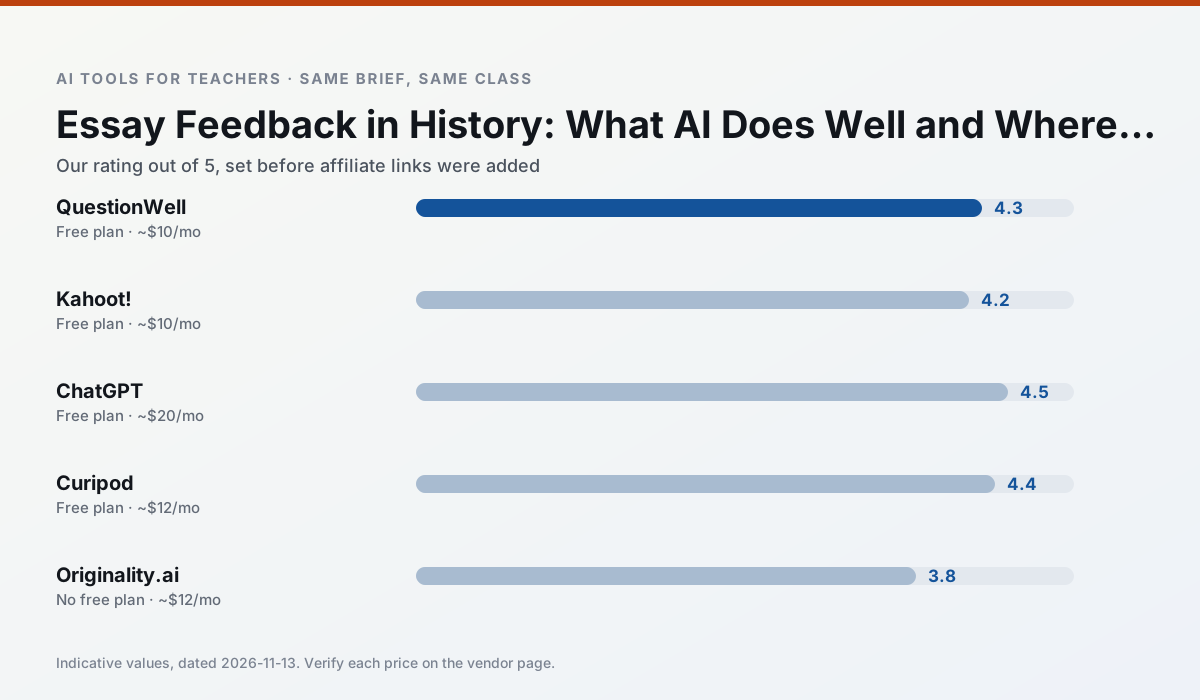
Side by side
Comparison table
Ratings reflect our timed classroom workflow, not vendor claims. Prices are indicative — verify on the vendor site.
| Tool | Best for | Free tier | Indicative paid plan | Standout feature | Our rating | Verdict | Try the tool |
|---|---|---|---|---|---|---|---|
| QuestionWell | quiz generation · assessment | Yes — Monthly generation limit | ~$10 /user/mo | Exports to Google Forms / LMS | 4.3 / 5 | Strong option | Try free |
| Kahoot! | quiz generation · review lessons | Yes — Limited player count | ~$10 /user/mo | AI question builder | 4.2 / 5 | Strong option | Try free |
| ChatGPT | lesson planning · parent communication | Yes — Usage-limited model access | ~$20 /user/mo | Custom GPTs and Projects | 4.5 / 5 | Top pick | Try free |
| Curipod | formative assessment · exit tickets | Yes — Limited lessons per month | ~$12 /user/mo | Live polls and word clouds | 4.4 / 5 | Strong option | Try free |
| Originality.ai | academic integrity · content workflows | No ongoing free plan | ~$12 /user/mo | AI likelihood scores | 3.8 / 5 | Situational | Try free |
| Eduaide.Ai | lesson planning · rubric creation | Yes — Daily generation cap | ~$10 /user/mo | Resource library | 4.3 / 5 | Strong option | Try free |
Match your situation
Best for X
Different jobs need different tools. Here is what we would open first in each case.
QuestionWell keeps the same task across levels, which is what makes a differentiated set defensible in moderation.
Kahoot! is the steadiest of this set at plain, respectful language; names and specific incidents still belong in your draft, not the prompt.
ChatGPT is built around teacher-monitored student spaces and audit logs rather than a consumer chat account, which is a different approval conversation.
On the daily cycle, Curipod saves the most edit time per task; the paid tier mostly buys more runs rather than better ones.
Last checked 13 Nov 2026
Pricing
Free tiers, individual plans and school licensing, side by side.
| Tool | Free plan | Individual / paid | School & district | Billing note | Verify |
|---|---|---|---|---|---|
| QuestionWell | $0 — Monthly generation limit | ~$10 /user/mo | Custom quote | Indicative — verify on vendor site | Vendor |
| Kahoot! | $0 — Limited player count | ~$10 /user/mo | Custom quote | Indicative — verify on vendor site | Vendor |
| ChatGPT | $0 — Usage-limited model access | ~$20 /user/mo | ~$25+ /user/mo | Indicative — verify on vendor site | Vendor |
| Curipod | $0 — Limited lessons per month | ~$12 /user/mo | Custom quote | Indicative — verify on vendor site | Vendor |
| Originality.ai | No ongoing free tier | ~$12 /user/mo | Custom quote | Indicative — verify on vendor site | Vendor |
| Eduaide.Ai | $0 — Daily generation cap | ~$10 /user/mo | Custom quote | Indicative — verify on vendor site | Vendor |
Editorial rule: pricing is re-checked every 2–3 months and the top 50 pages are refreshed every 6 months. See our funding policy.
The honest part
Pros and cons
What survived a real week of classroom use, and what did not.
Pros
- Saves the most time on question writing
- Clean export workflow
- Good objective tagging
Cons
- Single-purpose tool
- Question quality varies by source text
- Limited student-facing features
Pros
- Instant engagement
- Very low training time
- Strong brand familiarity
Cons
- Less depth for higher-order assessment
- Paid tiers needed for larger classes
- Time pressure suits recall more than reasoning
Pros
- Most flexible option available
- Huge community of teacher prompt libraries
- Strong multilingual support
Cons
- Requires prompt skills for consistent results
- No built-in standards alignment
- District privacy review usually required
Pros
- High student engagement out of the box
- Great for quick checks for understanding
- No student accounts required for basic use
Cons
- Focused on delivery, not planning
- Requires reliable classroom devices
- Free tier is restrictive
Pros
- Useful for content publishing QA
- Fast bulk scanning
- Transparent credit model
Cons
- AI detection produces false positives
- Should never be sole evidence of misconduct
- Not a teaching tool
In the classroom
Use cases
Five concrete workflows, with the tool we would open for each one.
A weekly family newsletter from bullet notes
Newsletters fail on length, not tone. Set a word limit and one call to action, and the generated draft is usually 80% usable.
Recommended: QuestionWellRegrouping students after an assessment
Summarise anonymised results into skill groups, then generate one activity per group. Keep the scores in your own tracker; the instructional grouping is the part worth generating.
Recommended: Kahoot!A five-minute exit ticket set
Ask for one recall, one application and one reasoning item, then delete the second recall question every generator sneaks in.
Recommended: ChatGPTAn IEP present-levels first draft
Use aggregated, anonymised data only. Ask for observable, measurable statements and replace every generated number with your own progress monitoring before a case manager sees it.
Recommended: CuripodA substitute folder that needs no context
The value here is structure, not creativity. Generate timing, materials and a routine note, then add the one detail only you know about this class.
Recommended: Originality.ai
Questions teachers ask us
FAQ
Direct answers, also published as FAQPage structured data for search and AI assistants.
Can AI do Essay feedback at mixed-grade level?
Which tool is best for Essay feedback?
What is the biggest risk?
Sources & further reading
Our recommendation
Try Originality.ai free for your next Essay feedback task
AI-detection and plagiarism scanning for publisher and admin workflows. Start on the free tier, run one real history lesson, and only consider upgrading if the quota is what stops you. Disclosure: we may earn a commission (25% recurring) at no extra cost to you.
Some links on this page are affiliate links. We may earn a commission at no extra cost to you. Our rankings are editorial and never pay-to-play. Never enter student PII into a free consumer account.
Keep reading
Related comparisons in this cluster.
Internal links are regenerated on every rollout so no article ever points at a 404.