The short answer
- Brisk Teaching is our default pick for teachers who need to shorten the marking cycle quickly; Formative is better when differentiation is the bottleneck.
- Start with Brisk Teaching on its free plan, keep Formative as the second opinion, and do not open a card until the quota, not the feature list, is what stops you.
- Every AI output for grading needs a teacher review, especially standards codes, Electives accuracy, and anything in an IEP, assessment or family message.
- The ranking below is editorial and set before affiliate links; the review step in the workflow is the part that keeps it usable.
Start with ElevenLabs on its free plan.
By the time I lugged thirty stacks of ceramic pinch pots and sketchbook journals to my desk last Tuesday, my lower back was throbbing. Elective grading is a strange beast. We do not grade by filling in bubble sheets or running essays through a standard five-paragraph rubric. We evaluate spatial reasoning, digital media compositions, and rough draft iterations that live across multiple messy mediums. When you teach art, music, or computer science, your planning period vanishes under a pile of physical artifacts and digital project folders. This is why teachers started looking into AI grading for electives teachers. We are drowning in subjective work that requires objective justification for final report cards.
Managing the paper trail in an elective classroom used to mean spending my entire Sunday evening squinting at handwritten design briefs. Now, I use a mix of specific platforms to claw back my weekends. The key is knowing which tools handle the heavy lifting and which ones require an eagle eye before scores get locked into the gradebook. If you are trying to map out your tech stack for the term, our overarching guide on the best AI tools for teachers 2026 offers a broad view, but elective grading demands subject-specific solutions.
The Reality of Subjective Scoring and AI
Let us be honest about what AI grading actually does in a room where students build things rather than write term papers. It does not replace the human judgment required to evaluate a sculpture or a musical arrangement. What it can do is ingest your criteria and give you a solid baseline of feedback before you apply your own professional lens. For paper-heavy performance tasks, Gradescope shines as best for mixed-ability classes because its AI-assisted rubric grouping lets me grade similar student answers in batches. I do not have to hunt for the rubric page on thirty different design portfolios. It reads the scanned work and groups like-minded responses together, saving my sanity when midterms roll around.
Of course, setting up these systems takes upfront labor. If you try to use Class Companion for quick checks on student workflow, you will find it offers the best for quick setup among scanned work platforms, but the scan quality dictates everything. If a student photographs their storyboard in dim lighting, the tool stumbles. You still have to spend time teaching kids how to scan their work properly. The feedback it generates is fast and specific, which helps kids fix minor composition errors before submission, but it never replaces my final sign-off.
Streamlining Feedback Inside Native Documents
Many elective teachers make the mistake of jumping between five different browser tabs just to leave comments on digital art critiques or coding projects. Brisk Teaching changes that workflow by operating directly inside Docs, Slides, and web articles as a browser extension. It stands out as best for student-safe deployments because it keeps the feedback loop inside the documents our districts already manage. I can highlight a student's digital media reflection and request inline feedback without copying text into an external chatbot window.
Prompt: "Review this high school digital design paragraph for clarity and technical vocabulary. Point out where the student confuses vector and raster graphics, and suggest one improvement in a warm, encouraging tone."
First output: The AI generated a lengthy paragraph praising the student's color choices, then dropped a dense textbook definition of vector scaling, finishing with a slightly robotic suggestion to use better terminology.
Two edits made:
- Trimmed the introductory praise to one sentence so the actual correction stood out.
- Rewrote the technical explanation to match the specific vocabulary we practiced during Tuesday's lab.
The free tier of Brisk gives you a limited number of actions per month, which forces you to use it strategically rather than relying on it for every single exit ticket. If you want full access, the paid tier runs around $10 per user per month as an indicative price. Remember that because the extension reads document content directly, your district IT department will need to review the permissions and data privacy agreement before you deploy it with student accounts.
Formative Assessment Without the Busywork
When I need to check if my tech-ed students actually grasped the safety protocols before they touch the band saws, I rely on live tracking rather than post-mortem grading. Formative acts as the best for parent-facing writing because its auto-grading and standards tracking generate clean progress reports that parents can actually understand without a decoder ring. It works smoothly with existing PDFs and Google Docs, meaning I do not have to rebuild my safety quizzes from scratch.
When you are designing these checkpoints, a five-minute exit ticket set works best when you ask for one recall item, one application item, and one reasoning item. The trick is that you must delete the second recall question every generator inevitably sneaks in. If you want to explore more strategies for short knowledge checks, our guide on AI exit tickets for ELA teachers offers adaptable ideas that work across different subject areas just as well. Formative runs on a free tier for core tools, while the paid version sits around $15 per user per month as an indicative price. The setup is heavier than a quick gamified quiz app, but the resulting data for intervention groups makes the initial friction worth it.
When to Draw the Hard Line
We need to talk about where AI has no business showing up in an elective classroom. Never feed identifiable student data into a free external model to draft IEP present-levels or disciplinary emails. If you are using tools like ElevenLabs, which provides natural voiceovers for learning materials at around $5 per user per month, or Colossyan, which turns text scripts into explainer videos for roughly $27 per user per month, you have to be vigilant about consent. Never clone a student's or colleague's voice without written permission, and keep student names completely out of cloud-based video generators.
AI grading in electives should save your energy for the human moments: the kid who finally figures out how to center a pot on the wheel, or the student who discovers a passion for audio engineering. Let the algorithms handle the bulk sorting and the first draft of rubrics, but keep your own hands on the final grade.
FAQ
Can AI do grading at mixed-grade level?
It can produce a first draft and a structure. The level judgement, the standards check and the tone are teacher decisions.
Which tool is best for grading?
Brisk Teaching on the evidence in this article, with Formative as the second opinion. Neither replaces the review step.
What is the biggest risk?
A confident, plausible output that nobody checked. The five checks below exist for that reason.
Sources
- Brisk Teaching Vendor Overview & Pricing. https://briskteaching.com
- Formative Assessment Platform Documentation. https://www.smartforms.com
- Gradescope AI-Assisted Rubric Grading Specifications. https://www.gradescope.com
- Class Companion Product Features and Data Privacy. https://classcompanion.com
- ElevenLabs Text-to-Speech Specifications. https://elevenlabs.io
- Colossyan Video Generation and Compliance Guidelines. https://www.colossyan.com
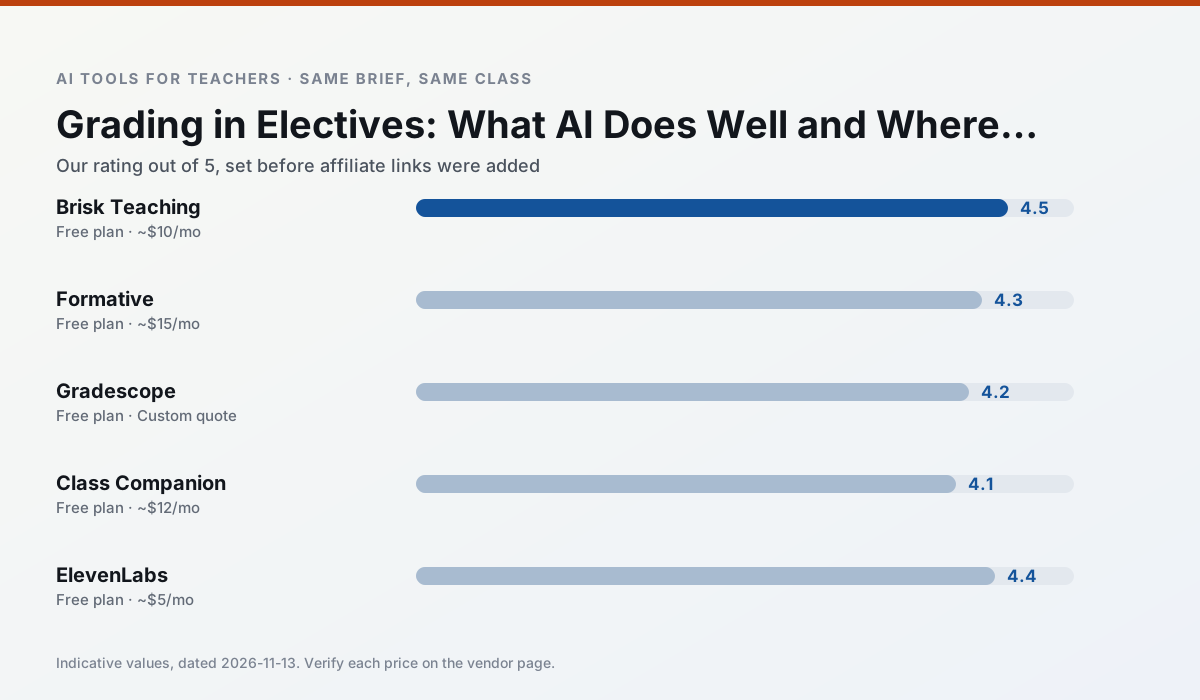
Side by side
Comparison table
Ratings reflect our timed classroom workflow, not vendor claims. Prices are indicative — verify on the vendor site.
| Tool | Best for | Free tier | Indicative paid plan | Standout feature | Our rating | Verdict | Try the tool |
|---|---|---|---|---|---|---|---|
| Brisk Teaching | feedback on writing · grading | Yes — Limited actions per month | ~$10 /user/mo | Works inside Google Docs | 4.5 / 5 | Top pick | Try free |
| Formative | formative assessment · grading | Yes — Core assessment tools | ~$15 /user/mo | Live student responses | 4.3 / 5 | Strong option | Try free |
| Gradescope | grading · rubric creation | Yes — Limited courses | Custom quote | Bubble sheet and handwriting capture | 4.2 / 5 | Strong option | Try free |
| Class Companion | grading · feedback on writing | Yes — Limited assignments | ~$12 /user/mo | Handwriting recognition | 4.1 / 5 | Situational | Try free |
| ElevenLabs | accessibility · reading intervention | Yes — Monthly character quota | ~$5 /user/mo | Very natural voices | 4.4 / 5 | Strong option | Try free |
| Colossyan | PD materials · video lessons | No ongoing free plan | ~$27 /user/mo | PDF/PPT-to-video | 4.1 / 5 | Situational | Try free |
Match your situation
Best for X
Different jobs need different tools. Here is what we would open first in each case.
For anything students touch directly, Brisk Teaching offers the supervision controls and logging that IT will ask about first.
Formative has the strongest tone control for family emails and report comments, provided you still read the message aloud before sending.
For three reading groups and one text, Gradescope needs the least manual relabelling of vocabulary and questions.
Class Companion has the shortest path from opening a tab to a usable draft, which matters more than the feature count on a Monday.
Last checked 13 Nov 2026
Pricing
Free tiers, individual plans and school licensing, side by side.
| Tool | Free plan | Individual / paid | School & district | Billing note | Verify |
|---|---|---|---|---|---|
| Brisk Teaching | $0 — Limited actions per month | ~$10 /user/mo | Custom quote | Indicative — verify on vendor site | Vendor |
| Formative | $0 — Core assessment tools | ~$15 /user/mo | Custom quote | Indicative — verify on vendor site | Vendor |
| Gradescope | $0 — Limited courses | Custom quote | Custom quote | LMS integration and support | Vendor |
| Class Companion | $0 — Limited assignments | ~$12 /user/mo | Custom quote | Indicative — verify on vendor site | Vendor |
| ElevenLabs | $0 — Monthly character quota | ~$5 /user/mo | ~$22 /user/mo | Indicative — verify on vendor site | Vendor |
| Colossyan | No ongoing free tier | ~$27 /user/mo | Custom quote | Indicative — verify on vendor site | Vendor |
Editorial rule: pricing is re-checked every 2–3 months and the top 50 pages are refreshed every 6 months. See our funding policy.
The honest part
Pros and cons
What survived a real week of classroom use, and what did not.
Pros
- No copy-paste between tools
- Fast inline feedback on student drafts
- Gentle learning curve
Cons
- Chrome-first workflow
- Extension permissions need IT approval
- Free quota is tight
Pros
- Strong data for intervention groups
- Works with existing PDFs and Docs
- Good LMS integrations
Cons
- Steeper setup than quiz games
- Best value requires school-wide rollout
- Price adds up per teacher
Pros
- Large time savings on paper assessments
- Consistent rubric application
- Detailed item analytics
Cons
- Overkill for elementary classrooms
- Institutional pricing is opaque
- Setup effort is real
Pros
- Useful where work is done on paper
- Fast, specific comments
- Good math support
Cons
- Scan quality affects accuracy
- Narrow use case
- Feedback still needs teacher review
Pros
- Excellent for accessible audio versions
- Low entry price
- Fast generation
Cons
- Quota-based billing
- Voice cloning consent considerations
- Not a teaching platform
In the classroom
Use cases
Five concrete workflows, with the tool we would open for each one.
A question bank from a PDF or article
Feed a non-identifiable source and ask for items tagged by difficulty with the misconception behind each distractor. Spot-check every answer key; numerical items are least reliable.
Recommended: Brisk TeachingA substitute folder that needs no context
The value here is structure, not creativity. Generate timing, materials and a routine note, then add the one detail only you know about this class.
Recommended: FormativeAn IEP present-levels first draft
Use aggregated, anonymised data only. Ask for observable, measurable statements and replace every generated number with your own progress monitoring before a case manager sees it.
Recommended: GradescopeA five-minute exit ticket set
Ask for one recall, one application and one reasoning item, then delete the second recall question every generator sneaks in.
Recommended: Class CompanionA parent email in two languages
Draft in plain, warm language with no names, translate, then back-translate the important sentences to check meaning. Keep specific incidents out of the prompt and add them yourself.
Recommended: ElevenLabs
Questions teachers ask us
FAQ
Direct answers, also published as FAQPage structured data for search and AI assistants.
Can AI do grading at mixed-grade level?
Which tool is best for grading?
What is the biggest risk?
Sources & further reading
Our recommendation
Try ElevenLabs free for your next grading task
Natural-sounding AI voiceover and text-to-speech for learning materials. Start on the free tier, run one real Electives lesson, and only consider upgrading if the quota is what stops you. Disclosure: we may earn a commission (22% recurring) at no extra cost to you.
Some links on this page are affiliate links. We may earn a commission at no extra cost to you. Our rankings are editorial and never pay-to-play. Never enter student PII into a free consumer account.
Keep reading
Related comparisons in this cluster.
Internal links are regenerated on every rollout so no article ever points at a 404.