The short answer
- Khanmigo is our default pick for teachers who need to produce reusable item banks quickly; Claude is better when differentiation is the bottleneck.
- The cheapest honest test is a week of real work on the free plans: Khanmigo: Yes — US teacher accounts, subject to eligibility; Claude: Yes — Usage-limited; Quizizz: Yes — Core quiz creation. If a tool is still open on Friday, it has earned a paid conversation.
- Every AI output for question banks needs a teacher review, especially standards codes, Librarians accuracy, and anything in an IEP, assessment or family message.
- Trial one tool for a week of real question banks work before any purchase conversation; the quota is the honest test.
Start with MagicSchool AI on its free plan.
It is 8:14 on a Tuesday morning, and the seventh-grade history cohort is due in the library in twenty minutes for a research session on primary sources. You have five different topics, a broken scanner at the circulation desk, and zero pre-made search strategy questions that match the reading levels of the kids who actually walked through the door.
Using AI question banks for library teachers used to mean copying and pasting text into random generators that spat out multiple-choice questions about punctuation rather than source evaluation. Now, library media specialists and school librarians are using specialised platforms to build targeted query sets, scaffold digital citizenship units, and differentiate database research guides without spending their prep periods hunched over a laminator. If you are trying to make sense of which tools actually hold up under real school conditions as of November 2026, here is how the landscape shakes out for library use.
The Reality of AI-Generated Question Banks
When building search strategy worksheets or digital literacy checks, the bottleneck is rarely generating text. The bottleneck is alignment. If a model generates ten questions about keyword boolean operators, but half of them use vocabulary your sixth graders have not touched yet, you have wasted twenty minutes editing. Library teachers need question banks that map cleanly to information literacy frameworks, whether that is AASL standards or your district's specific scope and sequence for online research.
Using tools like Eduaide.Ai ($10 /user/mo indicative, with a daily generation cap on its free tier) works well for structured worksheet creation and building resource libraries. Its clean, uncluttered UI means you can pull together a quick matching exercise on database truncation without wrestling with a chaotic dashboard. The limitation is that its template set is narrower than larger suites, so you will need to supply the specific library jargon yourself. If you are looking for the best free option to get started without budget approval, Brisk Teaching ($10 /user/mo indicative, with a tight free tier of limited actions per month) acts as a browser extension that brings AI feedback and question generation directly into Docs and Slides. You can highlight a library orientation guide and instantly generate comprehension checks without jumping between browser tabs.
Building Search Strategy and Research Checks
Differentiation in the library is messy because you might have students reading twenty grades apart all sitting at the same long oak tables. Diffit (~$15 /user/mo indicative, with a limited free tier) solves this by taking any article or web text and levelling it into appropriate reading materials while generating corresponding comprehension questions.
Prompt: Act as a school librarian. Take this library database guide on evaluating
.govwebsites and generate five short-answer questions for 8th-grade students with a Lexile measure around 900L, focusing on author bias and domain extensions.First pass: The model returned five multiple-choice questions that focused mostly on memorising URL endings rather than evaluating the actual bias of the government agency publishing the report.
Two edits for usability:
- Added a strict constraint specifying that questions must require a written two-sentence justification rather than a simple letter choice.
- Inserted a rule that prohibited URL memorisation questions and required students to cite a specific element from the provided source text.
For a broader breakdown of how other subjects handle similar generation tasks, take a look at our guide on AI exit tickets for ELA teachers.
Managing Scale and District Requirements
When you need to deploy question sets across an entire grade level or integrate them into library orientation modules, the choice of platform changes. For schools and districts looking for a purpose-built option, Khanmigo (free for US teacher accounts subject to eligibility; ~$4 /learner/mo indicative for paid tiers) offers strong nonprofit trust signals and excellent scaffolding for student inquiry. Because it is designed specifically for education, it acts more like a tutor than a raw text generator, though it does require student accounts to unlock its full value and is less useful for back-end library administration paperwork.
If your primary goal is gamified engagement for library orientation or digital citizenship check-ins, Quizizz (~$15 /user/mo indicative, with a core quiz creation free tier) remains a staple. Students already know the interface, it works reliably on low-end library Chromebooks, and the reporting features help you spot which classes missed the core lesson on copyright. Keep in mind that high-quality AI-generated questions still require human review to catch odd phrasings, and the gamification can sometimes turn a quiet research check into a race for speed rather than accuracy. You can compare these workflow strategies with our broader findings on best AI tools for teachers in 2026.
Document-Heavy Planning and Long-Form Curricula
Sometimes the task isn't a quick exit ticket, but building an entire semester-long digital literacy scope and sequence from scattered district guidelines and state media standards. For document-heavy planning, Claude (~$20 /user/mo indicative, with usage-limited free tiers) handles long-context inputs better than almost any other consumer assistant. You can drop in an entire hundred-page district curriculum document, a stack of rubrics, and your state library standards all at once.
The trade-off is that Claude has no teacher-specific templates and offers fewer direct classroom integrations, meaning you are doing more manual formatting. Furthermore, consumer plans are not suitable for handling student data. If you are mapping out complex resource lists or writing grant proposals for the library maker-space, its nuanced, less generic prose saves hours of rewriting. Always ensure you are using an approved workspace tier if any school-related documents touch institutional accounts.
Where to Draw the Line
AI question banks and generators are useful assistants for initial drafts, but they should never be the final authority on what your students are tested on. Models struggle to understand the specific physical constraints of your library space, the exact quirks of your subscription databases, or the real emotional state of a stressed student at the circulation desk. Generate the skeleton, borrow the phrasing for the distractors, and then rewrite the prompt yourself. That is where the actual teaching happens.
FAQ
Can AI do question banks at mixed-grade level?
It can produce a first draft and a structure. The level judgement, the standards check and the tone are teacher decisions.
Which tool is best for question banks?
Khanmigo on the evidence in this article, with Claude as the second opinion. Neither replaces the review step.
What is the biggest risk?
A confident, plausible output that nobody checked. The five checks below exist for that reason.
Sources
- Khan Academy. (2026). Khanmigo for Teachers and Districts. Retrieved from https://www.khanacademy.org/
- Anthropic. (2026). Claude Plans and Workspace Privacy. Retrieved from https://www.anthropic.com/
- Quizizz. (2026). Quizizz AI Quiz Generation and Pricing. Retrieved from https://quizizz.com/
- Brisk Teaching. (2026). Brisk Teaching Chrome Extension Features. Retrieved from https://www.briskteaching.com/
- Eduaide.Ai. (2026). Eduaide.Ai Resource Generator. Retrieved from https://www.eduaide.ai/
- Diffit. (2026). Diffit for Differentiated Learning. Retrieved from https://diffit.me/
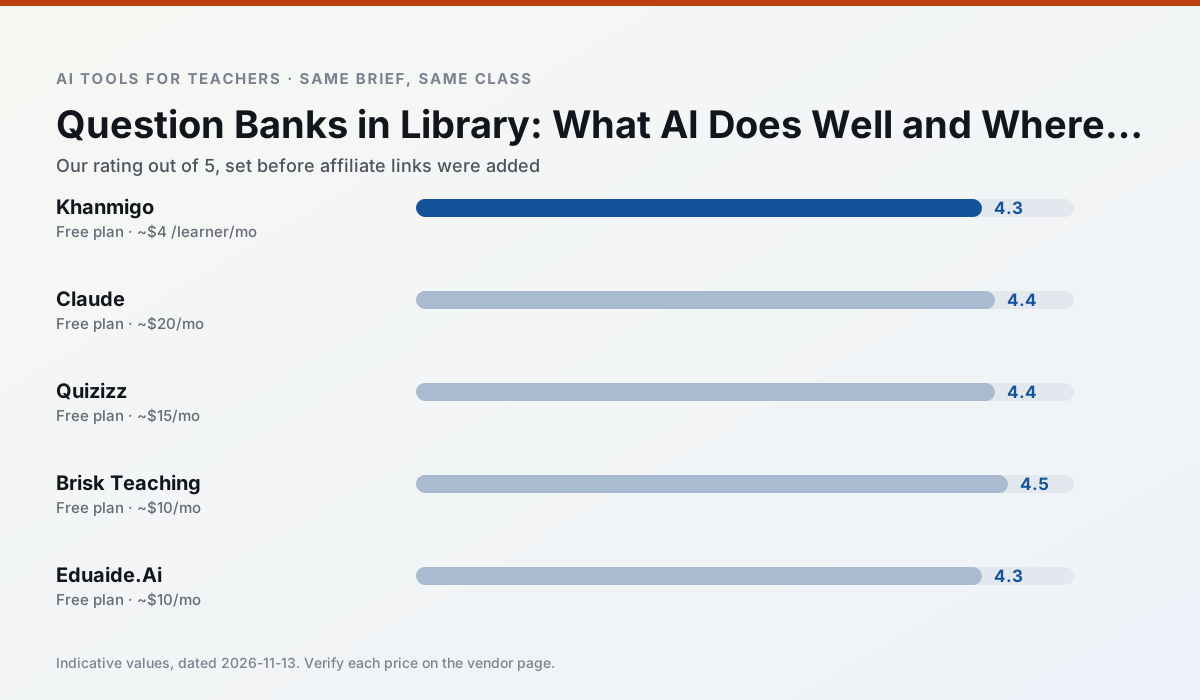
Side by side
Comparison table
Ratings reflect our timed classroom workflow, not vendor claims. Prices are indicative — verify on the vendor site.
| Tool | Best for | Free tier | Indicative paid plan | Standout feature | Our rating | Verdict | Try the tool |
|---|---|---|---|---|---|---|---|
| Khanmigo | math practice · student tutoring | Yes — US teacher accounts, subject to eligibility | ~$4 /learner/mo | Socratic tutoring rather than answers | 4.3 / 5 | Strong option | Try free |
| Claude | rubric creation · feedback on writing | Yes — Usage-limited | ~$20 /user/mo | Very large context window | 4.4 / 5 | Strong option | Try free |
| Quizizz | quiz generation · formative assessment | Yes — Core quiz creation | ~$15 /user/mo | AI question generator | 4.4 / 5 | Strong option | Try free |
| Brisk Teaching | feedback on writing · grading | Yes — Limited actions per month | ~$10 /user/mo | Works inside Google Docs | 4.5 / 5 | Top pick | Try free |
| Eduaide.Ai | lesson planning · rubric creation | Yes — Daily generation cap | ~$10 /user/mo | Resource library | 4.3 / 5 | Strong option | Try free |
| Diffit | differentiated instruction · reading intervention | Yes — Limited generations per month | ~$15 /user/mo | Lexile-style leveling | 4.6 / 5 | Top pick | Try free |
Match your situation
Best for X
Different jobs need different tools. Here is what we would open first in each case.
For a school rollout, Khanmigo offers the paperwork and the admin console; the classroom features are standard by comparison.
Claude runs in a browser tab with no extension, no student accounts and no onboarding call, so you can test it in a free period.
On the daily cycle, Quizizz saves the most edit time per task; the paid tier mostly buys more runs rather than better ones.
Brisk Teaching's free plan is the most usable in this comparison: a quota that survives a normal week. Not enough for a department, enough for one teacher to decide.
Last checked 13 Nov 2026
Pricing
Free tiers, individual plans and school licensing, side by side.
| Tool | Free plan | Individual / paid | School & district | Billing note | Verify |
|---|---|---|---|---|---|
| Khanmigo | $0 — US teacher accounts, subject to eligibility | ~$4 /learner/mo | Custom quote | Indicative — verify on vendor site | Vendor |
| Claude | $0 — Usage-limited | ~$20 /user/mo | ~$25+ /user/mo | Indicative — verify on vendor site | Vendor |
| Quizizz | $0 — Core quiz creation | ~$15 /user/mo | Custom quote | Indicative — verify on vendor site | Vendor |
| Brisk Teaching | $0 — Limited actions per month | ~$10 /user/mo | Custom quote | Indicative — verify on vendor site | Vendor |
| Eduaide.Ai | $0 — Daily generation cap | ~$10 /user/mo | Custom quote | Indicative — verify on vendor site | Vendor |
| Diffit | $0 — Limited generations per month | ~$15 /user/mo | Custom quote | Indicative — verify on vendor site | Vendor |
Editorial rule: pricing is re-checked every 2–3 months and the top 50 pages are refreshed every 6 months. See our funding policy.
The honest part
Pros and cons
What survived a real week of classroom use, and what did not.
Pros
- Education-first design
- Strong nonprofit trust signal
- Good math scaffolding
Cons
- Availability varies by region
- Less useful for admin paperwork
- Requires student accounts for full value
Pros
- Handles full unit plans and long rubrics
- Nuanced, less generic prose
- Good at structured document output
Cons
- No teacher-specific templates
- Fewer classroom integrations
- Consumer plan not suitable for student data
Pros
- Students already know the interface
- Good reporting
- Works on low-end devices
Cons
- Writing high-quality AI questions still needs review
- Gamification can distract
- Advanced analytics are paid
Pros
- No copy-paste between tools
- Fast inline feedback on student drafts
- Gentle learning curve
Cons
- Chrome-first workflow
- Extension permissions need IT approval
- Free quota is tight
Pros
- Very low entry price
- Good worksheet and rubric output
- Clean, uncluttered UI
Cons
- Smaller template set than MagicSchool
- Less polished export options
- Limited integrations
In the classroom
Use cases
Five concrete workflows, with the tool we would open for each one.
A weekly family newsletter from bullet notes
Newsletters fail on length, not tone. Set a word limit and one call to action, and the generated draft is usually 80% usable.
Recommended: KhanmigoRegrouping students after an assessment
Summarise anonymised results into skill groups, then generate one activity per group. Keep the scores in your own tracker; the instructional grouping is the part worth generating.
Recommended: ClaudeRubric and feedback comments in one pass
Reorder the workflow so the rubric is yours and the comments are generated. Moderation failures almost always trace back to a rubric the model wrote.
Recommended: QuizizzA parent email in two languages
Draft in plain, warm language with no names, translate, then back-translate the important sentences to check meaning. Keep specific incidents out of the prompt and add them yourself.
Recommended: Brisk TeachingA Monday morning lesson plan in twelve minutes
The twelve minutes come from not rewriting the skeleton. Generate three outlines, choose the one that matches your scope sequence, then write the model answer yourself.
Recommended: Eduaide.Ai
Questions teachers ask us
FAQ
Direct answers, also published as FAQPage structured data for search and AI assistants.
Can AI do question banks at mixed-grade level?
Which tool is best for question banks?
What is the biggest risk?
Sources & further reading
Our recommendation
Try MagicSchool AI free for your next question banks task
A large library of teacher-specific AI generators in one dashboard. Start on the free tier, run one real Librarians lesson, and only consider upgrading if the quota is what stops you. Disclosure: we may earn a commission (30% recurring) at no extra cost to you.
Some links on this page are affiliate links. We may earn a commission at no extra cost to you. Our rankings are editorial and never pay-to-play. Never enter student PII into a free consumer account.
Keep reading
Related comparisons in this cluster.
Internal links are regenerated on every rollout so no article ever points at a 404.