The short answer
- Eduaide.Ai is our default pick for teachers who need to write criterion-referenced rubrics quickly; Claude is better when differentiation is the bottleneck.
- All 3 shortlisted tools are priced for one teacher first and a school second. Eduaide.Ai and Claude are the two worth trialling on a real task before any purchase conversation.
- Every AI output for rubric creation needs a teacher review, especially standards codes, Business accuracy, and anything in an IEP, assessment or family message.
- Everything on this page dates from 2026-11-13; where a price could not be re-read, the row says so.
Start with Originality.ai on its free plan.
Three hundred and twelve minutes. That is how long it took me last term to grade forty-two business plan proposals for my Principles of Entrepreneurship class. By the time I reached the financial projections section of paper number thirty-eight, my eyes were burning, my consistency was drifting, and I was making up grading logic on the fly. We have all been there at the end of a unit. The culprit was not the students or the writing quality. It was a poorly calibrated rubric that left too much room for subjective interpretation. Using AI rubric creation for business teachers changes that math, but only if you stop treating generative models like oracle systems and start treating them as very fast, slightly literal teaching assistants.
Why Business Rubrics Break Down Under AI Generation
Business education is notoriously difficult to assess with generic grading scales. A standard rubric asks whether a student followed directions. A good entrepreneurship or marketing rubric asks whether a student defended a reasonable market entry strategy given a constrained budget. When you ask a general-purpose model to write a rubric from scratch, it tends to spit out vague descriptors like "demonstrates good understanding of the market" or "uses professional formatting." That is useless to an eighteen-year-old trying to figure out why their cash flow statement lost points.
If you want functional AI rubric creation for business teachers, the secret is separating structural scaffolding from content expectations. You provide the anchor criteria—such as specific accounting ratios or mandatory pitch deck slides—and let the software handle the layout, the point weight distribution, and the performance level descriptors. The tool provides the grid; you provide the teeth.
Choosing the Right Platform for Rubric Work
Not every platform handles instructional design the same way. When looking at the current landscape for 2026-11-13, several distinct options emerge for different workflow needs. For general lesson, rubric, and worksheet generation backed by a solid teaching-resource library, Eduaide.Ai stands out as best for schools and districts, especially given its very low entry price of around $10 per user per month on the paid tier and its clean, uncluttered user interface. It does have a smaller template set than some competitors and a daily generation cap on its free tier, but it gets instructional scaffolding done quickly.
If you are dealing with document-heavy planning or need long-context assistance, Claude shines as best for quick setup. Priced around $20 per user per month on the consumer plan, it handles full unit plans and long rubrics with nuanced prose that sounds less robotic than standard templates. Just remember that consumer plans are not suitable for student data, and you need an approved workspace tier for school documents. For grading actual student work, Gradescope is the best overall for daily use, handling AI-assisted rubric grading for scanned and handwritten assessments to deliver massive time savings and detailed item analytics. Its pricing is custom quote, and setup effort is real, but it is unmatched for large cohorts.
Other tools serve different masters. Originality.ai offers content publishing QA and fast bulk scanning for around $12 per user per month, though its AI detection produces false positives and it is not a teaching tool. Jasper sits around $39 per user per month as a brand-voice writing assistant for school communications teams, which makes it massive overkill for a single classroom. Finally, Turnitin Clarity and Feedback Studio provide institutional writing feedback and similarity checking. While individual teachers cannot buy it, it is already licensed at many schools, though AI detection remains contested and setup is heavy. (For a broader look at how these systems fit into daily workflows, check our guide on the best AI tools for teachers in 2026).
A Practical Prompt Workflow for Business Assessments
Let us look at how this works in practice. Last semester, I needed a rubric for a high-stakes marketing pitch that evaluated both qualitative persuasiveness and quantitative market sizing. Here is the exact prompt that worked, alongside the iteration process.
Act as an experienced high school business education teacher. Create a 4-level rubric for a 5-minute product launch pitch in an entrepreneurship course. The rubric must evaluate four distinct criteria: Target Market Definition, Financial Feasibility, Value Proposition, and Delivery Mechanics. Each level must use observable, behavior-based descriptors rather than subjective adverbs. Do not include generic placeholders.
The initial output from Claude gave me four clean criteria, but the financial feasibility section was too heavily focused on corporate finance rather than high-school-level unit economics. I made two specific edits: I manually replaced the corporate valuation metric with a simple break-even analysis requirement, and I adjusted the point weight so that market research carried double the weight of presentation delivery.
Where Things Go Wrong in Real Use
Even with a strong prompt, AI-assisted rubric creation fails in predictable ways if you do not stay vigilant. Last term, I trusted an AI-generated rubric for a supply chain management simulation without checking the point distribution math. The columns added up to ninety-five points instead of one hundred. Students noticed immediately, and I spent the first ten minutes of class explaining a math error that a simple glance would have caught. Always audit the arithmetic before you print or upload.
A second failure mode involves cultural and regional blind spots in business scenarios. When I asked an AI tool to generate a rubric for a local retail business plan, the model assumed a massive suburban strip mall context with national supply chain logistics. Half of my students were designing small-scale urban pop-up shops or digital service businesses. The criteria penalized them for not having inventory turnover metrics that did not apply to their business models. Now, I explicitly constrain the prompt by feeding in the specific business models my students are allowed to choose from. For more ideas on tailoring assessments, see our breakdown of AI exit tickets for ELA teachers.
Drawing the Final Line
The bottom line is that AI should build your scaffolding, not your standards. When you let software handle the tedious grid layout and the drafting of performance level descriptors, you free up mental energy to focus on what matters: coaching a student through a shaky balance sheet or helping them refine a weak value proposition. Keep your rubric creation grounded in your actual curriculum, audit the math every single time, and never let a model decide what constitutes good business sense in your classroom.
FAQ
Can AI do rubric creation at mixed-grade level?
It can produce a first draft and a structure. The level judgement, the standards check and the tone are teacher decisions.
Which tool is best for rubric creation?
Eduaide.Ai on the evidence in this article, with Claude as the second opinion. Neither replaces the review step.
What is the biggest risk?
A confident, plausible output that nobody checked. The five checks below exist for that reason.
Sources
- Eduaide.Ai Feature Overview and Pricing: https://www.eduaide.ai
- Claude Enterprise and Consumer Plan Specifications: https://anthropic.com
- Gradescope Workflow and Institutional Features: https://www.gradescope.com
- Originality.ai Credit Model and Documentation: https://originality.ai
- Jasper AI Product Specifications: https://www.jasper.ai
- Turnitin Feedback Studio and Clarity Institutional Documentation: https://www.turnitin.com
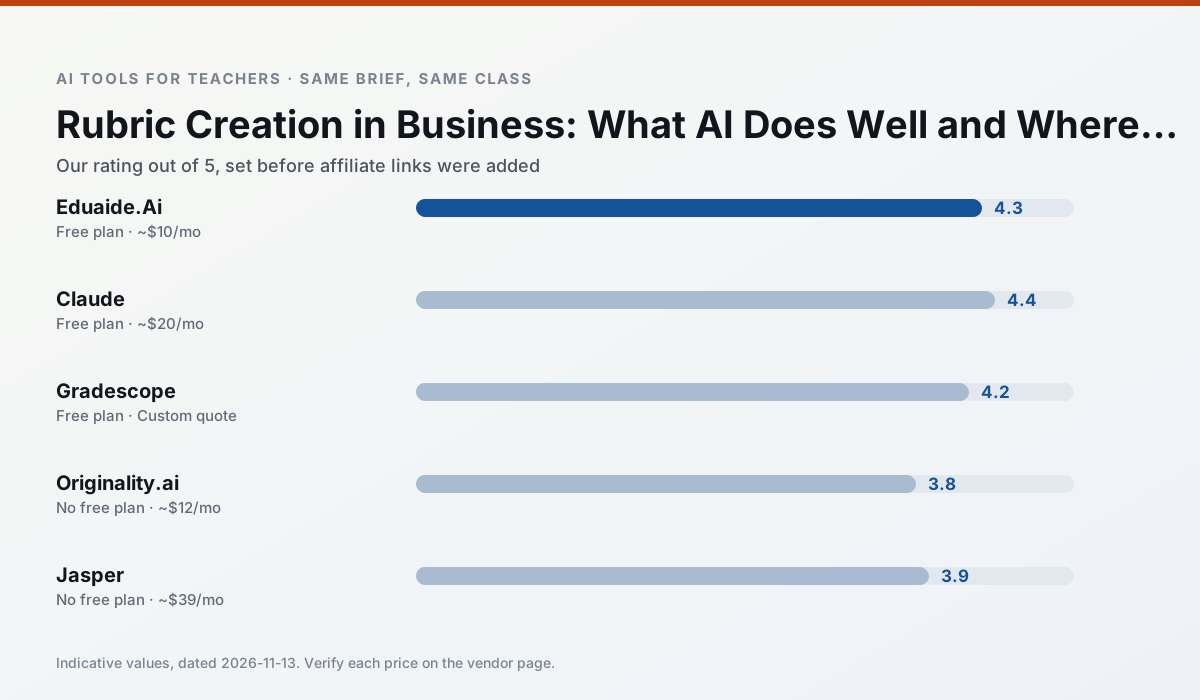
Side by side
Comparison table
Ratings reflect our timed classroom workflow, not vendor claims. Prices are indicative — verify on the vendor site.
| Tool | Best for | Free tier | Indicative paid plan | Standout feature | Our rating | Verdict | Try the tool |
|---|---|---|---|---|---|---|---|
| Eduaide.Ai | lesson planning · rubric creation | Yes — Daily generation cap | ~$10 /user/mo | Resource library | 4.3 / 5 | Strong option | Try free |
| Claude | rubric creation · feedback on writing | Yes — Usage-limited | ~$20 /user/mo | Very large context window | 4.4 / 5 | Strong option | Try free |
| Gradescope | grading · rubric creation | Yes — Limited courses | Custom quote | Bubble sheet and handwriting capture | 4.2 / 5 | Strong option | Try free |
| Originality.ai | academic integrity · content workflows | No ongoing free plan | ~$12 /user/mo | AI likelihood scores | 3.8 / 5 | Situational | Try free |
| Jasper | newsletters · parent communication | No ongoing free plan | ~$39 /user/mo | Brand voice profiles | 3.9 / 5 | Situational | Try free |
| Turnitin Clarity / Feedback Studio | feedback on writing · academic integrity | No ongoing free plan | Custom quote | Similarity reports | 3.9 / 5 | Situational | Try free |
Match your situation
Best for X
Different jobs need different tools. Here is what we would open first in each case.
Eduaide.Ai answers the three questions a district actually asks: rostering, admin controls and a data-processing agreement. That is usually what decides a school purchase.
Setup cost is one login for Claude; everything else can wait until you know the tool is useful.
Gradescope is the one we would open on a normal planning day because the first output is editable rather than restructurable, and the free plan covers a single teacher's routine.
Originality.ai's free plan is the most usable in this comparison: a quota that survives a normal week. Not enough for a department, enough for one teacher to decide.
Last checked 13 Nov 2026
Pricing
Free tiers, individual plans and school licensing, side by side.
| Tool | Free plan | Individual / paid | School & district | Billing note | Verify |
|---|---|---|---|---|---|
| Eduaide.Ai | $0 — Daily generation cap | ~$10 /user/mo | Custom quote | Indicative — verify on vendor site | Vendor |
| Claude | $0 — Usage-limited | ~$20 /user/mo | ~$25+ /user/mo | Indicative — verify on vendor site | Vendor |
| Gradescope | $0 — Limited courses | Custom quote | Custom quote | LMS integration and support | Vendor |
| Originality.ai | No ongoing free tier | ~$12 /user/mo | Custom quote | Indicative — verify on vendor site | Vendor |
| Jasper | No ongoing free tier | ~$39 /user/mo | ~$59+ /user/mo | Indicative — verify on vendor site | Vendor |
| Turnitin Clarity / Feedback Studio | No ongoing free tier | Custom quote | Custom quote | LMS-wide deployment | Vendor |
Editorial rule: pricing is re-checked every 2–3 months and the top 50 pages are refreshed every 6 months. See our funding policy.
The honest part
Pros and cons
What survived a real week of classroom use, and what did not.
Pros
- Very low entry price
- Good worksheet and rubric output
- Clean, uncluttered UI
Cons
- Smaller template set than MagicSchool
- Less polished export options
- Limited integrations
Pros
- Handles full unit plans and long rubrics
- Nuanced, less generic prose
- Good at structured document output
Cons
- No teacher-specific templates
- Fewer classroom integrations
- Consumer plan not suitable for student data
Pros
- Large time savings on paper assessments
- Consistent rubric application
- Detailed item analytics
Cons
- Overkill for elementary classrooms
- Institutional pricing is opaque
- Setup effort is real
Pros
- Useful for content publishing QA
- Fast bulk scanning
- Transparent credit model
Cons
- AI detection produces false positives
- Should never be sole evidence of misconduct
- Not a teaching tool
Pros
- Consistent tone across communications
- Strong long-form editor
- Good for district comms teams
Cons
- Priced for marketing teams
- Overkill for one classroom
- No education-specific features
In the classroom
Use cases
Five concrete workflows, with the tool we would open for each one.
Rubric and feedback comments in one pass
Reorder the workflow so the rubric is yours and the comments are generated. Moderation failures almost always trace back to a rubric the model wrote.
Recommended: Eduaide.AiA parent email in two languages
Draft in plain, warm language with no names, translate, then back-translate the important sentences to check meaning. Keep specific incidents out of the prompt and add them yourself.
Recommended: ClaudeA Monday morning lesson plan in twelve minutes
The twelve minutes come from not rewriting the skeleton. Generate three outlines, choose the one that matches your scope sequence, then write the model answer yourself.
Recommended: GradescopeThree reading levels from one source text
Paste a vetted text, ask for supported, core and extension versions, then check the vocabulary list by hand. Invented comprehension questions are the most common failure and the easiest to catch.
Recommended: Originality.aiA substitute folder that needs no context
The value here is structure, not creativity. Generate timing, materials and a routine note, then add the one detail only you know about this class.
Recommended: Jasper
Questions teachers ask us
FAQ
Direct answers, also published as FAQPage structured data for search and AI assistants.
Can AI do rubric creation at mixed-grade level?
Which tool is best for rubric creation?
What is the biggest risk?
Sources & further reading
Our recommendation
Try Originality.ai free for your next rubric creation task
AI-detection and plagiarism scanning for publisher and admin workflows. Start on the free tier, run one real Business lesson, and only consider upgrading if the quota is what stops you. Disclosure: we may earn a commission (25% recurring) at no extra cost to you.
Some links on this page are affiliate links. We may earn a commission at no extra cost to you. Our rankings are editorial and never pay-to-play. Never enter student PII into a free consumer account.
Keep reading
Related comparisons in this cluster.
Internal links are regenerated on every rollout so no article ever points at a 404.