The short answer
- Curipod is our default pick for teachers who need to write five-minute wrap-up prompts quickly; Quizizz is better when differentiation is the bottleneck.
- Start with Curipod on its free plan, keep Quizizz as the second opinion, and do not open a card until the quota, not the feature list, is what stops you.
- Every AI output for exit tickets needs a teacher review, especially standards codes, Kindergarten accuracy, and anything in an IEP, assessment or family message.
- Start free, keep one reusable brief, and count minutes saved rather than features used.
Start with Notion AI on its free plan.
At two o'clock on a Tuesday, I have twenty-two five-year-olds packed onto the reading rug, sixteen pairs of scissors missing from the caddy, and zero data on whether anyone actually understood our morning lesson on beginning letter sounds. The traditional exit ticket—handing a five-year-old a scrap of paper to draw a circle around a letter—usually results in three kids eating the crayon, seven drawing dinosaurs, and me staring at ambiguous squiggles while my prep period evaporates. Finding tools that actually work for this age group is exhausting, especially when most tech presumes students can type essays or read complex prompts independently. If you are looking for ways to streamline this daily routine, you might want to review our broader roundup of the best AI tools for teachers to see how these systems fit into a wider workflow.
When you are working with early childhood learners, the bottleneck isn't usually grading; it is creating prompts that don't rely on reading ability. I started experimenting with AI exit tickets for kindergarten teachers to generate quick, multimodal checks that I could project on the board or read aloud while students tapped a shared screen or used physical response cards. We are not trying to replace the crucial one-on-one conference where a child points to a letter and tells you its sound. We are trying to capture a fast snapshot of the room before the afternoon bell rings.
Curipod as the Best Free Option
Curipod takes top honors as the best free option because it lets you spin up an interactive check for understanding in a matter of minutes without requiring five-year-olds to log into individual accounts. On the free tier, which features limited lessons per month, you can design a slide deck with drawing prompts, word clouds, or poll questions that kids respond to via a shared classroom device or a big screen at the front of the room. The reported strengths are immediate student engagement and zero setup friction for young learners, since they don't need usernames or passwords. The limits are real: it focuses entirely on delivery rather than long-term curriculum planning, and the free tier restrictions mean you have to budget your interactive sessions carefully. Paid plans run around $12 per user per month if you outgrow the cap.
The main workflow risk here is over-relying on the tool's default prompts, which often use vocabulary that sails right over a kindergartener's head. You have to actively prune the AI-generated questions so they match your actual classroom anchor charts. For privacy, Curipod keeps student responses anonymous by default, but you should always verify local compliance with your district IT department before rolling it out broadly.
Quizizz for Daily Use
If you want something reliable that kids already recognize, Quizizz is the best overall for daily use. While many associate it with older grades, its AI-assisted quiz creation pulls from a massive question bank that you can adapt for young learners by adding image-based answers rather than text. Priced at roughly $15 per user per month for paid tiers alongside a functional core free option, it shines because it works well on low-end devices and provides clean reporting dashboards. The catch is that writing high-quality AI questions still demands heavy human review, and the built-in gamification elements can easily over-stimulate a room of kindergarteners if you aren't careful with the timer settings.
Prompt: Create a 3-question visual exit ticket for kindergarten about identifying the number 5, using multiple-choice image options instead of text.
First output: The AI generated text-heavy math word problems with numbers up to twenty and required typing responses.
Two edits:
- Restricted the scope to counting sets of familiar objects from 1 to 5 with picture answers only.
- Added a requirement for an audio read-aloud prompt so kindergarteners could hear the question spoken.
When I ran that edited version through Quizizz, two kids clicked randomly because they liked the sound effect when time ran out. I learned quickly to turn off the live leaderboard feature for this age group so the focus stayed on math rather than speed. COPPA and FERPA documentation are available from the vendor, but you still need to confirm alignment with your specific school board rules.
Notion AI for Rapid Setup
For organizing your literacy centers or grouping data behind the scenes, Notion AI stands out as the best for quick setup. At about $10 per user per month on paid tiers with limited free AI usage, it acts as a flexible workspace for notes and curriculum tracking. It saves you from staring at a blank screen when you need to structure a week of phonics stations, but it is not purpose-built for lesson generation, and the AI add-on pricing has shifted multiple times.
You must never store student personally identifiable information in personal workspaces, and the initial setup time to build a clean teacher database is significant. I use it strictly as my own behind-the-scenes planning desk, mapping out developmental progressions while keeping my actual formative assessment records in district-approved secure silos. For a deeper dive into how targeted AI workflows support specific grade bands, check out our guide on AI exit tickets for ELA teachers.
Grammarly for Parent Communication
When the exit ticket data is processed, the next hurdle is often communicating those small wins and struggles to families who speak multiple languages or need clear, professional updates. Grammarly is the best for schools and districts, costing roughly $12 per user per month with a robust core free tier. It catches errors in high-stakes parent emails and works everywhere you already write, possessing a very low learning curve.
The limitation is that it is not education-specific, and relying too heavily on its tone adjustments can flatten your authentic teacher voice. On school devices, ensure text collection is disabled and check the vendor data processing agreement with your tech department before letting it scan draft report card comments.
ChatGPT and Claude for Custom Planning
ChatGPT and Claude both sit around $20 per user per month on their respective paid tiers, offering usage-limited free options for educators who want heavy-duty assistance with lesson architecture. ChatGPT is the most flexible option available, boasting a massive community of teacher prompt libraries and strong multilingual support. Claude handles full unit plans and long rubrics exceptionally well, generating nuanced prose that feels less generic than its competitors.
Both tools share a major drawback: they require distinct prompt-writing skills to yield consistent results, they lack built-in standards alignment for specific state mandates, and their consumer plans are strictly unsuitable for student data. You cannot paste a class roster with reading levels into either tool without violating basic privacy norms. They are planning assistants, not automated grading engines for young children.
Making Exit Tickets Work in Early Childhood
Using AI to design a five-minute exit ticket set requires a deliberate structure: three questions at different cognitive levels plus one confidence check. You must discard anything that only tests recall of your exact wording, because that measures memory of the lesson rather than actual conceptual learning. When I tried to let an AI generate a whole week of science checks at once, the output assumed students could write sentences about plant life cycles. I had to intervene and pivot the format toward sorting picture cards into living and non-living categories.
The technology should lift the administrative weight off your shoulders, not dictate how your classroom runs. Keep your standards close, keep your district data rules closer, and remember that no algorithm can replace watching a child's face light up when they finally master a tricky letter sound.
FAQ
Can AI do exit tickets at mixed-grade level?
It can produce a first draft and a structure. The level judgement, the standards check and the tone are teacher decisions.
Which tool is best for exit tickets?
Curipod on the evidence in this article, with Quizizz as the second opinion. Neither replaces the review step.
What is the biggest risk?
A confident, plausible output that nobody checked. The five checks below exist for that reason.
Sources
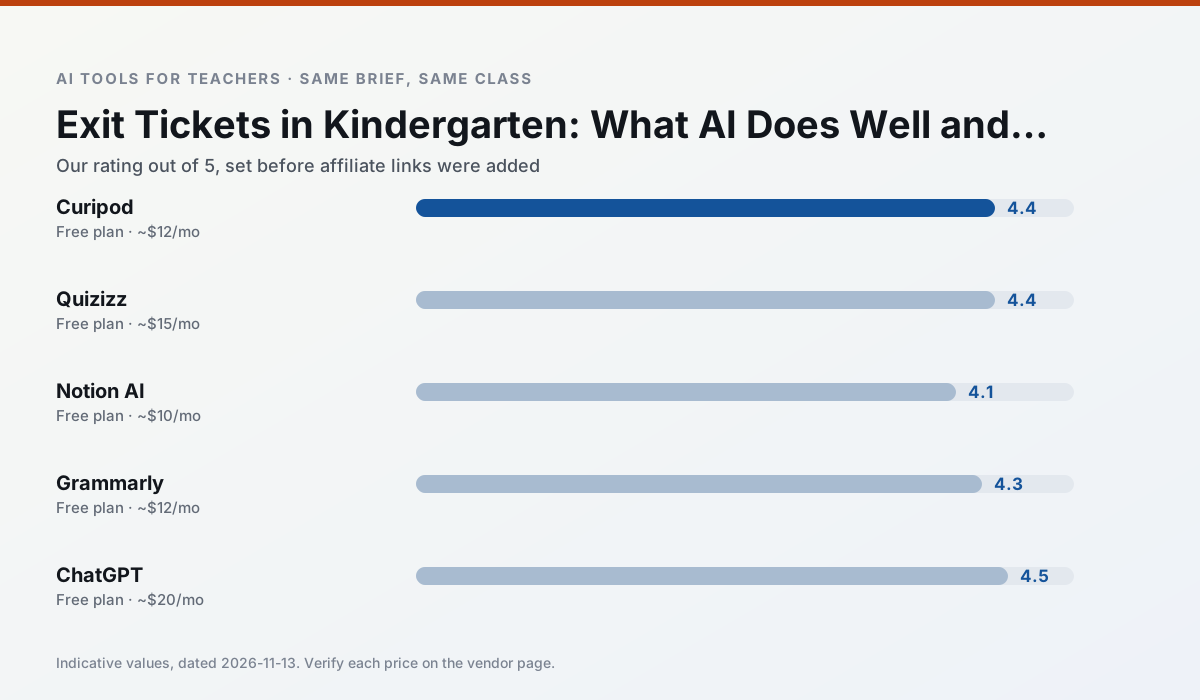
Side by side
Comparison table
Ratings reflect our timed classroom workflow, not vendor claims. Prices are indicative — verify on the vendor site.
| Tool | Best for | Free tier | Indicative paid plan | Standout feature | Our rating | Verdict | Try the tool |
|---|---|---|---|---|---|---|---|
| Curipod | formative assessment · exit tickets | Yes — Limited lessons per month | ~$12 /user/mo | Live polls and word clouds | 4.4 / 5 | Strong option | Try free |
| Quizizz | quiz generation · formative assessment | Yes — Core quiz creation | ~$15 /user/mo | AI question generator | 4.4 / 5 | Strong option | Try free |
| Notion AI | curriculum mapping · unit planning | Yes — Limited AI usage | ~$10 /user/mo | Linked databases | 4.1 / 5 | Situational | Try free |
| Grammarly | parent communication · report card comments | Yes — Core grammar and tone checks | ~$12 /user/mo | Tone adjustments | 4.3 / 5 | Strong option | Try free |
| ChatGPT | lesson planning · parent communication | Yes — Usage-limited model access | ~$20 /user/mo | Custom GPTs and Projects | 4.5 / 5 | Top pick | Try free |
| Claude | rubric creation · feedback on writing | Yes — Usage-limited | ~$20 /user/mo | Very large context window | 4.4 / 5 | Strong option | Try free |
Match your situation
Best for X
Different jobs need different tools. Here is what we would open first in each case.
Curipod's free plan is the most usable in this comparison: a quota that survives a normal week. Not enough for a department, enough for one teacher to decide.
Quizizz wins on the default path: fewer clicks to a usable draft, and the interface does not get in the way at 7:40am.
Setup cost is one login for Notion AI; everything else can wait until you know the tool is useful.
For a school rollout, Grammarly offers the paperwork and the admin console; the classroom features are standard by comparison.
Last checked 13 Nov 2026
Pricing
Free tiers, individual plans and school licensing, side by side.
| Tool | Free plan | Individual / paid | School & district | Billing note | Verify |
|---|---|---|---|---|---|
| Curipod | $0 — Limited lessons per month | ~$12 /user/mo | Custom quote | Indicative — verify on vendor site | Vendor |
| Quizizz | $0 — Core quiz creation | ~$15 /user/mo | Custom quote | Indicative — verify on vendor site | Vendor |
| Notion AI | $0 — Limited AI usage | ~$10 /user/mo | ~$8 /user/mo | Indicative — verify on vendor site | Vendor |
| Grammarly | $0 — Core grammar and tone checks | ~$12 /user/mo | ~$15 /user/mo | Indicative — billed annually | Vendor |
| ChatGPT | $0 — Usage-limited model access | ~$20 /user/mo | ~$25+ /user/mo | Indicative — verify on vendor site | Vendor |
| Claude | $0 — Usage-limited | ~$20 /user/mo | ~$25+ /user/mo | Indicative — verify on vendor site | Vendor |
Editorial rule: pricing is re-checked every 2–3 months and the top 50 pages are refreshed every 6 months. See our funding policy.
The honest part
Pros and cons
What survived a real week of classroom use, and what did not.
Pros
- High student engagement out of the box
- Great for quick checks for understanding
- No student accounts required for basic use
Cons
- Focused on delivery, not planning
- Requires reliable classroom devices
- Free tier is restrictive
Pros
- Students already know the interface
- Good reporting
- Works on low-end devices
Cons
- Writing high-quality AI questions still needs review
- Gamification can distract
- Advanced analytics are paid
Pros
- Great for long-term curriculum records
- Strong team collaboration
- Flexible structure
Cons
- Setup time is significant
- AI add-on pricing changed more than once
- Not purpose-built for lesson generation
Pros
- Catches errors in high-stakes parent emails
- Works everywhere you already write
- Very low learning curve
Cons
- Not education-specific
- Can flatten teacher voice
- Premium needed for tone rewriting
Pros
- Most flexible option available
- Huge community of teacher prompt libraries
- Strong multilingual support
Cons
- Requires prompt skills for consistent results
- No built-in standards alignment
- District privacy review usually required
In the classroom
Use cases
Five concrete workflows, with the tool we would open for each one.
A Monday morning lesson plan in twelve minutes
Two sentences into the brief: grade, subject, 45 minutes, one mixed-ability group. Ask for three structures, keep one, rewrite the prose yourself. The tool saves the blank-page time, not the thinking time.
Recommended: CuripodA parent email in two languages
Write the English version with one clear action item, translate it, and read the translation aloud with a colleague who speaks the language if you can. Machine translation is an aid, not a substitute for a family relationship.
Recommended: QuizizzRubric and feedback comments in one pass
Write the four criteria and the band wording first; generate only the comment bank. That keeps your department's rubric language intact and stops the model inventing a fifth criterion.
Recommended: Notion AIAn IEP present-levels first draft
The draft is a starting point for a conversation, not a document. Present levels need assessment evidence, and AI cannot supply the evidence you did not collect.
Recommended: GrammarlyA five-minute exit ticket set
Three questions at different cognitive levels plus one confidence check. Discard anything that only tests recall of your exact wording; that measures memory of the lesson, not the learning.
Recommended: ChatGPT
Questions teachers ask us
FAQ
Direct answers, also published as FAQPage structured data for search and AI assistants.
Can AI do exit tickets at mixed-grade level?
Which tool is best for exit tickets?
What is the biggest risk?
Sources & further reading
Our recommendation
Try Notion AI free for your next exit tickets task
AI-assisted notes, databases and curriculum planning in one workspace. Start on the free tier, run one real Kindergarten lesson, and only consider upgrading if the quota is what stops you. Disclosure: we may earn a commission (varies) at no extra cost to you.
Some links on this page are affiliate links. We may earn a commission at no extra cost to you. Our rankings are editorial and never pay-to-play. Never enter student PII into a free consumer account.
Keep reading
Related comparisons in this cluster.
Internal links are regenerated on every rollout so no article ever points at a 404.