The short answer
- Curipod is our default pick for teachers who need to create quick checks for understanding quickly; Khanmigo is better when differentiation is the bottleneck.
- Pricing is where these pages date fastest. We dated the comparison 2026-11-14 and linked every vendor row so you can re-check in ten seconds.
- Every AI output for formative assessment needs a teacher review, especially standards codes, math accuracy, and anything in an IEP, assessment or family message.
- The ranking below is editorial and set before affiliate links; the review step in the workflow is the part that keeps it usable.
Start with Writesonic on its free plan.
At 8:42 on a Tuesday morning, I was staring at thirty-four algebra exit tickets that proved my students had completely misunderstood factoring by grouping. I had twenty minutes before my next period, no planning period until three o'clock, and a stack of papers that told me nothing except that thirty-four kids could write random parentheses on a page. That was the day I stopped pretending I could grade every misconception by hand and started figuring out where AI formative assessment for math teachers actually saves time without breaking my pedagogical standards.
Using AI for math checks is not about letting a machine teach. It is about closing the feedback loop before a misconception hardens into a permanent block. If you are looking at the wider landscape of classroom software, you can browse the best AI tools for teachers 2026 roundup, but math requires a specific kind of diagnostic precision that generic text generators just cannot handle.
The Reality of Math Misconceptions and AI Generators
Math teachers face a unique trap when using artificial intelligence. General writing tools like Writesonic ($16 /user/mo) and Jasper ($39 /user/mo) are built for marketing copy and blog posts, making them utterly useless for generating rigorous math items because they treat equations like strings of text rather than logic problems. Even dedicated education tools require careful human oversight when building diagnostic questions.
When you feed a non-identifiable source PDF or curriculum standard into an assessment generator, you have to ask for items tagged by difficulty with the specific misconception behind each distractor. You must spot-check every single answer key because numerical items are notoriously unreliable when generated by large language models. A generator might give you a brilliant word problem about proportional reasoning and then bungle the arithmetic in the answer key.
Prompt: "Act as an 8th-grade math coach. Generate a 3-question diagnostic check on solving multi-step linear equations. Include one easy recall item, one application item, and one reasoning item. For each multiple-choice question, provide four distractors where each wrong answer targets a specific procedural error, such as distributing incorrectly or forgetting to flip an inequality sign."
First pass result: The AI generated two solid multi-step equations and one word problem. However, it snuck in a second recall question instead of a reasoning item, and the answer key for question two had a sign error in the steps.
Two edits that made it usable:
- Deleted the extra recall question and manually rewrote the reasoning prompt to ask students to explain why a common student error yields the wrong answer.
- Recalculated the solution to question two by hand and rewrote the distractors to target sign distribution errors specifically.
Curipod for Interactive Checks
When you need high engagement during a live lesson, Curipod (~$12 /user/mo indicative) turns a plain math topic into an interactive student-response session in minutes. It is best for student-safe deployments because it does not require student accounts for basic use, and student responses are anonymous by default. You can throw a quick geometry concept onto the board, and kids are drawing shapes or answering polls on their devices before you can hand out scrap paper.
The catch is that Curipod is focused on delivery, not planning. It requires reliable classroom devices, and the free tier is restrictive enough that you will hit a paywall right when you want to use it across multiple preps. Use it for the quick check in the middle of a class period, but do not rely on it to build your curriculum map.
Quizizz for Mixed-Ability Classes
Quizizz (~$15 /user/mo indicative) remains a staple for a reason: students already know the interface, and it works smoothly on low-end devices. It is best for mixed-ability classes because you can run live games or assign asynchronous paths that adjust to student pacing. The platform's AI-assisted quiz creation taps into a massive question bank, which saves hours when you are building practice sets.
Two things went wrong during my last unit on fractions. First, the AI-generated questions leaned too heavily on procedural drill rather than conceptual understanding, meaning my higher-level thinkers were bored while my struggling students guessed blindly. Second, the gamification features caused a few students to rush through calculations just to climb the leaderboard, making their diagnostic data completely useless. To fix this, I turned off the timer feature for specific learners and manually edited the quiz to mix in open-ended reasoning prompts alongside the rapid-fire multiple-choice items.
Formative for Quick Setup and Standards Data
If your primary goal is tracking individual student progress against specific state standards without fighting a clunky interface, Formative (~$15 /user/mo indicative) is the most straightforward option. It is best for quick setup because it works directly with the PDFs and Docs you already use. You can upload an existing worksheet, drop interactive question boxes over the problems, and watch student work appear on your screen in real time.
The data is robust enough to build intervention groups based on who missed which standard. However, the best value requires a school-wide rollout, and the price adds up quickly if you are paying out of pocket. Furthermore, the setup is steeper than a simple quiz game; you have to spend time tagging questions to standards if you want the auto-grading and analytics to mean anything.
Khanmigo for Scaffolding and Parent Communication
Khanmigo (~$4 /learner/mo indicative) approaches AI from an education-first design, backed by a strong nonprofit trust signal. It is best for parent-facing writing and student tutoring because it acts as a Socratic guide rather than an answer machine. When a student is stuck on a quadratic formula, Khanmigo asks leading questions instead of solving the problem for them.
When I needed to explain a complex grading policy to a guardian who spoke Spanish as a primary language, I relied on structured AI assistance. You can draft a plain, warm message with no student names, translate it, and then back-translate the important sentences to check for meaning before sending. Keep specific behavioral or academic incidents out of the prompt, and add those details in your own voice afterward. For more ideas on managing parent correspondence and administrative writing loads, take a look at the guidance on AI essay feedback for history teachers.
Drawing the Line on Automated Math Grading
AI formative assessment tools are brilliant at surfacing patterns in wrong answers, but they cannot replace a teacher looking at a messy student calculation. When an automated system marks a student wrong because they omitted a trailing zero or used a non-standard algebraic path, the technology has failed its purpose. Use AI to generate the distractors, organize your exit tickets, and draft your parent communications, but keep your eyes on the actual scratch paper your students leave behind.
FAQ
Can AI do formative assessment at mixed-grade level?
It can produce a first draft and a structure. The level judgement, the standards check and the tone are teacher decisions.
Which tool is best for formative assessment?
Curipod on the evidence in this article, with Khanmigo as the second opinion. Neither replaces the review step.
What is the biggest risk?
A confident, plausible output that nobody checked. The five checks below exist for that reason.
Sources
- Curipod Pricing and Features: Curipod Pricing
- Khanmigo for Districts: Khan Academy Districts
- Quizizz Educator Plans: Quizizz Pricing
- Formative Assessment Platform: GoFormative Features
- Writesonic Pricing: Writesonic Pricing
- Jasper AI Plans: Jasper Pricing
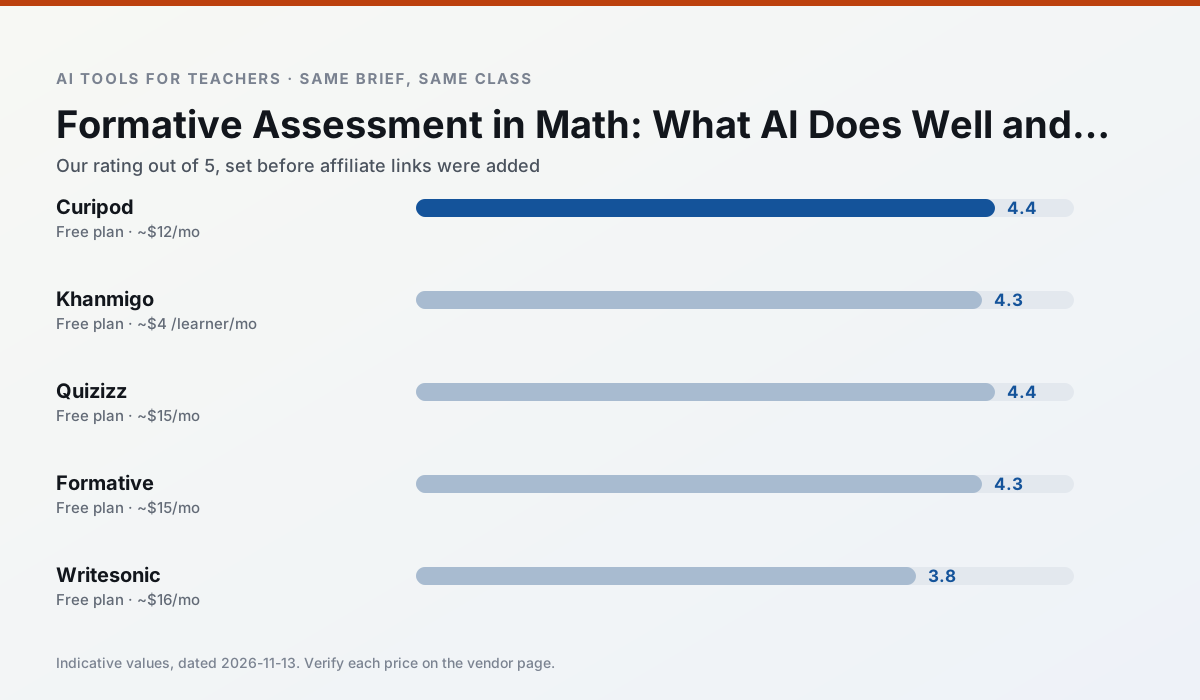
Side by side
Comparison table
Ratings reflect our timed classroom workflow, not vendor claims. Prices are indicative — verify on the vendor site.
| Tool | Best for | Free tier | Indicative paid plan | Standout feature | Our rating | Verdict | Try the tool |
|---|---|---|---|---|---|---|---|
| Curipod | formative assessment · exit tickets | Yes — Limited lessons per month | ~$12 /user/mo | Live polls and word clouds | 4.4 / 5 | Strong option | Try free |
| Khanmigo | math practice · student tutoring | Yes — US teacher accounts, subject to eligibility | ~$4 /learner/mo | Socratic tutoring rather than answers | 4.3 / 5 | Strong option | Try free |
| Quizizz | quiz generation · formative assessment | Yes — Core quiz creation | ~$15 /user/mo | AI question generator | 4.4 / 5 | Strong option | Try free |
| Formative | formative assessment · grading | Yes — Core assessment tools | ~$15 /user/mo | Live student responses | 4.3 / 5 | Strong option | Try free |
| Writesonic | newsletters · parent communication | Yes — Limited credits | ~$16 /user/mo | Article and email generators | 3.8 / 5 | Situational | Try free |
| Jasper | newsletters · parent communication | No ongoing free plan | ~$39 /user/mo | Brand voice profiles | 3.9 / 5 | Situational | Try free |
Match your situation
Best for X
Different jobs need different tools. Here is what we would open first in each case.
Curipod is built around teacher-monitored student spaces and audit logs rather than a consumer chat account, which is a different approval conversation.
Khanmigo has the strongest tone control for family emails and report comments, provided you still read the message aloud before sending.
Quizizz produces levelled versions from one source in a single pass, which is the highest-value differentiation shortcut we tested at this level.
Setup cost is one login for Formative; everything else can wait until you know the tool is useful.
Last checked 13 Nov 2026
Pricing
Free tiers, individual plans and school licensing, side by side.
| Tool | Free plan | Individual / paid | School & district | Billing note | Verify |
|---|---|---|---|---|---|
| Curipod | $0 — Limited lessons per month | ~$12 /user/mo | Custom quote | Indicative — verify on vendor site | Vendor |
| Khanmigo | $0 — US teacher accounts, subject to eligibility | ~$4 /learner/mo | Custom quote | Indicative — verify on vendor site | Vendor |
| Quizizz | $0 — Core quiz creation | ~$15 /user/mo | Custom quote | Indicative — verify on vendor site | Vendor |
| Formative | $0 — Core assessment tools | ~$15 /user/mo | Custom quote | Indicative — verify on vendor site | Vendor |
| Writesonic | $0 — Limited credits | ~$16 /user/mo | ~$49 /user/mo | Indicative — verify on vendor site | Vendor |
| Jasper | No ongoing free tier | ~$39 /user/mo | ~$59+ /user/mo | Indicative — verify on vendor site | Vendor |
Editorial rule: pricing is re-checked every 2–3 months and the top 50 pages are refreshed every 6 months. See our funding policy.
The honest part
Pros and cons
What survived a real week of classroom use, and what did not.
Pros
- High student engagement out of the box
- Great for quick checks for understanding
- No student accounts required for basic use
Cons
- Focused on delivery, not planning
- Requires reliable classroom devices
- Free tier is restrictive
Pros
- Education-first design
- Strong nonprofit trust signal
- Good math scaffolding
Cons
- Availability varies by region
- Less useful for admin paperwork
- Requires student accounts for full value
Pros
- Students already know the interface
- Good reporting
- Works on low-end devices
Cons
- Writing high-quality AI questions still needs review
- Gamification can distract
- Advanced analytics are paid
Pros
- Strong data for intervention groups
- Works with existing PDFs and Docs
- Good LMS integrations
Cons
- Steeper setup than quiz games
- Best value requires school-wide rollout
- Price adds up per teacher
Pros
- Cheaper than enterprise writing suites
- Many templates
- Reasonable free trial
Cons
- Generic classroom output
- Credit system is confusing
- Limited education context
In the classroom
Use cases
Five concrete workflows, with the tool we would open for each one.
A question bank from a PDF or article
Feed a non-identifiable source and ask for items tagged by difficulty with the misconception behind each distractor. Spot-check every answer key; numerical items are least reliable.
Recommended: CuripodA substitute folder that needs no context
The value here is structure, not creativity. Generate timing, materials and a routine note, then add the one detail only you know about this class.
Recommended: KhanmigoAn IEP present-levels first draft
Use aggregated, anonymised data only. Ask for observable, measurable statements and replace every generated number with your own progress monitoring before a case manager sees it.
Recommended: QuizizzA five-minute exit ticket set
Ask for one recall, one application and one reasoning item, then delete the second recall question every generator sneaks in.
Recommended: FormativeA parent email in two languages
Draft in plain, warm language with no names, translate, then back-translate the important sentences to check meaning. Keep specific incidents out of the prompt and add them yourself.
Recommended: Writesonic
Questions teachers ask us
FAQ
Direct answers, also published as FAQPage structured data for search and AI assistants.
Can AI do formative assessment at mixed-grade level?
Which tool is best for formative assessment?
What is the biggest risk?
Sources & further reading
Our recommendation
Try Writesonic free for your next formative assessment task
Budget-friendly AI writing and content generation. Start on the free tier, run one real math lesson, and only consider upgrading if the quota is what stops you. Disclosure: we may earn a commission (varies) at no extra cost to you.
Some links on this page are affiliate links. We may earn a commission at no extra cost to you. Our rankings are editorial and never pay-to-play. Never enter student PII into a free consumer account.
Keep reading
Related comparisons in this cluster.
Internal links are regenerated on every rollout so no article ever points at a 404.