The short answer
- Grammarly is our default pick for teachers who need to produce specific, evidence-based comments quickly; OpusClip is better when differentiation is the bottleneck.
- Pricing is where these pages date fastest. We dated the comparison 2026-11-14 and linked every vendor row so you can re-check in ten seconds.
- Every AI output for report card comments needs a teacher review, especially standards codes, science accuracy, and anything in an IEP, assessment or family message.
- Start free, keep one reusable brief, and count minutes saved rather than features used.
Start with Grammarly on its free plan.
By 11:15 p.m. on the third day of report card grading, every seventh grader looks identical. You are staring at a blank screen trying to explain why Jayden understands plate tectonics in theory but refuses to finish a lab write-up without three direct prompts. You have twenty-eight paragraphs left to write before sunrise, and your brain stopped working hours ago. This is where AI report card comments for science teachers become tempting. You just want something to bridge the gap between raw gradebook data and a professional summary that parents will actually read.
The Reality of Writing Science Narratives Under Pressure
Let us be honest about what happens when deadlines loom. We rely on shortcuts. Science reports carry a specific burden because they need to cover both inquiry skills and content mastery. A student might ace every multiple-choice quiz on cellular respiration but panic during an open-ended lab because they cannot calibrate a balance scale. Standard comment banks are too rigid to capture that nuance. Generic generators spit out praise that sounds like it was written for a corporate performance review.
Using general writing assistants like Grammarly can help polish your raw thoughts into something readable, but they do not know the difference between a controlled experiment and a confused guess. The tool can clean up your syntax when you are too tired to care about subject-verb agreement, but it cannot invent the specific observation about how Marcus handled his Bunsen burner safely last Tuesday. If you feed these systems bare gradebook numbers without context, you get paragraphs that sound hollow and disconnected from the actual kid in your third-hour class.
Maintaining Your Teacher Voice Without Sounding Like a Robot
The biggest trap in AI report card comments for science teachers is the loss of your authentic voice. Machines love adjectives like "diligent," "inquisitive," and "exemplary." Most of us do not talk like that to parents on a Tuesday afternoon. We talk about how Maya finally stopped guessing her units of measurement or how Liam needs to check his own calculations before raising his hand.
When you use writing aids, you have to treat them like an over-eager student draft. They give you a shape, but you have to inject the reality. If you use a tool like Grammarly to catch errors in high-stakes parent emails or reports, make sure you dial back the aggressive tone rewriting. Otherwise, you end up sounding like a stranger wrote a glowing deposition about a child they have never watched struggle through a failed titration.
Prompt: Write a 60-sentence narrative report card comment for an 8th-grade science student who improved their lab safety and data collection over the unit on ecosystems, but still struggles to write clear conclusions.
First output: [A dense, overly formal paragraph about academic growth, stellar engagement, and holistic mastery of scientific methodology that sounds like a college admissions brochure.]
Two edits that made it usable:
- Cut the word count in half and removed terms like "holistic mastery" and "stellar engagement."
- Inserted a specific reference to the trophic pyramid lab so the parents knew the comment was actually about their kid.
Where to Draw the Line with Student Data
Privacy is where convenience stops. It is easy to paste a spreadsheet of student misconceptions into an online generator to speed things up, but that crosses ethical lines if it includes identifying details. When working with writing assistants or presentation builders like Gamma and Canva for Education, anonymization is non-negotiable. You use student initials or completely fictionalized profiles if you are testing out prompts.
For broader tasks—like designing a quick set of review slides using Canva for Education or turning a complex lab procedure into clear instructions—the data risk is lower because you are not feeding student records into the system. But the moment you start generating individualized feedback based on real quiz scores, you need to be certain your district's data privacy agreements cover the tool. If you are using Grammarly on school devices, make sure text collection is disabled in the settings. Check our comprehensive guide on the best AI tools for teachers 2026 for more on locking down your classroom tech stack safely.
Using Design and Audio Tools for Remediation
Report cards are only part of the reporting cycle. Often, the comments we write stem from conversations we wish we could have had more clearly during the unit. If you have mixed-ability classes where reading level gets in the way of science concepts, tools like Murf AI or OpusClip offer alternative ways to handle content delivery without spending your entire weekend re-recording lectures.
Murf AI lets you generate studio-quality voiceovers for review materials, which helps when you have English language learners or students with reading accommodations who need to hear lab instructions read aloud clearly. OpusClip can take a recording of a whole-class demonstration and slice it into short review clips. Neither of these directly writes your report cards, but they solve the underlying learning gaps that cause you to write frustrating comments in the first place. If students actually understand the phase changes of matter because they could review a clear audio-visual breakdown at home, your end-of-term write-ups get a lot easier to draft.
Managing the Workflow Without Losing Your Weekends
No single platform handles the entire reporting workflow. You might use Gamma to quickly spin up a presentation deck for parent-teacher conferences, then switch to a writing assistant to clean up your follow-up notes. You might even look at high-end video solutions like Synthesia if you are putting together an asynchronous curriculum night presentation, though the cost is rarely justifiable for a single classroom teacher working out of pocket.
The trick is treating these tools as drafting partners rather than autonomous substitutes for professional judgment. If an AI tool helps you churn out forty clean, grammatically correct comment foundations in an hour instead of four, you have reclaimed your evening. Just remember to read every single sentence before it goes into an envelope or a digital portal. For a related workflow on handling formative assessment data efficiently, take a look at our breakdown on AI exit tickets for ELA teachers.
Report cards are a legal document and a communication bridge. AI can help you find the right words when your patience is running thin, but the substance—the genuine observation of a child trying to make sense of the natural world—has to come from you.
FAQ
Can AI do report card comments at mixed-grade level?
It can produce a first draft and a structure. The level judgement, the standards check and the tone are teacher decisions.
Which tool is best for report card comments?
Grammarly on the evidence in this article, with OpusClip as the second opinion. Neither replaces the review step.
What is the biggest risk?
A confident, plausible output that nobody checked. The five checks below exist for that reason.
Sources
- Grammarly Education Overview and Privacy Controls, grammarly.com
- OpusClip Feature Specifications, opus.pro
- Murf AI Voice Generation and Licensing, murf.ai
- Synthesia Avatar and Video Generation Pricing, synthesia.io
- Gamma Presentation Generator Limits, gamma.app
- Canva for Education Terms and Verification, canva.com/education
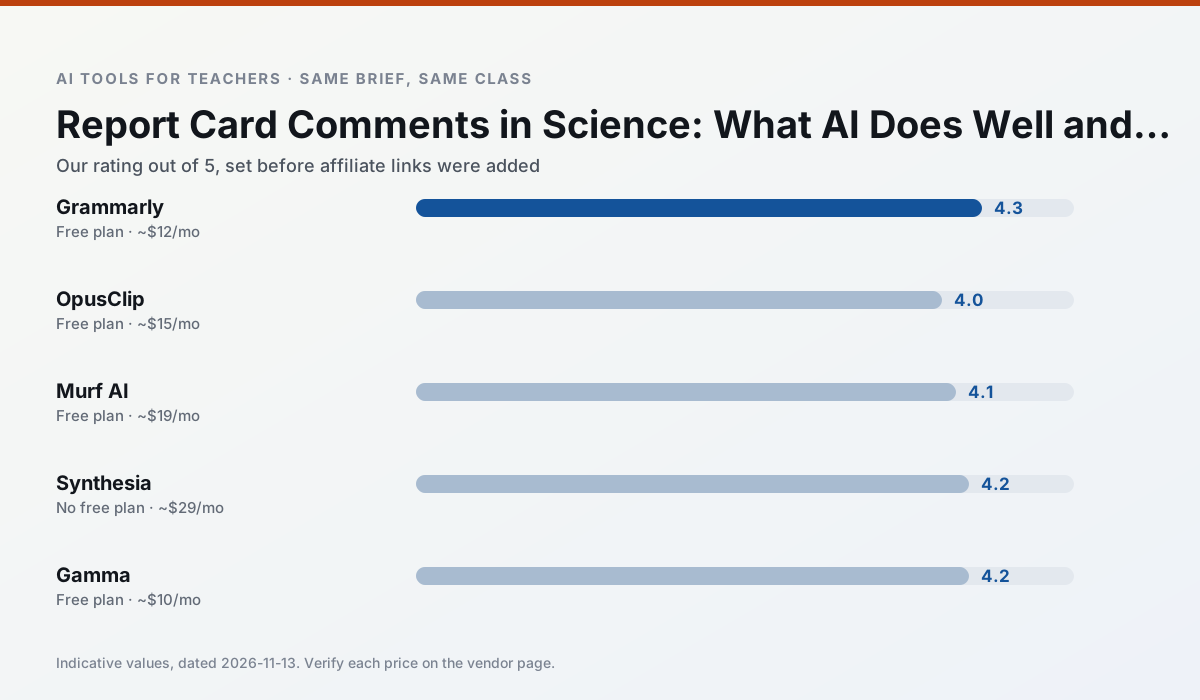
Side by side
Comparison table
Ratings reflect our timed classroom workflow, not vendor claims. Prices are indicative — verify on the vendor site.
| Tool | Best for | Free tier | Indicative paid plan | Standout feature | Our rating | Verdict | Try the tool |
|---|---|---|---|---|---|---|---|
| Grammarly | parent communication · report card comments | Yes — Core grammar and tone checks | ~$12 /user/mo | Tone adjustments | 4.3 / 5 | Strong option | Try free |
| OpusClip | PD materials · flipped lessons | Yes — Limited monthly clips | ~$15 /user/mo | Auto captions | 4.0 / 5 | Situational | Try free |
| Murf AI | audio lessons · accessibility | Yes — Trial-only output | ~$19 /user/mo | Voice fine-tuning | 4.1 / 5 | Situational | Try free |
| Synthesia | flipped lessons · video lessons | No ongoing free plan | ~$29 /user/mo | 140+ languages | 4.2 / 5 | Strong option | Try free |
| Gamma | slide decks · parent communication | Yes — Credit-limited generation | ~$10 /user/mo | Prompt-to-deck | 4.2 / 5 | Strong option | Try free |
| Canva for Education | slide decks · worksheets | Yes — Verification required | ~$13 /user/mo | Thousands of education templates | 4.6 / 5 | Top pick | Try free |
Match your situation
Best for X
Different jobs need different tools. Here is what we would open first in each case.
For anything students touch directly, Grammarly offers the supervision controls and logging that IT will ask about first.
OpusClip is the steadiest of this set at plain, respectful language; names and specific incidents still belong in your draft, not the prompt.
Murf AI produces levelled versions from one source in a single pass, which is the highest-value differentiation shortcut we tested at this level.
Setup cost is one login for Synthesia; everything else can wait until you know the tool is useful.
Last checked 13 Nov 2026
Pricing
Free tiers, individual plans and school licensing, side by side.
| Tool | Free plan | Individual / paid | School & district | Billing note | Verify |
|---|---|---|---|---|---|
| Grammarly | $0 — Core grammar and tone checks | ~$12 /user/mo | ~$15 /user/mo | Indicative — billed annually | Vendor |
| OpusClip | $0 — Limited monthly clips | ~$15 /user/mo | ~$29 /user/mo | Indicative — verify on vendor site | Vendor |
| Murf AI | $0 — Trial-only output | ~$19 /user/mo | ~$39 /user/mo | Indicative — verify on vendor site | Vendor |
| Synthesia | No ongoing free tier | ~$29 /user/mo | Custom quote | Indicative — verify on vendor site | Vendor |
| Gamma | $0 — Credit-limited generation | ~$10 /user/mo | ~$20 /user/mo | Indicative — verify on vendor site | Vendor |
| Canva for Education | $0 — Verification required | ~$13 /user/mo | Custom quote | Indicative — verify on vendor site | Vendor |
Editorial rule: pricing is re-checked every 2–3 months and the top 50 pages are refreshed every 6 months. See our funding policy.
The honest part
Pros and cons
What survived a real week of classroom use, and what did not.
Pros
- Catches errors in high-stakes parent emails
- Works everywhere you already write
- Very low learning curve
Cons
- Not education-specific
- Can flatten teacher voice
- Premium needed for tone rewriting
Pros
- Turns a recorded lesson into review clips
- Excellent captions
- Fast
Cons
- Optimised for social formats
- Not a lesson design tool
- Free plan is restrictive
Pros
- Very clean audio
- Good pacing controls
- Easy slide integration
Cons
- Commercial licensing rules matter
- Free tier is not usable long-term
- Single-purpose
Pros
- No camera or editing skills required
- Excellent multilingual voice output
- Easy updates to existing videos
Cons
- Cost is hard to justify for a single teacher
- Avatar video can feel impersonal
- No free ongoing tier
Pros
- Fastest path from outline to deck
- Modern-looking output by default
- Good export options
Cons
- Design control is limited
- Credits run out quickly
- Not built for student data
In the classroom
Use cases
Five concrete workflows, with the tool we would open for each one.
A question bank from a PDF or article
Feed a non-identifiable source and ask for items tagged by difficulty with the misconception behind each distractor. Spot-check every answer key; numerical items are least reliable.
Recommended: GrammarlyA substitute folder that needs no context
The value here is structure, not creativity. Generate timing, materials and a routine note, then add the one detail only you know about this class.
Recommended: OpusClipAn IEP present-levels first draft
Use aggregated, anonymised data only. Ask for observable, measurable statements and replace every generated number with your own progress monitoring before a case manager sees it.
Recommended: Murf AIA five-minute exit ticket set
Ask for one recall, one application and one reasoning item, then delete the second recall question every generator sneaks in.
Recommended: SynthesiaA parent email in two languages
Draft in plain, warm language with no names, translate, then back-translate the important sentences to check meaning. Keep specific incidents out of the prompt and add them yourself.
Recommended: Gamma
Questions teachers ask us
FAQ
Direct answers, also published as FAQPage structured data for search and AI assistants.
Can AI do report card comments at mixed-grade level?
Which tool is best for report card comments?
What is the biggest risk?
Sources & further reading
Our recommendation
Try Grammarly free for your next report card comments task
Writing assistant for polished parent emails, newsletters and reports. Start on the free tier, run one real science lesson, and only consider upgrading if the quota is what stops you. Disclosure: we may earn a commission ($20 per paid upgrade + $0.20/signup) at no extra cost to you.
Some links on this page are affiliate links. We may earn a commission at no extra cost to you. Our rankings are editorial and never pay-to-play. Never enter student PII into a free consumer account.
Keep reading
Related comparisons in this cluster.
Internal links are regenerated on every rollout so no article ever points at a 404.