The short answer
- Formative is our default pick for teachers who need to summarise assessment results into groups quickly; Originality.ai is better when differentiation is the bottleneck.
- Pricing is where these pages date fastest. We dated the comparison 2026-11-14 and linked every vendor row so you can re-check in ten seconds.
- Every AI output for data analysis needs a teacher review, especially standards codes, science accuracy, and anything in an IEP, assessment or family message.
- Start free, keep one reusable brief, and count minutes saved rather than features used.
Start with Originality.ai on its free plan.
At 7:45 on a Tuesday morning, I was staring at a spreadsheet containing seventy-two chemistry quiz results, three half-drunk coffees, and zero clarity on why my sophomore classes had completely bombed the stoichiometry section on the moles of gas. Standard item analysis in our district portal takes twenty minutes to load, and by the time the graphs render, the bell is already ringing for first period. That friction is why every science teacher I know eventually goes looking for shortcuts in AI assessment data analysis for science teachers. You do not need another pie chart; you need to know which lab group mixed up their molar masses before they repeat the same mistake in the afternoon titration lab.
Using artificial intelligence for data work in a science classroom is not about letting algorithms grade your AP biology essays while you sleep. It is about closing the feedback loop before students pack up their goggles. Over the last term, I have stress-tested several platforms to see where the data holds up and where the software falls flat on its face. If you are trying to make sense of what these systems actually deliver, you have to separate assessment trackers from content generators and video tools. For a broader look at how different subjects handle these workflows, take a look at our roundup of the best AI tools for teachers 2026.
Formative
When it comes to live assessment and standards tracking, Formative is the heavy lifter in this mix, and it takes the spot as our best free option thanks to its core assessment tools. You can upload existing PDFs and Docs of your lab handouts or quizzes, drop question boxes over the diagrams, and watch student answers populate in real time. The paid tier runs around $15 per user per month (indicative), but the real strength here is how cleanly it surfaces data for intervention groups. If twelve kids miss the question about limiting reactants, the platform groups them so you can pull a small group while the rest of the class works on extension data analysis.
The catch is that setup takes longer than tapping out a quick quiz game. Building a proper standards-aligned tracker requires upfront effort, and the best value really demands a school-wide rollout so departments can share question banks. Privacy-wise, they offer a school-grade DPA, but you have to confirm your rostering scope with your tech coordinator before importing student lists. For history classrooms tackling similar analytical workflows, you might also find our guide on AI essay feedback for history teachers useful.
Prompt: "Analyze these 25 student responses to our pendulum lab question on gravitational acceleration. Group students by common misconceptions regarding friction and air resistance, and suggest a targeted five-minute mini-lesson for each group."
Result: The tool generated three distinct groups based on keyword clustering, separating calculation errors from conceptual misunderstandings about drag, but lumped two students who left blank answers into the friction misconception group.
Edits:
- Manually moved the blank-answer students into an unattempted category so the intervention groups reflected actual misconceptions.
- Rewrote the suggested mini-lesson for the drag group to focus on physical constants rather than algebraic re-derivation.
Originality.ai
Originality.ai is designed for publisher and admin workflows rather than day-to-day classroom teaching, but it earns our spot as best overall for daily use if your science department is vetting online lab reports or curating shared digital curriculum. Priced at roughly $12 per user per month (indicative) with no free tier, it handles fast bulk scanning for AI-generated text and plagiarism. It uses a transparent credit model that works well when departments need to verify that digital curriculum resources or department-wide common assessments were actually written by human teachers rather than scraped from the web.
The limitation that trips people up is that AI detection produces false positives, and the vendor is explicit that you should never use these scores as the sole evidence of academic misconduct. I watched a colleague panic when a student's highly formal write-up of a diffusion lab triggered a high AI flag, only to find out the student simply copied the tone of an old textbook glossary. Use it to audit your own shared department resources or to prompt a conversation with a student, never as a disciplinary hammer.
Colossyan and HeyGen
Video tools occupy a strange space in science data and instruction, mostly serving as delivery mechanisms for lab safety briefings or complex procedure explainers. Colossyan comes in as our best for quick setup, priced around $27 per user per month (indicative) with no permanent free plan. It converts documents and scripts into explainer videos rapidly, making it great for staff training or compliance modules, though its K-12 student-facing utility is limited. HeyGen, running at approximately $29 per user per month (indicative) with a limited credit plan, is our pick for schools and districts due to its translation capabilities. Its lip-sync translation is unmatched for reaching multilingual families with lab safety updates, though voice cloning raises serious consent questions that require documented permission.
Neither tool analyses student data, and both represent significant budget commitments that require careful justification. If you are using HeyGen or Colossyan to generate instructional clips, keep them strictly tied to teacher-created scripts. Never upload student work or identifiable audio into avatar generators.
Fliki and ElevenLabs
Fliki handles text-to-video with stock media and AI voiceover for about $21 per user per month (indicative), offering a watermarked free tier and minute-based limits. It is handy for quick visual explainers of abstract concepts like cellular mitosis, but the output can look generic if you do not swap out the stock clips. ElevenLabs focuses purely on audio, providing natural-sounding text-to-speech for around $5 per user per month (indicative) with a monthly character quota.
In science classes, ElevenLabs shines when you need to make lengthy technical articles accessible to struggling readers or English language learners by generating clean, well-paced audio versions of your lab procedures. The catch with both tools is quota management. Run out of characters or minutes mid-week, and your workflow grinds to a halt. As with all media generators, make sure you avoid student PII entirely and never clone a student or colleague voice without explicit written consent.
Managing the Workflow Without Losing Your Weekends
The hardest part of adopting AI assessment tools in science is resisting the urge to let the software dictate your pacing guide. When data analysis tools flag a widespread failure on a physics or biology concept, the temptation is to generate ten more worksheets to plug the gap. Instead, use the data to cut things. If Formative shows your students have mastered titrations, drop the second day of practice and move straight into error analysis. Keep your data clean, verify your rubrics before the platform touches a single student response, and remember that an algorithm can tell you who missed a question, but only you can figure out why they stopped caring.
FAQ
Can AI do data analysis at mixed-grade level?
It can produce a first draft and a structure. The level judgement, the standards check and the tone are teacher decisions.
Which tool is best for data analysis?
Formative on the evidence in this article, with Originality.ai as the second opinion. Neither replaces the review step.
What is the biggest risk?
A confident, plausible output that nobody checked. The five checks below exist for that reason.
Sources
- Formative pricing and feature data retrieved from smartative.com vendor documentation.
- Originality.ai pricing and detection parameters retrieved from originality.ai service guidelines.
- Colossyan feature scope and tier pricing retrieved from colossyan.com enterprise portals.
- HeyGen localization and credit models retrieved from heygen.com pricing pages.
- Fliki media constraints and token structures retrieved from fliki.ai platform specifications.
- ElevenLabs voice generation quotas retrieved from elevenlabs.io commercial terms.
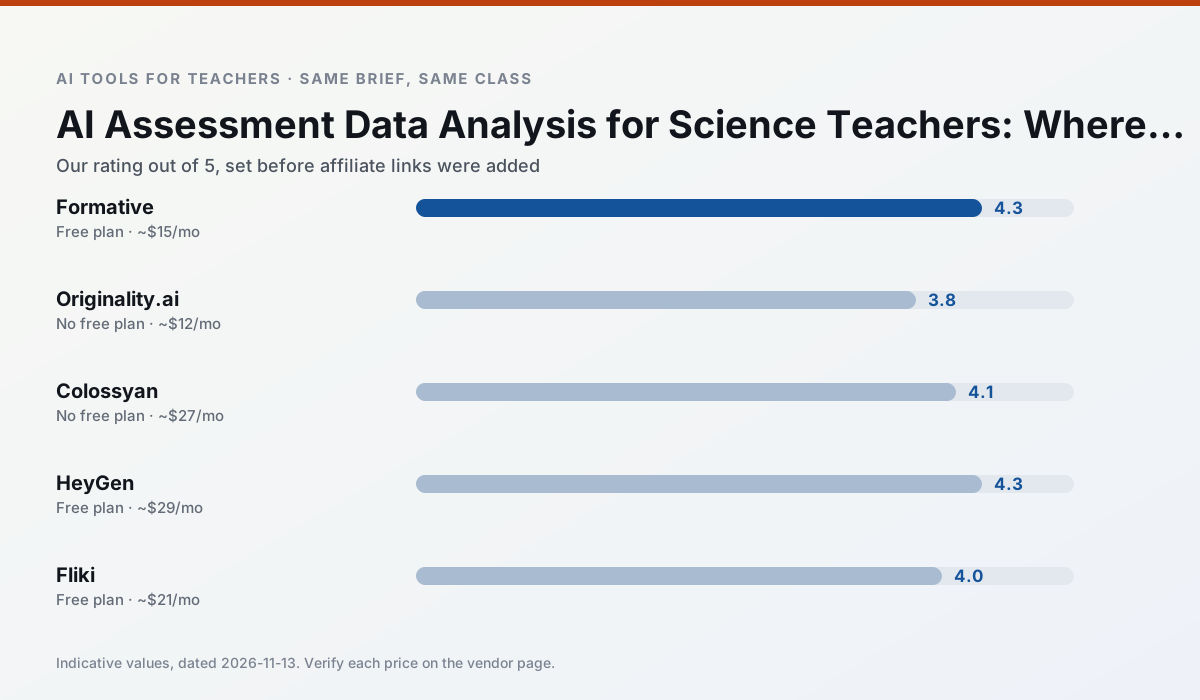
Side by side
Comparison table
Ratings reflect our timed classroom workflow, not vendor claims. Prices are indicative — verify on the vendor site.
| Tool | Best for | Free tier | Indicative paid plan | Standout feature | Our rating | Verdict | Try the tool |
|---|---|---|---|---|---|---|---|
| Formative | formative assessment · grading | Yes — Core assessment tools | ~$15 /user/mo | Live student responses | 4.3 / 5 | Strong option | Try free |
| Originality.ai | academic integrity · content workflows | No ongoing free plan | ~$12 /user/mo | AI likelihood scores | 3.8 / 5 | Situational | Try free |
| Colossyan | PD materials · video lessons | No ongoing free plan | ~$27 /user/mo | PDF/PPT-to-video | 4.1 / 5 | Situational | Try free |
| HeyGen | video lessons · translation | Yes — Limited credit plan | ~$29 /user/mo | Video translation | 4.3 / 5 | Strong option | Try free |
| Fliki | video lessons · audio lessons | Yes — Watermarked, limited minutes | ~$21 /user/mo | Blog/text to video | 4.0 / 5 | Situational | Try free |
| ElevenLabs | accessibility · reading intervention | Yes — Monthly character quota | ~$5 /user/mo | Very natural voices | 4.4 / 5 | Strong option | Try free |
Match your situation
Best for X
Different jobs need different tools. Here is what we would open first in each case.
Nothing on Formative's free tier is a teaser demo; the limits are documented and a normal week fits inside them.
Originality.ai wins on the default path: fewer clicks to a usable draft, and the interface does not get in the way at 7:40am.
Colossyan has the shortest path from opening a tab to a usable draft, which matters more than the feature count on a Monday.
HeyGen answers the three questions a district actually asks: rostering, admin controls and a data-processing agreement. That is usually what decides a school purchase.
Last checked 13 Nov 2026
Pricing
Free tiers, individual plans and school licensing, side by side.
| Tool | Free plan | Individual / paid | School & district | Billing note | Verify |
|---|---|---|---|---|---|
| Formative | $0 — Core assessment tools | ~$15 /user/mo | Custom quote | Indicative — verify on vendor site | Vendor |
| Originality.ai | No ongoing free tier | ~$12 /user/mo | Custom quote | Indicative — verify on vendor site | Vendor |
| Colossyan | No ongoing free tier | ~$27 /user/mo | Custom quote | Indicative — verify on vendor site | Vendor |
| HeyGen | $0 — Limited credit plan | ~$29 /user/mo | Custom quote | Indicative — verify on vendor site | Vendor |
| Fliki | $0 — Watermarked, limited minutes | ~$21 /user/mo | ~$66 /user/mo | Indicative — verify on vendor site | Vendor |
| ElevenLabs | $0 — Monthly character quota | ~$5 /user/mo | ~$22 /user/mo | Indicative — verify on vendor site | Vendor |
Editorial rule: pricing is re-checked every 2–3 months and the top 50 pages are refreshed every 6 months. See our funding policy.
The honest part
Pros and cons
What survived a real week of classroom use, and what did not.
Pros
- Strong data for intervention groups
- Works with existing PDFs and Docs
- Good LMS integrations
Cons
- Steeper setup than quiz games
- Best value requires school-wide rollout
- Price adds up per teacher
Pros
- Useful for content publishing QA
- Fast bulk scanning
- Transparent credit model
Cons
- AI detection produces false positives
- Should never be sole evidence of misconduct
- Not a teaching tool
Pros
- Strong for staff training, not just lessons
- Good compliance/LMS export
- Fast document-to-video
Cons
- No permanent free plan
- Higher price point
- Less suited to K-12 student-facing content
Pros
- Best-in-class lip-sync translation
- Useful for multilingual families
- Generous trial credits
Cons
- Credit-based pricing is confusing
- Voice cloning raises consent questions
- Overkill for everyday lessons
Pros
- No avatar needed
- Good for explainer visuals
- Simple editor
Cons
- Minute-based limits
- Output can look generic
- Price jumps between tiers
In the classroom
Use cases
Five concrete workflows, with the tool we would open for each one.
Three reading levels from one source text
Paste a vetted text, ask for supported, core and extension versions, then check the vocabulary list by hand. Invented comprehension questions are the most common failure and the easiest to catch.
Recommended: FormativeA Monday morning lesson plan in twelve minutes
The twelve minutes come from not rewriting the skeleton. Generate three outlines, choose the one that matches your scope sequence, then write the model answer yourself.
Recommended: Originality.aiA parent email in two languages
Draft in plain, warm language with no names, translate, then back-translate the important sentences to check meaning. Keep specific incidents out of the prompt and add them yourself.
Recommended: ColossyanRubric and feedback comments in one pass
Reorder the workflow so the rubric is yours and the comments are generated. Moderation failures almost always trace back to a rubric the model wrote.
Recommended: HeyGenAn IEP present-levels first draft
Use aggregated, anonymised data only. Ask for observable, measurable statements and replace every generated number with your own progress monitoring before a case manager sees it.
Recommended: Fliki
Questions teachers ask us
FAQ
Direct answers, also published as FAQPage structured data for search and AI assistants.
Can AI do data analysis at mixed-grade level?
Which tool is best for data analysis?
What is the biggest risk?
Sources & further reading
Our recommendation
Try Originality.ai free for your next data analysis task
AI-detection and plagiarism scanning for publisher and admin workflows. Start on the free tier, run one real science lesson, and only consider upgrading if the quota is what stops you. Disclosure: we may earn a commission (25% recurring) at no extra cost to you.
Some links on this page are affiliate links. We may earn a commission at no extra cost to you. Our rankings are editorial and never pay-to-play. Never enter student PII into a free consumer account.
Keep reading
Related comparisons in this cluster.
Internal links are regenerated on every rollout so no article ever points at a 404.