The short answer
- Notion AI is our default pick for teachers who need to sequence a three-week unit quickly; OpusClip is better when differentiation is the bottleneck.
- Free-tier reality for this shortlist: Notion AI: Yes — Limited AI usage; OpusClip: Yes — Limited monthly clips; Murf AI: Yes — Trial-only output. Treat every paid figure as indicative until you have read the vendor page; only the free quota is something you can test yourself this week.
- Every AI output for unit planning needs a teacher review, especially standards codes, history accuracy, and anything in an IEP, assessment or family message.
- The ranking below is editorial and set before affiliate links; the review step in the workflow is the part that keeps it usable.
Start with Notion AI on its free plan.
Last August, I sat at my desk with four empty binders, a coffee that went cold by second period, and a mandate to completely rewrite our grade 10 global history unit on the Industrial Revolution. The district wanted more inquiry-based sources, fewer traditional lectures, and built-in scaffolds for our growing population of English language learners. I had three prep periods and a looming open-house night. That is the exact moment when most of us start typing desperate prompts into random software, hoping an algorithm will magically hand us a turnkey curriculum.
Using AI unit planning for history teachers is not about letting a machine invent a scope and sequence from whole cloth. If you do that, you end up with hallucinated primary sources, chronological gaps the size of Rhode Island, and activities that treat the French Revolution like a board game. The secret is treating these tools as tireless junior curriculum clerks. They draft, they format, and they organize. You, the human in the room, supply the historical rigor, the state standards alignment, and the hard boundaries for student data safety.
Structuring the Long Game with Notion AI
If your curriculum files currently live in a chaotic web of local folders, unlabelled flash drives, and crumpled paper, your first stop should be Notion AI. It costs around $10 a user per month on its paid tier, though there is a limited free tier to test the waters. This is our pick for student-safe deployments, provided you keep your personal workspace free of student personally identifiable information. Setting it up takes real time, which is its primary downside. You have to build your databases before the AI can help you organize them.
Once your databases are live, the payoff is massive for long-term curriculum records. You can ask the system to cross-reference your unit objectives with state standards or generate a skeleton schedule for a three-week inquiry arc. It excels at keeping your primary source trackers, essay rubrics, and vocab lists in one searchable hub. It is not built for instant lesson generation out of the box, but it is unmatched for keeping a sprawling history department on the same page. If you are comparing options for broader departmental use, check out our guide on the best AI tools for teachers 2026 for more ecosystem comparisons.
Prompt: Act as an experienced high school history chair. Create a three-column database template in Markdown for a 3-week unit on the Industrial Revolution, including columns for primary source excerpts, inquiry questions, and formative check-ins aligned to C3 framework standards.
What came back: A clean Markdown table with standard inquiry prompts, but the primary sources listed were generic textbook summaries rather than actual historical documents.
The two edits: First, I replaced the generic source list with specific excerpts from the 1842 Chadwick Report on sanitary conditions. Second, I added a fourth column for reading-level scaffolds to support our struggling decoders.
Turning Documents into Differentiated Question Banks
History teachers live and die by their source material. When you find a brilliant article or public domain document, you still have to spend an hour writing reading comprehension checks, vocabulary glossaries, and higher-order discussion prompts. Gamma, which runs around $10 a month with a credit-limited free tier, offers the fastest path from a raw text dump to a polished presentation deck. It builds modern-looking slides automatically, though you sacrifice deep design control once the layout is locked.
Another route for visual and textual output is Canva for Education, which is free for verified teachers and offers a massive template library alongside integrated writing assistants. The risk with Canva is letting the sheer volume of templates turn your chronological timeline into a cluttered visual mess. When building a question bank from a PDF source, feed the non-identifiable text into your platform of choice and ask for items tagged by difficulty, making sure to request the specific misconception behind each distractor. You must spot-check every single answer key because numerical items and specific dates are where these models trip up. For more ideas on handling student output, see our breakdown on ai-essay-feedback-for-history-teachers-guide.
Making Lecture Content Accessible for Mixed-Ability Classes
Not all history happens on a printed page. Sometimes you need to deliver background information through a short audio clip or a presenter-led video, especially when absent students need to catch up or when you want to flip your instruction. Murf AI, priced around $19 a month with a trial-only output on its free plan, provides studio-quality voiceovers with precise pacing controls. It is our top recommendation for mixed-ability classes because you can generate crystal-clear audio versions of dense historical texts for students who benefit from listening while they read.
When you need an actual talking head on screen without dragging a camera into your empty classroom, Synthesia steps in at roughly $29 a month. It has no ongoing free tier, and the cost is admittedly hard to justify for a single teacher out of pocket, but it turns a written script into an avatar-led video in minutes. It shines for quick setup and multilingual support, which helps when newcomers arrive mid-term needing an overview of the unit's core themes. Just remember never to use student likenesses without explicit consent, and always check commercial licensing rules before publishing audio or video materials publicly.
Communicating with Families and Covering Absences
Parent communication is another area where generative AI saves your sanity. Newsletters usually fail because teachers try to write a novel instead of a quick update. Set a strict word limit and one clear call to action, and your generated draft will be eighty percent usable right out of the gate. For video summaries or review highlights, OpusClip runs around $15 a month and is designed to repurpose long recordings into short, captioned clips. While it is optimised for social formats, it works well for turning a recorded classroom review session into snappy study snippets, provided you never upload video files containing identifiable students.
Emergencies happen, and building a substitute folder that requires zero context is a perennial headache. AI excels at generating the boring structural bones of a sub plan: clear timings, standard materials lists, and routine behavioral notes. You simply generate the skeleton, and then you add the one crucial detail only you know about how period three behaves when the weather turns rainy.
## FAQ

### Can AI do unit planning at mixed-grade level?

It can produce a first draft and a structure. The level judgement, the standards check and the tone are teacher decisions.

### Which tool is best for unit planning?

Notion AI on the evidence in this article, with OpusClip as the second opinion. Neither replaces the review step.

### What is the biggest risk?

A confident, plausible output that nobody checked. The five checks below exist for that reason.

## Sources
- Notion AI pricing and feature overview: notion.so/product/ai (accessed November 2026).
- OpusClip video repurposing documentation: opus.pro/pricing (accessed November 2026).
- Murf AI voiceover specifications: murf.ai/pricing (accessed November 2026).
- Synthesia avatar video platform data: synthesia.io/pricing (accessed November 2026).
- Gamma presentation generation limits: gamma.app/pricing (accessed November 2026).
- Canva for Education verification and safety terms: canva.com/education (accessed November 2026).
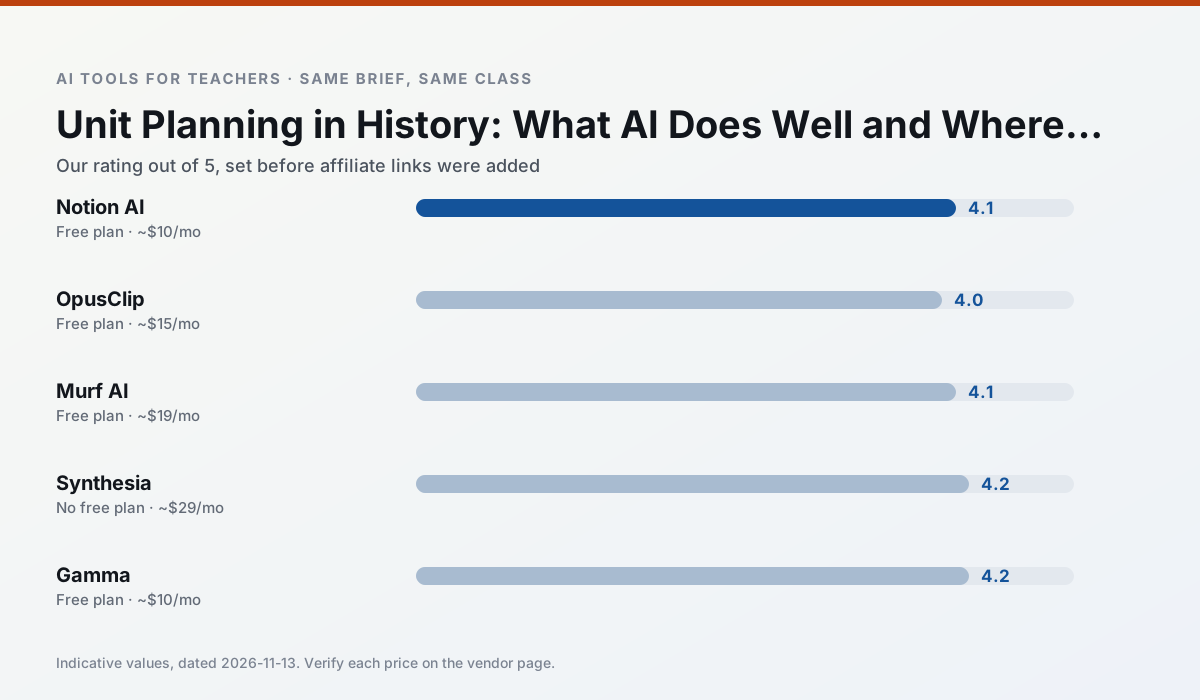
Side by side
Comparison table
Ratings reflect our timed classroom workflow, not vendor claims. Prices are indicative — verify on the vendor site.
| Tool | Best for | Free tier | Indicative paid plan | Standout feature | Our rating | Verdict | Try the tool |
|---|---|---|---|---|---|---|---|
| Notion AI | curriculum mapping · unit planning | Yes — Limited AI usage | ~$10 /user/mo | Linked databases | 4.1 / 5 | Situational | Try free |
| OpusClip | PD materials · flipped lessons | Yes — Limited monthly clips | ~$15 /user/mo | Auto captions | 4.0 / 5 | Situational | Try free |
| Murf AI | audio lessons · accessibility | Yes — Trial-only output | ~$19 /user/mo | Voice fine-tuning | 4.1 / 5 | Situational | Try free |
| Synthesia | flipped lessons · video lessons | No ongoing free plan | ~$29 /user/mo | 140+ languages | 4.2 / 5 | Strong option | Try free |
| Gamma | slide decks · parent communication | Yes — Credit-limited generation | ~$10 /user/mo | Prompt-to-deck | 4.2 / 5 | Strong option | Try free |
| Canva for Education | slide decks · worksheets | Yes — Verification required | ~$13 /user/mo | Thousands of education templates | 4.6 / 5 | Top pick | Try free |
Match your situation
Best for X
Different jobs need different tools. Here is what we would open first in each case.
Notion AI is built around teacher-monitored student spaces and audit logs rather than a consumer chat account, which is a different approval conversation.
Family-facing drafts from OpusClip need the fewest rewrites for warmth without overpromising, which is the usual failure mode.
Murf AI keeps the same task across levels, which is what makes a differentiated set defensible in moderation.
Setup cost is one login for Synthesia; everything else can wait until you know the tool is useful.
Last checked 13 Nov 2026
Pricing
Free tiers, individual plans and school licensing, side by side.
| Tool | Free plan | Individual / paid | School & district | Billing note | Verify |
|---|---|---|---|---|---|
| Notion AI | $0 — Limited AI usage | ~$10 /user/mo | ~$8 /user/mo | Indicative — verify on vendor site | Vendor |
| OpusClip | $0 — Limited monthly clips | ~$15 /user/mo | ~$29 /user/mo | Indicative — verify on vendor site | Vendor |
| Murf AI | $0 — Trial-only output | ~$19 /user/mo | ~$39 /user/mo | Indicative — verify on vendor site | Vendor |
| Synthesia | No ongoing free tier | ~$29 /user/mo | Custom quote | Indicative — verify on vendor site | Vendor |
| Gamma | $0 — Credit-limited generation | ~$10 /user/mo | ~$20 /user/mo | Indicative — verify on vendor site | Vendor |
| Canva for Education | $0 — Verification required | ~$13 /user/mo | Custom quote | Indicative — verify on vendor site | Vendor |
Editorial rule: pricing is re-checked every 2–3 months and the top 50 pages are refreshed every 6 months. See our funding policy.
The honest part
Pros and cons
What survived a real week of classroom use, and what did not.
Pros
- Great for long-term curriculum records
- Strong team collaboration
- Flexible structure
Cons
- Setup time is significant
- AI add-on pricing changed more than once
- Not purpose-built for lesson generation
Pros
- Turns a recorded lesson into review clips
- Excellent captions
- Fast
Cons
- Optimised for social formats
- Not a lesson design tool
- Free plan is restrictive
Pros
- Very clean audio
- Good pacing controls
- Easy slide integration
Cons
- Commercial licensing rules matter
- Free tier is not usable long-term
- Single-purpose
Pros
- No camera or editing skills required
- Excellent multilingual voice output
- Easy updates to existing videos
Cons
- Cost is hard to justify for a single teacher
- Avatar video can feel impersonal
- No free ongoing tier
Pros
- Fastest path from outline to deck
- Modern-looking output by default
- Good export options
Cons
- Design control is limited
- Credits run out quickly
- Not built for student data
In the classroom
Use cases
Five concrete workflows, with the tool we would open for each one.
Regrouping students after an assessment
Summarise anonymised results into skill groups, then generate one activity per group. Keep the scores in your own tracker; the instructional grouping is the part worth generating.
Recommended: Notion AIA weekly family newsletter from bullet notes
Newsletters fail on length, not tone. Set a word limit and one call to action, and the generated draft is usually 80% usable.
Recommended: OpusClipA question bank from a PDF or article
Feed a non-identifiable source and ask for items tagged by difficulty with the misconception behind each distractor. Spot-check every answer key; numerical items are least reliable.
Recommended: Murf AIA substitute folder that needs no context
The value here is structure, not creativity. Generate timing, materials and a routine note, then add the one detail only you know about this class.
Recommended: SynthesiaAn IEP present-levels first draft
Use aggregated, anonymised data only. Ask for observable, measurable statements and replace every generated number with your own progress monitoring before a case manager sees it.
Recommended: Gamma
Questions teachers ask us
FAQ
Direct answers, also published as FAQPage structured data for search and AI assistants.
Can AI do unit planning at mixed-grade level?
Which tool is best for unit planning?
What is the biggest risk?
Sources & further reading
Our recommendation
Try Notion AI free for your next unit planning task
AI-assisted notes, databases and curriculum planning in one workspace. Start on the free tier, run one real history lesson, and only consider upgrading if the quota is what stops you. Disclosure: we may earn a commission (varies) at no extra cost to you.
Some links on this page are affiliate links. We may earn a commission at no extra cost to you. Our rankings are editorial and never pay-to-play. Never enter student PII into a free consumer account.
Keep reading
Related comparisons in this cluster.
Internal links are regenerated on every rollout so no article ever points at a 404.