The short answer
- Quizizz is our default pick for teachers who need to build a balanced question set quickly; Kahoot! is better when differentiation is the bottleneck.
- The cheapest honest test is a week of real work on the free plans: Quizizz: Yes — Core quiz creation; Kahoot!: Yes — Limited player count; QuestionWell: Yes — Monthly generation limit. If a tool is still open on Friday, it has earned a paid conversation.
- Every AI output for quiz generation needs a teacher review, especially standards codes, science accuracy, and anything in an IEP, assessment or family message.
- Everything on this page dates from 2026-11-13; where a price could not be re-read, the row says so.
Start with ElevenLabs on its free plan.
It is Thursday night at 8:45 PM, and I am looking at thirty blank exit ticket cards on my desk alongside a state science standard about energy transfer that I am fairly certain my eighth graders did not absorb today. Writing four plausible multiple-choice distractors for twenty-four distinct lab groups used to take me forty minutes of heavy lifting. When we talk about AI quiz generation for science teachers, we are not talking about replacing pedagogy or handing our classrooms over to Silicon Valley. We are talking about buying back our evenings so we do not burn out by Thanksgiving.
Science teachers face a specific puzzle when using automated generation tools. A history teacher can prompt for an essay prompt and let students argue the nuances, but a science quiz requires precision. If the model invents a wrong distractor that actually sounds scientifically plausible to a thirteen-year-old, you have just taught a misconception. Over the past term, I put a half-dozen generation platforms through the grinder of real classroom use, testing where they actually save time and where they quietly fail us.
QuestionWell: Best for Standards-Aligned Question Banks
If your primary bottleneck is writing curriculum-aligned questions from scratch, QuestionWell takes the crown as our pick for schools and districts. You drop in a block of text or a specific state standard, and it spits out a structured bank of multiple-choice questions complete with objective tagging. It is a single-purpose tool, which is both its blessing and its curse. It does not try to host games or track your gradebook; it just builds the raw material.
The free tier gives you a monthly generation limit, while the paid tier runs around $10 per user per month. The clean export workflow is where you save hours, letting you push straight into your preferred platform. The catch is that question quality varies wildly depending on the source text you feed it. If you paste a muddy, dense article on cellular respiration, the resulting questions will test vocabulary rather than conceptual understanding.
Prompt: Generate ten multiple-choice questions aligned to NGSS MS-LS1-6 for eighth graders, focusing on photosynthesis and energy storage, with four options each.
Result: The tool returned ten clean questions, but two distractors for the carbon dioxide input question were factually overlapping and confusing.
Edit 1: Rewrote the second distractor to target the common misconception that plants get their mass from soil rather than gas.
Edit 2: Adjusted the difficulty rating tag on question eight from core to extension.
Quizizz: Best Overall for Daily Use
For daily formative assessment, Quizizz remains our best overall tool. Students already know the interface from half their other classes, which cuts training time down to zero. You can use its AI-assisted quiz creation to bulk up a review session, drawing from a massive existing question bank. The reporting dashboard is genuinely useful for spotting class-wide gaps the morning after a homework assignment.
At about $15 per user per month for the paid tier, with core quiz creation on the free side, it hits most classroom budgets. The interface runs smoothly on low-end school-issued Chromebooks that choke on heavier web apps. The main limitation is that writing high-quality AI questions still demands a careful human read-through. Gamification elements like memes and timer bonuses can also distract students who treat the review as a button-mashing contest rather than an assessment of thermal energy. Keep in mind that advanced analytics require the paid subscription, and you should always verify district COPPA and FERPA compliance before pushing rosters. For broader context on how these systems fit into modern classrooms, check out the best AI tools for teachers in 2026.
Kahoot!: Best Free Option
When you need immediate engagement on a Friday afternoon before a long weekend, Kahoot! is unmatched for quick review lessons. The brand familiarity is absolute; students hear the lobby music and instantly lock in. The AI-assisted question generation feature helps you spin up a game from a pasted article in under two minutes.
The free tier limits your player count, while paid options sit around $10 per user per month. The biggest strength is instantaneous energy and zero learning curve. The major limit for science teachers is that time pressure heavily favors rapid recall over deep scientific reasoning. You cannot easily assess a student's ability to analyze an experimental graph when they are trying to answer a multiple-choice prompt in twelve seconds. For younger learners, use pseudonyms or nicknames rather than real names to keep data private. If you are looking at similar lightweight assessment strategies across other subjects, take a look at our guide on AI exit tickets for ELA teachers.
ElevenLabs: Best for Quick Setup and Accessible Audio
Science is full of complex reading passages, lab safety documents, and multi-step procedures that trip up our struggling readers. ElevenLabs provides natural-sounding AI voiceover and text-to-speech that turns dry text into clear audio files in seconds. It is our top pick for quick setup when you need to make reading materials accessible without spending your Sunday recording yourself reading aloud.
The free tier offers a monthly character quota, and paid plans start around $5 per user per month. The entry price is low, and the voice generation speed is remarkable. However, it is fundamentally a content tool rather than a teaching platform. You will run into quota-based billing if you try to convert an entire textbook, and you must never clone a student's or colleague's voice without explicit written consent.
Fliki and Gamma: Visuals and Decks
When you need to turn a complex lab breakdown into an explainer visual or an entire slide deck from a single prompt, Fliki and Gamma step in. Fliki handles text-to-video with stock media and AI voiceovers for roughly $21 per user per month on its paid tier, with a watermarked free tier. Gamma generates presentation decks from a text prompt for about $10 per user per month. Both tools are lightning fast at getting a skeleton outline onto a screen, saving you from starting with a blank slide.
Both tools share the same fundamental limit: they are content creation platforms, not student data systems. You should never upload student work or personally identifiable information into them. Fliki's output can look generic if you do not swap out the stock media, and Gamma's design control is limited once the initial deck generates. Use them to draft your Monday morning lesson introduction in twelve minutes, then build out the actual inquiry-based lab work yourself.
What Went Wrong in Real Use
Using these tools in a live classroom taught me two hard lessons this term. First, I tried to generate three different reading levels from one source text on plate tectonics for my periods with diverse learners. The generated vocabulary lists were mostly fine, but the AI-invented comprehension questions were complete garbage, testing trivial details instead of the core subduction concepts. I spent more time fixing the questions than it would have taken to write them manually. The fix is simple: use AI to level the text, but write your own assessment questions based on what you actually emphasized during direct instruction.
Second, I tried to batch-generate lab rubric feedback comments in one pass alongside my quiz scores. Because I let the model write both the rubric criteria and the feedback sentences, the resulting moderation was a disaster. Students received conflicting explanations for why they lost points on their titration lab. Moderation failures almost always trace back to a rubric the model wrote for you. Now, I keep the rubric strictly my own and only use generation tools to vary the phrasing of supportive feedback comments. Keep your hand on the wheel, and these tools will earn their keep.
FAQ
Can AI do quiz generation at mixed-grade level?
It can produce a first draft and a structure. The level judgement, the standards check and the tone are teacher decisions.
Which tool is best for quiz generation?
Quizizz on the evidence in this article, with Kahoot! as the second opinion. Neither replaces the review step.
What is the biggest risk?
A confident, plausible output that nobody checked. The five checks below exist for that reason.
Sources
- Quizizz Vendor Overview and Pricing, quizizz.com
- Kahoot! Educator Features and Plans, kahoot.com
- QuestionWell Documentation, questionwell.ai
- ElevenLabs Safety and Pricing Guidelines, elevenlabs.io
- Fliki Generative Media Specs, fliki.ai
- Gamma App Features, gamma.app
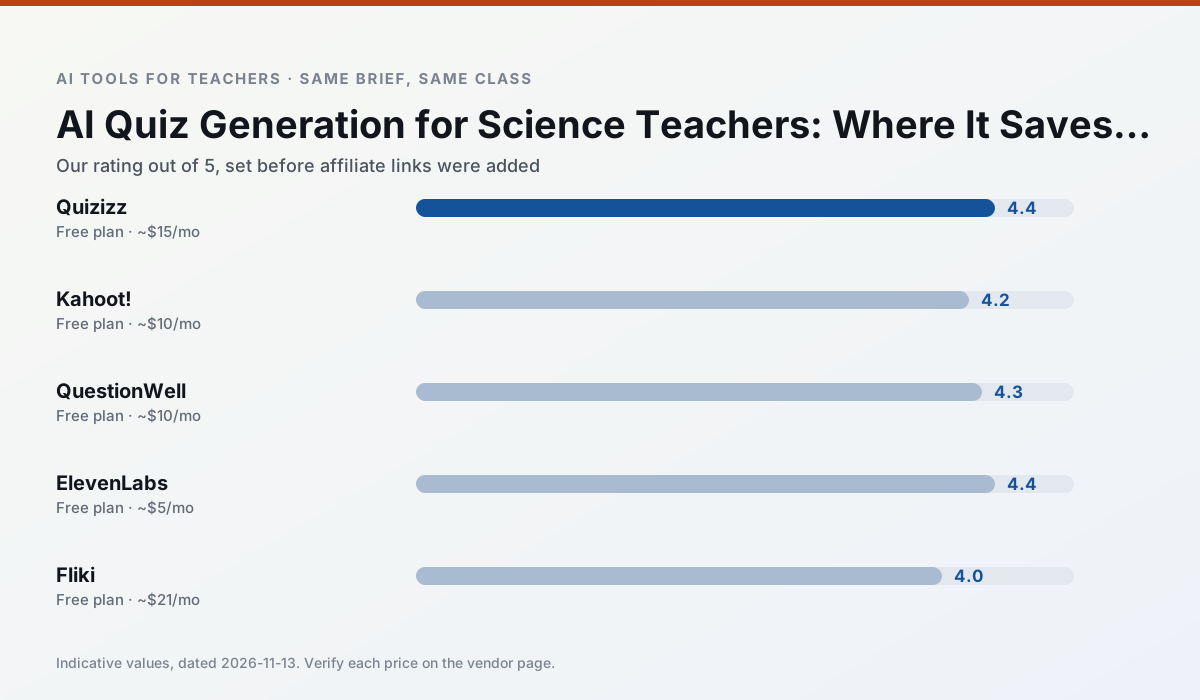
Side by side
Comparison table
Ratings reflect our timed classroom workflow, not vendor claims. Prices are indicative — verify on the vendor site.
| Tool | Best for | Free tier | Indicative paid plan | Standout feature | Our rating | Verdict | Try the tool |
|---|---|---|---|---|---|---|---|
| Quizizz | quiz generation · formative assessment | Yes — Core quiz creation | ~$15 /user/mo | AI question generator | 4.4 / 5 | Strong option | Try free |
| Kahoot! | quiz generation · review lessons | Yes — Limited player count | ~$10 /user/mo | AI question builder | 4.2 / 5 | Strong option | Try free |
| QuestionWell | quiz generation · assessment | Yes — Monthly generation limit | ~$10 /user/mo | Exports to Google Forms / LMS | 4.3 / 5 | Strong option | Try free |
| ElevenLabs | accessibility · reading intervention | Yes — Monthly character quota | ~$5 /user/mo | Very natural voices | 4.4 / 5 | Strong option | Try free |
| Fliki | video lessons · audio lessons | Yes — Watermarked, limited minutes | ~$21 /user/mo | Blog/text to video | 4.0 / 5 | Situational | Try free |
| Gamma | slide decks · parent communication | Yes — Credit-limited generation | ~$10 /user/mo | Prompt-to-deck | 4.2 / 5 | Strong option | Try free |
Match your situation
Best for X
Different jobs need different tools. Here is what we would open first in each case.
On the daily cycle, Quizizz saves the most edit time per task; the paid tier mostly buys more runs rather than better ones.
Kahoot!'s free plan is the most usable in this comparison: a quota that survives a normal week. Not enough for a department, enough for one teacher to decide.
For a school rollout, QuestionWell offers the paperwork and the admin console; the classroom features are standard by comparison.
ElevenLabs runs in a browser tab with no extension, no student accounts and no onboarding call, so you can test it in a free period.
Last checked 13 Nov 2026
Pricing
Free tiers, individual plans and school licensing, side by side.
| Tool | Free plan | Individual / paid | School & district | Billing note | Verify |
|---|---|---|---|---|---|
| Quizizz | $0 — Core quiz creation | ~$15 /user/mo | Custom quote | Indicative — verify on vendor site | Vendor |
| Kahoot! | $0 — Limited player count | ~$10 /user/mo | Custom quote | Indicative — verify on vendor site | Vendor |
| QuestionWell | $0 — Monthly generation limit | ~$10 /user/mo | Custom quote | Indicative — verify on vendor site | Vendor |
| ElevenLabs | $0 — Monthly character quota | ~$5 /user/mo | ~$22 /user/mo | Indicative — verify on vendor site | Vendor |
| Fliki | $0 — Watermarked, limited minutes | ~$21 /user/mo | ~$66 /user/mo | Indicative — verify on vendor site | Vendor |
| Gamma | $0 — Credit-limited generation | ~$10 /user/mo | ~$20 /user/mo | Indicative — verify on vendor site | Vendor |
Editorial rule: pricing is re-checked every 2–3 months and the top 50 pages are refreshed every 6 months. See our funding policy.
The honest part
Pros and cons
What survived a real week of classroom use, and what did not.
Pros
- Students already know the interface
- Good reporting
- Works on low-end devices
Cons
- Writing high-quality AI questions still needs review
- Gamification can distract
- Advanced analytics are paid
Pros
- Instant engagement
- Very low training time
- Strong brand familiarity
Cons
- Less depth for higher-order assessment
- Paid tiers needed for larger classes
- Time pressure suits recall more than reasoning
Pros
- Saves the most time on question writing
- Clean export workflow
- Good objective tagging
Cons
- Single-purpose tool
- Question quality varies by source text
- Limited student-facing features
Pros
- Excellent for accessible audio versions
- Low entry price
- Fast generation
Cons
- Quota-based billing
- Voice cloning consent considerations
- Not a teaching platform
Pros
- No avatar needed
- Good for explainer visuals
- Simple editor
Cons
- Minute-based limits
- Output can look generic
- Price jumps between tiers
In the classroom
Use cases
Five concrete workflows, with the tool we would open for each one.
A weekly family newsletter from bullet notes
Newsletters fail on length, not tone. Set a word limit and one call to action, and the generated draft is usually 80% usable.
Recommended: QuizizzRegrouping students after an assessment
Summarise anonymised results into skill groups, then generate one activity per group. Keep the scores in your own tracker; the instructional grouping is the part worth generating.
Recommended: Kahoot!A Monday morning lesson plan in twelve minutes
The twelve minutes come from not rewriting the skeleton. Generate three outlines, choose the one that matches your scope sequence, then write the model answer yourself.
Recommended: QuestionWellThree reading levels from one source text
Paste a vetted text, ask for supported, core and extension versions, then check the vocabulary list by hand. Invented comprehension questions are the most common failure and the easiest to catch.
Recommended: ElevenLabsRubric and feedback comments in one pass
Reorder the workflow so the rubric is yours and the comments are generated. Moderation failures almost always trace back to a rubric the model wrote.
Recommended: Fliki
Questions teachers ask us
FAQ
Direct answers, also published as FAQPage structured data for search and AI assistants.
Can AI do quiz generation at mixed-grade level?
Which tool is best for quiz generation?
What is the biggest risk?
Sources & further reading
Our recommendation
Try ElevenLabs free for your next quiz generation task
Natural-sounding AI voiceover and text-to-speech for learning materials. Start on the free tier, run one real science lesson, and only consider upgrading if the quota is what stops you. Disclosure: we may earn a commission (22% recurring) at no extra cost to you.
Some links on this page are affiliate links. We may earn a commission at no extra cost to you. Our rankings are editorial and never pay-to-play. Never enter student PII into a free consumer account.
Keep reading
Related comparisons in this cluster.
Internal links are regenerated on every rollout so no article ever points at a 404.