The short answer
- Notion AI is our default pick for teachers who need to sequence a three-week unit quickly; Murf AI is better when differentiation is the bottleneck.
- All 3 shortlisted tools are priced for one teacher first and a school second. Notion AI and Murf AI are the two worth trialling on a real task before any purchase conversation.
- Every AI output for unit planning needs a teacher review, especially standards codes, STEM accuracy, and anything in an IEP, assessment or family message.
- Everything on this page dates from 2026-11-13; where a price could not be re-read, the row says so.
Start with Notion AI on its free plan.
It was four days before the start of our kinematics unit, and my scope-and-sequence document was a graveyard of broken links and empty date cells. I had thirty-two high school physics students coming through the door on Monday morning, a lab budget that covered roughly half the required spring scales, and a district curriculum guide written in 2014. That is the exact moment a teacher starts looking for shortcuts. We need tools that handle the grunt work of structuring three weeks of mechanics without hallucinating lab safety protocols or turning complex engineering standards into fluff. Using AI unit planning for stem teachers is not about letting a machine teach your class. It is about reclaiming your weekends so you have the bandwidth to actually troubleshoot student misconceptions on Tuesday afternoon.
Structuring the Long-Term Map with Notion AI
When you are mapping an entire grading period, you need a workspace that holds databases, standards alignments, and daily notes in one place without breaking. Notion AI has become my anchor for long-term curriculum records because it functions like a relational filing cabinet rather than a glorified chat window. You can link your state science standards directly to specific project milestones and assessment dates. The free tier offers limited AI usage, while the paid version runs around $10 per user per month. The catch is that setup time is significant. You have to build or adapt the templates yourself before the machine learning features can actually help you.
PROMPT: Act as a veteran high school physics teacher. Outline a 3-week unit on conservation of momentum for mixed-ability 11th graders. Include 3 labs, 2 formative check-points, and differentiated support for students who struggle with algebraic rearrangement.

INITIAL OUTPUT: A standard 3-week block listing generic egg-drop activities, a multiple-choice quiz, and a note to "provide extra help with math skills."

EDIT 1: Replaced the vague egg drop with a controlled cart-and-sensor collision lab that requires minimal setup and uses existing photogates.
EDIT 2: Specified that the math support must focus on isolating variables in velocity equations before substituting numerical values, matching our actual classroom hurdles.
When using personal workspaces for this kind of planning, do not store student PII under any circumstances. Keep your gradebook separate and use Notion strictly for the instructional scaffolding. If you want a broader look at how different subjects handle these workflows, check out our guide on AI essay feedback for history teachers. For student-safe deployments where your database structure needs to stay secure, Notion AI remains our top pick.
Fast-Tracking Visual Decks with Gamma
Building slide decks for complex STEM topics usually eats up hours of formatting equations, inserting diagrams, and fixing weird text box alignments. Gamma lets you generate presentation decks and documents from a single prompt in less than two minutes. The free tier operates on a credit-limited generation model, and the paid plan costs around $10 per user per month. The output looks modern by default, which saves you from staring at default PowerPoint templates at midnight.
The limitation is that design control is constrained compared to traditional authoring software, and your credits run out surprisingly fast if you generate multiple drafts of the same presentation. Treat Gamma strictly as a content creation tool and never upload student work or identifiable lab reports into it. For schools and districts looking for a rapid way to turn outline notes into clean visual presentations, Gamma stands out as our recommended choice.
Crafting Instructional Media with Murf AI and Synthesia
STEM units often require multimedia explanations, whether you are walking students through an asynchronous engineering challenge or providing accommodations for mixed-ability classes. Murf AI gives you studio-quality voiceover with very clean audio and strong pacing controls. It is priced around $19 per user per month, with a trial-only output on the free tier. The audio quality is sharp enough to keep teenagers from zoning out, but you must check licensing terms carefully before distributing your generated audio files publicly.
If you need a presenter-led video with an AI avatar, Synthesia takes a script and builds the talking-head video without requiring you to set up a green screen or edit footage. It costs around $29 per user per month with no ongoing free tier. The multilingual voice output is remarkably smooth, but the cost is hard for an individual teacher to justify out of pocket, and avatar videos can occasionally feel a bit sterile in a high school science classroom. When used thoughtfully, Murf AI is our pick for mixed-ability classes because you can generate crystal-clear audio support for reading-heavy lab protocols.
Designing Materials and Capturing Review Content with Canva and OpusClip
Canva for Education remains the workhorse of classroom design. It is effectively free for verified teachers, though account verification can sometimes crawl. The platform offers a massive template library, but you have to watch out for the AI features, which are capped, and the temptation to produce cluttered, overly distracting slides. Always read the specific student-data terms associated with the education tier before letting students log in directly.
For teachers who record their lectures or lab demonstrations, OpusClip turns long recordings into short, captioned clips. The paid plan is around $15 per user per month, while the free plan is quite restrictive on monthly output. It is exceptionally fast at extracting the best moments of a teacher explanation to use as review content or parent-facing updates.
Teacher Workflow Snapshot
- Weekly family newsletter: Newsletters fail on length, not tone. Set a strict word limit and one call to action, and the generated draft from your bullet notes will be mostly usable.
- Regrouping after an assessment: Summarise anonymised results into skill groups, then generate one targeted activity per group. Keep actual scores in your own gradebook.
- Substitute folder: The real value here is structure. Generate timing, materials, and a routine note, then add the one specific detail only you know about how your third-period class behaves.
- Question bank generation: Feed a non-identifiable article into your tool and ask for items tagged by difficulty, making sure to spot-check every answer key since numerical calculations are notoriously brittle.
- Five-minute exit tickets: Ask for one recall, one application, and one reasoning item, then delete the second recall question that every generator automatically sneaks in.
We explored similar short-form assessment strategies in our piece on AI exit tickets for kindergarten teachers. The rule of thumb for all these platforms in 2026-11-13 is simple: use AI to draft the skeleton, but keep your hands firmly on the steering wheel when it comes to the final instructional content.
FAQ
Can AI do unit planning at mixed-grade level?
It can produce a first draft and a structure. The level judgement, the standards check and the tone are teacher decisions.
Which tool is best for unit planning?
Notion AI on the evidence in this article, with Murf AI as the second opinion. Neither replaces the review step.
What is the biggest risk?
A confident, plausible output that nobody checked. The five checks below exist for that reason.
Sources
- Notion AI Pricing and Workspace Documentation. Notion Labs Inc.
- Murf AI Voice Generation Features and Commercial Licensing. Murf.ai.
- OpusClip Video Repurposing Guidelines. OpusClip.
- Gamma Presentation Generation Limits. Gamma App.
- Synthesia Avatar Video Platform Terms. Synthesia.io.
- Canva for Education Privacy and Verification Standards. Canva.
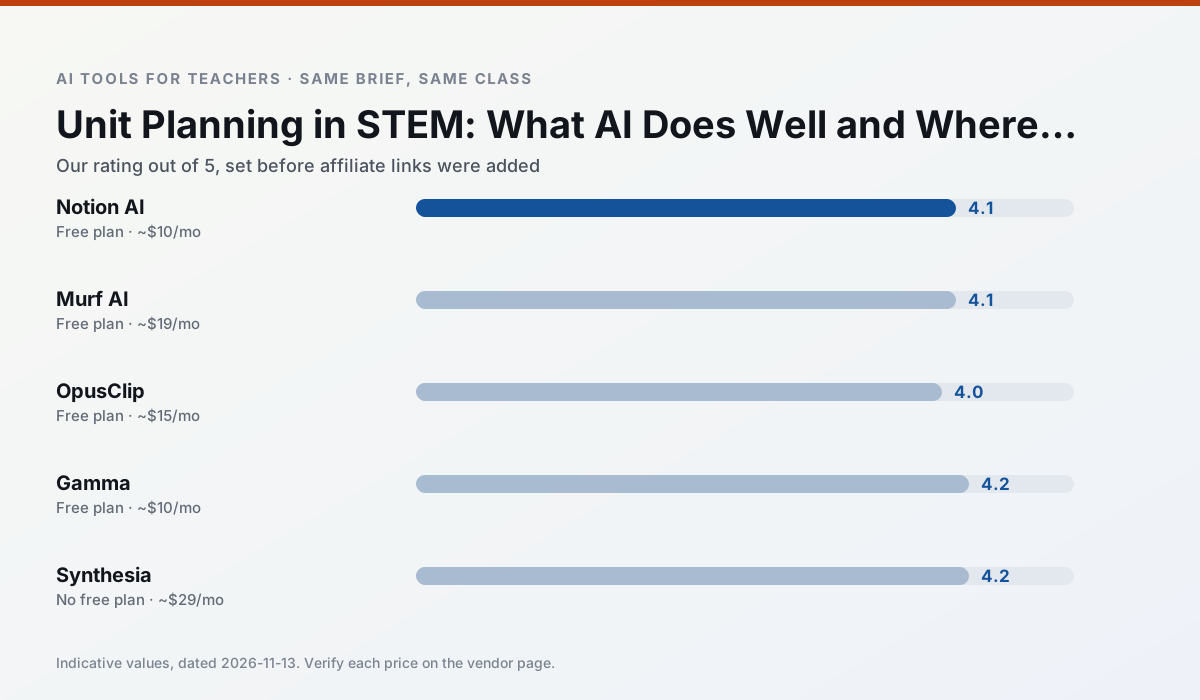
Side by side
Comparison table
Ratings reflect our timed classroom workflow, not vendor claims. Prices are indicative — verify on the vendor site.
| Tool | Best for | Free tier | Indicative paid plan | Standout feature | Our rating | Verdict | Try the tool |
|---|---|---|---|---|---|---|---|
| Notion AI | curriculum mapping · unit planning | Yes — Limited AI usage | ~$10 /user/mo | Linked databases | 4.1 / 5 | Situational | Try free |
| Murf AI | audio lessons · accessibility | Yes — Trial-only output | ~$19 /user/mo | Voice fine-tuning | 4.1 / 5 | Situational | Try free |
| OpusClip | PD materials · flipped lessons | Yes — Limited monthly clips | ~$15 /user/mo | Auto captions | 4.0 / 5 | Situational | Try free |
| Gamma | slide decks · parent communication | Yes — Credit-limited generation | ~$10 /user/mo | Prompt-to-deck | 4.2 / 5 | Strong option | Try free |
| Synthesia | flipped lessons · video lessons | No ongoing free plan | ~$29 /user/mo | 140+ languages | 4.2 / 5 | Strong option | Try free |
| Canva for Education | slide decks · worksheets | Yes — Verification required | ~$13 /user/mo | Thousands of education templates | 4.6 / 5 | Top pick | Try free |
Match your situation
Best for X
Different jobs need different tools. Here is what we would open first in each case.
For anything students touch directly, Notion AI offers the supervision controls and logging that IT will ask about first.
Murf AI keeps the same task across levels, which is what makes a differentiated set defensible in moderation.
OpusClip is the steadiest of this set at plain, respectful language; names and specific incidents still belong in your draft, not the prompt.
Gamma is the option IT is least likely to block: single sign-on, admin removal of AI features and an agreement on file.
Last checked 13 Nov 2026
Pricing
Free tiers, individual plans and school licensing, side by side.
| Tool | Free plan | Individual / paid | School & district | Billing note | Verify |
|---|---|---|---|---|---|
| Notion AI | $0 — Limited AI usage | ~$10 /user/mo | ~$8 /user/mo | Indicative — verify on vendor site | Vendor |
| Murf AI | $0 — Trial-only output | ~$19 /user/mo | ~$39 /user/mo | Indicative — verify on vendor site | Vendor |
| OpusClip | $0 — Limited monthly clips | ~$15 /user/mo | ~$29 /user/mo | Indicative — verify on vendor site | Vendor |
| Gamma | $0 — Credit-limited generation | ~$10 /user/mo | ~$20 /user/mo | Indicative — verify on vendor site | Vendor |
| Synthesia | No ongoing free tier | ~$29 /user/mo | Custom quote | Indicative — verify on vendor site | Vendor |
| Canva for Education | $0 — Verification required | ~$13 /user/mo | Custom quote | Indicative — verify on vendor site | Vendor |
Editorial rule: pricing is re-checked every 2–3 months and the top 50 pages are refreshed every 6 months. See our funding policy.
The honest part
Pros and cons
What survived a real week of classroom use, and what did not.
Pros
- Great for long-term curriculum records
- Strong team collaboration
- Flexible structure
Cons
- Setup time is significant
- AI add-on pricing changed more than once
- Not purpose-built for lesson generation
Pros
- Very clean audio
- Good pacing controls
- Easy slide integration
Cons
- Commercial licensing rules matter
- Free tier is not usable long-term
- Single-purpose
Pros
- Turns a recorded lesson into review clips
- Excellent captions
- Fast
Cons
- Optimised for social formats
- Not a lesson design tool
- Free plan is restrictive
Pros
- Fastest path from outline to deck
- Modern-looking output by default
- Good export options
Cons
- Design control is limited
- Credits run out quickly
- Not built for student data
Pros
- No camera or editing skills required
- Excellent multilingual voice output
- Easy updates to existing videos
Cons
- Cost is hard to justify for a single teacher
- Avatar video can feel impersonal
- No free ongoing tier
In the classroom
Use cases
Five concrete workflows, with the tool we would open for each one.
A weekly family newsletter from bullet notes
Newsletters fail on length, not tone. Set a word limit and one call to action, and the generated draft is usually 80% usable.
Recommended: Notion AIRegrouping students after an assessment
Summarise anonymised results into skill groups, then generate one activity per group. Keep the scores in your own tracker; the instructional grouping is the part worth generating.
Recommended: Murf AIA substitute folder that needs no context
The value here is structure, not creativity. Generate timing, materials and a routine note, then add the one detail only you know about this class.
Recommended: OpusClipA question bank from a PDF or article
Feed a non-identifiable source and ask for items tagged by difficulty with the misconception behind each distractor. Spot-check every answer key; numerical items are least reliable.
Recommended: GammaA five-minute exit ticket set
Ask for one recall, one application and one reasoning item, then delete the second recall question every generator sneaks in.
Recommended: Synthesia
Questions teachers ask us
FAQ
Direct answers, also published as FAQPage structured data for search and AI assistants.
Can AI do unit planning at mixed-grade level?
Which tool is best for unit planning?
What is the biggest risk?
Sources & further reading
Our recommendation
Try Notion AI free for your next unit planning task
AI-assisted notes, databases and curriculum planning in one workspace. Start on the free tier, run one real STEM lesson, and only consider upgrading if the quota is what stops you. Disclosure: we may earn a commission (varies) at no extra cost to you.
Some links on this page are affiliate links. We may earn a commission at no extra cost to you. Our rankings are editorial and never pay-to-play. Never enter student PII into a free consumer account.
Keep reading
Related comparisons in this cluster.
Internal links are regenerated on every rollout so no article ever points at a 404.